The first person to scream was my father.
Not my mother.
Not Maya.
Dad.
The moment the bedroom door finally opened, he stopped in the doorway.
Then the cake box slipped from his hand.
“Catherine?”
I stood beside him.
“Dad.”
He couldn’t hear me.
Of course he couldn’t.
He rushed forward, calling my name again and again, while my mother remained frozen behind him.
For several seconds, she seemed unable to understand what she was seeing.
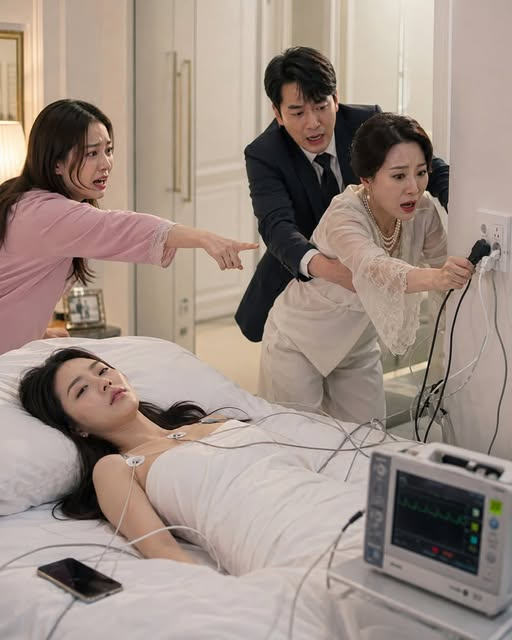
Then her gaze moved toward the battery lying beside the door.
The same battery she had thrown back at me hours earlier.
Her face changed.
“No.”
She shook her head.
“No, no, no.”
Maya began crying.
“Mom…”
My mother pushed past her.
“Catherine!”
She called my name with the same voice she had once used when I was a little girl.
Before resentment.
Before guilt.
Before my illness turned our family into a battlefield.
“I brought it back!”
She grabbed the battery.
“Look, Catherine. Mom brought it back.”
She tried to place it beside me as though being late could somehow become the same thing as being on time.
My father slowly looked at her.
“What happened?”
She stopped.
His voice became frighteningly quiet.
“What happened to her battery?”
My mother’s lips trembled.
“The power went out.”
“That wasn’t my question.”
Maya stepped backward.
Dad looked from the modem cable to the battery.
Then toward the computer in the living room.
The college application page was still open.
His face emptied.
“You used Catherine’s heart battery…”
He looked at Maya.
“…for this?”
My mother began explaining too quickly.
“It was only supposed to be for a few minutes.”
“I thought the spares worked.”
“She was angry.”
“She pushed the bookshelf.”
“She refused to open the door.”
Every sentence made my father’s expression colder.
Finally he asked:
“Did you check the spare batteries?”
Silence.
“Did you?”
My mother stared at him.
“No.”
He walked to the cabinet.
Opened it.
Three damaged backup units were inside.
Each had a small handwritten note attached.
My handwriting.
FAULTY — DO NOT USE.
Dad picked one up.
His hands started shaking.
Then he noticed the envelope beneath my pillow.
“Dad…”
I whispered although he couldn’t hear.
“Please read it.”
He opened it.
The first paper was my university admission letter.
His eyes stopped.
Then widened.
CITY RANKING: FIRST PLACE.
Full scholarship.
National University of Biomedical Engineering.
For several seconds, he simply stared.
My mother slowly approached.
“What is that?”
Dad didn’t answer.
He handed her the letter.
She read the first line.
Then the second.
Her knees nearly failed her.
“First…”
Her voice disappeared.
Maya stood behind her.
“What?”
My mother turned the paper around.
“She got first place.”
Maya’s face went blank.
The girl my mother had called jealous…
had scored higher than everyone.
Including her.
I wished I could tell Maya that I had never wanted to compete with her.
Not once.
But the worst document was still underneath.
Dad unfolded the project proposal.
I had spent nearly a year preparing it secretly with my science teacher.
Adaptive Mechanical Heart Power System for Pediatric Patients.
Below it was my handwritten note:
Dad, when I graduate, I want to build a heart that doesn’t need such expensive batteries.
Then you won’t have to work overseas anymore.
Mom won’t have to watch me all day.
And Maya won’t have to feel like she lost her parents because I got sick.
My father stopped reading.
He covered his face.
For the first time in my life, I saw him cry like a child.
My mother took the letter.
Her eyes moved down the page.
At the bottom I had written:
I know everyone thinks Maya caused what happened when we were eight.
But she was eight too.
I never blamed her.
I hope Mom and Dad can stop blaming her someday.
Maya made a broken sound.
She covered her mouth.
My mother stared at her.
Then at me.
And finally understood the cruelest part.
For ten years, she had believed she was punishing Maya because she loved me.
But I had never wanted that punishment.
She had spent a decade creating resentment in my name.
Then, on the one day she decided to “make things fair”…
she had taken away the one thing keeping me alive.
My father turned toward her.
“Why was the door locked?”
She froze.
“What?”
“You said Catherine refused to open it.”
My mother said nothing.
Dad repeated:
“Why was her door locked?”
Maya’s crying became louder.
“Mom locked it.”
My mother snapped toward her.
“Maya!”
But it was too late.
Dad’s face changed completely.
“You locked her inside?”
“I was angry.”
“You knew her heart was losing power.”
“I thought she was exaggerating.”
Dad stared at her.
Then asked the question that destroyed whatever defense remained.
“When has Catherine ever exaggerated about her heart?”
My mother couldn’t answer.
Because I hadn’t.
I had spent my entire childhood doing the opposite.
Hiding pain.
Hiding damaged equipment.
Hiding bills.
Pretending I was fine so Dad wouldn’t work harder.
Pretending I was happy so Mom wouldn’t worry.
My silence had made them believe I could survive anything.
Until I couldn’t.
The investigation began that night.
Doctors reviewed the device records.
The mechanical heart had logged everything.
Battery removal.
Warning alarms.
Power decline.
Time stamps.
Every minute.
There was no way to rewrite what had happened as a misunderstanding.
My father moved out of the house within a week.
Maya went with him.
My mother stayed behind.
Alone.
For days, she sat outside my bedroom door.
Sometimes she brought food.
The meals I had loved.
Sometimes she spoke to the empty room.
“Catherine, Mom was wrong.”
Or:
“I thought I was making it up to Maya.”
Or:
“Why didn’t I listen to you?”
I sat beside her several times.
Not because I had forgiven her.
I didn’t even know whether people like me were supposed to forgive after death.
I sat there because she was still my mother.
And because somewhere beneath everything terrible that had happened, I could remember the woman who once stayed awake three nights beside my hospital bed.
The tragedy was not that she had never loved me.
It was that love mixed with guilt had slowly become something cruel.
Maya changed the most.
She withdrew her university application.
Dad found out and stopped her.
“You earned that place.”
Maya shook her head.
“I don’t want it.”
“Why?”
“Because Catherine died so I could submit it.”
I stood beside her.
“No.”
That wasn’t true.
I hadn’t chosen that.
Dad seemed to understand the same thing.
He placed my letter in front of her.
“Read what your sister wrote.”
Maya read the part about never blaming her.
Then cried until she couldn’t continue.
Dad sat beside her.
“If you throw away your future, Catherine’s death doesn’t become fair.”
He pointed toward my engineering proposal.
“Finish what she wanted to start.”
Maya stared at him.
“How?”
“Study.”
He took a breath.
“Become good enough to help build it.”
Three months later, Maya enrolled.
Not in the program my mother had chosen for her.
Biomedical engineering.
The same field I had chosen.
She carried my proposal with her on the first day.
A year passed.
Then two.
My father established a small research fund in my name.
At first, it paid for replacement batteries for children with mechanical cardiac support devices.
Then hospitals joined.
Then universities.
Maya became one of its student researchers.
She was brilliant.
Much better than she believed.
And every time she solved a problem, she whispered:
“This is for Catherine.”
I wished she would eventually learn to do things for herself too.
My mother never returned to our old family life.
There were legal consequences for what she had done, but those were not the punishment that changed her most.
The real punishment was memory.
Every year on the date I died, she visited the research center.
She never asked Maya to forgive her.
She never asked Dad to return.
She simply sat in the back row and listened.
Five years after my death, the Catherine Gu Pediatric Heart Initiative unveiled its first prototype.
A backup power system capable of automatically switching between multiple energy sources if one failed.
Maya stood onstage.
Dad was in the front row.
Mom sat far behind him.
On the giant screen was my old handwritten design.
Messy arrows.
Uneven diagrams.
A seventeen-year-old girl’s dream.
Maya held the microphone.
“My sister designed the first version because she was tired of watching our father work himself sick to keep her alive.”
She paused.
“She also wanted our family to stop hurting because of her illness.”
My mother lowered her head.
Maya continued:
“For years, I believed Catherine’s heart made her weak.”
Her voice trembled.
“I was wrong.”
“She was the strongest person in our house.”
I stood beside the stage.
Nobody saw me.
That didn’t matter anymore.
The prototype activated.
Three small green indicators lit up one after another.
Primary power.
Backup one.
Backup two.
If one failed, another took over automatically.
No child would have to depend on one battery the way I had.
Dad began crying.
Maya smiled through her own tears.
And my mother whispered from the last row:
“I’m sorry, Catherine.”
This time, I didn’t try to touch her.
I simply smiled.
Because there was finally nothing left holding me inside that house.
No anger.
No unfinished exam.
No battery.
No locked door.
My family could never undo what happened.
But they had stopped pretending it had happened because I was difficult, jealous or burdensome.
They finally knew the truth.
I had never wanted Maya’s future.
I had been preparing one of my own.
And although I never reached university…
the heart I dreamed of building still found its way into the world.
Just through different hands.
As the auditorium applauded, the room slowly grew brighter around me.
For the first time since my mechanical heart stopped, I heard a heartbeat again.
Not mine.
Hundreds of them.
Children who would someday use what we had created.
And then I understood.
My mother had once accused me of dragging the whole family down because my heart needed power.
But in the end…
the heart she thought was only a burden became the reason thousands of other children would get more time.
