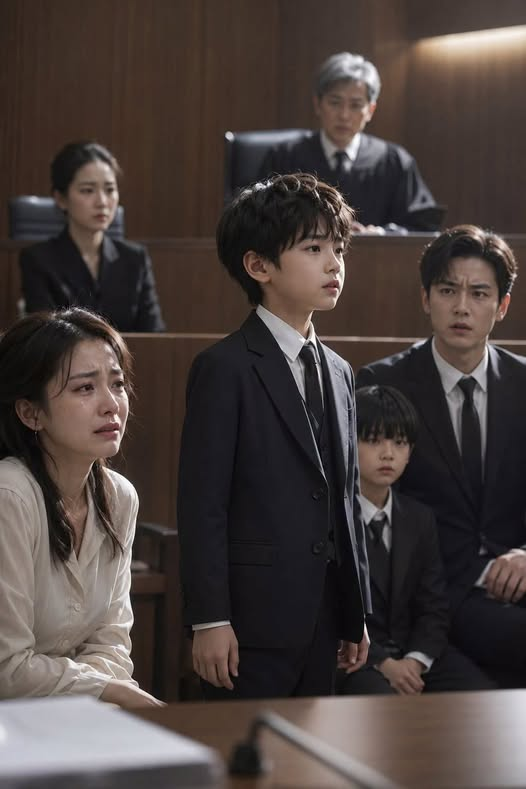
“Liam, give me that.”
Daniel’s voice was no longer calm.
That frightened me more than shouting would have.
My son pressed the old phone against his chest.
“No.”
The judge immediately raised a hand.
“Mr. Whitman, remain where you are.”
Daniel stopped.
Vanessa Crowe grabbed his sleeve and whispered something sharply, but he wasn’t looking at his lawyer anymore.
He was looking at Liam.
At a nine-year-old boy.
As if the child had become his most dangerous opponent.
The judge softened his voice.
“Liam, what is on the phone?”
My son swallowed.
“Recordings.”
My stomach dropped.
“What recordings?” I whispered.
Liam looked at me.
His eyes finally looked nine again.
Scared.
Tired.
“I’m sorry, Mom.”
“For what?”
“For not telling you.”
Noah started crying silently beside him.
Liam took his brother’s hand.
Then he looked at the judge.
“Dad gave us this phone because he didn’t want Mom seeing what he said.”
Daniel’s lawyer stood.
“Your Honor, we object to any unauthenticated recording being played in open court, particularly material obtained by a minor—”
The judge stopped her.
“The court will determine admissibility. First, I want to understand what these children are trying to report.”
Daniel spoke quickly.
“They misunderstood private family conversations.”
Liam looked at him.
“No, we didn’t.”
The entire room went silent.
Then my son unlocked the phone.
There was no password.
He opened the audio folder.
Forty-three recordings.
I stopped breathing.
The judge ordered the bailiff to take custody of the device.
A short recess was called while the court technician copied the contents.
I remained sitting.
Unable to move.
Daniel passed me on his way out.
For the first time in ten years, there was no contempt in his eyes.
There was fear.
He leaned toward me.
“You put them up to this.”
I stared at him.
“I didn’t even know the phone existed.”
“Of course you’ll say that.”
Liam heard him.
My son immediately stepped between us.
“Stop blaming Mom.”
Daniel’s face hardened.
“Liam.”
“No.”
His small voice shook.
“You always say she makes us do things.”
“But she doesn’t.”
“You do.”
Daniel froze.
The bailiff stepped closer.
“Sir. Outside.”
And Daniel walked away.
My nine-year-old son was still trembling.
I crouched beside him.
“Why did you record him?”
Liam looked toward Noah.
Then whispered:
“Because nobody believed you.”
That sentence nearly broke me.
The first recording was played forty minutes later.
Daniel’s voice filled the courtroom.
Calm.
Patient.
Almost affectionate.
Exactly the voice he used when he wanted other people to believe he was reasonable.
“Boys, your mother is confused right now.”
Then Liam’s younger voice:
“Is Mom sick?”
Daniel answered:
“Not exactly. But if you tell the judge you want to stay with her, she may take you somewhere I can’t find you.”
My hands turned cold.
On the recording, Noah began crying.
“What happens to Mom?”
Daniel paused.
Then:
“If she keeps causing problems, grown-ups may decide she shouldn’t see you anymore.”
The recording ended.
Nobody moved.
Daniel immediately stood.
“That conversation has been taken completely out of context.”
The judge’s face had changed.
“What context would improve it, Mr. Whitman?”
Daniel sat back down.
The second recording played.
This one was worse.
Daniel was coaching them.
“If anyone asks whether your mother feeds you dinner every night, remember the times she didn’t.”
Liam answered:
“She always gives us food.”
Daniel sighed.
“What about when she stays in her room?”
“She has headaches.”
“That’s not the question.”
Then:
“You need to answer carefully. If you say the wrong thing, you could end up living in that tiny apartment.”
My throat tightened.
That tiny apartment.
The one I had rented after leaving everything else behind.
The one Daniel had mocked in court as proof I couldn’t provide for our children.
The third recording explained his accusation that the boys prepared food alone at dawn.
Daniel’s voice:
“Tomorrow morning, I want you to make cereal before Mom wakes up.”
Noah asked:
“Why?”
“Because I said so.”
“But Mom already made breakfast.”
“Don’t touch it.”
Silence.
Then Liam:
“Are we doing another test?”
Daniel answered:
“Yes.”
My entire body went numb.
Test.
He had manufactured evidence.
Small moments.
Controlled situations.
Then turned them into stories about my neglect.
Vanessa Crowe slowly turned toward him.
Her expression had changed too.
“Daniel.”
He whispered:
“Not now.”
She moved away from him.
There were more recordings.
Too many.
Daniel telling the boys not to mention that I attended every school meeting.
Daniel instructing them to tell the custody evaluator that they were “afraid when Mom cried.”
Daniel promising them a gaming room if they chose his house.
Daniel warning that if they chose me, he might have to “send Mom far away so she couldn’t upset them anymore.”
And finally, the recording that made Noah cover his ears.
Daniel said:
“Your mother gave up the house because she knew she couldn’t handle you.”
Liam answered:
“No. Mom said she gave you everything because she only wanted us.”
There was a pause.
Then Daniel’s voice became cold.
“Don’t repeat that.”
“Why?”
“Because I said so.”
The audio ended.
I was crying by then.
Not loudly.
I didn’t want my children watching me collapse again.
The judge called another recess.
This time, Daniel’s lawyer followed him into a private consultation room.
Ten minutes later, she returned alone.
She approached the bench.
“Your Honor, my client and I have a professional matter to address before proceedings continue.”
Daniel entered behind her.
Furious.
“What are you doing?”
Vanessa did not look at him.
“I will not present statements to this court that I now have reason to believe may be materially false.”
His face changed.
“You work for me.”
“I represent you.”
She finally looked at him.
“I do not manufacture facts for you.”
For the first time that morning, Daniel looked completely alone.
The judge did not make a final custody ruling that day.
Instead, everything stopped.
A guardian ad litem was appointed for Liam and Noah.
A forensic review of the phone was ordered.
School records were requested.
Medical records too.
The custody evaluator’s previous report was reopened.
Daniel looked angry about the delay.
I felt something else.
Relief.
Because for once, nobody was asking me to prove the entire truth while I was shaking.
They were going to investigate.
Properly.
And the truth did not need me to scream.
It already existed.
Over the next three weeks, everything Daniel had carefully built began falling apart.
The twins’ teacher testified that I had attended twenty-seven parent meetings in three years.
Daniel had attended two.
Their pediatrician confirmed I had handled almost every appointment.
The school counselor had notes from Noah saying:
“Dad says Mom is bad when she cries, but Mom only cries after Dad comes.”
Our former housekeeper provided something I never knew existed.
A notebook.
Daniel had instructed her to record every day I appeared “emotionally unstable.”
She had refused.
Instead, she kept her own record.
On one date Daniel claimed I locked myself away all day, the housekeeper had written:
Elena stayed upstairs from 2:00 to 4:00 with migraine. Lunch prepared before resting. Boys checked twice. Daniel not home.
Another allegation:
Children forced to make their own dinner.
Her note:
Elena cooked pasta. Daniel instructed children not to eat it because “Mom needs to learn they don’t like her cooking.”
When I read that, I had to put the page down.
Not because the lie shocked me anymore.
Because I remembered that night.
The untouched plates.
Liam saying he wasn’t hungry.
Noah looking guilty.
Me sitting alone in the kitchen wondering why my own children suddenly rejected the food they had always loved.
Daniel had been there.
Watching.
Building evidence.
One painful evening at a time.
Then came something I did not expect.
Noah had his own evidence.
Not recordings.
Drawings.
The court-appointed child specialist found a notebook hidden inside his school bag.
Page after page showed our family.
Dad in the big house.
Mom in the small apartment.
Two boys in the middle.
In several pictures, Daniel was drawn holding scissors.
Cutting a line between me and the children.
The specialist asked him what it meant.
Noah answered:
“Dad said if Mom wins, he’ll cut her out.”
I had to leave the room when they told me.
Liam found me in the hallway.
He stood beside me without speaking.
After a while, I asked:
“Why didn’t you tell me?”
He looked down.
“Because Dad said if you knew, you would cry.”
My chest hurt.
“And you didn’t want me to cry?”
He shook his head.
“No.”
Then he whispered:
“You already cried enough.”
I pulled both boys into my arms.
For the first time since the divorce began, I stopped caring whether anyone saw me cry.
The final hearing took place six weeks later.
Daniel wore another perfect suit.
But the illusion was gone.
Everyone in that courtroom had heard his real voice.
The judge reviewed the findings slowly.
Then he looked at Daniel.
“Mr. Whitman, this court is deeply concerned by your attempts to influence the children’s statements, undermine their relationship with their mother, and manufacture circumstances later presented as evidence of neglect.”
Daniel’s face remained rigid.
The judge continued:
“Financial resources are relevant.”
“A mansion may be comfortable.”
“Private schools may be excellent.”
“But children are not assets awarded to the parent with the largest bank account.”
Then he looked at me.
My hands started shaking.
“Primary physical custody is awarded to Mrs. Morales.”
I stopped breathing.
Noah gasped.
Liam squeezed my hand so hard it hurt.
I did not care.
The judge continued with structured visitation for Daniel, initially supervised, along with mandatory family counseling and a prohibition against discussing litigation with the children.
Daniel closed his eyes.
He had lost.
Not because Liam destroyed him.
Not really.
Daniel destroyed himself.
My son had simply stopped helping him hide it.
Outside the courthouse, Daniel called my name.
I turned.
He looked at the boys beside me.
“Can I speak to them?”
The court-appointed supervisor was standing nearby.
Liam immediately stiffened.
I wanted to say no.
Then I remembered something.
This was not about revenge.
So I looked at my sons.
“You decide.”
Daniel flinched at those words.
Because that was something he had never given them.
A choice.
Noah hid behind me.
Liam stayed where he was.
Then he said:
“Not today.”
Daniel’s face fell.
He nodded.
“Okay.”
Liam stared at him.
“Dad?”
Daniel looked up.
“I didn’t make the recordings because I hate you.”
His eyes reddened.
“Then why?”
Liam answered:
“Because I love Mom too.”
That was the sentence Daniel had never been willing to understand.
The boys loving me did not mean they had to stop loving him.
Custody was never supposed to be a competition where one parent erased the other.
Daniel had turned it into one.
And lost.
Our life afterward was not luxurious.
The apartment was still small.
Liam and Noah still had separate single beds.
Our dining table only seated four.
I went back to work part-time at first, then full-time after completing the certification I had abandoned years before.
Money was tighter.
But the boys laughed more.
The first Friday after the ruling, Noah asked:
“Can we eat pizza on the floor?”
“Why?”
“Because Dad said poor people do that.”
I stared at him.
Then looked at Liam.
Liam shrugged.
So I ordered pizza.
We sat on the floor.
All three of us.
No crystal dining table.
No housekeeper.
No perfect photographs.
Just cheese, cardboard boxes and two children arguing over the last slice.
Halfway through dinner, Liam suddenly said:
“Mom.”
“Yes?”
“Are you unstable?”
My hand stopped.
“No.”
He looked embarrassed.
“I looked up the word.”
I put my food down.
“Sometimes I became overwhelmed.”
“Sometimes I cried.”
“Sometimes I was exhausted.”
I looked at both boys.
“But having feelings doesn’t make someone dangerous.”
Liam nodded slowly.
Then Noah said:
“Dad cries now too.”
I almost smiled.
“Then maybe he’s finally learning that.”
Daniel changed slowly.
Not enough to undo the past.
But enough that, a year later, supervised visits were no longer required.
He apologized to the boys.
Then to me.
I accepted the apology.
I did not take him back.
Those are different things.
The mansion was eventually sold.
Daniel said it felt empty without the children.
I never told him that was how I had felt inside our marriage for years.
He already knew.
As for the old phone, Liam asked me once whether we should throw it away.
I looked at the cracked screen.
The device that had carried forty-three pieces of truth into a courtroom full of adults.
“No.”
I put it in a box.
“Why keep it?” he asked.
“So one day you remember something.”
“What?”
I crouched in front of him.
“You were never responsible for saving me.”
His eyes filled.
I continued:
“You told the truth.”
“The adults were supposed to do the rest.”
He nodded.
Then hugged me.
That distinction mattered more than the court victory.
My nine-year-old son should never have needed to become my lawyer.
He should never have needed to gather evidence against his own father.
But when Daniel tried to turn two children into weapons, Liam did the bravest thing he could.
He refused to fire.
And the day the judge asked my twins to choose between their parents, Liam revealed the truth Daniel had never understood:
Children should not have to destroy one parent to be allowed to love the other.
