The plane took off at 1:17 in the morning.
At almost the same time, Co Tram Chu signed the last document on his desk.
He rubbed his temples, called his secretary, and said:
“Take these downstairs tomorrow morning.”
Then he went home.
The villa was silent.
At first, he noticed nothing unusual.
That was the most ironic part.
He removed his coat.
Changed his shoes.
Asked the housekeeper:
“Has Khuong Niem gone to sleep?”
Aunt Vuong lowered her head.
“I think so, sir.”
He went upstairs.
The bedroom door opened.
Darkness.
No lamp beside the bed.
No faint smell of the lotion I used after bathing.
No sleeping woman curled beneath the blanket waiting for him.
Co Tram Chu frowned.
“Niem Niem?”
Nothing.
He turned on the light.
Then he finally saw it.
My half of the closet was empty.
The drawers were empty.
The children’s crib was gone.
Formula.
Diapers.
Baby clothes.
Everything.
His expression changed.
He rushed into the nursery.
Empty.
He opened the bathroom.
Empty.
The dressing room.
Empty.
“KHƯƠNG NIỆM!”
His voice echoed through the entire villa.
The housekeeper came running.
“Sir…”
“Where is my wife?”
Nobody answered.
“Where are the children?”
Aunt Vuong went pale.
“I… I thought Mrs. Co was resting.”
He pulled out his phone.
Called me.
The number rang once.
Then:
The subscriber you are calling is unavailable.
Again.
Same response.
WeChat.
Message undelivered.
Co Tram Chu stood completely still.
For the first time in years, the man who could move hundreds of millions with one signature had no idea what to do.
Then he remembered something.
The documents.
He drove back to the company himself.
At two thirty in the morning, the lights on the executive floor came on again.
He tore through the processed files.
Number twenty-eight.
Twenty-nine.
Thirty.
Then—
Thirty-one.
The white sheet appeared.
His hand stopped.
Two lines.
A divorce agreement.
And beneath them—
his signature.
Co Tram Chu.
Perfectly clear.
Perfectly legal-looking.
Perfectly careless.
His face lost all color.
The secretary who had rushed back to the office stared at him.
“President Co?”
He didn’t answer.
He read the paper again.
Then a third time.
Finally, he whispered:
“When did this get here?”
Nobody knew.
But he did.
Three days earlier.
The hallway.
My voice behind him.
“Co Tram Chu.”
“Let’s get divorced.”
He had heard me.
Not clearly.
Not properly.
Because at that moment he had been answering a message from the finance department.
He had thought I was complaining.
Creating another “small domestic problem.”
And he had answered:
“Don’t make trouble. I don’t have time.”
His hand tightened around the document.
Suddenly the paper crumpled.
“Find her.”
His secretary froze.
“Sir?”
“Check every airport. Every station. Every hotel.”
His voice cracked.
“Find my wife and my children.”
By sunrise, the answer arrived.
Nothing.
No commercial flight record.
No train ticket.
No hotel booking connected to my name.
It was as if the three of us had disappeared.
Then his mother called.
“What happened? Why are people asking where Khuong Niem went?”
He closed his eyes.
“She left.”
“What do you mean, left?”
“With the twins.”
His mother became angry immediately.
“She took Co family blood without permission?”
Something changed in his expression.
“Mom.”
“What?”
“For once…”
His voice became terrifyingly cold.
“Don’t call my children family property.”
He hung up.
It took him another day to remember the wine cellar.
Years earlier, when we first married, we had buried a bottle there.
He had said we would open it on our tenth anniversary.
He entered the cellar alone.
The bottle was still there.
Beside it was an envelope.
His name on the front.
Inside was a single letter.
Not long.
I had no more long explanations left for him.
Tram Chu,
When you read this, I will already be gone.
Do you remember promising that when you survived your most difficult years, you would make it up to me?
You don’t have to anymore.
I don’t want repayment.
The money my family invested in you was my choice. The nights I waited were my choice. Loving you was also my choice.
Leaving is the last choice I will make for this marriage.
Then came the sentence that made him sit down.
An An and Lac Lac learned to recognize my voice before they learned to recognize yours. I refuse to let them grow up believing that this is what a father looks like and this is what a mother should endure.
At the bottom:
You signed the divorce yourself.
This time, please respect your own signature.
For a long time, Co Tram Chu didn’t move.
Then he covered his face.
The man who hadn’t cried when his company nearly collapsed finally broke inside an empty wine cellar.
Three months later, I was living in Tinh City.
Not hiding.
Simply living.
I returned to the Khuong family business.
My father didn’t ask many questions when I arrived.
He looked at the twins.
Then at me.
Then said:
“Your room is still there.”
That was all.
My mother cried enough for everyone.
I started working again when the twins were old enough to spend several hours with their nanny.
The first project I handled was a shipping contract.
The second was an overseas acquisition.
Within six months, people stopped introducing me as “Mrs. Co.”
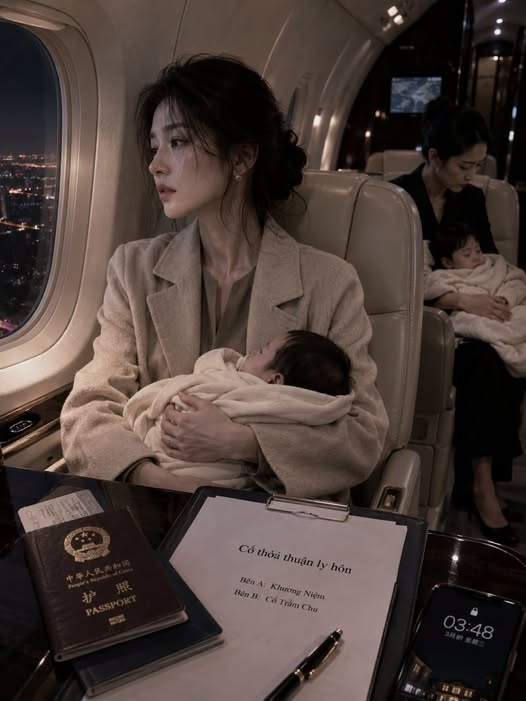
I became Khuong Niem again.
Then Co Tram Chu found us.
He did not storm into the house.
Did not bring bodyguards.
Did not threaten custody.
He waited outside the Khuong residence for almost four hours.
My father finally asked:
“Do you want me to throw him out?”
I shook my head.
“No.”
I went downstairs alone.
He looked thinner.
For the first time since I had known him, his suit was wrinkled.
“Niem Niem.”
“Don’t call me that.”
His face stiffened.
“Khuong Niem.”
“Better.”
He looked toward the house.
“Are the children well?”
“Yes.”
“Can I see them?”
“No.”
His eyes reddened.
But he nodded.
“I understand.”
That surprised me.
Then he held out the divorce agreement.
This time it had been formally prepared by lawyers.
Property division.
Custody terms.
Financial support.
He had signed every page.
“I read it.”
I looked at him.
“All of it?”
“Three times.”
A bitter smile appeared on his lips.
“I’ve started reading things before signing them.”
I didn’t smile back.
He continued:
“I transferred back the capital your family injected into the southern project years ago, with interest.”
“I don’t need it.”
“I know.”
“Then why?”
“Because I finally understand that I built my success on things you gave me and then behaved as if I built everything alone.”
Silence.
“I’m not asking you to come back.”
That was the first intelligent thing he had said.
“I want the right to learn how to be their father.”
I looked at him for a long time.
“You don’t have that right automatically.”
“I know.”
“You earn it.”
“I know.”
“And if they don’t want you someday—”
“I’ll accept it.”
Months passed.
Then a year.
He came when I allowed him.
Never unannounced.
He learned how to hold Lac Lac when he cried.
How An An refused formula unless the bottle was exactly warm enough.
How both children hated peas.
The first time they called him “Dad,” he turned away so they wouldn’t see his eyes.
But I saw.
It changed nothing between us.
That mattered.
Because regret can create a better father.
It does not automatically recreate a husband.
Two years after I left, our divorce became final.
Outside the courthouse, Co Tram Chu asked one question.
“If I had read that paper before signing, would you have stayed?”
I thought about it.
Then shook my head.
“No.”
His eyes closed.
“Why?”
“Because the problem was never that you signed it.”
I looked directly at him.
“The problem was that you could believe anything I placed in front of you was unimportant enough to sign without reading.”
He had no answer.
I walked away.
This time, he didn’t chase me.
Years later, people still called Co Tram Chu one of the most powerful businessmen in City A.
And I built something of my own in Tinh City.
The twins grew up knowing both parents.
But they never saw their mother waiting beside a cold dinner for a man who might not return.
Sometimes I remembered that final night in his office.
The thirty-first document.
The red pen.
The signature he placed without hesitation.
For a long time, I thought that signature ended my marriage.
I was wrong.
The marriage had ended long before that.
The signature simply gave me permission to stop pretending it was still alive.
