At nine that night, Chu Du Bach returned home.
I was sitting on the floor of the study, sorting six years of medical notes into two piles: what belonged to the hospital, and what belonged to me.
He stood at the door for a long time.
“Bed six stabilized.”
I didn’t look up.
“Good.”
“They activated the second-level consultation after your message.”
“Then the system worked.”
His expression tightened.
“Wen Tung, must you speak to me like a stranger?”
I finally raised my head.
“Aren’t we becoming strangers?”
He went silent.
I pointed toward the dining table.
Divorce papers were lying there.
For the first time that day, the calm disappeared from his face.
“What is that?”
“What it looks like.”
He walked over quickly.
“You want a divorce because you lost the ICU director position?”
I laughed.
“No.”
“Then because of Jiang Nian?”
Still no.
I stood.
“I want a divorce because when they took my work, you defended them.”
“When they humiliated me, you told me not to be emotional.”
“And when an unstable patient needed help, you wanted me to save everyone without authority so that if anything went wrong, I would carry the responsibility.”
His face stiffened.
“I was trying to protect the department.”
“And I finally decided to protect myself.”
I went to bed.
The next morning, I flew to Dali.
For seventeen days, I turned off every work group.
I walked beside the lake.
Slept until sunrise.
Ate when I was hungry.
For the first time in more than a decade, no monitor alarm woke me at three in the morning.
Then, on the seventeenth day, my phone rang.
Head nurse Meng Zhiwei.
I almost ignored it.
Then I answered.
Her voice was trembling.
“Director Wen…”
“I’m no longer your director.”
She inhaled sharply.
“Three major emergency cases arrived within forty minutes.”
I sat upright.
“One postoperative cardiac patient, one severe trauma case and one complicated infection.”
“Director Jiang activated three emergency alerts at once.”
I closed my eyes.
“And?”
“The departments are fighting over beds.”
“Radiology says one patient must wait.”
“Cardiology says their consultant is unavailable.”
“The emergency department says ICU promised two beds that don’t exist.”
Then another voice came through the phone.
Chu Du Bach.
“Wen Tung.”
His tone was different.
No impatience.
No superiority.
Only panic.
“What should the evaluation standards you left behind be calculated from?”
I looked at the lake outside my hotel window.
Then I smiled.
“Doctor Chu, didn’t you say the team should learn to operate without me?”
Silence.
“Wen Tung, this isn’t the time.”
“You’re right.”
My voice became colder.
“So call the current ICU director.”
“Jiang Nian doesn’t understand how the emergency priority matrix works.”
“Then why is she director?”
He had no answer.
I did not leave patients without help.
But I also refused to become their invisible emergency button again.
“Activate hospital-level consultation.”
“We already did.”
“Put every responsible department head in the same room.”
“They’re arguing.”
“Then tell Vice President Tan Zheng to chair it.”
Another silence.
“He doesn’t know the clinical details.”
I laughed softly.
“Interesting.”
“The man who said my system was too expensive now doesn’t understand how to use the cheaper version.”
I hung up.
Two hours later, the hospital called again.
This time it was the president.
Not Tan Zheng.
President Qin himself.
“Dr. Wen.”
“President Qin.”
“I have reviewed what happened.”
“I’m sure you have.”
“I need you to return temporarily as emergency consultant.”
“Under what authority?”
He paused.
Then answered correctly.
“Written hospital-wide emergency authorization. Full command authority. All medical decisions recorded under your name. No one may alter them.”
That was different.
I booked the next flight.
Not for Jiang Nian.
Not for Chu Du Bach.
For the patients.
When I entered the ICU the following morning, nobody applauded.
I wouldn’t have accepted it anyway.
I put on my coat.
Read the charts.
Then issued the first order.
“Stop treating three emergencies as if they have equal priority.”
Everyone became silent.
Within fifteen minutes, resources were redistributed.
A specialist who “couldn’t come” arrived after I called him personally.
Radiology opened an additional slot.
Two departments that had been arguing for an hour suddenly found a solution when I forced their chiefs to stand in the same room.
The system began moving again.
Not because I was a miracle.
Because for ten years I had learned where every invisible obstacle was hidden.
By evening, the crisis was under control.
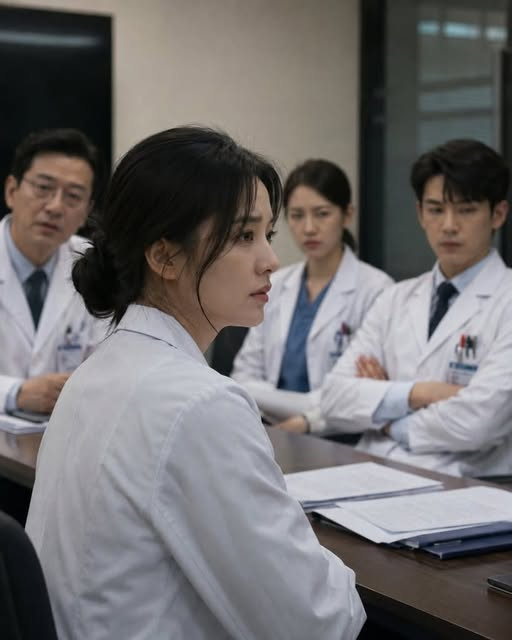
Only then did President Qin summon the executive board.
Jiang Nian sat pale beside Tan Zheng.
Chu Du Bach was opposite me.
President Qin placed two documents on the table.
The first was Jiang Nian’s “reform plan.”
The second was my original draft.
“Explain.”
Nobody spoke.
He turned to Jiang Nian.
“You claimed authorship.”
Her lips trembled.
“I reorganized it.”
President Qin opened page thirteen.
“Even the deleted test note?”
Her face went white.
Tan Zheng interrupted.
“This is an internal intellectual-property matter. There is no need to exaggerate.”
President Qin looked at him.
“Then perhaps we should discuss the other matter.”
Another folder landed on the table.
Budget reports.
After I left, ICU consumable costs had not fallen.
They had risen twenty-three percent.
Average response time had increased.
Two senior physicians had submitted resignations.
And three emergency transfers had nearly failed because the new leadership had removed what they called “unnecessary redundancy.”
Redundancy.
The second on-call specialist.
The backup bed allocation.
The parallel consultation channel.
Everything that looked wasteful on paper—
until someone’s life depended on it.
President Qin turned toward Tan Zheng.
“You removed the safeguards because they were expensive?”
Tan Zheng’s face hardened.
“We were controlling costs.”
“You were cutting things you did not understand.”
Then came the final document.
Emails.
Tan Zheng had instructed HR to accelerate my removal before the quarterly performance review so Jiang Nian could formally present the “reform system” as her own achievement.
Chu Du Bach had been copied.
I looked at him.
He lowered his eyes.
That hurt more than I expected.
“You knew?”
His voice was barely audible.
“I knew they wanted to replace you.”
“And the plan?”
“I thought Jiang Nian had rewritten enough of it.”
I nodded slowly.
“So you knew.”
He stood.
“Wen Tung, listen—”
“No.”
For six years I had listened.
That was enough.
Tan Zheng was removed from executive duties pending investigation.
Jiang Nian lost the ICU leadership position and returned to supervised clinical work.
The hospital publicly corrected the authorship of the emergency system.
Then President Qin offered me my old position.
I refused.
The entire board went silent.
He frowned.
“What do you want?”
“A new independent critical-care safety office.”
I placed my proposal on the table.
“It reports directly to the hospital president.”
“No relative appointments.”
“No budget cuts without clinical review.”
“And every emergency protocol must have traceable authorship and responsibility.”
President Qin read it.
Then nodded.
“Approved.”
I returned to medicine.
But not to the old life.
Three months later, my divorce from Chu Du Bach was finalized.
He asked me once:
“If I had defended you in that meeting, would we still be together?”
I thought about it.
“Maybe.”
His eyes reddened.
“Then I ruined everything.”
“No.”
I shook my head.
“You simply showed me that when choosing between convenience and me, you had already made your choice.”
He didn’t argue.
A year later, the hospital’s emergency system received national recognition.
Reporters called it the “Wen Critical Response Model.”
I hated the name.
But Meng Zhiwei loved it.
One night, after another difficult shift, she handed me coffee and laughed.
“They used to say you were too strong.”
I looked through the ICU window.
Young doctors were running the new emergency simulation without me.
This time, properly.
“That’s fine.”
She raised an eyebrow.
“Fine?”
I smiled.
“A system should eventually work without its creator.”
Then I looked toward the boardroom on the opposite side of the hospital.
“But first, the people running it have to understand why it was built.”
They had thrown me out because they believed I was expensive, rigid and replaceable.
Seventeen days later, they discovered the truth.
I had never been holding the ICU hostage.
I had been holding its chaos together.
