PART 1 — THE FOLDER THAT CHANGED EVERYTHING
The banquet hall had never been quieter.
More than three hundred veterans and family members stood frozen as the retired officer slowly opened the worn deployment folder.
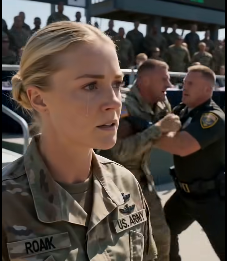
I could still feel the sting of the slap burning across my face.
The Command Sergeant Major stood only a few feet away, breathing heavily, his fists clenched.
For years he had been treated like a military icon.
A warrior.
A leader.
A legend.
Now everyone was staring at the folder that seemed capable of destroying everything.
The retired officer carefully removed a yellowed document.
His hands were steady.
His expression was not.
“I think everyone should hear this,” he said.
The room remained silent.
Then he began reading.
The document was a sworn witness statement written twenty years earlier.
It described the battle everyone had been arguing about.
The battle that had become the foundation of the Command Sergeant’s reputation.
As the officer read, details emerged that nobody expected.
The heroes named in the statement were not the men featured in speeches and military reunions.
The names belonged to ordinary soldiers.
Men who never received public recognition.
Men who had quietly returned home and continued living their lives.
One of those names belonged to the former squad leader.
Another belonged to me.
The room erupted into whispers.
The Command Sergeant’s face turned pale.
But then something even stranger happened.
The officer stopped reading halfway through.
His eyes narrowed.
He looked confused.
Then he turned the page.
His expression changed completely.
Almost as if he had discovered something unexpected himself.
Something he had never noticed before.
Something that made him stare directly at the Command Sergeant.
“Well…” he said quietly.
“I didn’t remember this part.”
Everyone leaned forward.
The Command Sergeant looked like he might collapse.
Because at the bottom of the statement was a second signature.
A signature nobody recognized.
And next to it was a name that hadn’t been mentioned in twenty years.
Captain Michael Brennan.
The officer lowered the folder.
“He’s here tonight.”
The room exploded.
PART 2 — THE MAN EVERYONE THOUGHT WAS DEAD
People turned toward the back of the banquet hall.
An elderly man slowly stood.
Several veterans gasped.
Others looked shocked.
I couldn’t believe my eyes.
Captain Michael Brennan.
The officer who commanded our company during the deployment.
The man many believed had died years ago.
He walked toward the stage carrying a cane.
The room parted around him.
Nobody spoke.
Nobody moved.
When he reached the microphone, he looked directly at the Command Sergeant.
For several seconds neither man said anything.
Then Captain Brennan sighed.
“I hoped I’d never have to tell this story.”
The Command Sergeant lowered his head.
The captain continued.
“The reports are accurate.”
The room froze.
“The men being credited tonight saved lives.”
He pointed toward me.
Then toward the former squad leader.
Then several other veterans in the crowd.
“The wrong people received recognition.”
The Command Sergeant looked broken.
But Captain Brennan wasn’t finished.
“However…”
The room became silent again.
“That’s not the entire truth.”
Everyone exchanged confused looks.
Including me.
Because I had no idea what he meant.
PART 3 — A SECRET HIDDEN FOR TWENTY YEARS
Captain Brennan carefully removed another document.
This one was sealed.
The paper looked untouched.
He held it up.
“This remained classified until last year.”
Every veteran in the room stared.
The captain explained that the battle involved a covert intelligence operation.
Information had been deliberately altered.
Reports had been rewritten.
Names had been changed.
Entire events had been hidden.
The audience listened in disbelief.
Then he looked directly at the Command Sergeant.
“I told him to take the blame.”
The room erupted.
Nobody understood.
Not even me.
The captain raised his hand for silence.
Years earlier, intelligence failures had nearly caused a catastrophic friendly-fire incident.
Several high-ranking officers faced career-ending consequences.
Someone needed to become the public face of the operation.
Someone needed to absorb the attention.
The Command Sergeant volunteered.
His exaggerated stories were encouraged.
His reputation grew.
The public narrative distracted attention from classified mistakes that could have destroyed dozens of careers.
The room sat in stunned silence.
The Command Sergeant slowly looked up.
Tears filled his eyes.
For the first time all evening, he looked less like a villain and more like a man carrying a burden.
But that still didn’t explain everything.
Especially the slap.
PART 4 — THE CONFESSION
The Command Sergeant finally spoke.
His voice shook.
“None of that excuses what I did.”
The room remained silent.
He looked at me.
Then at the veterans surrounding us.
For twenty years he had lived inside a story that wasn’t completely true.
At first he told himself it was for the mission.
Then for the Army.
Then for the men involved.
Eventually he stopped knowing where the truth ended and the lie began.
The room listened quietly.
He admitted he had become addicted to admiration.
Addicted to applause.
Addicted to being seen as a hero.
Every reunion.
Every speech.
Every award ceremony.
The lie became harder to escape.
Then tonight happened.
And the truth finally caught him.
His shoulders slumped.
“I slapped you because I was terrified.”
The words echoed through the hall.
No excuses.
No justifications.
Just truth.
For the first time all evening, people saw a deeply flawed man instead of a military legend.
PART 5 — THE SURPRISING DISCOVERY
The story should have ended there.
It didn’t.
Captain Brennan requested a projector.
A large screen illuminated behind the stage.
Old battlefield footage appeared.
Grainy helmet-camera recordings.
Radio logs.
Combat images.
Hours of archived material.
People watched carefully.
Then a young military historian helping organize the reunion noticed something unusual.
A timestamp.
A vehicle number.
A location marker.
He paused the footage.
Then replayed it.
Again.
And again.
The room watched.
Confused.
Finally the historian looked stunned.
“I don’t think anyone noticed this before.”
The screen displayed a burning convoy.
Soldiers evacuating casualties.
Chaos everywhere.
Then a figure appeared briefly in the background.
Only for a few seconds.
But long enough.
The room collectively gasped.
Because the soldier was carrying two wounded men to safety under enemy fire.
And it wasn’t the Command Sergeant.
It wasn’t me.
It wasn’t the squad leader.
Nobody recognized him.
Until Captain Brennan whispered a name.
“Private Daniel Mercer.”
The room fell silent.
PART 6 — THE LOST HERO
Daniel Mercer.
The name sounded familiar.
Then memories flooded back.
A quiet soldier.
Barely twenty years old.
Never spoke much.
Never sought attention.
After deployment he disappeared from contact.
Nobody knew what happened to him.
The footage continued.
More evidence appeared.
Radio transcripts.
Witness statements.
Medical evacuation records.
Everything pointed toward the same conclusion.
Daniel Mercer had saved nearly a dozen lives that day.
Including mine.
Including the Command Sergeant’s.
Including Captain Brennan’s.
Yet somehow his role vanished from history.
The audience sat speechless.
Families wiped tears from their eyes.
Veterans stared at the screen.
A hero had been hiding in plain sight for two decades.
Then the organizer quietly stepped onto the stage.
His hands trembled.
“I know where Daniel is.”
The room exploded again.
PART 7 — THE REUNION NOBODY EXPECTED
Nobody sat down.
Nobody even breathed.
The organizer smiled.
“He accepted my invitation.”
The banquet hall doors opened.
An older man entered.
Gray hair.
Simple clothes.
No medals.
No decorations.
No entourage.
Just a quiet smile.
Daniel Mercer.
The room instantly stood.
Hundreds of people rose to their feet.
Veterans began applauding.
Then cheering.
Then crying.
I felt tears running down my face.
The former squad leader was openly sobbing.
Captain Brennan wiped his eyes.
Even the Command Sergeant looked overwhelmed.
Daniel walked toward the stage.
Completely confused by the reaction.
Then the footage played again.
This time he watched himself rescuing soldiers twenty years earlier.
When the video ended, the room exploded into the loudest standing ovation I have ever witnessed.
It lasted nearly five minutes.
Daniel never said a word.
He simply cried.
PART 8 — THE LEGACY NO ONE SAW COMING (THE END)
The Command Sergeant slowly approached Daniel.
The room became silent once more.
Nobody knew what would happen.
Then the former military legend did something nobody expected.
He removed every medal he was wearing.
One by one.
Carefully.
Respectfully.
Then he handed them to Daniel.
The room gasped.
Daniel immediately tried to refuse.
But the Command Sergeant shook his head.
“No.”
His voice cracked.
“They belong to the people who earned them.”
The room erupted into applause again.
But the greatest surprise was still coming.
Captain Brennan stepped forward carrying a sealed envelope.
Inside was official correspondence from the Department of Defense.
Months earlier, historians reviewing declassified records had reopened the case.
The investigation was complete.
The findings were unanimous.
Daniel Mercer would receive a long-overdue commendation recognizing his actions.
Several other veterans—including members of our squad—would finally receive proper acknowledgment as well.
The room stood cheering.
Families embraced.
Old wounds began healing.
And then something remarkable happened.
The Command Sergeant wasn’t rejected.
He wasn’t thrown out.
He wasn’t hated.
Because after admitting the truth, apologizing publicly, and helping restore the record, the veterans chose forgiveness.
Not because he deserved a free pass.
But because everyone in that room understood something important.
Heroes can make mistakes.
Legends can become trapped inside their own stories.
And sometimes the bravest thing a soldier ever does is finally tell the truth.
As the reunion ended, veterans gathered around Daniel.
Children asked for photographs.
Families thanked him.
Old friends reunited.
For the first time in twenty years, the real story had finally been told.
And strangely enough, nobody left remembering the slap.
Nobody left remembering the lies.
Everyone left remembering the moment a forgotten hero walked through a banquet hall door and reclaimed the legacy that had always belonged to him.
The truth had won.
Friendship had survived.
Honor had been restored.
And for the first time in two decades, every man who fought that battle could finally sleep knowing history remembered the right names.
THE END
