PART 2 — THE WORDS THAT BROKE THE TABLE SILENCE
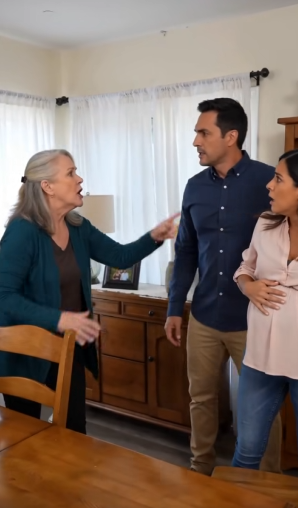
“Margaret, tell them why you really need their bank account.”
My father-in-law’s voice cracked through the dining room like thunder.
For one stunned second, no one moved.
My mother-in-law, Margaret, still had her hand half-raised from where she had shoved me. Her face was flushed with fury, but the moment her husband spoke, something changed. The anger didn’t disappear. It tightened. Hardened. Became fear.
My husband, Ethan, reached me first.
“Claire,” he said, his hands hovering over my arms like he was afraid to touch me wrong. “Are you hurt? Are you dizzy?”
“I’m okay,” I whispered, though I wasn’t sure.
My heart was pounding so hard I could feel it in my throat. My hands covered my belly, and our baby shifted beneath them, a small movement that nearly made me collapse with relief.
Ethan turned toward his mother.
His face looked unfamiliar.
Not confused. Not torn. Not gentle.
Done.
“What is wrong with you?” he said.
Margaret’s mouth opened, but no words came out.
At the table, Ethan’s sister, Rachel, had one hand pressed over her mouth. His younger brother, Mark, was frozen with his chair pushed halfway back. Aunt Denise stared at Margaret as if seeing her for the first time.
But my father-in-law, George, remained standing at the head of the table, trembling with rage.
Margaret finally snapped, “Don’t you dare.”
George’s voice dropped lower. “No. You don’t get to shove our pregnant daughter-in-law and still decide what gets said in this house.”
“She is not our daughter-in-law in any meaningful sense,” Margaret hissed. “She has turned Ethan against his family.”
Ethan stepped between us.
“Don’t speak about my wife like that again.”
Margaret looked wounded, as if she had been attacked.
“I am your mother.”
“And Claire is my wife.”
The room went silent again.
Those five words did something. They landed on the table between the untouched roast chicken, the spilled gravy, and the rattled crystal glasses like a verdict.
Margaret blinked rapidly.
George gripped the back of his chair. “She needs money, Ethan.”
Ethan frowned. “What?”
Margaret spun toward him. “George, stop.”
But George was past stopping.
“She’s been asking relatives for loans. Quietly. She told your aunt she needed emergency cash for a house repair. She told Mark she had a medical bill. She asked me to transfer money from my retirement account last week.”
Rachel lowered her hand. “Mom?”
Margaret’s eyes flashed. “This family is unbelievable. I ask for a little help and suddenly I’m on trial?”
George laughed once, bitterly.
“A little help? Margaret, you emptied the home equity line.”
Ethan’s face went pale.
“What does that mean?”
George looked at his son with a terrible sadness.
“It means your mother has been hiding debt.”
Every person at that table seemed to stop breathing.
Margaret’s fury surged back, wild and sharp.
“And whose fault is that?” she demanded. “Do you think it’s cheap keeping this family together? Hosting dinners? Paying for gifts? Helping people? Maintaining appearances?”
Rachel whispered, “What debt?”
Margaret ignored her.
Her eyes locked on me.
“This started when she came into the family. Before Claire, Ethan helped. Ethan cared. Ethan didn’t question me.”
Ethan stared at her. “You mean before I got married, I let you guilt me into giving you money.”
“That is a cruel way to describe helping your mother.”
“No,” he said, voice shaking. “It’s the honest way.”
George looked exhausted.
“She wanted access to your accounts because she’s been denied another loan. The bank called today.”
My stomach dropped.
I looked at Margaret, and suddenly the questions made sense.
How much do you have saved?
Who handles the accounts?
Does Ethan still have his old emergency fund?
Do you two share passwords?
This wasn’t curiosity.
This was desperation wearing the mask of family concern.
Margaret pointed at George. “You weak, pathetic man.”
He flinched, and for the first time, I saw the years behind that flinch.
The years of silence. The years of surrender. The years of letting Margaret rule every room by making everyone too tired to resist.
Ethan turned to me.
“We’re leaving.”
This time, no one argued.
He wrapped an arm around my shoulders and led me toward the front hall. I could hear Margaret behind us, breathing hard.
Then she shouted, “If you walk out that door, Ethan, don’t come back.”
Ethan stopped.
For one second, I thought he might turn around.
He had been raised on that threat. Trained by it. Controlled by it.
Then he looked over his shoulder.
“Then I won’t.”
And we walked out.
PART 3 — THE DRIVE HOME WITH A TRUTH BETWEEN US
The car felt too quiet.
Ethan drove with both hands on the wheel, his knuckles white. I sat beside him, trying to breathe normally, trying not to replay the feeling of Margaret’s hand on my arm.
The baby moved again.
I closed my eyes.
“Claire?”
“I felt her,” I said quickly. “She moved.”
Ethan let out a shaky breath.
Then he pulled into a gas station parking lot and stopped the car.
“What are you doing?”
“I can’t drive like this.”
He covered his face with both hands.
For a moment, he was not the confident man who could fix a leaking sink, negotiate at work, and make me laugh when I was swollen and exhausted and crying over commercials.
He was a son who had just realized his mother might have hurt his wife and child because she wanted money.
“I should have stopped this earlier,” he said.
“You did tell her to stop.”
“No.” His voice broke. “Earlier than tonight.”
I turned toward him as much as my belly allowed.
He stared ahead through the windshield. “She’s always been like this. Not the shoving. But the demands. The guilt. The emergencies that somehow required money. When I was twenty-three, she told me Dad’s business was failing and asked me for five thousand dollars. Later I found out Dad didn’t even know.”
My chest tightened.
“She used you.”
He nodded slowly.
“I told myself she was just proud and bad with stress. I told myself she loved hard. But tonight…” He swallowed. “Tonight she looked at you like you were standing between her and something she owned.”
The words landed deep.
Because that was exactly how Margaret had looked at me.
Not like I was Ethan’s wife.
Not like I was a pregnant woman.
Not even like I was family.
Like I was a locked door.
I touched his arm. “Ethan, we need to make sure she can’t access anything.”
“I know.”
“I mean everything. Bank accounts, cards, passwords, documents. Anything.”
He looked ashamed.
“She doesn’t have our current information.”
“Are you sure?”
He hesitated.
That hesitation chilled me.
“When we first got married,” he said slowly, “she helped me gather some tax documents because Dad’s accountant used to do them. She might have old account numbers. Not passwords, but…”
“But enough to try something.”
He nodded.
I felt fear creep up my spine.
Not loud fear. Cold fear.
The kind that arrives when you realize someone has been watching your life for weaknesses.
Ethan pulled out his phone.
“I’m calling the bank tonight.”
“Good.”
“And after that, I’m calling your doctor.”
“I’m fine.”
“I need to hear it from them.”
I wanted to argue, but then I remembered the shove. The screams. The way my body had tilted backward before Ethan caught me.
So I nodded.
At home, Ethan went into action.
He called the bank. He changed passwords. He froze old cards. He set up alerts. He contacted the credit bureaus. He checked our mortgage file, insurance policies, and shared documents.
I sat on the couch with a glass of water and listened.
Every few minutes, he came over and asked if I felt okay.
Every time, I said yes.
But inside, I felt changed.
The baby’s nursery stood down the hall, painted pale green, with tiny clothes folded in drawers and a rocking chair by the window.
Margaret had tried to choose that chair.
She had sent links for cribs, bassinets, blankets, and bottles. She had suggested names. She had called our daughter “my baby” more times than I liked.
I had once thought she was overbearing.
Now I wondered whether overbearing had only been the polite word for something darker.
At ten-thirty, Ethan’s phone rang.
It was Rachel.
He answered on speaker.
“Are you both okay?” she asked immediately.
“We’re home,” Ethan said. “Claire’s okay.”
Rachel exhaled. “Good.”
A pause followed.
Then she said, “Dad told us more after you left.”
Ethan closed his eyes.
“How bad?”
Rachel’s voice lowered.
“Bad.”
I sat up straighter.
Rachel continued, “Mom has credit cards none of us knew about. She used Dad’s name on some of them. He thinks she may have opened one using Mark’s information when he was in college.”
Ethan cursed under his breath.
Mark’s voice came through faintly in the background. “Tell him the rest.”
Rachel hesitated.
“What rest?” Ethan asked.
Rachel’s voice trembled.
“Dad found a folder in her desk. It had copies of your financial paperwork.”
My hand tightened around the glass.
Ethan went still.
“What kind of paperwork?”
“Old bank statements. Your employment contract. A copy of Claire’s insurance information.”
My stomach twisted.
“And,” Rachel said quietly, “a printout of your baby registry with notes written on it.”
The room seemed to shrink.
“What notes?” I asked.
Rachel took a breath.
“She wrote down who bought what. How much they spent. And beside some names, she wrote: potential request.”
Ethan looked at me, horrified.
Potential request.
As if generosity toward our child was a list of people she could squeeze for cash.
Then Rachel said the sentence that made the whole night even worse.
“Ethan, Dad thinks Mom was planning to throw you a surprise baby shower next month.”
I frowned. “She already knew we didn’t want another shower.”
“I know,” Rachel said. “But it wasn’t really for the baby.”
Ethan’s voice turned cold.
“What was it for?”
Rachel whispered, “Money.”
PART 4 — THE BABY SHOWER THAT WAS NEVER ABOUT THE BABY
The next morning, I woke to Ethan sitting at the kitchen table surrounded by papers.
He had not slept.
His laptop was open. His coffee was untouched. His face looked hollow.
“Ethan,” I said softly.
He looked up quickly. “You should be in bed.”
“I’ve been in bed for eight months.”
“That is not medically accurate.”
I gave him a look.
Despite everything, his mouth twitched.
Then the sadness returned.
“I found something,” he said.
My body tensed.
He turned the laptop toward me.
It was an email invitation draft.
The subject line read:
A Blessing For Baby And Family
My name and Ethan’s were written at the top in a cheerful script. The invitation described an elegant shower at Margaret’s house, with catered food, floral arrangements, and a gift table.
Then I saw the line near the bottom.
Instead of gifts, the family kindly requests contributions toward the young couple’s growing household needs.
I stared at it.
“We didn’t approve this.”
“No.”
“We didn’t even know about this.”
“No.”
“Were the contributions going to us?”
Ethan’s jaw tightened.
“I don’t think so.”
He clicked another tab.
It showed a bank account name I didn’t recognize.
Caldwell Family Support Fund.
My skin went cold.
“That’s not our account.”
“No.”
“Is it hers?”
“I think so.”
I lowered myself into a chair.
Everything felt surreal. Margaret had been ready to use my pregnancy, our daughter, our names, and the kindness of relatives to funnel money into an account she controlled.
The baby shower was a cover.
My throat tightened—not from anger at first, but grief.
There is something uniquely painful about realizing someone looked at your child’s arrival and saw an opportunity.
Ethan reached for my hand.
“I’m sorry.”
I shook my head. “Stop apologizing for her.”
“I know. I just…”
He looked toward the nursery hallway.
“I wanted our daughter to have grandparents who loved her without conditions.”
“She has your dad,” I said. “She has Rachel. Mark. My parents. Aunt Denise.”
He nodded, but I saw the wound.
No matter how old you are, realizing your mother’s love has strings can still make you feel like a child holding scissors too small to cut them.
At noon, George came over.
He stood on our porch holding a cardboard box and looking like he had aged ten years overnight.
Ethan opened the door.
“Dad.”
George’s eyes went immediately to me. “Claire. I am so sorry.”
I believed him.
That was what hurt.
Because sorry from the wrong person can feel like theft, but sorry from someone who should have protected you can feel like a door finally opening.
“I know,” I said.
George carried the box to our dining table.
“I found more.”
Ethan rubbed his forehead. “How much more?”
George opened the box.
Inside were folders, envelopes, receipts, and notebooks filled with Margaret’s neat handwriting.
“She kept records of everything,” George said. “Every gift she gave. Every favor. Every dinner. Every check. Every time she believed someone owed her.”
Rachel arrived twenty minutes later. Then Mark. Then Aunt Denise.
One by one, they sat around our table, not eating, not smiling, each holding a piece of a family they thought they understood.
George placed a notebook in the center.
On the cover, Margaret had written:
Family Obligations
Rachel looked sick.
“She had a ledger?”
George nodded.
Mark opened it and flipped through the pages.
His face darkened.
“She wrote down my graduation gift.”
Rachel leaned over. “She wrote down my wedding dress.”
Aunt Denise snatched the book, scanned a page, and went pale.
“She wrote down the money I gave her after Mom died. She told me it was for funeral expenses.”
George’s eyes filled with shame.
“It wasn’t.”
A heavy silence fell.
Then Ethan took the notebook.
He flipped slowly.
His hand stopped.
I knew before he spoke that he had found our names.
“What does it say?” I asked.
He didn’t answer immediately.
Then he read aloud.
“Ethan — ungrateful since marriage. Claire — influence negative. Baby — leverage possible if access established early.”
No one breathed.
Baby — leverage possible.
The words seemed to crawl across the room.
I put both hands over my belly.
Ethan closed the notebook with a quiet, terrible finality.
“No more,” he said.
Rachel whispered, “What do we do?”
Ethan looked at his father.
George straightened.
“We tell everyone the shower is canceled. We warn the relatives. We secure our accounts. And I meet with an attorney.”
Mark leaned forward. “For what?”
George looked at the box.
“For divorce. And possibly fraud.”
The word fraud changed the air.
Margaret had crossed many lines at Sunday dinner.
But it was becoming clear she had crossed some long before she ever touched me.
PART 5 — MARGARET’S LAST PERFORMANCE
By evening, the family group chat exploded.
Not with truth.
With Margaret.
She sent a long message filled with outrage, heartbreak, and careful lies. She claimed George was confused. She claimed Ethan had abandoned her. She claimed I had manipulated the family during my pregnancy to isolate her.
Then she wrote:
I only wanted to help them prepare for the baby. Claire has always resented that.
I stared at the message, feeling a strange calm settle over me.
Not peace.
Something colder.
Clarity.
Ethan took the phone gently from my hand.
“You don’t have to read this.”
“Yes,” I said. “I do.”
He looked at me.
“I need to see it plainly. I need to stop wondering if I misunderstood her.”
Because that is what people like Margaret do.
They make cruelty confusing.
They hurt you, then act wounded by your pain. They demand, accuse, corner, and control—then call your boundaries disrespect.
But now there were records. Notes. Accounts. Lies that could be compared against paper.
Margaret’s magic was failing.
At seven, she arrived at our house.
Of course she did.
We saw her through the front window, marching up the walkway in a black coat, clutching her purse like a weapon.
Ethan stood.
George stood too.
“No,” I said.
They both turned.
I pushed myself up carefully from the couch.
“I’m not hiding.”
Ethan’s eyes softened. “Claire—”
“I won’t open the door. But I’m not hiding in my own home.”
The doorbell rang.
Then came Margaret’s voice.
“Ethan. Open the door.”
No one moved.
She rang again.
“Ethan!”
He walked to the door but did not unlock it.
“Leave, Mom.”
“I will not be treated like a criminal.”
George stepped beside him.
“You should leave.”
Margaret went silent.
Then she laughed.
“Oh. So this is where you are. Hiding behind our son.”
“I’m standing with him,” George said.
“After everything I sacrificed for you?”
George’s voice was tired. “Margaret, you sacrificed other people and called it love.”
A sharp inhale came from the porch.
Then Margaret said, “Claire, I know you’re listening.”
I stepped closer, staying behind Ethan.
“I am.”
“You must be very proud.”
“No.”
“You wanted this family divided.”
“No, Margaret. I wanted dinner.”
Rachel, who had arrived again after getting Margaret’s messages, gave a tiny, shocked laugh from the hallway.
Margaret ignored it.
“You think you’ve won because Ethan is protecting you now. But you don’t understand this family. You don’t understand loyalty.”
I felt our daughter move inside me.
That small kick gave me courage.
“You’re right,” I said. “I don’t understand your version of loyalty.”
Silence.
I continued, my voice shaking but clear. “I don’t understand loyalty that requires bank passwords. I don’t understand love that keeps ledgers. I don’t understand family that treats a baby like leverage.”
Behind the door, Margaret went completely quiet.
Then she said, softer, “You went through my things.”
George answered, “I went through my own house.”
“They had no right to know.”
“They had every right,” he said. “You wrote about their child.”
Margaret’s voice snapped back into rage. “Because someone had to think ahead! Claire would have shut me out the moment that baby was born.”
Ethan’s hand tightened on the doorframe.
“Because you gave us every reason to.”
“She is my grandchild!”
“She is our daughter,” Ethan said. “And you are not entitled to her.”
For the first time, Margaret had no instant reply.
Then her voice changed.
Not angry.
Desperate.
“Ethan. Please open the door.”
He closed his eyes.
I saw the child in him again—the part trained to respond when his mother sounded hurt.
I touched his back.
He opened his eyes.
“No.”
A sound came from the porch. Maybe a sob. Maybe anger disguised as one.
Then Margaret whispered, “You’ll regret choosing her.”
Ethan’s voice was quiet.
“I regret not choosing her sooner.”
Margaret left after that.
But she did not go quietly.
Within an hour, relatives started calling.
Some were confused. Some were worried. Some had already received messages from Margaret claiming she had been robbed, betrayed, and emotionally abused.
Aunt Denise took over.
She sent one message to the entire extended family:
The baby shower is canceled. Do not send money to any account claiming to support Ethan, Claire, or their baby. Contact Ethan directly with questions.
Then George sent a second message:
Margaret does not have permission to collect funds in our names. I will address this privately with legal counsel.
For the first time, the family saw the crack in the wall.
And behind it, the mold.
PART 6 — THE NAME ON THE ACCOUNT
Three days later, Ethan and George met with an attorney.
I stayed home with Rachel, who insisted on making soup despite not knowing how to make soup.
“It’s supposed to be comforting,” she said, staring into the pot.
“It’s bubbling like a swamp.”
“That means it’s working.”
I laughed for the first time since Sunday.
Then Ethan called.
His voice was strange.
“Claire, I need you to sit down.”
Rachel immediately turned off the stove.
“What happened?”
Ethan exhaled slowly.
“The attorney traced the account attached to the baby shower invitation.”
“The Family Support Fund?”
“Yes.”
I gripped the edge of the counter.
“It wasn’t only Mom’s.”
My chest tightened. “Whose was it?”
There was a pause.
Then Ethan said, “My grandmother’s trust name was connected to it.”
Rachel went pale. “What?”
Ethan continued, “Dad didn’t know. The attorney thinks Mom created the account to look like it was tied to an old family trust. That way, relatives would assume it was legitimate.”
I sat slowly.
“That’s awful, but why did you tell me to sit down?”
Another pause.
“Because there were deposits already.”
Rachel whispered, “From who?”
Ethan’s voice dropped.
“From your parents, Claire.”
The room tilted.
“My parents?”
“They thought it was a college fund for the baby. Mom contacted them privately.”
My eyes burned.
“How much?”
“Ten thousand.”
I covered my mouth.
My parents were not wealthy. They were careful, generous people. My father still fixed his own car because he hated unnecessary expenses. My mother clipped coupons out of habit even when she didn’t need to.
Ten thousand dollars was not casual money.
It was sacrifice.
Rachel sat beside me and put an arm around my shoulders.
Ethan said quickly, “The attorney is handling it. Dad is going to repay them immediately and pursue the funds from Mom.”
“No,” I said, too sharply.
Ethan went quiet.
I took a breath.
“Your dad shouldn’t have to repay what she stole.”
“He wants to.”
“I know. But Margaret needs to face what she did.”
That evening, we called my parents.
My mother answered cheerfully, then fell silent as Ethan explained.
When he finished, there was a long pause.
Then my father spoke.
“Claire, are you safe?”
That was his first question.
Not the money.
Me.
I started crying.
“Yes, Dad.”
“And the baby?”
“She’s okay.”
“Then we’ll deal with the rest.”
My mother’s voice trembled when she came back on the line. “She told us you were embarrassed to ask. She said you and Ethan were struggling but too proud.”
I closed my eyes.
Of all Margaret’s lies, that one cut deepest.
She had used my parents’ love for me against them.
Ethan leaned close to the phone.
“I’m so sorry.”
My father said, “Ethan, listen to me carefully. This is not your shame. But it is your responsibility to keep your mother away from my daughter.”
Ethan’s voice was firm.
“I will.”
After the call, I went into the nursery.
The tiny clothes were still folded. The crib was still waiting. A mobile of soft white clouds hung above it, turning slowly in the air from the vent.
I sat in the rocking chair and cried.
Not loudly.
Just enough to let the grief leave my body.
Ethan found me there.
He knelt in front of me.
“I hate this,” he said.
“I know.”
“She took something beautiful and made it ugly.”
I wiped my face.
“No. She tried to.”
He looked up.
I placed my hands on my belly.
“This is still beautiful. Our daughter is still beautiful. My parents’ love is still beautiful. Margaret doesn’t get to own what she tried to steal.”
Ethan’s eyes filled.
Then he leaned forward and rested his forehead gently against my stomach.
“I promise,” he whispered to our baby, “you will never be someone’s leverage.”
The baby kicked.
For the first time in days, we both laughed.
PART 7 — THE DINNER WHERE EVERYONE FINALLY SPOKE
One week after the Sunday dinner disaster, George asked the family to gather again.
Not at Margaret’s house.
At ours.
I almost said no. But then I realized something important: Margaret had controlled rooms for years because everyone else kept leaving them.
So that Sunday, our dining table filled with people who were tired of being quiet.
George came first, carrying flowers for me and a stack of documents for Ethan.
Rachel came with store-bought soup and admitted it was safer that way.
Mark came with his girlfriend, who looked nervous until I told her, “Don’t worry. No one is allowed to demand your bank passwords here.”
Aunt Denise brought dessert and a sharp tongue.
Margaret was not invited.
At first, everyone was awkward. They spoke too politely, passed dishes too carefully, laughed too loudly.
Then George stood.
“I need to say something.”
The room settled.
He looked at each of us, then finally at me.
“I failed this family by choosing silence. I told myself I was keeping peace, but what I was really keeping was Margaret’s power.”
No one interrupted.
He turned to Ethan, Rachel, and Mark.
“I let your mother make you responsible for her moods. Her debts. Her disappointments. That was wrong.”
Rachel wiped her eyes.
Mark looked down at his plate.
George continued, “I am filing for separation. I am cooperating with the attorney. And I will not ask any of you to forgive her on my behalf.”
Aunt Denise nodded. “Good.”
Then Rachel spoke.
“When I was planning my wedding, Mom told me I owed her because she raised me. I thought that was normal.”
Mark added quietly, “She told me if I didn’t help her financially, Dad might lose the house. I gave her money from my student loans.”
George closed his eyes in pain.
“I didn’t know.”
“I know,” Mark said. “That’s the problem. None of us knew what she was telling everyone else.”
Then Ethan reached for my hand.
“She told me Claire was changing me,” he said. “But the truth is, Claire was the first person who made me feel like love didn’t require payment.”
The room went quiet.
I squeezed his hand.
Aunt Denise pointed her fork at him. “That one is worth writing down.”
Everyone laughed softly.
Then the doorbell rang.
The room froze.
No one had to ask who it was.
Ethan stood.
George stood too.
I stayed seated.
The doorbell rang again.
Then Margaret’s voice came through the door.
“I know you’re all in there.”
Rachel whispered, “How did she know?”
Aunt Denise muttered, “Because drama has a nose.”
Ethan walked to the door.
He did not open it.
“You need to leave.”
Margaret’s voice sounded rough, less polished than usual.
“I want to speak to my family.”
George joined Ethan.
“You were not invited.”
“They are my children.”
“And they are adults.”
A long silence.
Then Margaret said something none of us expected.
“I have nowhere to go.”
George stiffened.
“What?”
“The hotel asked me to leave. The card declined.”
Rachel covered her mouth.
Mark looked conflicted.
Ethan’s jaw tightened.
George spoke carefully. “Margaret, I will arrange a safe place for you tonight. But you are not coming inside this house.”
Her voice broke. “George.”
“No,” he said, though his voice trembled. “Not after what you did to Claire.”
Another silence.
Then she said, “Claire. Please.”
Everyone looked at me.
My heart pounded.
For years, Margaret had used tears like keys.
But I was not a locked door anymore.
I stood slowly and walked near the hallway, still behind Ethan.
“I hope you have somewhere safe tonight,” I said. “But you can’t come in.”
“You would leave me outside?”
“I am keeping my home safe.”
“I’m your child’s grandmother.”
“Not today,” I said softly.
The words hurt. But they were true.
Margaret began crying then. Maybe for herself. Maybe because the door stayed closed. Maybe because she had finally reached for control and found nothing in her hand.
George made a call and arranged for Aunt Denise’s church friend to help Margaret get temporary lodging.
Then he spoke through the door.
“You have a place to go. I will send the information. But you must leave now.”
For several seconds, there was nothing.
Then footsteps.
Margaret walked away.
Inside, no one celebrated.
It was not a victory.
It was a boundary.
And sometimes boundaries feel less like triumph and more like grief wearing armor.
PART 8 — THE END — THE ACCOUNT THAT SAVED US
Three weeks later, our daughter was born on a quiet morning after a night of rain.
We named her Nora.
Nora Grace.
She arrived with a furious little cry, tiny fists, and a face that made Ethan sob so hard the nurse handed him tissues before handing him scissors for the cord.
When they placed her against my chest, the world narrowed to warmth, breath, and wonder.
After all the fear, she was here.
Safe.
Real.
Ours.
George came to the hospital with red eyes and a stuffed rabbit. Rachel brought balloons. Mark cried and denied crying. My parents drove in with homemade food and held me like I was still their baby too.
For two days, there was no Margaret.
Then, on the third day, a letter arrived.
Not a visit.
Not a demand.
A letter.
Ethan recognized the handwriting immediately.
He looked at me.
“You don’t have to read it.”
But I did.
Inside was a single page.
Margaret wrote that she was entering a financial counseling program recommended by the attorney. She wrote that George had agreed to communicate only through lawyers for now. She wrote that she had signed paperwork allowing the remaining money in the false Family Support Fund to be returned.
Then came the part that made my throat tighten.
I told myself I was protecting my place in the family. The truth is, I was trying to purchase it, demand it, and steal it when love was not freely given. I am sorry for putting my hands on you. I am sorry for using your parents. I am sorry for seeing Nora as access instead of a person.
There were no excuses.
No accusations.
No “but.”
At the bottom, she wrote:
I will not ask to see her. I will wait until I am someone safe enough to be invited.
Ethan read it twice.
Then he sat beside my hospital bed and cried quietly.
Not because everything was fixed.
It wasn’t.
But because for the first time in his life, his mother had written something without asking him to carry it for her.
Months passed.
The money was returned to my parents. George moved into a small house with a sunny kitchen and learned how to cook three meals badly but enthusiastically. Rachel started therapy. Mark checked his credit and found one account he had never opened, which became part of the legal case.
Margaret stayed away.
At first, I expected her to break the silence. To appear at the door. To call Ethan from unknown numbers. To send gifts with emotional notes.
But she didn’t.
The strangest thing happened.
She respected the boundary.
Six months after Nora was born, Ethan received another letter.
This one was shorter.
Margaret wrote that she had taken responsibility for the fraudulent account. She had arranged restitution. She was attending counseling. She knew none of that entitled her to forgiveness.
Then she wrote:
Please tell Claire the first person who crossed the line was not her. It was me, long before that dinner. I crossed it every time I confused control with love.
I read that sentence three times.
Because that was the question everyone had whispered after the disaster.
Who crossed the line first?
Was it me, when I refused to discuss our finances?
Was it Ethan, when he told his mother to stop?
Was it George, when he exposed her secret?
No.
Margaret crossed the line first.
Not when she shoved me.
Earlier.
When she decided our marriage was her business.
When she treated Ethan’s income like an extension of her own needs.
When she turned family love into a debt ledger.
When she saw my pregnancy as leverage.
When she demanded access to accounts that were never hers.
The shove was only the moment everyone finally saw what had been happening for years.
One Sunday afternoon, nearly a year after that terrible dinner, we hosted lunch at our house.
Nora sat in her high chair, smashing sweet potatoes with deep seriousness. George was laughing with my father in the kitchen. Rachel and Mark were arguing over whether Nora had said “duck” or “dad.” My mother was taking too many pictures.
The doorbell rang.
Ethan looked at me.
We both knew.
Margaret stood on the porch holding nothing.
No gifts.
No flowers.
No envelopes.
Just herself.
Older. Thinner. Nervous.
“Hello,” she said.
Ethan opened the screen door but stayed in place.
“Hi, Mom.”
Her eyes filled when she saw Nora through the hallway.
But she did not push forward.
She did not ask to hold her.
She did not say “my baby.”
She looked at me.
“Thank you for allowing me to come.”
I nodded.
“This is a short visit.”
“I understand.”
“No financial conversations. No guilt. No private conversations with Ethan about family loyalty. No comments about parenting.”
Margaret swallowed.
“I understand.”
Then she looked at Ethan.
“I’m sorry I made you feel responsible for me.”
Ethan’s face tightened with emotion.
“I needed to hear that.”
“I know.”
Nora banged her spoon on the high chair and shouted something that sounded like “Da!”
Everyone laughed, and the tension broke just enough for air to enter the room.
Margaret stood in the doorway, watching the family she had almost lost.
Not controlling it.
Not directing it.
Not owning it.
Just being allowed to witness it.
After a while, Nora looked at her and waved a sticky orange hand.
Margaret pressed her fingers to her lips, tears spilling silently.
“Hello, Nora,” she whispered. “I’m Margaret.”
Not Grandma.
Not yet.
Maybe someday.
Maybe not.
But that day, the ending was not a dramatic forgiveness scene or a perfect family portrait.
It was better.
It was honest.
A woman who had demanded access finally learned to wait at the door.
A son who had been trained to obey finally learned to protect his peace.
A family that had been ruled by fear finally sat at one table without pretending.
And me?
I held my daughter later that night in the quiet nursery, rocking her beneath the soft glow of the moon-shaped lamp.
I thought about the dinner. The shove. The secret account. The ledger. The lies.
Then I looked at Nora’s sleeping face and understood something with absolute certainty.
The inheritance I wanted to give my daughter was not money.
It was not a family name.
It was not a perfect image.
It was the right to say no without being punished.
The right to be loved without being used.
The right to grow up in a home where peace was stronger than guilt.
Ethan came in and leaned against the doorway.
“She asleep?”
“Finally.”
He smiled.
Then he looked at us, his eyes soft.
“I used to think family was something you had to survive.”
I reached for his hand.
“And now?”
He bent and kissed Nora’s forehead, then mine.
“Now I think it’s something we get to build.”
Outside, the night was still.
Inside, our daughter slept safely in our arms.
And somewhere beyond our closed door, Margaret was learning that love could not be forced open like a bank account.
It had to be earned.
Gently.
Honestly.
One respectful knock at a time.
THE END
