The room went silent.
My husband, Truong Quoc Dong, stared at me as if he had misheard.
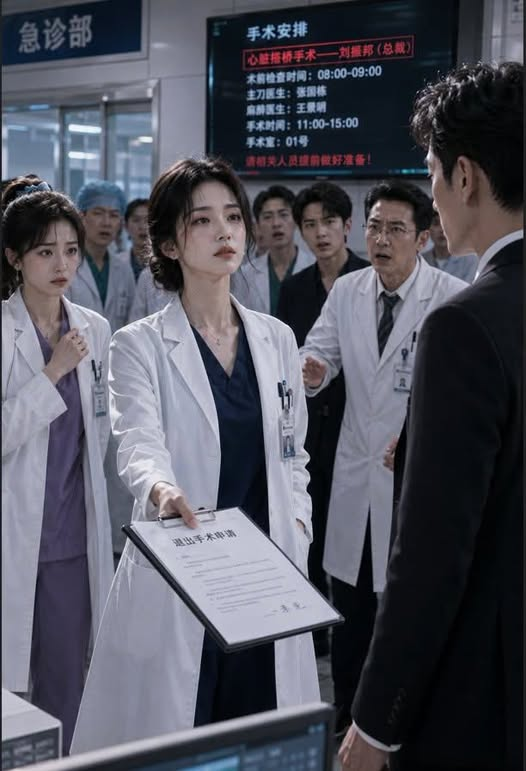
“You’re withdrawing completely?”
“Yes.”
Ta Van Van’s eyes lit up before she quickly lowered them.
General Manager Luu’s son looked satisfied.
“Good. Then Doctor Ta will take over.”
I nodded.
“Please have the family sign a new authorization confirming the change of chief surgeon and treatment team.”
Quoc Dong frowned.
“Why make things so formal?”
I looked at him.
“Because from this moment onward, I am no longer responsible for General Manager Luu’s case.”
His expression stiffened.
Perhaps that was the first moment he sensed something was wrong.
But it was too late.
He had spent days creating the perfect stage for his junior sister.
So I gave it to her.
That afternoon, Ta Van Van held a press conference beside my husband.
She announced that she would lead the coronary bypass procedure personally.
Quoc Dong praised her as “the new generation of cardiovascular surgery.”
Then came the most ridiculous part.
Van Van smiled at the cameras and announced:
“The operation will be broadcast live for academic observation.”
Reporters applauded.
Medical bloggers reposted the news.
By evening, everyone was calling her a future star.
Someone sent me the video.
I watched ten seconds and closed it.
My colleague asked:
“You’re really not going to stop them?”
“No.”
“But that treatment plan is yours.”
“The plan they have is incomplete.”
She froze.
“What?”
I opened my laptop.
Three days earlier, I had sent Quoc Dong the hospital-record version of the treatment plan.
It contained the diagnosis, surgical route, drug principles and basic operative strategy.
But because General Manager Luu’s liver, lungs and circulation were all unstable, I had designed an additional individualized intraoperative adjustment protocol.
That part had never been uploaded.
It was still being modified according to his latest test results.
Only I had the completed version.
And the most important point was not some secret technique.
It was judgment.
When to change perfusion strategy.
When to abandon the original sequence.
When a “normal” indicator was actually dangerous specifically for this patient.
No document could replace the person who had monitored him for three sleepless nights.
Van Van thought she had stolen a recipe.
She had forgotten that surgery was not cooking from instructions.
The evening before the operation, Quoc Dong finally came to my office.
“Send me the supplementary notes.”
I looked up.
“What supplementary notes?”
His face darkened.
“Minh Chau, don’t be childish.”
“I withdrew from the case.”
“You designed the treatment.”
“And Doctor Ta is now the chief surgeon.”
He lowered his voice.
“This is a human life.”
“Exactly.”
I looked directly at him.
“That is why you should never have used a patient’s life to arrange an internship opportunity.”
His face changed.
He denied it immediately.
“I don’t know what you’re talking about.”
I took out my phone.
The message he had sent that morning was still there.
General Manager Luu ate breakfast. Examination postponed until tomorrow. Go support Emergency.
Timestamp.
Hospital schedule.
Call records.
Everything preserved.
Quoc Dong went pale.
“You recorded all this?”
“I started documenting things when you asked me for the treatment plan outside standard procedure.”
He stared at me.
Then his tone softened.
“Minh Chau, Van Van only needs one major case to pass her evaluation.”
I laughed.
Finally.
The truth.
“So you sacrificed my surgical qualification to give her one?”
“She’s talented.”
“Then let her prove it with a case appropriate to her experience.”
“She can do this.”
“Good.”
I closed the laptop.
“Then she doesn’t need me.”
The livestream began the next morning.
I did not watch.
I was in another operating room handling a scheduled case when a nurse ran in after we finished.
“Doctor To, something happened with General Manager Luu.”
I removed my gloves.
“What happened?”
“His condition became unstable during surgery.”
I stayed still.
“They’re asking for you.”
“Who?”
“Director Truong.”
Of course.
When I reached the observation area, Quoc Dong met me at the door.
The arrogance was gone.
“Minh Chau, come in.”
I did not move.
“Who is the chief surgeon?”
His jaw tightened.
“Van Van.”
“Then let her lead.”
“She can’t stabilize the situation.”
Behind the glass, the surgical team was tense.
The livestream had already been cut.
General Manager Luu’s son stood in the corridor, white-faced.
He rushed toward me.
“Doctor To, please save my father.”
Yesterday he had pointed at me and said I did not deserve to be a doctor.
Today he bowed his head.
I did not enjoy it.
A patient’s life was not a place for revenge.
I looked at him.
“If I enter, I take full command.”
“Yes.”
“No interference from Director Truong.”
“Yes.”
“Doctor Ta steps down immediately.”
His voice shook.
“Anything. Just save him.”
I turned to Quoc Dong.
“Prepare the transfer-of-command document.”
He looked humiliated.
I repeated:
“Now.”
Five minutes later, I entered.
The surgery lasted several more hours.
There was no miracle.
No dramatic applause inside the operating room.
Only adjustments, decisions, teamwork and the discipline to correct what had gone wrong.
By evening, General Manager Luu was stable enough to be transferred for intensive monitoring.
When I came out, his son burst into tears.
“Doctor To…”
I raised a hand.
“Thank the entire team.”
Then I walked past the cameras.
I refused every interview.
But the truth could no longer be hidden.
The hospital had announced Ta Van Van as chief surgeon.
The livestream had shown her beginning the operation.
Then the feed suddenly disappeared.
Hours later, the hospital confirmed that I had taken over after an intraoperative emergency.
People began asking why.
And once people ask the right question, lies become expensive.
The internal investigation started the next day.
The system logs proved Quoc Dong had personally changed my schedule.
Security footage showed him taking me to Emergency just before General Manager Luu’s examination.
The message about the patient supposedly eating breakfast was still on my phone.
And the most damaging evidence came from Van Van herself.
Under pressure, she admitted:
“Director Truong said Sister Minh Chau was too established already. He wanted me to have a chance to become known.”
That sentence ended his career as hospital director.
He was suspended first.
Then removed from administrative duties after the ethics committee concluded that he had deliberately manipulated clinical scheduling and misrepresented responsibility for a high-risk patient.
Van Van failed her internship evaluation.
Not because the surgery had become complicated.
Complications can happen to any surgeon.
She failed because she accepted a case beyond her authorized experience, participated in falsifying the circumstances under which she replaced me, and publicly exaggerated her role before the operation even began.
The press conference that was supposed to make her famous became the recording everyone replayed after her fall.
Quoc Dong came home three nights later.
I had already packed.
He stood beside the suitcase.
“You’re leaving?”
“Yes.”
“You’re divorcing me over this?”
I looked at him.
“No.”
“I’m divorcing you because when you wanted to help another woman advance, your first solution was to sacrifice my reputation.”
His face tightened.
“I never wanted you harmed.”
“You reported me as negligent.”
Silence.
“You let a patient’s family humiliate me.”
Silence again.
“And then, when your plan failed, you remembered I was your wife and asked me to save both the patient and your career.”
He whispered:
“I made a mistake.”
“No.”
I picked up my suitcase.
“You made a plan.”
That was worse.
Six months later, General Manager Luu returned to the hospital for follow-up.
He walked slowly, supported by his son.
The first thing his son did was apologize to me.
“I judged you before knowing the truth.”
I nodded.
“Then next time, ask before you condemn someone.”
He accepted it.
The Luu family later funded a cardiovascular research center.
They asked me to lead it.
I agreed under one condition:
Clinical appointments would never again be used as rewards, favors or publicity opportunities.
A year later, I became head of cardiovascular surgery.
Not because someone gave me a stage.
Because after everything, my record still stood.
As for Quoc Dong, he eventually returned to clinical work at another hospital.
Van Van disappeared from social media and restarted her training elsewhere.
I heard she became far more careful.
Perhaps failure taught her what praise never could.
That day, everyone thought I had calmly handed my greatest opportunity to another woman.
They thought I was surrendering.
I wasn’t.
I simply refused to fight for a position that had already been earned through my ability.
They wanted the title.
The press conference.
The livestream.
The applause.
So I gave them all of it.
And when the cameras went dark and only real medicine remained—
they finally discovered the one thing they had never managed to steal from me: the skill to stand behind the name.
