The night I found the contract, my unborn daughter kicked so hard that the paper slipped from my hands.
At first, I thought it was just another legal document.
My husband, Nathan Whitlock, had always lived surrounded by paper. Deeds, trusts, stock agreements, tax files, insurance riders—his office was a museum of signatures and locked drawers. He came from a family that believed everything could be protected if it was written in expensive ink and hidden behind polished mahogany.
I was not supposed to enter that office.
Nathan never said it like a rule. He said it with a smile.
“Don’t worry your pretty head with business, Emma.”
At first, I thought it was old-fashioned affection.
Later, I learned it was a warning.
I was eight months pregnant, swollen, exhausted, and desperate to find our updated health insurance documents before my final hospital registration appointment. Nathan was downstairs on a work call. His parents were arriving that evening for dinner. His brother, Aaron, and half the Whitlock family would be there too.
I only needed one file.
That was what I told myself as I stood inside his office, breathing in the smell of leather, printer toner, and his sharp cedar cologne.
The insurance folder wasn’t on the desk.
It wasn’t in the cabinet.
Then I noticed the bottom drawer.
Locked.
I should have left.
But something about that drawer made my skin tighten.
Maybe it was the way Nathan checked it every morning before work. Maybe it was how he always closed the office door when he printed anything. Maybe it was the memory of him waking up one night, panicked, because he thought I had gone near his desk.
The key was taped beneath the brass lamp.
Too carefully hidden.
Too easy to find if you knew where to look.
My hand trembled as I opened the drawer.
Inside, every folder was arranged perfectly, labeled in Nathan’s neat block letters.
PROPERTY.
INSURANCE.
BABY.
My heart paused.
I pulled the folder marked BABY.
Inside was a contract.
My name was on the first page.
Emma Whitlock.
Then my maiden name.
Emma Harper.
Then our unborn daughter’s name.
Lily Grace Whitlock.
We had only told three people that name.
I sat slowly in Nathan’s chair and began reading.
The first page made no sense.
The second made my mouth go dry.
By the fourth, my vision blurred.
It described property transfers from my inheritance trust into a Whitlock-controlled family entity. It listed “maternal incapacity conditions.” It included asset clauses, guardianship preferences, and language suggesting I had agreed that if anything happened to me during delivery, Nathan’s family would assume legal and financial control over everything connected to me and Lily.
At the bottom of page six was my signature.
Except I had never signed it.
My daughter kicked again.
This time, I pressed both hands over my stomach.
“No,” I whispered.
Downstairs, Nathan laughed into his phone.
The sound floated up through the floorboards, smooth and confident.
I looked again at the signature.
It was close.
Almost perfect.
But it had one flaw.
The loop on the H in Harper was wrong.
My father had taught me to sign my name when I was twelve. “Never rush the H,” he used to say. “That’s where people show who they are.”
My father had died two years before I married Nathan, leaving me a modest but valuable inheritance: a farmhouse, land outside Asheville, and a trust he said was “for the life you choose, not the life anyone forces on you.”
I had never touched most of it.
Nathan had.
Or he was trying to.
I heard footsteps in the hall and shoved the papers back into the folder, but not before taking photos with shaking hands.
When Nathan appeared in the doorway, his smile faded.
“What are you doing?”
“I was looking for the insurance papers.”
His eyes moved to the open drawer.
For one second, the man I married disappeared.
Something colder stood there.
“Did you find them?” he asked.
“No.”
He walked toward me slowly.
I stood, holding my stomach.
“You shouldn’t be in here,” he said.
“I know.”
He reached past me and closed the drawer.
The click of the lock sounded like a verdict.
Then he kissed my forehead.
“Go rest. Tonight will be long.”
I nodded.
But inside me, something had already changed.
That evening, the Whitlock house filled with voices.
Nathan’s parents arrived first. Richard Whitlock, his father, walked in with silver hair, a stiff jaw, and the permanent disappointment of a man who measured love in quarterly returns. His mother, Vivian, kissed the air beside my cheek and immediately commented on how tired I looked.
Aaron arrived late, as usual, with his tie loose and mischief in his eyes.
Aaron was the only Whitlock who had ever treated me like a person instead of an acquisition.
“You look like you’re about to either give birth or murder someone,” he whispered as he hugged me.
“Maybe both.”
He paused, searching my face.
“Emma?”
I forced a smile. “Later.”
Dinner began with roasted salmon, white wine I couldn’t drink, and family gossip I barely heard. The contract sat folded inside my maternity cardigan pocket, heavy as a stone.
Nathan kept watching me.
Every time I reached for water, his eyes followed my hand.
Every time someone mentioned Lily, his smile tightened.
I waited until dessert.
The family gathered in the dining room beneath the chandelier. Vivian was discussing which private preschool Lily should eventually attend. Richard was lecturing Aaron about responsibility. Nathan sat at the head of the table, king of a kingdom built on silence.
I stood.
The room quieted.
Nathan’s eyes narrowed.
“Emma?” he said softly.
I pulled the contract from my pocket and placed it on the table.
The pages spread beneath the chandelier light.
“I found this today.”
At first, Nathan laughed.
A small, sharp laugh.
“That’s business paperwork. You wouldn’t understand it.”
I looked at him.
“I understand my name.”
Vivian leaned forward. Richard frowned. Aaron picked up the first page.
Nathan’s chair scraped back.
“Give that to me.”
“No.”
His face changed.
“Emma, you are embarrassing yourself.”
“No,” I said, voice shaking but clear. “I’m asking why there is a forged contract in your locked drawer transferring my inheritance and naming your family as guardians of my baby.”
The room died.
Vivian’s lips parted.
Richard grabbed a page from Aaron.
Aaron kept reading, his expression darkening line by line.
Nathan reached across the table.
I stepped back.
“Give it back,” he said.
“No.”
“You invaded my privacy.”
“I found my stolen future in your drawer.”
Someone gasped.
Nathan’s face flushed red.
“That contract is not what you think.”
“What is it, then?” Aaron asked.
Nathan glared at him.
“I’m asking you,” Aaron said. “What is it?”
Nathan opened his mouth.
Closed it.
Richard’s voice cut through the silence. “Nathan.”
“It’s a draft,” Nathan snapped. “Nothing final.”
“My signature is on it,” I said.
“It was prepared in case something happened.”
“To me?”
“For Lily.”
“For my money,” I whispered.
Nathan slammed his palm on the table. Plates jumped. Vivian cried out.
“You always do this,” he hissed. “You twist everything. You play fragile because you’re pregnant and everyone rushes to protect you.”
I felt Lily move inside me.
I placed both hands over her.
“I found it in the bottom locked drawer,” I said, turning to the relatives. “The one he told me never to touch.”
The room erupted.
Questions flew from every direction.
Who drafted it?
Who witnessed it?
Why was the baby named?
Why was Emma’s inheritance included?
Why was there an incapacity clause?
Every answer Nathan gave contradicted the last.
Then Aaron said quietly, “This wasn’t drafted by our legal department.”
Nathan froze.
Aaron held up the page. “This firm name. I’ve seen it before.”
Richard looked at his son. “Where?”
Aaron’s eyes stayed on Nathan.
“That shell company dispute last year.”
Nathan’s face twisted.
“Shut up.”
It was not loud.
That made it worse.
Aaron leaned back. “What did you do?”
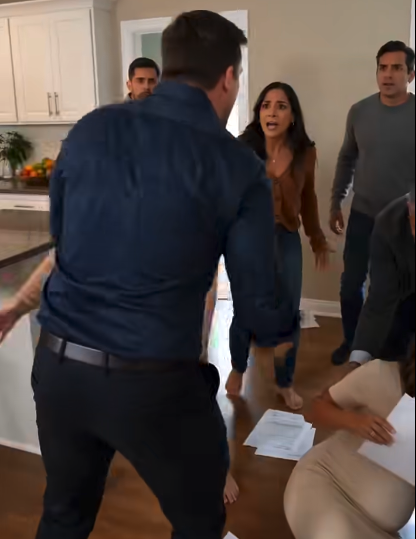
Nathan moved so fast I barely understood it.
One moment he was behind the table.
The next, he was in front of me.
His foot struck my side, low and hard.
Pain exploded through my body.
I crashed to the floor.
The room shattered into screams.
My arms wrapped around my stomach before I even hit the ground.
“Lily,” I gasped. “My baby—”
Aaron tackled Nathan backward. Richard shouted. Vivian screamed his name as if sound could undo what he had done. Chairs overturned. Silverware clattered across the floor. Contract pages scattered like white birds.
Nathan fought against Aaron, wild-eyed.
“Get out!” he roared. “Everyone get out! Don’t touch those papers!”
Then the sound came.
BZZZZZT.
Everyone froze.
It came from down the hallway.
Nathan’s office.
The printer.
BZZZZZT.
Another page.
Then another.
The house went silent except for the machine.
Nathan stopped struggling.
His face went white.
Not pale.
White.
Like every drop of blood had abandoned him.
BZZZZZT.
Richard turned slowly toward the hallway.
“Nathan,” he said. “What is printing?”
Nathan shook his head.
“No.”
Aaron released him and ran to help me.
“Emma, can you breathe?”
“I need the hospital.”
“We’re going.”
But Richard was already walking toward the office.
Nathan lunged after him.
“Dad, don’t!”
That was the wrong thing to say.
Richard Whitlock had built his life on suspicion. If told not to open a door, he opened it.
He returned moments later holding a sheet of paper.
He read the first line.
Then nearly dropped it.
Vivian whispered, “Richard?”
He handed the page to Aaron.
Aaron read aloud, his voice low.
“Private settlement agreement regarding the death of Daniel Reyes.”
Nathan made a strangled sound.
I stared from the floor, pain pulsing through my side.
Daniel Reyes.
I knew that name.
Years ago, before Nathan and I married, his college roommate died in a boating accident. Nathan always said it had been tragic. A storm. A drunk mistake. A terrible night no one liked discussing.
The printer kept going.
BZZZZZT.
Richard grabbed another page.
Then another.
Photos.
Bank transfers.
Emails.
A witness statement.
A non-disclosure agreement.
Aaron’s face hardened with each page.
“What is this?” Vivian asked.
Richard turned toward Nathan.
For the first time in my life, I saw fear in his eyes.
“Nathan,” he said slowly. “What did you do to Daniel Reyes?”
Nathan backed away.
“I didn’t kill him.”
No one had accused him of murder.
Not yet.
That sentence changed everything.
Sirens wailed in the distance.
Someone had called 911.
Nathan looked toward the sound, then toward the scattered documents, then toward me.
For a second, I saw hatred.
Not guilt.
Not panic.
Hatred.
As if I had caused his secrets by surviving them.
“You ruined everything,” he whispered.
Aaron stood in front of me.
“No,” he said. “You did.”
The paramedics arrived minutes later. Police followed. I was lifted onto a stretcher, terrified, clutching Aaron’s hand until Daniel Reyes’s name blurred into hospital lights and the rhythm of Lily’s heartbeat on a monitor.
Strong.
Fast.
Alive.
I cried when I heard it.
Aaron stayed until nurses wheeled me into a room.
Nathan was arrested that night.
Not only for assault.
The printed documents had opened a door years of money had kept shut.
And the strangest part?
Nobody knew who had triggered the printer.
At least, not at first.
The next morning, while I lay in a hospital bed with bruised ribs and a monitor strapped around my belly, Aaron came to see me.
He looked like he had aged ten years.
“Lily okay?” he asked.
“She’s stubborn,” I said. “Like her mother.”
He smiled weakly.
Then he placed a flash drive on the blanket.
“What is that?”
“The rest.”
My throat tightened.
“You printed it?”
Aaron sat beside the bed.
“No.”
“Then who?”
He looked toward the window.
“My mother.”
I stared at him.
“Vivian?”
He nodded.
“She’s been collecting evidence for years.”
“That doesn’t make sense. She defended Nathan.”
“She defended the family name,” Aaron said. “Not Nathan.”
He leaned forward, voice quiet.
“After Daniel Reyes died, my mother found blood on Nathan’s watch. She asked questions. My father buried them. He said Nathan was young, reckless, but not evil. He paid off witnesses, destroyed reports, forced everyone into silence.”
“And Vivian kept copies?”
“She kept everything.”
I remembered Vivian’s cold comments, her perfect posture, her distant eyes.
“She knew about the contract?”
Aaron looked ashamed.
“She suspected he was after your inheritance. She installed backup software on the office printer after she found old forged documents months ago. Anything sent, scanned, or printed from Nathan’s computer was copied and scheduled to print if a certain file was opened.”
My breath caught.
“The contract.”
Aaron nodded.
“She knew you would eventually find it.”
“Why didn’t she warn me?”
Pain crossed his face.
“Because she was afraid of him too.”
I turned away.
I wanted to hate Vivian.
Part of me did.
But another part remembered her scream when I hit the floor. The sound of a mother realizing what her silence had grown.
Later that day, Vivian came alone.
She stood at the doorway, stripped of pearls, makeup gone, face gray with grief.
“I don’t deserve to come in,” she said.
“No,” I said. “You don’t.”
She flinched.
But she stayed.
“I knew he was dangerous,” she whispered. “Not like this. Or maybe exactly like this, and I refused to name it.”
I said nothing.
She stepped closer, trembling.
“I thought if I gathered enough proof, I could force Richard to stop protecting him. I thought I could control the timing.”
“You watched him plan to take my money and my baby.”
Her eyes filled.
“Yes.”
The honesty surprised me more than any excuse would have.
“I am sorry,” she said. “That means nothing, I know. But I will testify. Against Nathan. Against Richard. Against myself if needed.”
My hand moved over my stomach.
“Why now?”
Vivian looked at the monitor where Lily’s heartbeat pulsed steady and fierce.
“Because when he kicked you, I saw what my silence had become.”
She pressed a hand over her mouth.
“I lost my first child before Nathan. A daughter. Stillborn. I convinced myself protecting my living son was love. But love without truth becomes rot.”
For a long time, neither of us spoke.
Then I said, “You will never be alone with my daughter.”
Vivian nodded, tears spilling.
“I know.”
“But if you tell the truth,” I added, “maybe one day she’ll know you tried to become better.”
Vivian covered her face and cried.
Three weeks later, Lily Grace Harper was born.
Not Whitlock.
Harper.
I changed my name before delivery.
Nathan fought from jail through lawyers, but every motion collapsed under the weight of printed evidence. The forged contract. The assault witnesses. The emails. The Daniel Reyes file.
And then came the twist that shook the entire Whitlock empire.
Daniel Reyes had not drowned by accident.
He had discovered Nathan was embezzling from a college investment club funded by wealthy families. Nathan confronted him on the dock during a party. There was a fight. Daniel fell, hit his head, and went into the water unconscious.
Nathan did not push him in.
But he watched him drown.
Then he called his father.
Richard arrived before police.
Together, they built a storm out of lies.
The printer had exposed not just a contract, but a family business model: bury the truth, pay the witnesses, polish the name.
This time, the truth did not stay buried.
Richard was indicted for obstruction and evidence tampering. Nathan was charged in connection with Daniel’s death, the forgery, fraud, and assault. Vivian testified. Aaron testified. I testified too, my voice shaking only once—when I described wrapping my arms around Lily before I hit the floor.
Nathan never looked at me.
Good.
I did not need him to.
The happiest day of my life came six months later, not in court, but in a sunlit kitchen.
Lily was sleeping in a yellow bassinet beside the window. Aaron was assembling a bookshelf badly. My attorney, who had become a friend, was laughing at him. Vivian had sent a letter I had not opened yet. Maybe someday.
My father’s farmhouse had been restored.
The land Nathan tried to steal became home.
There were apple trees behind the house. Wildflowers near the fence. A nursery painted the soft green my father always loved.
On the wall above Lily’s crib, I hung a framed note my father had written years ago:
For the life you choose.
I stood beneath it holding my daughter, breathing in her milk-sweet hair.
Aaron stepped into the doorway, a screw stuck to his sleeve.
“You know,” he said, “this shelf may collapse.”
“Then don’t put the baby under it.”
He smiled.
For a moment, the house was quiet.
No locked drawers.
No forbidden rooms.
No contracts written behind my back.
Just sunlight. Wood floors. Lily’s soft breathing. My own name returned to me.
Aaron looked at the note on the wall.
“Your dad saved you,” he said.
I kissed Lily’s forehead.
“Yes,” I whispered. “He did.”
Because Nathan had thought paper could steal my future.
But one hidden contract, one frightened mother’s printer, and one baby determined to survive had done something far stronger.
They gave it back.
