The first time I saw the old woman, I woke up screaming.
Not because she frightened me.
Because she looked so sad.
In the dream, she stood alone beneath a giant oak tree behind our house.
Moonlight silvered her gray hair.
Her hands were folded in front of her.
She never smiled.
Never moved.
Never blinked.
She simply pointed at the ground and whispered four words.
“Ten feet down, Eleanor.”
Then I woke up.
The clock read 3:17 a.m.
My heart hammered against my ribs.
Beside me, my husband, Caleb, slept peacefully.
I stared at the ceiling until dawn.
I told nobody.
Pregnancy dreams were strange.
Everyone knew that.
I was seven months pregnant with our first child.
Some nights I dreamed our baby could talk.
Other nights I dreamed the house floated away.
So I dismissed it.
Then the dream came again.
And again.
And again.
Exactly the same.
Same woman.
Same tree.
Same words.
Ten feet down.
By the fifth night, I stopped sleeping.
By the sixth, I started recognizing details.
The old woman wore a dark blue dress.
A silver ring.
A necklace shaped like a strange symbol I didn’t recognize.
A circle intersected by three lines.
Most disturbing of all—
She seemed familiar.
Not like someone I’d met.
Like someone I should know.
The feeling haunted me.
On the seventh morning, I walked into the backyard carrying coffee.
The giant oak tree stood exactly where it had in every dream.
Its roots twisted through the soil like giant fingers.
The patch of earth beneath it looked ordinary.
Nothing unusual.
No disturbed dirt.
No markers.
No clues.
Yet the moment I looked at it, chills ran down my spine.
That night, I took a shovel outside.
Just for a few minutes.
Just to prove nothing was there.
I dug for twenty minutes.
Then an hour.
Then two.
When Caleb discovered me at midnight, he nearly dropped his flashlight.
“Eleanor!”
I jumped.
“What are you doing?”
I looked down at the hole.
“I don’t know.”
His expression shifted from confusion to concern.
“Come inside.”
I didn’t argue.
But I dreamed of the woman again.
Ten feet down.
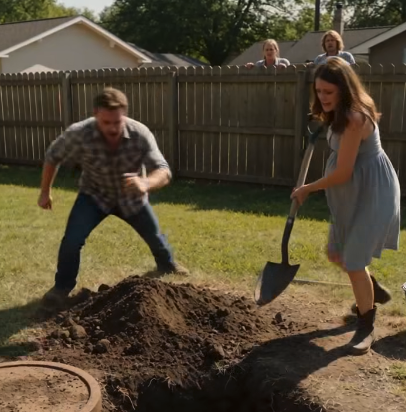
The next evening, I dug again.
The neighbors noticed.
The hole grew larger.
Caleb grew increasingly worried.
By the third night of digging, he sat beside me on a lawn chair.
“You realize everyone thinks you’ve lost your mind.”
I kept digging.
“I know.”
“And?”
I drove the shovel into the earth.
“She’s still there.”
“Who?”
“The woman.”
Silence.
Caleb rubbed his face.
“Eleanor…”
“I know how this sounds.”
“Good.”
“But she’s real.”
“No.”
I stopped digging.
The baby kicked.
I placed a hand on my stomach.
“Maybe not real real.”
Caleb sighed.
“You’re exhausted.”
“Maybe.”
“Hormones.”
“Maybe.”
“Stress.”
“Maybe.”
He leaned forward.
“Then stop.”
I wanted to.
God help me, I wanted to.
Every muscle hurt.
My back ached constantly.
The baby pressed against my ribs.
The neighbors stared.
People whispered.
But every night I saw her.
And every morning the feeling remained.
Something was waiting.
On the eighth day, Caleb’s mother arrived.
Margaret Donovan.
A practical woman who believed every problem could be solved with soup, prayer, or common sense.
Usually all three.
She found me outside digging.
Then she found Caleb watching helplessly.
Then she demanded an explanation.
After hearing the entire story, she crossed her arms.
“Dreams aren’t treasure maps.”
“I know.”
“Good.”
“So why are you digging?”
I opened my mouth.
Then closed it.
Because I didn’t know.
Not really.
Margaret softened slightly.
“Honey, you’re carrying a baby.”
“I know.”
“You need rest.”
“I know.”
“Then stop.”
I looked at the hole.
The old woman flashed through my mind.
The sadness in her eyes.
The urgency.
I couldn’t explain it.
But it felt important.
Terribly important.
That night I dug again.
Caleb and Margaret watched from the porch.
Neither spoke.
By then the hole was nearly six feet deep.
The following morning, our next-door neighbor approached the fence.
“Find oil yet?”
I laughed weakly.
“No.”
“Buried treasure?”
“No.”
“A body?”
That stopped my laughter.
Something about the joke felt wrong.
The old woman appeared in my thoughts again.
For the first time, I wondered:
What if something truly was buried there?
The ninth night arrived with rain.
Not heavy.
Just enough to turn the dirt slick.
I stood at the edge of the hole holding the shovel.
Caleb appeared behind me.
“Enough.”
I didn’t answer.
“Eleanor.”
I stared into the darkness.
“One more night.”
“No.”
“Please.”
“No.”
The baby shifted.
A cramp rippled through my back.
Caleb immediately moved closer.
Fear replaced irritation in his eyes.
“Eleanor.”
“I’m okay.”
“You shouldn’t be doing this.”
“I know.”
“Then stop.”
I almost agreed.
I almost dropped the shovel.
Then a memory surfaced.
Not from a dream.
From childhood.
A voice.
My grandmother’s voice.
Some truths wait underground until someone is willing to dig.
I froze.
My grandmother had died when I was twelve.
Why had I suddenly remembered that?
Caleb gently took the shovel.
“Come inside.”
For the first time, I let him.
That night I cried myself to sleep.
Not because I believed.
Because I feared I had finally lost my mind.
Then the dream changed.
For the first time.
The old woman stepped closer.
Close enough for me to see tears in her eyes.
Close enough to see every wrinkle.
Every detail.
Every scar.
She touched my stomach.
Then she whispered:
“He must know.”
I woke up gasping.
At 3:17 a.m.
Again.
The same time.
The same darkness.
The same certainty.
Ten feet down.
The tenth night arrived.
I didn’t ask permission.
I simply picked up the shovel.
Caleb followed.
Neither of us spoke.
He looked exhausted.
Defeated.
But he carried a flashlight.
That meant everything.
We dug together.
Thirty minutes passed.
An hour.
The hole deepened.
The baby kicked constantly.
As if aware something was happening.
Sweat soaked my clothes despite the cold air.
Then—
CLANG.
The sound echoed through the yard.
Both of us froze.
I looked down.
Caleb slowly lowered the flashlight.
The beam revealed metal.
A flat surface beneath the dirt.
For several seconds neither of us moved.
Then Caleb whispered:
“Oh my God.”
The next two hours became a blur.
We cleared dirt.
Roots.
Rocks.
More dirt.
Until the object emerged completely.
A rusted steel hatch.
Massive.
Ancient.
Hidden beneath nearly ten feet of earth.
I stared at it.
Unable to breathe.
Unable to think.
The old woman’s face flashed through my mind.
Ten feet down.
Exactly ten feet.
Caleb knelt beside the hatch.
Then suddenly went pale.
“What?”
He didn’t answer.
Instead he brushed dirt from the center.
A symbol appeared.
A circle crossed by three lines.
The same symbol from the necklace.
The same symbol from my dreams.
And the moment Caleb saw it—
He staggered backward.
I had never seen fear like that on his face.
“What is it?”
His voice trembled.
“My father’s necklace.”
My blood turned cold.
“What?”
“My dad wore this symbol every day.”
I stared.
Caleb’s father had vanished twenty years earlier.
Gone without explanation.
The official story was simple.
Missing.
Presumed dead.
No body.
No answers.
Just absence.
Caleb looked physically ill.
“That’s impossible.”
Yet the symbol remained.
Silent.
Undeniable.
We called Margaret.
She arrived twenty minutes later.
The moment she saw the hatch, all color drained from her face.
For several seconds she couldn’t speak.
Then she whispered:
“No.”
“Mom?”
“No.”
“You know what this is?”
Her eyes filled with tears.
“I prayed nobody would ever find it.”
The world seemed to tilt.
“What is it?” Caleb demanded.
Margaret closed her eyes.
“When your father disappeared… he told me never to dig beneath the oak.”
Silence.
Nobody moved.
Nobody breathed.
Then Caleb grabbed the hatch handle.
The rust screamed as it opened.
Darkness waited below.
A metal ladder descended into blackness.
And beneath that—
A hidden room.
We called the sheriff.
By sunrise, investigators arrived.
The chamber was real.
Approximately twenty feet wide.
Perfectly preserved.
Built from reinforced concrete.
A secret underground bunker.
But what they found inside shocked everyone.
Photographs.
Hundreds of them.
Every wall was covered.
Family gatherings.
Birthdays.
Christmas mornings.
Weddings.
Graduations.
Pictures spanning decades.
Generations.
Some dated back fifty years.
Others twenty.
Others ten.
Every member of Caleb’s family appeared somewhere.
Watching us.
Growing older.
Living life.
As if someone had documented everything.
The chamber felt less like a bunker.
More like a shrine.
Or surveillance.
Then investigators found boxes.
Journals.
Letters.
Film reels.
Documents.
And finally—
The last photograph.
The newest one.
Taken only six months earlier.
Caleb picked it up.
Then started shaking.
Because standing in the photograph—
Alive.
Smiling.
Holding a newspaper dated six months ago—
Was his father.
Thomas Donovan.
The man declared dead twenty years earlier.
The room exploded into confusion.
Margaret nearly fainted.
The sheriff immediately opened an investigation.
News spread through town like wildfire.
Reporters arrived.
Experts arrived.
Everyone wanted answers.
But the strangest discovery came three days later.
Inside one of the journals.
A single sentence.
Written repeatedly.
Hundreds of times.
When the child returns, tell him everything.
When the child returns.
Tell him everything.
Nobody knew what it meant.
Until my labor began.
Exactly one week after opening the hatch.
I went into labor during a thunderstorm.
The contractions came hard and fast.
Caleb drove through pouring rain.
Margaret sat in the backseat praying.
By dawn, our son arrived.
Healthy.
Perfect.
Beautiful.
The moment I held him, something happened.
Not physically.
Emotionally.
A feeling.
The same certainty that had driven me to dig.
But now it felt complete.
Finished.
Like a message delivered.
I thought that would be the end.
I was wrong.
Because two weeks later, a man walked into the sheriff’s office.
And changed everything.
He was seventy years old.
Gray-haired.
Thin.
Tired.
And carrying the same symbol on a necklace.
His name was Thomas Donovan.
Caleb’s father.
Alive.
The town erupted.
News helicopters circled overhead.
Reporters swarmed.
Questions flew from every direction.
Where had he been?
Why had he disappeared?
Who built the bunker?
Why the photographs?
Why return now?
Thomas answered none of them.
At first.
He requested only one thing.
To meet his grandson.
Privately.
Margaret refused.
Caleb almost refused.
But curiosity won.
The meeting took place in our living room.
I held our baby.
Thomas sat across from us.
Silence stretched between generations.
Then Thomas began to cry.
Not quietly.
Not politely.
The kind of crying that comes from carrying grief too long.
“I never wanted this.”
Caleb stared.
“Then explain.”
Thomas nodded.
And told us the truth.
Twenty years earlier, he discovered something impossible.
The symbol wasn’t a family emblem.
It belonged to a secret historical society.
One dedicated to preserving family histories.
Genealogies.
Records.
Stories.
For generations.
Thomas had inherited responsibility for maintaining thousands of forgotten family archives.
Including hidden records connected to dozens of families throughout the region.
But while cataloging old documents, he uncovered something shocking.
Caleb wasn’t his biological son.
The room froze.
Margaret began sobbing immediately.
Thomas continued.
Years earlier, a hospital error had switched newborn babies.
The mistake had been covered up.
Buried.
Forgotten.
Until Thomas found proof.
The real Donovan child had been raised elsewhere.
Caleb belonged to another family entirely.
Thomas spent years searching.
Obsessing.
Investigating.
Eventually the search consumed him.
Destroyed him.
He vanished because he couldn’t live with the truth.
Or face it.
The bunker became his prison.
His archive.
His obsession.
But that wasn’t the twist.
Not even close.
Because Thomas then looked directly at our newborn son.
And smiled.
“He came back.”
A chill swept through me.
The same words from my dream.
The same certainty.
The same feeling.
“What do you mean?” Caleb asked.
Thomas reached into his coat.
Removed a photograph.
And handed it to me.
The picture showed the old woman from my dreams.
Exactly.
Every wrinkle.
Every scar.
Every detail.
I nearly dropped it.
“Who is she?”
Thomas stared at the photo lovingly.
“My mother.”
The room spun.
“That’s impossible.”
“She died thirty years ago.”
I couldn’t breathe.
Thomas nodded.
“Before she died, she told me something strange.”
Nobody moved.
Nobody blinked.
“‘One day,'” Thomas whispered, “‘a woman carrying your future grandson will dream of me. When she does, tell her thank you.'”
Tears filled my eyes.
My hands shook.
Thomas smiled softly.
“She believed some people leave messages behind.”
The room fell silent.
Then he looked at our baby.
“And she believed your son would unite what was broken.”
Months later, DNA testing confirmed everything.
Caleb truly had been switched at birth.
His biological family was located.
Alive.
Good people.
Heartbroken.
Hopeful.
The reunion changed countless lives.
Families thought lost were found.
Secrets hidden for decades were healed.
Thomas never returned to the bunker.
Instead, he moved nearby.
Determined to spend whatever years remained with the son he had loved all along.
Because biology had never been the point.
Love had.
The hidden chamber eventually became a historical archive preserving family histories throughout the county.
The photographs were restored.
The stories preserved.
And every year on our son’s birthday, we visited the oak tree.
The hole was gone.
The hatch sealed.
The earth healed.
But sometimes, late at night, I sat on the porch and watched the moonlight filter through the branches.
And I thought about the old woman.
The one nobody believed existed.
The one who guided me ten feet beneath the earth.
The one who somehow knew exactly where hope had been buried.
And every time our son laughed beneath those branches, I felt the same certainty I felt the night the shovel struck metal.
Some truths are buried.
Some truths are hidden.
And some truths wait patiently beneath generations of silence until exactly the right person arrives to uncover them.
The old woman had been right.
Something important was waiting ten feet down.
It just wasn’t a secret.
It was an entire family waiting to come home.
