I looked at Tran Hao for several seconds.
Then I asked:
“Who pays the mortgage on this house?”
He froze.
“What does that have to do with anything?”
“Answer me.”
My father finally lowered the newspaper.
“Why are you bringing money into a family argument?”
Because money was apparently the only language everyone in that room understood.
I pointed toward Chu Van.
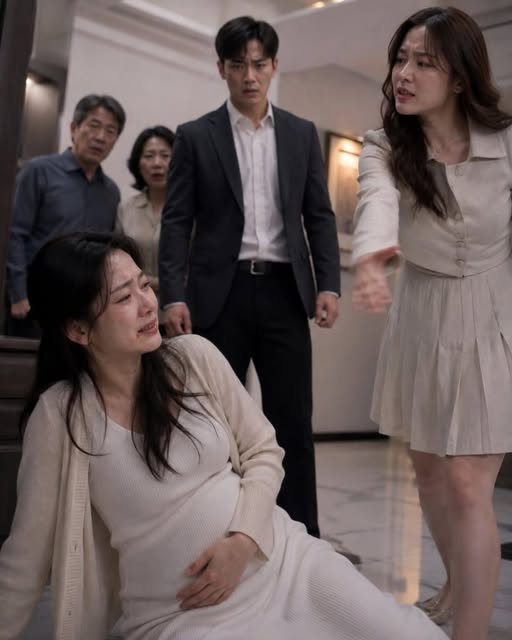
“My six-month-pregnant wife is sitting on the floor after being assaulted in her own home.”
Then I looked at Vuong Phuong.
“And you’re asking why I’m defending her?”
Tran Hao’s expression hardened.
“She shouldn’t have interfered in our affairs.”
I laughed.
“Your affairs?”
Chu Van had discovered that morning that Vuong Phuong had broken a decorative lamp in the study, then tried to take money from the household account to replace it before I came home.
When Chu Van stopped the transfer, they argued.
That was all.
The account belonged to my wife and me.
The lamp belonged to us.
The house belonged to us.
Yet somehow Chu Van had become the interfering outsider.
I took out my phone.
“Enough.”
My mother immediately became nervous.
“What are you doing?”
“Calling a car.”
“For whom?”
I looked at all four of them.
“You.”
The room went silent.
My mother laughed awkwardly.
“Stop joking.”
“I’m not joking.”
I crouched beside Chu Van.
“Can you stand?”
She nodded weakly.
I helped her up carefully.
“We’re going to the hospital first.”
Then I looked at my parents.
“While we’re gone, pack your things.”
My father stood up.
“What nonsense are you talking about?”
“You heard me.”
“This is your parents’ home!”
“No.”
I pointed around the living room.
“This is the home Chu Van and I bought after we married.”
My mother’s face stiffened.
“But you said we could live here.”
“I did.”
“That was before you watched my pregnant wife be treated like she had no right to speak in her own home.”
Nobody answered.
I turned to Tran Hao.
“You and Vuong Phuong leave too.”
His eyes widened.
“Where are we supposed to go?”
I almost couldn’t believe the question.
Three years earlier, when Tran Hao lost his job, I let him move into the spare room “for two months.”
Two months became three years.
His wife moved in after their wedding.
My parents arrived later because they wanted to “help keep the family together.”
Chu Van had agreed every time.
She gave up the study.
She changed cooking habits for my mother.
She paid household expenses when Tran Hao said money was tight.
And now the same people called her an outsider.
“Go back to your own apartment,” I said.
Tran Hao’s face turned ugly.
“You know I rented it out.”
“Then end the lease when legally possible.”
“And until then?”
“Find somewhere else.”
My mother rushed forward.
“You’re throwing your own brother onto the street because of one push?”
I stared at her.
“No.”
“I’m asking four adults to take responsibility for their own lives because today I finally saw what my generosity taught you.”
“That you could mistreat my wife and still expect me to provide everything.”
At the hospital, the doctor examined Chu Van and monitored the baby.
Thankfully, there were no serious complications.
Only then did I feel myself breathe properly again.
Chu Van lay against the pillow, exhausted.
I sat beside her.
For a long time, neither of us spoke.
Then she whispered:
“Are you really making them leave?”
“Yes.”
“They’ll blame me.”
“I know.”
“They’ll say I divided your family.”
I took her hand.
“They were already dividing it.”
She looked at me.
“Between the people they considered family and you.”
Her eyes filled.
That hurt more than anything.
Because I realized how long she had known.
“How many times?” I asked.
She looked away.
“What?”
“How many times have they treated you like this when I wasn’t home?”
Silence.
That was my answer.
Not violence.
But criticism.
Commands.
Money requests.
My mother entering our bedroom without knocking.
Tran Hao borrowing my car and returning it empty.
Vuong Phuong taking Chu Van’s things because “we’re family.”
Small humiliations I had dismissed individually.
Together, they formed a pattern.
I squeezed her hand.
“I’m sorry.”
She shook her head.
“I should have told you more clearly.”
“No.”
“I should have noticed.”
For years, I had called myself a good son because I gave my parents everything.
I had never asked whether being a good son was turning me into a bad husband.
When we returned that evening, suitcases were lined up in the living room.
But nobody had actually left.
My father was sitting on the sofa.
My mother looked as if she had been crying.
Tran Hao stood near the window.
Vuong Phuong had locked herself in the spare bedroom.
My father spoke first.
“We need to talk.”
“We can talk.”
He sighed with relief.
Then I continued:
“After you move out.”
His face darkened.
“So there’s no room for negotiation?”
“No.”
My mother began crying.
“We raised you for more than twenty years!”
“And I will continue supporting you where appropriate.”
They all looked at me.
“I’m not abandoning my parents.”
“I’ll help with reasonable medical expenses.”
“I’ll contribute to living costs if you genuinely need it.”
“But nobody is living here anymore.”
Then I looked at Tran Hao.
“And I’m no longer paying your personal debts.”
His expression changed instantly.
“What debts?”
“The credit card.”
“The car.”
“The 300,000 yuan you borrowed from me last year.”
He opened his mouth.
I continued:
“You’re thirty-one.”
“Your wife is thirty.”
“You are not children.”
Vuong Phuong finally came out.
Her cheek still showed the redness from the confrontation.
She looked at me bitterly.
“So because Chu Van cried, you’re cutting everyone off?”
Chu Van’s hand tightened around mine.
I answered calmly.
“No.”
“I’m changing the rules because you attacked my wife and then explained that she was an outsider.”
I looked around the room.
“From now on, nobody who considers her an outsider gets to live in her house.”
That ended the discussion.
My parents rented a two-bedroom apartment nearby.
I paid the first six months.
After that, my father’s pension covered most of it.
They discovered, surprisingly, that life remained possible without my wife cooking every meal.
Tran Hao had a harder adjustment.
Without free housing and my monthly support, he had to return to work.
His first job was not prestigious.
He complained.
I did not rescue him.
Within a year, he changed jobs twice and eventually settled into a sales position.
For the first time since his twenties, he paid his own rent.
Vuong Phuong apologized to Chu Van three weeks after moving out.
Not because I demanded it.
Because my mother finally told her something I never expected.
“You were wrong.”
Apparently losing the comfort of our house had forced my mother to reconsider what she had witnessed.
Vuong Phuong came alone.
She stood at our door and said:
“I shouldn’t have touched you.”
Chu Van looked at her.
“No.”
“You shouldn’t have.”
That was all.
No dramatic forgiveness.
No instant reconciliation.
But the apology mattered.
Our daughter was born three months later.
My mother visited the hospital.
She stopped outside the room first.
Then knocked.
A tiny thing.
But Chu Van noticed.
So did I.
“Can I come in?” my mother asked.
Chu Van smiled.
“Yes.”
That was how our family slowly rebuilt itself.
Not by pretending nothing had happened.
By learning boundaries that should have existed from the beginning.
Years later, Tran Hao once asked me whether I regretted throwing everyone out.
I looked at my wife sitting in the garden while our two children played beside her.
“No.”
He laughed awkwardly.
“You were really ruthless that day.”
I shook my head.
“No.”
“I was late.”
That surprised him.
I had spent years believing protecting my family meant keeping everyone under one roof.
But a house full of relatives is not automatically a family.
Not when one person is expected to endure everything simply because she married into it.
The day I came home and found Chu Van on the floor, everyone expected me to calm things down.
To ask my wife to forgive.
To tell my sister-in-law to behave better.
To preserve the appearance of harmony.
Instead, I finally understood something simple.
My wife was not the outsider in that house.
She was the woman who had built a life there with me.
And anyone who could not respect that—
could pack their things and leave.
