My son disappeared on a Saturday morning, and the world kept moving as if it had no shame.
Cars still passed our house.
Mail still landed in the box.
Neighbors still mowed their lawns.
The sun still rose.
But inside me, time stopped at 9:12 a.m., the moment I realized eight-year-old Noah was gone.
He had only walked two blocks with Rusty, our red-brown mutt with one floppy ear and a white patch shaped like a star on his chest. Noah had done it a hundred times before. Down Maple Street, past Mrs. Keller’s garden, around the old train station, then home for pancakes.
Rusty came back alone.
His leash was torn.
His paws were muddy.
And my son was gone.
The police searched for weeks.
Then months.
Divers checked the river.
Volunteers combed the woods.
Dogs tracked scents that vanished near the abandoned railway line.
Posters covered every telephone pole in town.
HAVE YOU SEEN NOAH MILLER?
Eight years old.
Brown hair.
Green jacket.
Blue backpack.
Loved trains.
The backpack was never found.
Neither was Noah.
After the first year, people stopped saying, “We’ll find him.”
They started saying, “You need to heal.”
After the second year, they avoided my eyes in the grocery store.
After the third, my husband David stopped sleeping in Noah’s room and began sleeping in the garage.
By the fourth year, everyone had moved on.
Everyone except Rusty.
Every morning at exactly 7 a.m., he scratched at the front door.
If I didn’t open it, he whined until his whole body shook.
Then he ran.
Not wandered.
Ran.
Straight to the abandoned train station.
Every afternoon, he came home with dust on his paws and grief in his eyes.
At first, I followed him often.
Then less.
Then not at all.
Because watching him wait hurt too much.
He would sit beside the same old wooden bench on platform two, staring down the tracks as if Noah might appear out of the fog with his crooked smile and say, “Mom, I was just exploring.”
Four years.
Rain.
Snow.
Heat.
Storms.
Rusty never stopped.
One October afternoon, thunder rolled over town, and the sky turned the color of bruised steel.
Rusty scratched the door at 6:59 a.m.
“No,” I whispered. “Not today.”
Lightning flashed.
He looked at me with those old amber eyes.
The same eyes that had seen my boy last.
Something inside me broke.
I grabbed my coat.
“I’m coming with you.”
Rusty didn’t wait.
By the time I reached the station, rain was pouring through holes in the roof. Weeds grew between the tracks. The ticket window was boarded up. The old clock above the platform still pointed to 9:12, frozen since the building lost power years before.
Rusty ran to the bench.
But this time, he didn’t sit.
He barked.
Once.
Twice.
Then he began digging beneath the bench with frantic desperation.
“Rusty!”
He ignored me.
His claws scraped concrete.
His paws bled.
I dropped to my knees and tried to pull him back.
That was when a voice shouted over the rain.
“Ma’am! You okay?”
A maintenance worker ran toward us carrying a flashlight.
His name tag read CALVIN.
“My dog,” I gasped. “He won’t stop.”
Calvin watched Rusty for only a second before his expression changed.
“Dogs don’t dig like that for nothing.”
He fetched a shovel from his truck.
The storm battered the platform.
Rusty trembled beside me, whining, eyes locked on the ground.
Calvin drove the shovel beneath a cracked slab.
Concrete shifted.
Mud gave way.
Then—
CLANG.
The sound went through my bones.
Calvin froze.
I stopped breathing.
Together, we cleared the mud.
Something metal appeared beneath the concrete.
A rusted box.
Small.
Flat.
Locked.
And across the lid, written in faded blue paint, was one word.
NOAH.
I made a sound I didn’t recognize.
Calvin whispered, “Oh my God.”
Rusty pressed his nose to the box and cried.
Not barked.
Cried.
The police arrived within twenty minutes.
Detective Maria Lawson came too.
She had worked Noah’s case from the beginning. Her hair was grayer now. Her eyes looked older. But when she saw the box, the old fire returned.
“Where exactly was it?” she asked.
Calvin pointed.
“Under the bench.”
Detective Lawson looked at Rusty.
“He knew.”
I couldn’t speak.
At the station, they opened the box carefully.
Inside was Noah’s blue backpack.
Folded neatly.
Dry.
Protected.
My knees almost gave out.
There was also a toy train, a photo of me and David, and a plastic whistle Noah used to wear around his neck.
At the bottom was an envelope wrapped in plastic.
My name was written on it.
Mom.
The room blurred.
Detective Lawson opened it with gloved hands.
Inside was a note.
The handwriting was shaky.
Childish.
But unmistakably Noah’s.
Mom, I am not dead.
Rusty knows the place.
Don’t trust the man with the silver train pin.
I love you.
Find the tunnel.
I screamed.
David arrived moments later and nearly collapsed when he saw the note.
For four years we had buried hope because everyone told us hope was cruel.
But there it was.
Written in our son’s hand.
I am not dead.
Detective Lawson reopened the case that night.
The “silver train pin” changed everything.
The old station had once belonged to a private rail preservation group. Volunteers restored old trains, organized tours, and maintained underground utility passages beneath the platform.
One volunteer had worn a silver locomotive pin every day.
Graham Vale.
A respected retired conductor.
A man who had helped organize searches after Noah vanished.
A man who had once looked me in the eye and said, “We’ll bring your boy home.”
He had died the year before.
For one terrible hour, I thought the truth had died with him.
Then Rusty led us to the tunnel.
Behind the boarded ticket office, beneath rotted floorboards, investigators found a narrow maintenance hatch. It opened into darkness, damp and cold, leading beneath the tracks.
On the wall inside, scratched into old brick, was another word.
RUSTY.
My legs shook.
Detective Lawson touched the carving.
“He left signs.”
The tunnel led to a sealed storage room.
Inside were old blankets.
Food tins.
Children’s drawings.
And maps.
Not recent.
But not four years old either.
Someone had kept this place alive long after Noah disappeared.
Then we found the photograph.
It showed Noah at ten years old.
Not eight.
Ten.
Standing beside a woman with silver hair outside a farmhouse I didn’t recognize.
On the back, in adult handwriting, were the words:
He is safe because the dog remembered.
The search widened.
Graham Vale had owned land forty miles away under his sister’s name.
At dawn, police drove there.
David and I were told to wait.
We didn’t.
We followed.
The farmhouse sat at the end of a dirt road surrounded by pine trees and fog.
Rusty went wild before the cars even stopped.
He leapt from the back seat and ran toward the porch, barking with a joy I had not heard in four years.
The front door opened.
A boy stepped out.
Tall.
Thin.
Brown hair.
Older.
But mine.
My Noah.
For one second, nobody moved.
He looked at me.
I looked at him.
Then he whispered, “Mom?”
I ran so hard I fell on the steps.
Noah met me halfway.
He crashed into my arms, taller than memory, thinner than dreams, alive.
Alive.
David reached us and wrapped both of us in his arms, sobbing like a broken man.
Rusty jumped around us, barking, crying, pressing himself against Noah as if afraid he would vanish again.
Noah buried his face in Rusty’s fur.
“You came,” he whispered. “I knew you’d come.”
The truth came slowly.
Graham Vale had not taken Noah to hurt him.
At least, not at first.
Noah had witnessed something at the station: a child trafficking exchange involving Graham’s own son. Graham panicked. He hid Noah in the tunnels, claiming he was protecting him until he could expose the criminals.
But Graham was a coward.
Days became weeks.
Fear became control.
He moved Noah to the farmhouse and told him his parents had died in a car accident.
Noah did not believe him.
So he left signs.
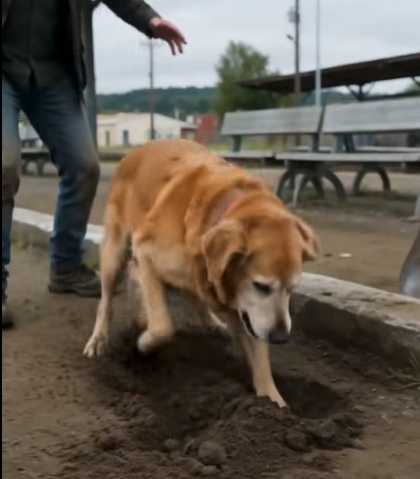
The buried box.
The tunnel carvings.
The dog’s name.
He trusted Rusty to remember what people forgot.
After Graham died, his sister, Elaine, discovered the truth. Horrified, she cared for Noah while trying to gather proof against the remaining men involved.
She was the woman in the photograph.
She opened the farmhouse door that morning with tears in her eyes and said, “I was trying to bring him home safely.”
She did.
Detective Lawson’s investigation led to seven arrests.
The old station was searched inch by inch.
The tunnel became evidence.
The bench became sacred.
And Rusty became a hero.
But to me, he was something more.
He was the part of our family that never accepted absence as an answer.
Months later, Noah came home for good.
Not easily.
Not magically.
He had nightmares.
So did we.
Some days he was quiet.
Some days he sat in his old room touching things like they belonged to another boy.
But he laughed again.
He slept with Rusty at the foot of his bed.
And every morning at 7 a.m., Rusty no longer scratched at the door.
He simply walked into Noah’s room, climbed carefully onto the bed, and rested his head on my son’s chest.
Checking.
Listening.
Making sure.
One year after Noah came home, the town restored the abandoned station.
Not as a place of sorrow.
As a memorial.
On platform two, beneath the old wooden bench, they placed a small bronze plaque.
It read:
For Noah, who left signs.
For Rusty, who never stopped looking.
And for every family waiting for someone to come home.
That morning, Noah stood beside me holding Rusty’s leash.
The old dog’s muzzle had gone white.
His steps were slower.
But his eyes were peaceful.
The station clock had been repaired too.
At exactly 9:12, it chimed again for the first time in years.
Noah squeezed my hand.
“Mom?”
“Yes, baby?”
He looked down the tracks.
“Can we go home?”
I smiled through tears.
“Yes.”
Rusty led the way.
Not toward the tracks.
Not toward the bench.
Not toward the past.
Toward our car.
Toward sunlight.
Toward the life he had protected for four long years.
And this time, when we left the station, nobody was waiting behind.
