The email arrived just as my boarding group was called.
Sender:
Emma Miller.
Recipient:
CEO, Legal Department, Internal Audit.
Scheduled delivery date:
Today.
Six months earlier.
I stared at it for several seconds.
Then I remembered.
I had prepared that email when I first noticed discrepancies in the Aurora project.
Not because I suspected an affair.
Because I suspected fraud.
At the time, I had told myself I was being paranoid.
So I created a delayed safeguard.
If nothing happened, I could cancel it.
But during the last six months I had been too exhausted to remember it existed.
Now it had sent itself.
Attached were contracts, design files, access logs, invoices and screenshots.
And one document Adrian had never expected me to preserve:
the original ownership record for the project that could make our company hundreds of millions.
My project.
Not his.
I boarded the plane.
For the first time that morning, I laughed.
The photograph had embarrassed Adrian.
The email was about to cost him much more.
In Bali, Adrian called the CEO immediately.
“Sir, Emma is emotional.”
The CEO’s answer was cold.
“I’m not calling about your marriage.”
Adrian stopped.
“What?”
“I’m calling about Aurora.”
Silence.
Aurora had begun as my concept eighteen months earlier.
A luxury hotel group wanted a completely new visual identity for forty-three properties.
I created the core design system.
The prototype.
The typography.
The spatial branding.
Even the digital interface concepts.
But when the project entered final negotiations, Adrian told me the client preferred having a director as the official lead.
“Your name will remain inside,” he promised.
“It’s only hierarchy.”
I believed him.
Then Vanessa became project coordinator.
Gradually, my name disappeared.
First from presentations.
Then from client emails.
Then from the final contract.
I complained once.
Adrian kissed my forehead and said:
“Why are husband and wife counting credit?”
Now the audit was counting.
Everything.
The first attachment showed version history.
My files existed ten months before Adrian’s supposed “creative direction.”
The second showed that Vanessa had downloaded entire project folders to a private drive.
The third showed payments from an outside consultancy called VC Strategy Studio.
Its owner?
Vanessa Cole.
The company had billed our employer for “independent concept development.”
Concepts copied directly from my work.
Nearly 1.8 million yuan had already been paid.
The CEO looked at Vanessa over video call.
“Did your company create these designs?”
Vanessa began crying.
“I only did what Adrian asked.”
Adrian immediately turned toward her.
“Don’t say nonsense.”
Too late.
Internal audit had the messages.
One from Adrian:
Remove Emma’s name before the client presentation. She doesn’t need to know yet.
Another:
Invoice through your studio. Once Aurora closes, we can leave together.
And the worst:
Emma will finish the work because she never abandons a project halfway.
He knew me very well.
That was precisely how he used me.
By the time my plane landed twelve hours later, Adrian and Vanessa had been suspended.
I had sixty-three new emails.
I opened only one.
From the CEO.
Emma, please contact us when you are ready. We need to discuss authorship, compensation and your future with the company.
I did not reply immediately.
I was in London.
The city I had once planned to move to before Adrian convinced me to stay.
Seven years earlier, I had rejected an offer from a design studio there because he said:
“We’re building something together.”
Apparently, I had been building.
He had simply been putting his name on it.
Two days later, I joined the audit meeting remotely.
Adrian was present with a lawyer.
Vanessa had separate counsel.
The CEO began:
“Emma, were you aware VC Strategy Studio was being paid for Aurora?”
“No.”
“Did you authorize transfer of your source files?”
“No.”
“Did you agree to remove your authorship?”
“No.”
Adrian interrupted.
“Emma, don’t do this.”
Everyone looked at him.
He lowered his voice.
“We can solve our personal issues separately.”
I almost admired the nerve.
“This is not personal.”
I held up the contract.
“You billed the company for work I created.”
His face tightened.
“You’re my wife.”
“Not for much longer.”
Silence.
Then I added:
“And marriage does not transfer intellectual ownership.”
His lawyer touched his arm.
A warning.
Stop talking.
For once, Adrian listened.
The investigation lasted three months.
The affair alone would not have destroyed his career.
Plenty of terrible husbands remain employed.
What destroyed Adrian was his belief that because I loved him, everything I created belonged to him too.
The company terminated Vanessa for undisclosed conflicts and false invoicing.
Adrian was removed as creative director after the audit concluded he had authorized improper payments, misrepresented authorship and concealed a relationship affecting project decisions.
Some funds were recovered.
Others became part of a civil claim.
Aurora remained with the company—but under a revised agreement recognizing me as principal creator.
They offered me Adrian’s position.
I declined.
The CEO was stunned.
“You’ve earned it.”
“I know.”
That was exactly why I could say no.
I accepted a settlement for the misuse of my work, retained the rights negotiated through my attorney, and resigned.
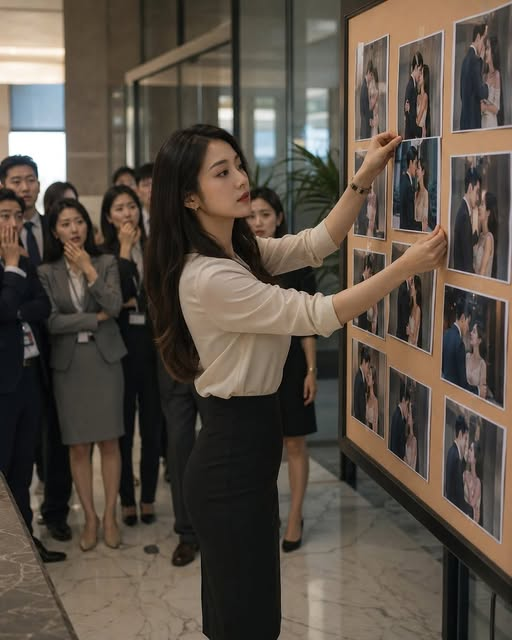
Then I stayed in London.
Adrian came three months later.
He waited outside the small studio where I had started consulting.
When I saw him through the glass, he looked unfamiliar without the office around him.
No director’s badge.
No employees stepping aside.
Just Adrian.
He held one of the printed Bali photographs.
I had forgotten how ridiculous it looked.
“You really made a hundred copies?”
“Yes.”
“Why?”
I thought for a moment.
“Because Vanessa sent it to make me feel ashamed.”
“And?”
“I decided the shame belonged to the people in the photograph.”
He looked down.
“I was going to tell you.”
“No, you weren’t.”
“I loved you.”
I smiled sadly.
“You loved what I did for you.”
“That’s not fair.”
“Then tell me one thing you sacrificed for my career.”
His mouth opened.
Nothing came out.
Seven years.
And he could not name one.
I nodded.
“That’s what I thought.”
He tried one last time.
“Was printing the photographs necessary?”
“No.”
That surprised him.
I continued:
“It was impulsive.”
“Leaving wasn’t.”
“The audit wasn’t.”
“The divorce isn’t.”
His face fell.
That was the difference.
One dramatic night had not ended our marriage.
It had simply illuminated years of smaller betrayals.
A year later, I opened my own design firm.
The first project on the wall was Aurora.
But this time, beneath the image, only one name appeared:
Emma Hayes — Original Creative Director.
I had returned to my maiden name.
My firm was small.
Then it wasn’t.
Two former colleagues joined me.
Then five.
Then twelve.
I built rules I wished someone had protected for me:
Credit belongs to the creator.
Conflicts must be disclosed.
Nobody uses marriage, rank or affection to erase another person’s work.
Vanessa disappeared from the industry for a while.
Adrian eventually found a position at a smaller agency.
I heard he became very careful about attribution.
Perhaps consequences taught him what love never could.
I did not hate him.
Hatred would have required too much attention.
The last time I saw the Bali photograph, it was inside the evidence box my lawyer returned after the divorce.
I almost threw it away.
Instead, I kept one copy.
Not because I missed him.
Because it reminded me of the exact moment humiliation stopped working on me.
Vanessa thought she had sent me proof that she had won my husband.
Adrian thought I would cry, forgive him, and return to finish the project he had stolen.
Neither understood what happened in those first three seconds.
I didn’t lose a husband that night.
I lost the illusion that protecting him was more important than protecting myself.
And once that illusion disappeared, the photograph they meant to use against me became the first page of the evidence that gave me my name back.
