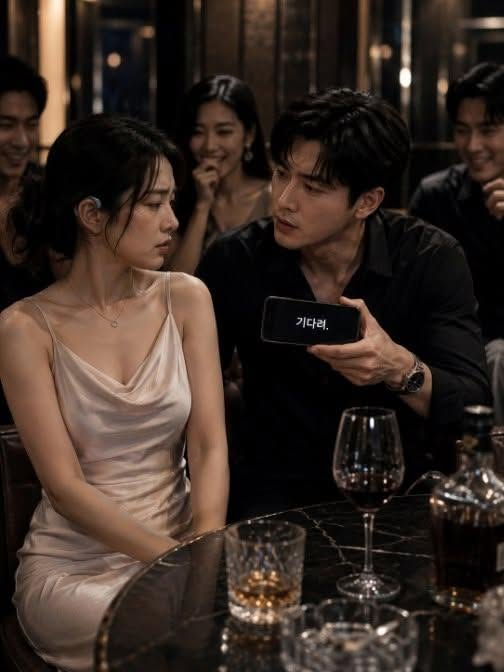
“Wait for me.”
Mauricio exaggerated every syllable so I could supposedly read his lips.
I nodded obediently.
Then I watched him leave with Renata.
Ten seconds.
Twenty.
Thirty.
The room immediately exploded with laughter.
One of Mauricio’s friends raised his glass.
“Brother, you really have courage. Tomorrow you’re marrying her and tonight you’re going upstairs with the best friend.”
Another replied:
“Marriage is marriage. Fun is fun.”
I lowered my head.
They believed I heard nothing.
What they didn’t know was that my hearing had improved dramatically during the last six months.
That afternoon, my doctor had even told me:
“Lucía, with the new treatment, you may soon stop depending on the device for ordinary conversations.”
I had planned to tell Mauricio that night.
It was supposed to be my wedding gift.
Instead, he gave me a much better one.
The truth.
I took out my phone beneath the table and activated the recorder.
Then I waited.
Twenty minutes later, Mauricio returned alone.
His hair was slightly disordered.
He sat beside me and typed:
Renata felt better. Let’s go home.
I looked at him.
For the first time, his familiar face looked completely foreign.
I smiled.
And nodded.
At home, Mauricio showered and went straight to bed.
Within minutes, he fell asleep.
I remained sitting in the living room.
Tomorrow at ten in the morning, we were supposed to register our marriage.
At eleven thirty, I had an appointment with the bank.
Mauricio did not know the purpose.
I had intended to add him as beneficiary to an investment account my grandmother had left me.
The account contained enough money to clear my father’s remaining debts and provide us with a comfortable start.
I had wanted it to be another surprise.
At 2:13 a.m., I canceled the appointment.
Then I opened the folder containing the documents for the apartment where Mauricio and I lived.
Mine.
Purchased before my first marriage.
Mauricio had always believed it belonged to my father.
I changed the access authorization and removed his name from the parking permit.
Then I messaged my lawyer.
Tomorrow’s civil marriage will not happen.
I sent another message to my brother.
I need you at my apartment at nine. Bring a moving company.
Finally, I opened my conversation with Renata.
Twenty-two years of friendship.
School photographs.
Birthdays.
My first wedding.
Her holding my hand after my injury.
Her sitting beside my hospital bed and crying:
“Lu, even if the whole world abandons you, I’ll stay.”
I stared at those words.
Then I blocked her.
No speech.
No final accusation.
She already knew what she had done.
Mauricio woke at eight thirty.
He found me drinking coffee.
“You’re dressed already?”
I nodded.
He kissed my forehead.
I nearly recoiled.
“You seem strange.”
I looked directly at him.
“Do I?”
He froze for half a second.
My pronunciation was normal.
Natural.
He apparently noticed nothing.
At nine sharp, the doorbell rang.
My brother entered with two movers.
Mauricio frowned.
“What’s going on?”
I placed a suitcase in front of him.
“Your things.”
His face changed.
“What?”
“I packed what I could.”
“Lucía, what kind of joke is this? We have to register in an hour.”
“No.”
He stared at me.
“No what?”
“No wedding.”
Silence.
Then he laughed.
“You’re nervous.”
I reached behind my ear.
Slowly removed the hearing aid.
Placed it on the table.
And said:
“I heard everything last night.”
Mauricio stopped breathing.
Absolute silence filled the room.
I almost enjoyed the irony.
For years, silence had frightened me.
That morning, it belonged to him.
His lips parted.
“Lucía…”
“Old balance.”
His face whitened.
“Broken scrap metal.”
He took one step backward.
I continued:
“Bargain trinket.”
“Two-for-one promotion.”
Every phrase he had spoken when he thought I could not hear returned to him perfectly.
“Lu, listen—”
“I have been listening.”
I smiled.
“That’s the problem.”
He immediately changed tactics.
“It was a joke.”
“Of course.”
“The guys were drinking.”
“Yes.”
“I was showing off.”
“And Renata?”
Nothing.
I looked at him.
“Was her foot under the table also a joke?”
His face tightened.
“You misunderstood.”
“Then explain it.”
He couldn’t.
The doorbell rang again.
Renata.
Of course.
She entered carrying two coffees and stopped when she saw the movers.
“Lu?”
I turned toward her.
She looked at the hearing aid on the table.
Then at Mauricio.
And understood.
Her face drained of color.
“You heard?”
“Yes.”
Renata began crying almost immediately.
“Lucía, please. It wasn’t what you think.”
I laughed.
“You two should coordinate your lines better.”
Mauricio snapped:
“Renata, shut up.”
She turned toward him.
“Why are you blaming me?”
And there it was.
Within thirty seconds, the great secret romance became an argument.
He accused her of provoking him.
She accused him of promising that our marriage was only temporary.
I stood there listening.
Apparently Mauricio had told her he would marry me because I was “easy to manage,” stabilize his finances, and later find a way to separate without losing access to the life we built.
That finally interested me.
“Financially stabilize?”
Both stopped.
Renata realized she had said too much.
Mauricio glared at her.
I smiled.
“Please continue.”
Nobody did.
So I called my lawyer again.
By noon, there was no wedding.
Instead, Mauricio was sitting inside a law office while my attorney explained that he had no ownership rights over my apartment or investment account.
The registration application had been withdrawn.
The authorization I had prepared for him had never been signed.
He stared at me across the conference table.
“You were going to give me access to all that?”
“Yes.”
“How much?”
I smiled.
“Enough that knowing the number would hurt you.”
His face turned gray.
That was the moment I finally understood something.
He had believed I was poor because I lived simply.
He believed disability had made me dependent.
He believed my previous divorce meant I would accept anyone willing to choose me.
Most of all, he believed humiliation had lowered my standards.
He had confused vulnerability with desperation.
Renata called me for weeks.
I never answered.
Eventually she sent a long email.
She said she had always been jealous of me.
Even after my accident.
Even after my divorce.
Because, according to her, people still loved me sincerely.
I deleted the message.
An explanation is not an eraser.
Mauricio came back twice.
The second time, he waited outside my building until evening.
When I finally appeared, he said:
“I really did love you once.”
I believed him.
That was perhaps the saddest part.
“Maybe.”
“Can we start over?”
“No.”
“Because of one night?”
I shook my head.
“Because one night showed me what you were doing during all the others.”
He lowered his eyes.
Then asked:
“Did you ever plan to tell me your hearing had recovered?”
I smiled faintly.
“That was why I went out with you that night.”
His face crumpled.
He finally understood.
He thought he had lost a damaged woman.
In reality, he had thrown away the person who had been preparing to tell him she was healing.
One year later, I no longer wore my hearing aid every day.
Some environments still required it.
Others didn’t.
I stopped being ashamed of either version of myself.
I also returned to work.
My father’s business recovered.
My brother repaid the debt that had once dragged our entire family into chaos.
And I finally stopped viewing my first divorce as proof that I had somehow become less valuable.
One afternoon, my audiologist asked:
“Do you remember the first thing you wanted to hear when treatment began working?”
I did.
Mauricio’s voice.
I had imagined him saying my name.
Saying he loved me.
Saying we would grow old together.
Instead, the first truth I clearly heard from the man I planned to marry was:
Damaged goods.
For months, I thought that was cruel fate.
Later I understood it was mercy.
Because if my hearing had recovered one day later, I would have married him.
I would have transferred assets.
I would have welcomed Renata into my home and continued calling her my best friend.
So no, I never hated the night my hearing returned.
It saved me.
Mauricio thought my disability meant I could not hear what people said behind my back.
What he never understood was much simpler:
Losing part of my hearing had never made me broken.
But hearing the truth finally gave me the courage to stop giving broken people a place in my life.
