My brother said it as if the solution were obvious.
“Thank goodness you have Elena. She’s a nurse.”
I looked at him.
Marcos continued:
“She can take Mom home with you. She already knows how to do all that medical stuff.”
Something inside me turned cold.
“Why my house?”
He frowned.
“Because you’re the oldest.”
“No. Why Elena?”
Marcos stared at me as though I had asked something ridiculous.
“Because she’s your wife.”
Eight years earlier, I would have accepted that answer.
That night, I heard how ugly it sounded.
Not because Elena was a nurse.
Because once again, everyone had decided what she owed us without asking her.
I called her anyway.
Not to demand.
At least, that was what I told myself.
“Elena.”
“Yes?”
“My mother had a stroke.”
There was a pause.
“I’m sorry.”
“The doctors say she’ll need long-term care.”
Another pause.
Then Elena asked:
“Have you spoken with rehabilitation services?”
“No.”
“Home nursing?”
“Not yet.”
“Then do that first.”
I swallowed.
“Marcos suggested…”
I could barely finish.
Elena understood.
“He suggested I take care of her.”
“Yes.”
“No.”
One word.
Calm.
Final.
“Elena, I wasn’t saying you had to.”
“You called because part of you hoped I would.”
I said nothing.
She knew me too well.
Then she added:
“Victor, I will not bathe the woman who applauded while her son hit me.”
There was no anger in her voice.
That made it worse.
“I understand.”
“No.”
She sighed.
“You’re beginning to.”
Then she hung up.
My mother remained hospitalized for three weeks.
Marcos visited twice.
His wife, Laura, refused immediately when someone suggested my mother move into their house.
“My home isn’t a rehabilitation center.”
My brother became furious.
Later, in the corridor, he complained:
“Women nowadays have no sense of duty.”
For the first time, I heard myself in him.
I turned.
“Then you take care of Mom.”
He blinked.
“I work.”
“So do Elena and Laura.”
“That’s different.”
“Why?”
He had no answer.
Neither had I for eight years.
When my mother came home, we hired a caregiver for the daytime.
At night, my father and I divided the work.
The first week destroyed every fantasy I had ever had about “women’s duties.”
Medication schedules.
Meals.
Laundry.
Appointments.
Helping someone move safely.
Cleaning.
Getting up at two in the morning.
Then four.
Then five thirty.
My father, who had spent his life smoking silently while women worked around him, looked exhausted after ten days.
One evening he said:
“Your wife used to do all this without complaining.”
I stared at him.
“Not this.”
“Yes.”
He pointed toward the kitchen.
“Cooking. Cleaning. Serving everyone.”
“At New Year.”
“Your mother always expected it.”
I felt ashamed.
Because I had expected it too.
Elena worked all week as a nurse, then traveled to my parents’ house for the holidays and worked again for free.
Laura sat down because her family had money.
Elena worked because we believed she had fewer options.
And when she finally resisted—
I hit her.
Twice.
Then spent eight years wondering why she would not return.
My mother eventually regained some speech.
One afternoon, I was helping her drink water when she managed to say:
“Elena.”
I froze.
“What about her?”
Her words were slow.
“Call… her.”
“Why?”
“Care… for me.”
I stared at my mother.
Even now.
Even after eight years.
“Elena isn’t coming.”
My mother’s face twisted with anger.
“She… wife.”
“Yes.”
“My wife.”
“Not your daughter.”
She hit the armrest with her good hand.
I continued:
“You told her never to come back.”
My mother looked away.
“You applauded when I hit her.”
She began making agitated sounds.
For once, I did not silence the truth to protect her feelings.
“She owes you nothing.”
My father was standing in the doorway.
He did not defend her.
Maybe he had finally understood too.
I returned home two months later.
Elena was helping Sofía with homework.
Our daughter was twelve now.
Smart.
Quiet.
She looked more like her mother every year.
I sat across from Elena.
“I’m sorry.”
She continued marking something on Sofía’s worksheet.
“For what?”
I almost said everything.
Instead, I chose the thing I should have said eight years earlier.
“For hitting you.”
Her pencil stopped.
Sofía looked up.
I had never told our daughter.
Elena glanced at her and said:
“Go finish in your room, sweetheart.”
After Sofía left, Elena looked at me.
“You’ve never apologized for that before.”
“I know.”
“You usually said I provoked you.”
“I know.”
“Or that your mother had made you angry.”
“I know.”
“Or that it was only twice.”
That one hurt most.
Because I had said it.
More than once.
I lowered my head.
“There’s no excuse.”
Elena stared at me for a long time.
Then she said:
“Thank you.”
My heart lifted before she added:
“But it changes nothing.”
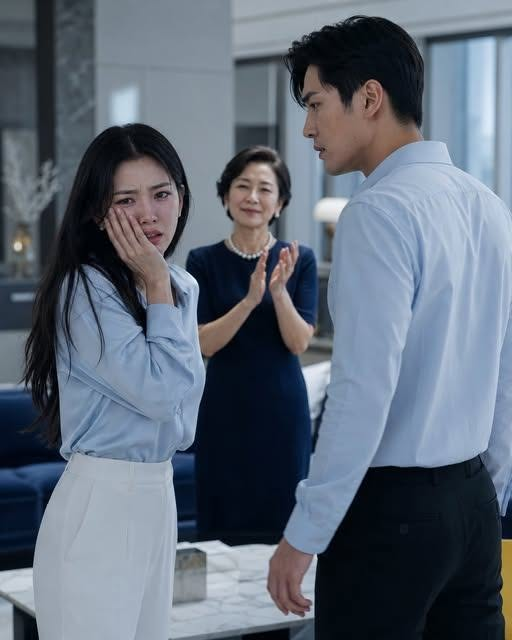
Three days later, she placed divorce papers on the table.
This time I read every page.
“Elena…”
“I waited eight years.”
“For what?”
“For you to understand without needing the same woman who humiliated me to become helpless first.”
I could not breathe properly.
She continued:
“I stayed because Sofía was young.”
“Because you were away for work most of the month.”
“Because I had built a life here and leaving seemed more exhausting than staying.”
“But I stopped being your wife emotionally on February 6, 2016.”
The date.
She had remembered it exactly.
Of course she had.
I whispered:
“Was there really nothing good after that?”
“There was.”
That surprised me.
She smiled sadly.
“You were a decent father sometimes.”
“We laughed sometimes.”
“We had peaceful years.”
“But peace is not the same as trust.”
I looked at the papers.
Then at her.
“Do you want me to sign?”
“Yes.”
This time, I did not sign without reading.
I read every page.
Then I signed my name.
Victor Salazar.
My hand shook.
Her expression did not.
We divorced quietly.
Sofía stayed mostly with Elena, but I remained part of her life.
And I made one promise to myself:
My daughter would never grow up believing that enduring disrespect was part of being a wife.
When my mother complained that Sofía rarely visited, I told her:
“You spent years telling her mother that girls mattered less.”
“You don’t get to be surprised when the girl remembers.”
My mother cried.
I still cared for her.
She was my mother.
But caring for someone did not require pretending they had done no harm.
That was another lesson Elena had taught me.
Two years later, I saw Elena at Sofía’s school ceremony.
She looked peaceful.
Afterward I asked:
“Do you still remember that day?”
She knew immediately which one.
“Yes.”
“Do you hate me?”
“No.”
That almost hurt more.
“Then what do you feel?”
She thought for a moment.
“Nothing that requires me to come back.”
I nodded.
Finally, I understood.
For eight years, my family called Elena spiteful.
Proud.
Cold.
We said she was holding onto two slaps.
But Elena had never spent eight years punishing us.
She had spent eight years keeping the promise my mother herself had shouted at the door:
If you leave, don’t come back.
And eventually I understood the cruel irony.
The person who never truly came back after February 6, 2016—
was not Elena.
It was the woman who had once trusted me enough to call my family hers.
