The Dog Knew Which Secret Had Been Buried With Grandma. When The Frame Fell, Our Family Finally Learned Who We Really Were.
Charlie had not barked at anyone for three months.
Not at the mailman.
Not at the squirrels that skittered along the fence.
Not even at my uncle Richard, who had always smelled like expensive cologne, cigarette smoke, and impatience.
Since my grandmother died, Charlie had become a shadow with fur.
Every morning, he walked into the living room, lowered himself onto the same faded rug, and stared at the photograph above the fireplace.
It was an old family portrait.
Grandma Evelyn sat in the center wearing her pearl earrings and that soft blue cardigan she loved.
My mother stood behind her, young and nervous, one hand resting on Grandma’s shoulder.
Uncle Richard stood beside them in a pressed shirt, smiling like he had practiced in a mirror.
And at the far edge of the photo, half-hidden by the frame, was my grandfather, who had died before I was born.
Nothing strange.
Nothing worth staring at for hours.
But Charlie stared anyway.
At first, we thought it was grief.
“He misses her,” my mother whispered one afternoon, wiping dust from the mantel.
Uncle Richard scoffed from the doorway.
“Dogs don’t understand pictures, Linda.”
Charlie’s ears twitched at his voice, but his eyes never moved from the frame.
I watched him from the couch, uneasy.
Grandma had always said Charlie knew things people missed.
“He listens with his heart,” she used to tell me, tapping his nose. “And a heart can hear lies long before ears do.”
Back then, I thought it was just one of her warm little sayings.
After the frame fell, I understood she had been warning us.
It happened on a rainy Thursday.
The house smelled of wet leaves, old wood, and the lemon cleaner my mother used whenever she was anxious.
We were sorting Grandma’s belongings because Uncle Richard insisted the house needed to be sold.
“She’s gone,” he said, flipping through papers at the dining table. “There’s no reason to keep pretending this place is a museum.”
My mother flinched.
“This was her home.”
“It’s an asset,” he replied.
That was Richard. Everything had a price tag. Even memories.
Charlie was in his usual place, staring at the photograph.
Then suddenly, he stood.
His whole body went stiff.
A low whine rose from his throat.
“Charlie?” I said.
He jumped onto the couch.
My mother gasped. “He never does that.”
Charlie placed his paws on the back cushion, stretched toward the photograph, and barked.
Once.
Sharp.
Desperate.
Uncle Richard slammed his folder shut.
“For God’s sake, get that dog down.”
I reached for Charlie’s collar, but he twisted away. His claws scratched the wall beneath the frame.
“Charlie, stop,” my mother pleaded.
But he lunged.
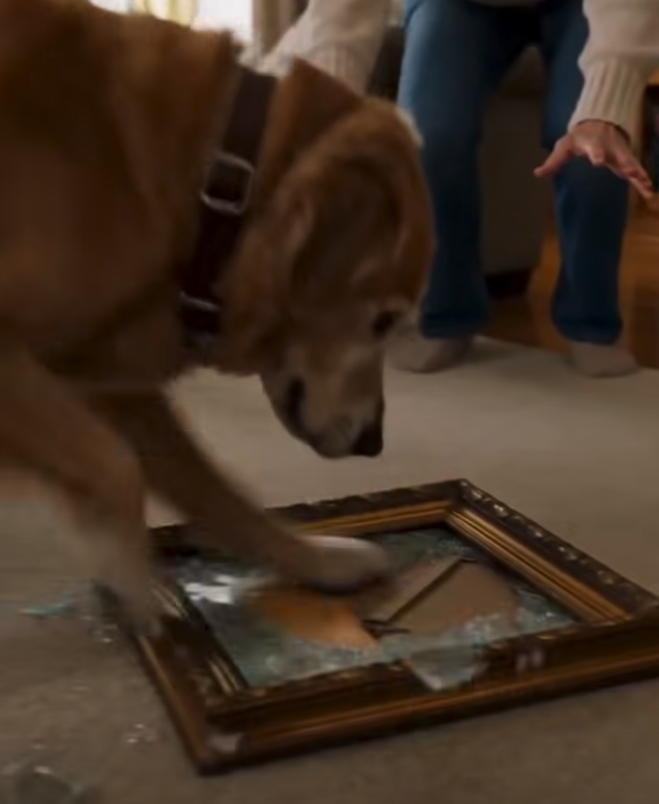
The photograph crashed down.
Glass shattered across the hardwood like ice.
For one second, nobody moved.
Then Uncle Richard exploded.
“That stupid animal!”
Charlie ignored him. He pawed at the broken frame, digging at the cardboard backing with frantic determination.
“Careful,” I said, rushing forward. “There’s glass.”
But Charlie had already hooked one claw under the loose back panel.
A folded envelope slipped out and landed on the carpet.
The room went silent.
My mother picked it up with trembling fingers.
It was yellowed with age.
Across the front, written in my grandmother’s careful handwriting, was a name.
My mother read it aloud.
“Richard.”
Uncle Richard staggered backward.
The blood drained from his face.
“Give me that,” he said.
His voice had changed.
It was no longer irritated.
It was afraid.
My mother held the envelope against her chest. “Why would Mom hide a letter to you inside a photograph?”
“I said give it to me.”
Charlie stepped between them and growled.
I had never heard Charlie growl before.
Uncle Richard froze.
My mother slowly opened the envelope.
Inside was a letter, a small brass key, and an old black-and-white photograph.
The photograph showed Grandma younger, standing outside a hospital.
In her arms was a baby wrapped in a white blanket.
Beside her stood my grandfather.
And next to them, half-turned away from the camera, was another woman crying into her hands.
My mother’s voice broke as she read the first line.
“My dear Richard, if you are reading this, then Charlie kept his promise.”
A chill ran through me.
Uncle Richard whispered, “No.”
My mother kept reading.
“I am sorry I was not brave enough to tell you while I was alive. I loved you as my son from the moment I held you. But you were not born from my body.”
The room seemed to tilt.
My uncle’s mouth opened, but no sound came out.
My mother looked up, stunned. “Richard… you’re adopted?”
He snatched at the letter, but I stepped in front of my mother.
“Don’t touch her.”
His eyes flashed with panic. “You don’t understand.”
My mother continued, tears sliding down her cheeks.
“Your birth mother was my younger sister, Clara. She was only seventeen. She came to me terrified, pregnant, and alone. The man who promised to marry her disappeared when he learned about the baby. Our father threatened to throw her out. So your father and I took you in.”
Uncle Richard gripped the back of a chair.
His whole body trembled.
“She lied to me,” he whispered. “All these years.”
“No,” my mother said softly. “She protected you.”
But the letter was not finished.
“If I have hidden this too long, forgive me. I feared the truth would hurt you. But there is another reason I must tell you now. Clara did not die when we said she did.”
My mother stopped breathing.
I felt my own pulse hammer in my throat.
Grandma’s younger sister had been a ghost in family stories.
A tragic girl.
A name spoken only in whispers.
Uncle Richard shook his head violently. “Stop reading.”
My mother’s voice shook harder.
“She lived. She wrote to me for years. She wanted to know if you were happy. She never asked to take you from me. She only asked that one day, when you were ready, I tell you she loved you.”
A strange sound escaped Uncle Richard.
Not anger.
Not quite sorrow.
Something smaller.
Something broken.
Then my mother unfolded the second page.
Her face changed.
Fear replaced confusion.
“What is it?” I asked.
She read silently for a moment.
Then she looked at Richard.
“Mom says you found out.”
The room froze.
Richard said nothing.
My mother’s hands tightened around the paper.
“She says you found the letters from Clara ten years ago. You confronted her. You demanded money to stay silent.”
My uncle’s face hardened.
“That old woman was confused.”
“No,” my mother whispered. “She wrote dates. Details.”
I took the page from her gently and read.
Grandma had written that Richard discovered the truth after searching her desk for bank documents.
He learned Clara was alive.
He learned Clara had inherited land from their father.
And he learned something else.
Something Grandma had never told anyone.
The house was not supposed to go to Richard.
It was not supposed to go to my mother either.
Grandma had placed it in a trust.
For Clara.
And for Clara’s son.
Richard.
But only if Richard accepted the truth with compassion.
If he tried to exploit it, the trust would transfer to Clara’s only remaining blood descendant.
A child Clara had later given birth to.
A daughter.
My mother covered her mouth.
“There’s another heir?”
Uncle Richard laughed, but it came out sharp and hollow.
“This is ridiculous.”
Charlie barked once.
I looked at the brass key.
It had a small paper tag attached.
Rosewood Station.
Locker 17.
My mother stared at it.
“That train station closed twenty years ago.”
“No,” I said quietly. “The building is still there. They turned part of it into a historical office.”
Uncle Richard lunged for the key.
Charlie moved faster.
He snapped—not biting, but warning.
Richard stumbled back with a curse.
For the first time in my life, I saw my uncle afraid of something he could not buy, bully, or explain.
My mother folded the letter carefully.
“We’re going to Rosewood Station.”
“No,” Richard said.
His voice was cold now.
“If you open that locker, you will destroy this family.”
My mother looked at him through tears.
“No, Richard. I think this family was destroyed by secrets a long time ago.”
We drove through the rain with Charlie in the back seat, his head between the front seats, eyes fixed on the road as if he knew exactly where we were going.
My mother held the envelope in her lap.
She looked older than she had that morning.
“Do you think Grandma wanted us to find it now?” I asked.
“She trained Charlie,” my mother whispered.
I glanced at her.
“What?”
“When she was sick, she used to point at that photograph and tell him, ‘Not yet, boy. Not until I’m gone.’ I thought she was confused.”
Charlie’s ears lifted at Grandma’s name.
My chest tightened.
Grandma had known death was coming.
And she had trusted the only soul in the house who could not be threatened.
When we reached Rosewood Station, the rain had softened into mist.
The old brick building smelled of dust, iron, and damp paper.
A woman at the front desk looked surprised when we asked about Locker 17.
“Most of those lockers are decorative now,” she said.
But the key fit.
Inside was a metal box.
My mother carried it to a wooden bench beneath the station clock.
Her fingers shook so badly I opened it for her.
Inside were letters.
Dozens of them.
All tied with blue ribbon.
There was also a birth certificate.
A deed.
A cassette tape.
And a photograph of a young woman with Grandma’s eyes.
Clara.
On the back, written in faded ink, were six words.
For my son, when he forgives me.
My mother began to cry.
Not loudly.
Just silently, like her heart had finally found a grief older than herself.
We took everything home.
Uncle Richard was waiting in the driveway.
So were two men in suits.
Lawyers, I guessed.
“You had no right,” Richard said.
My mother stepped out of the car.
“I had every right. She was my mother.”
“She was my mother too!” he shouted.
For one second, the anger fell away and the wound beneath it showed.
He looked like a boy abandoned in a storm.
Then he buried it again.
“She lied to me my whole life.”
“She loved you your whole life,” my mother said.
He pointed at the box.
“You think those papers make you righteous? Clara didn’t want me. Evelyn stole me and dressed it up as kindness.”
A voice behind him said, “That isn’t true.”
Everyone turned.
An elderly woman stood near the sidewalk beneath a black umbrella.
She was thin, silver-haired, and trembling.
But her eyes were unmistakable.
Grandma’s eyes.
My mother whispered, “Clara?”
The woman’s face crumpled.
“Yes.”
Uncle Richard went completely still.
Clara looked at him as if she had been waiting a lifetime to see his face.
“Hello, Richard.”
He stared at her.
“You’re dead.”
She gave a sad smile.
“Some families find that easier than shame.”
Nobody spoke.
Charlie walked to Clara, sniffed her hand, and pressed his head against her knee.
She began to sob.
“He remembers me,” she whispered.
My mother looked stunned. “Charlie knew you?”
Clara nodded.
“Evelyn brought him to me every month after she got sick. She said if courage failed her, Charlie would finish what she started.”
Uncle Richard’s jaw tightened.
“You expect me to believe this sentimental garbage?”
Clara took a step toward him.
“I expect nothing from you. I lost the right to expect anything when I let my sister raise my son.”
“You gave me away.”
“I saved you,” she said, voice breaking. “I was seventeen. Our father beat me when he found out. He said he would send you somewhere no one would ever find you. Evelyn and Thomas took you before he could.”
Richard’s face flickered.
For the first time, doubt entered his eyes.
Clara reached into her coat and pulled out a folded paper.
“I wrote to you every birthday. Evelyn kept the letters because I was too much of a coward to send them directly. Then ten years ago, you came to me.”
My mother sucked in a breath.
Richard’s face turned pale again.
Clara looked at him with unbearable sadness.
“You already knew who I was.”
“No,” he said.
“You asked me to sign over the land. You said if I didn’t, you would tell everyone I had abandoned my baby.”
My mother stared at him. “Richard…”
He shouted, “She did abandon me!”
Clara flinched.
“Yes,” she whispered. “And I have carried that punishment every day.”
Then she looked at my mother.
“But Evelyn was afraid. Not for the house. Not for money. For Linda.”
My mother blinked. “Me?”
Clara nodded slowly.
“Richard was selling pieces of the estate. Evelyn found out. She changed the trust to protect you.”
Uncle Richard’s mask cracked.
“It was supposed to be mine.”
“No,” Clara said. “It was supposed to be healed.”
That night, everything came out.
Grandma had known Richard’s bitterness had grown dangerous.
He had pressured her for money.
He had forged her signature on small withdrawals.
Nothing large enough to cause alarm.
Just enough to drain her quietly.
When Grandma realized what he was doing, she changed her will, hid the evidence, and began training Charlie.
But the final twist waited on the cassette tape.
We played it in the living room.
Grandma’s voice filled the house.
Thin.
Tired.
But unmistakably hers.
“If this tape is playing, then I am gone. Linda, my sweet girl, forgive me. Richard, my son, forgive me too. I loved you both, but love without truth becomes a cage.”
A pause.
Then Grandma inhaled shakily.
“There is something none of you know. Clara’s daughter did not die in infancy as the family believed. She was adopted by a couple in Ohio. Her name is Anna.”
My hands went cold.
My mother looked at me.
Grandma continued.
“Anna had a child. A girl. Maya.”
My name.
The world stopped.
My mother made a strangled sound.
I stared at the tape recorder.
Grandma’s voice softened.
“Maya, if you are hearing this, you must know Linda is your mother in every way that matters. She raised you. She loved you. She chose you. But your blood comes from Clara’s lost daughter.”
I could not breathe.
My mother grabbed my hand.
“No,” she whispered. “No, Mom would have told me.”
Grandma’s voice answered from the machine like a ghost.
“Linda, you could not have children after the accident. When Anna died giving birth, Clara called me. She asked if I knew anyone who could love a baby with their whole soul. I knew only one person. You.”
My mother collapsed into tears.
I sat frozen, every memory rearranging itself.
The late-night lullabies.
The way Grandma always watched me with aching tenderness.
The way Charlie had followed me since I was little, sleeping outside my door whenever I cried.
I was not outside the secret.
I was the secret.
Uncle Richard stared at me with horror.
Because he understood before I did.
The trust.
The heir.
The house.
The land.
Everything Grandma had protected.
It had never been meant for him.
It had been meant for Clara’s bloodline.
For me.
But the strangest part was that I did not feel victorious.
I felt shattered.
I turned to my mother.
“Did you know?”
She shook her head violently, sobbing.
“No. Maya, no. You are my daughter. You are my daughter.”
I fell into her arms.
And somehow, even with the whole world breaking open, that remained true.
Uncle Richard left that night without another word.
For two weeks, we heard nothing.
Lawyers called.
Documents were verified.
The cassette was authenticated.
The forged withdrawals came to light.
The trust transferred to me legally, but I signed half the house to my mother.
Not because blood demanded it.
Because love did.
Clara stayed in town.
At first, she only visited for tea.
She sat stiffly in Grandma’s chair, hands folded, looking like a woman afraid to touch happiness in case it vanished.
Charlie always climbed beside her.
Slowly, she told us everything.
About Anna.
About the daughter she had lost and found too late.
About the guilt that had kept her silent.
About Grandma’s monthly visits.
About the photograph on the wall.
“That picture was Evelyn’s anchor,” Clara said one evening. “She said everyone in it was standing beside a lie.”
I looked at the now-empty space above the fireplace.
“What should we put there?”
My mother smiled through tears.
“A new picture.”
The happy ending did not arrive all at once.
It came in pieces.
It came when my mother stopped apologizing for a secret she had never known.
It came when Clara began teaching me Grandma’s old recipes.
It came when Charlie finally stopped staring at the wall and started sleeping in patches of sunlight again.
Then one morning, Uncle Richard returned.
He looked thinner.
Older.
Rain clung to his coat.
Charlie saw him first and stood.
But he did not growl.
Richard stopped in the doorway.
“I’m not here for the house,” he said.
My mother watched him carefully.
“What are you here for?”
His eyes moved to Clara.
For a long moment, he could not speak.
Then he took a folded photograph from his pocket.
It was the one from the metal box.
Clara holding him as a baby.
His voice broke.
“I don’t know how to forgive you.”
Clara nodded, tears already falling.
“I know.”
“I don’t know how to forgive her either,” he said, looking at Grandma’s empty chair.
My mother’s face softened.
Richard swallowed hard.
“But I’m tired of being angry at dead people.”
Clara covered her mouth.
Richard looked at me.
“I did terrible things.”
“Yes,” I said.
He nodded.
“I’ll repay the money.”
“That’s not enough,” my mother said.
“I know.”
His eyes filled.
“I want to try to become someone she wouldn’t be ashamed of.”
Nobody rushed to embrace him.
This was not that kind of ending.
Some wounds do not close because someone says sorry.
But Clara stepped forward and touched his cheek with a trembling hand.
“My son,” she whispered.
Richard broke.
He sank to his knees and sobbed like the boy he had never been allowed to be.
Charlie walked over, pressed his head into Richard’s shoulder, and stayed there.
Six months later, we took the new family photograph.
It was my mother’s idea.
We stood in the living room, in front of the fireplace.
My mother held my hand.
Clara stood on my other side.
Richard stood at the edge, uncertain but present.
Charlie sat in the center, wearing Grandma’s blue ribbon around his collar.
Just before the camera flashed, he looked up at the wall where the old photograph had hung.
Then he wagged his tail.
As if someone we could not see had finally smiled.
We framed the new picture and hung it above the fireplace.
No hidden envelope.
No secret panel.
No lies pressed behind cardboard.
Just us.
Broken, mended, imperfect, alive.
That night, after everyone left, I found Charlie lying beneath the photograph.
For the first time since Grandma died, he was not staring.
He was sleeping.
And tucked beneath one paw was Grandma’s old pearl earring, the one we thought had been lost forever.
I picked it up with tears in my eyes.
On the back, in letters so tiny I had never noticed them before, were three engraved words.
Truth brings home.
I looked at Charlie.
His tail thumped once against the rug.
And I finally understood.
Grandma had not left us a house.
She had left us a way back to each other.
