On the third day, Chu Dien still did not return.
On the fourth, nothing.
On the fifth morning, he sent me a photograph of breakfast from a hotel.
No explanation.
Only one sentence:
“I’ll come back when you’ve calmed down.”
I stared at the message for several seconds.
Then I laughed.
Apparently, in his version of events, I was the one throwing a tantrum.
I didn’t answer.
Instead, during lunch, I called a real estate agent.
The apartment we lived in belonged to Chu Dien. We had moved there after our wedding because it was closer to his company.
For three years I had called it home.
But suddenly I realized there wasn’t much of me inside it.
Most furniture was his.
The decorations were chosen by his mother.
Even the study had been converted into a gaming room because he said my work could be done at the dining table.
So I rented a small apartment fifteen minutes from my office.
One bedroom.
Large windows.
A tiny balcony.
When the agent asked whether I needed time to think, I said:
—No.
That evening, I began packing.
Not angrily.
That was what surprised me.
I folded my clothes carefully.
Collected my books.
Took the coffee machine I had bought myself.
My laptop.
My documents.
And the cactus on the windowsill that Chu Dien always complained was ugly.
Everything I truly owned fit into six boxes.
On the sixth day, his mother called.
—Why hasn’t Chu Dien come home?
I almost laughed.
—You should ask him.
She immediately sounded annoyed.
—You’re his wife. If a husband is angry, you should know how to coax him.
I remained silent.
Then she added:
—Men need dignity. He went all the way to the airport to pick you up and you still argued with him.
That sentence made me stop.
—He told you that?
—Of course.
Apparently, Chu Dien’s version was that I had complained the moment I saw him, accused him of not caring enough, and forced him to leave because I was “too emotional after the business trip.”
I asked:
—Did he tell you he drove away and left me there?
Silence.
Then she said:
—There must have been a reason.
There was always a reason.
For him.
Never for me.
I ended the call.
That night, I moved the first three boxes.
On the seventh day, I removed the rest.
I left my key on the dining table.
Beside it, I placed something I had been carrying in my handbag for almost two weeks.
A transfer notice.
My company had offered me a promotion to lead the new regional division in Shanghai.
Originally, I had planned to refuse.
Chu Dien hated long-distance relationships.
He once told me:
—If you ever transfer, don’t expect me to follow you.
So I had spent two weeks deciding how to sacrifice another opportunity.
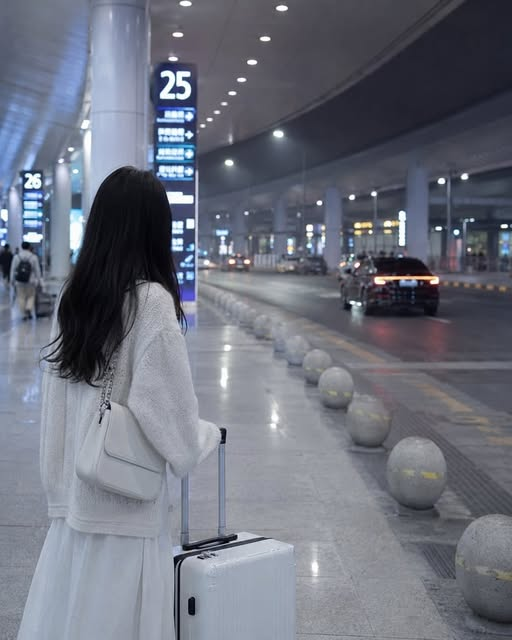
The airport changed that.
I signed the acceptance.
My starting date was Monday.
Then, before leaving the apartment for the last time, I removed Chu Dien from my emergency contact.
Eight days after abandoning me at the airport, he finally returned home.
I learned what happened from his younger sister.
Chu Dien opened the door around nine at night.
The apartment was dark.
He tossed his car keys onto the cabinet and called:
—I’m back.
No answer.
He apparently smiled to himself.
He believed I was still angry.
He showered.
Changed clothes.
Ordered takeout.
Then, around ten thirty, he noticed something.
My toothbrush was gone.
He opened the closet.
Half empty.
He checked the bathroom cabinet.
My skincare products had disappeared.
Then he saw the key.
He called me immediately.
I was still at the office preparing documents for my transfer.
I didn’t answer the first call.
Nor the second.
On the fifth, I finally picked up.
—What?
There was silence.
Then:
—Where are you?
—At work.
His voice sharpened.
—It’s almost eleven.
—I’m aware.
—Why haven’t you come home?
For a moment, I genuinely didn’t know how to answer.
Then I said:
—Because I don’t live there anymore.
Silence.
Absolute silence.
—What do you mean?
—I moved.
—Moved where?
—Somewhere else.
His breathing changed.
—Why?
That question almost made me laugh.
—Chu Dien, you left me at the airport eight days ago.
—So you’re moving out because of one argument?
—No.
I leaned back in my chair.
—I’m moving out because it wasn’t one argument.
He didn’t speak.
So I continued.
—Last year, you forgot my birthday and told me I was childish for being disappointed.
—When I had pneumonia, you went drinking because your friends had already made reservations.
—When my mother had surgery, you said you couldn’t accompany me because you had a gaming tournament with your colleagues.
I closed my eyes.
—At the airport, I finally realized something.
—What?
—Every time I needed you, you made me feel unreasonable for expecting you to be there.
His voice lowered.
—I was angry that night.
—And I was exhausted.
—You could have called a taxi.
—I did.
Silence.
That answer seemed to embarrass him.
Eventually he said:
—Come home. We’ll talk.
—No.
—Stop being stubborn.
That old phrase.
I smiled.
—I’m leaving for Shanghai on Monday.
He stopped breathing.
—What?
—I accepted the promotion.
—You told me you weren’t going.
—I changed my mind.
His voice rose.
—Without discussing it with me?
I almost couldn’t believe the irony.
—You disappeared for eight days.
—Now you’re concerned about communication?
He had no answer.
I hung up.
Twenty minutes later, he arrived at my office.
His hair was messy.
His coat wasn’t buttoned properly.
For the first time in years, Chu Dien looked genuinely panicked.
—You’re really leaving?
I nodded.
—For how long?
—Permanently, if things go well.
His face changed.
—And me?
I looked at him.
—What about you?
That hurt him.
I saw it.
—I’m your husband.
—Then perhaps you should have remembered that before driving away.
He stepped closer.
—I thought you would come after me.
There it was.
The truth.
I frowned.
—What?
He looked embarrassed.
—I was angry. I thought you’d call.
—I did.
—Then I turned my phone off because…
He stopped.
—Because?
His voice became quieter.
—Because I wanted you to worry.
For several seconds, I simply stared at him.
Then I laughed.
Not because it was funny.
Because suddenly everything was so clear.
He had not accidentally abandoned me.
He had wanted punishment.
He wanted me standing at the airport, calling again and again, terrified that I had made him angry.
He expected me to chase him.
Instead, I had gone home.
Then gone to work.
Then moved on.
I said quietly:
—Thank you for telling me.
His expression brightened slightly.
He misunderstood.
—Then you’ll come home?
—No.
His face fell.
—Chu Dien, you just confirmed exactly why I’m leaving.
Two weeks later, I filed for divorce.
He refused at first.
He sent flowers.
Then angry messages.
Then apologies.
He even flew to Shanghai and waited outside my new office.
But by then, I had discovered something dangerous to a marriage built on one person constantly giving in:
I was happier without him.
Months later, during mediation, Chu Dien finally signed.
Before leaving, he asked:
—If I hadn’t left you at the airport, would we still be together?
I thought about it.
Probably.
Because I would still have been making excuses.
Still declining opportunities.
Still believing that asking my husband to care was somehow asking too much.
So I answered honestly:
—Maybe.
His eyes reddened.
Then I added:
—That’s why I’m glad you did.
A year later, I became regional director.
I bought my own apartment.
The ugly cactus survived the move and grew three new branches.
Sometimes people asked why my marriage ended.
I never told them it was because my husband left me at an airport.
That wasn’t really true.
The marriage ended because, when he drove away, I finally stopped running after him.
Eight days later, Chu Dien asked why I hadn’t come home.
By then, he still hadn’t understood.
Home was never simply the apartment where he expected to find me waiting.
And once I learned how peaceful life could feel when nobody was punishing me for having needs—
I never went back.
