Duong Phi’s studio occupied the top two floors of an old industrial building.
My room was on the third.
Small bed.
Desk.
One wardrobe.
A window facing south.
I placed my suitcase beside the wall and stood there for a long time.
Five years earlier, I would have called it miserable.
That night, it felt like freedom.
At 7:16 p.m., Ha Canh Hanh finally called.
I watched his name appear.
I didn’t answer.
He called again.
Then sent a message.
Where are you?
Another followed.
The children are asking about dinner.
I stared at that sentence.
Not asking where their mother was.
Asking who would make dinner.
I replied:
There are frozen dumplings in the second drawer. Tieu Man doesn’t eat coriander. Tieu Du needs his allergy medicine after dinner.
His answer came immediately.
When are you coming back?
I switched off the phone.
The following morning, I entered Duong Phi’s design department.
She placed an old cardboard box in front of me.
—Do you recognize these?
Inside were my university notebooks.
Rehabilitation devices.
Pediatric mobility supports.
Adaptive joints.
And the unfinished project I had carried into Ha Canh Hanh’s office at twenty-three.
I touched the yellowed pages.
—Why do you have these?
—Because five years ago you asked me to keep copies.
She opened another folder.
—And because I never believed you were really done.
For the next month, I worked like someone waking from a long sleep.
My hands still remembered.
CAD software.
Mechanical tolerances.
Prototype testing.
Materials.
I had spent five years being introduced as Mrs. Ha.
But Evelyn before marriage had not disappeared.
She had simply stopped being called by name.
On the fourth day, Tieu Du’s robotics competition happened.
I did not attend.
At ten twenty, my phone rang.
My son.
I answered.
His voice was small.
—Mom.
—Yes?
—The robot keeps turning left.
I closed my laptop.
—What did you check?
—Everything.
—No, you checked everything you already know.
Silence.
Then I asked:
—Remember the front sensor bracket we adjusted together?
—Yes.
—Measure the angle again.
He disappeared for several minutes.
When he returned, he was excited.
—Mom! It’s crooked by three degrees!
—Then fix it.
He hesitated.
—Aren’t you coming?
My chest tightened.
—You told me you didn’t need me there.
Another silence.
This time his voice was quieter.
—I was wrong.
I closed my eyes.
—I know.
I didn’t rush back.
I guided him through the problem.
He fixed it himself.
His team won second place.
That evening he sent me a photograph.
No caption.
Just him holding the certificate.
I replied:
I’m proud of you.
He sent another message ten minutes later.
I wish you were here.
That one made me cry.
But I still didn’t go home.
Ha Canh Hanh arrived in Nam Thanh two weeks later.
He came directly to the studio.
Duong Phi tried to block him.
I let him in.
He looked around at the prototypes and drafting tables.
Then at me.
For several seconds, he seemed unable to connect the woman in front of him with the wife who had spent years carrying school bags and preparing breakfast.
—You work here?
—I always worked in this field.
His face tightened.
—I know that.
I smiled faintly.
—Do you?
He had no answer.
Then he placed the divorce agreement on my desk.
—You really signed it.
—Yes.
—The children cry at night.
That sentence hurt.
But I had expected it.
—Then comfort them.
His expression hardened.
—You are their mother.
—And you are their father.
I looked directly at him.
—For five years, whenever school called, you called me.
Whenever they were sick, you called me.
Whenever you forgot a parent event, you sent Tham Lenh Nghi.
Now you have to learn what parenting looks like when there is no woman standing behind you fixing everything.
He lowered his voice.
—Linh Nghi was only helping.
—Then let her help.
His eyes changed.
Apparently, that had not gone well.
Tham Lenh Nghi liked attending competitions.
Choosing clothes.
Taking photographs.
Being called “Mom” in public.
But she did not know Tieu Man woke from nightmares after fever.
She did not know Tieu Du refused carrots unless they were hidden inside meat.
She did not remember medication times.
Or school forms.
Or which child needed the hall light left on.
Being mistaken for a mother had been enjoyable.
Actually doing the invisible work was different.
Ha Canh Hanh sat down.
—Tieu Man asked yesterday why you don’t love her anymore.
My fingers tightened.
—And what did you tell her?
He looked away.
I understood immediately.
—You didn’t correct her.
—She was crying.
—So?
My voice remained calm.
—Did you tell her Mommy left because she stopped loving her?
He said nothing.
I stood.
—Get out.
—Nam Tinh—
—Get out.
That was the first time he realized there were consequences even his money could not negotiate.
Three months passed.
I exercised visitation exactly as agreed.
Every other weekend, the children came to Nam Thanh.
At first, Tieu Man was angry.
—Why don’t you live with us?
I knelt in front of her.
—Because Mom and Dad can live separately and still both love you.
—Is it because I called Aunt Linh Nghi “Mom”?
My heart hurt.
But I shook my head.
—No.
Children should not carry adult guilt.
—I left because I needed to become myself again.
She didn’t understand then.
She would later.
Meanwhile, my career moved faster than I expected.
The rehabilitation device I had abandoned five years earlier was redesigned for children recovering from lower-limb injuries.
Duong Phi found a medical engineering incubator.
We entered a national innovation competition.
And that was where Ha Canh Hanh learned something neither of us had realized.
Ha Thi Medical had been using part of my original design architecture for years.
Not illegally.
I had signed the development agreement before marriage.
But the contract clearly stated that I retained inventor attribution and a percentage interest in any commercial spin-off derived directly from my design.
Because I had disappeared into domestic life, nobody had bothered activating that clause.
Not even me.
Until now.
Ha Canh Hanh’s legal department called.
—Mrs. Ha—
I interrupted.
—Ms. Nam.
The lawyer corrected himself.
—Ms. Nam, we need to discuss your rights in the rehabilitation division.
I almost laughed.
The studio shares I had requested in the divorce suddenly stopped looking insignificant.
A new hospital procurement contract pushed their value dramatically higher.
Ha Canh Hanh did not fight me over them.
Perhaps for the first time, he understood that I had not asked for charity.
I had asked for something I helped create.
Six months later, our divorce became final.
Tham Lenh Nghi disappeared from family life before that.
Not because I demanded it.
Tieu Man stopped calling her Mom first.
Then Tieu Du told his father:
—If Aunt Linh Nghi is so good at everything, why did Mom teach me how to build the robot?
Ha Canh Hanh had no answer.
One year after I left, I opened my own rehabilitation design studio.
The children attended the opening.
Tieu Du stood in front of my first patent certificate for a long time.
—Mom, your name is on this.
I smiled.
—Yes.
—Why did nobody tell me you designed things?
That question silenced me.
Then Ha Canh Hanh, standing behind him, answered:
—Because Dad didn’t tell you.
I looked at him.
He continued quietly:
—That was my mistake.
It was the closest thing to a real apology he had ever given.
Later, while the children ate cake, he approached me.
—If I had paid attention earlier, would you have stayed?
I thought about our marriage.
About breakfast at six.
Parent groups.
Appointments.
Meals.
Children learning to dismiss me by copying the adults around them.
—Maybe.
His eyes lowered.
Then I added:
—But you only noticed me after I stopped serving a function in your house.
He had no answer.
We never remarried.
We eventually learned to co-parent without using the children as messengers.
Tieu Du began spending school holidays helping in my prototype room.
Tieu Man announced proudly to anyone who asked that her mother “builds machines that help people move again.”
Years later, I found my old wedding ring in a box.
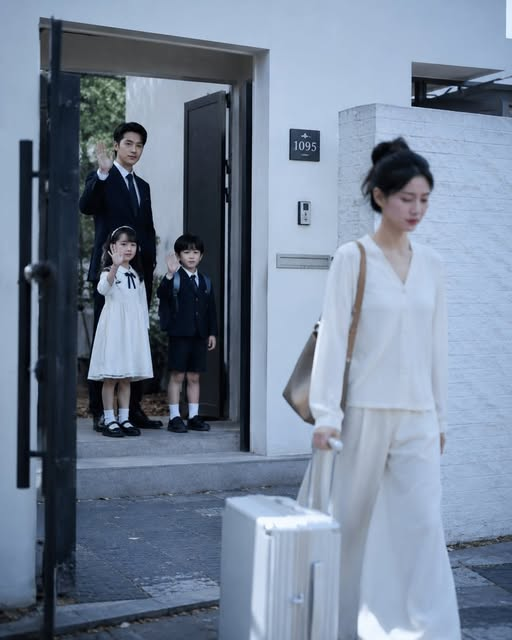
For a moment, I remembered the woman who had placed it on the entrance tray before leaving with one suitcase.
She had thought she was abandoning everything.
She was wrong.
That morning I had left behind a marriage, a title and a house.
But I had taken the only thing that mattered.
Myself.
For 1,094 days, everyone called me Mrs. Ha until even I forgot that I had once possessed a name of my own.
On day 1,095, I walked out.
And from that day forward, my children did not lose their mother.
They finally got the chance to know who she really was.
