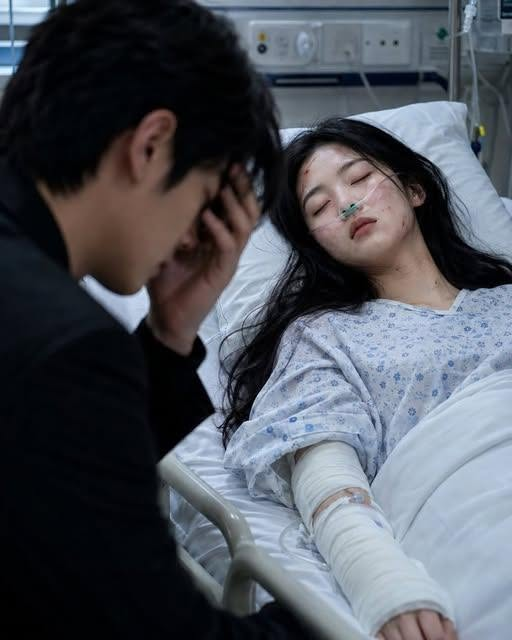
For the first two weeks, I barely spoke.
Not because I had nothing to say.
Because every word felt useless.
Gabriel came twice.
The first time, he stood at the foot of my bed and asked:
—Are you ready to apologize to Natalie?
I closed my eyes.
The second time, he brought his mother.
She placed a basket of fruit beside me and sighed as if I had caused everyone an inconvenience.
—Clara, Natalie lost her husband. She is emotionally fragile. Even if she misunderstood something, you should have been more tolerant.
I looked at her.
Then at Gabriel.
Neither of them asked what had actually happened.
So I said nothing.
After they left, my rehabilitation doctor, Dr. Elena Ruiz, entered.
She had watched the entire conversation from the hallway.
—Mrs. Cross.
I looked at her.
—Do you have somewhere safe to go after discharge?
That was the first time anyone had asked.
I started crying.
Quietly.
Not because she pitied me.
Because she believed there might be something I needed protection from.
The next morning, I asked for a lawyer.
Her name was Sarah Bennett.
She came with a laptop, a yellow legal pad and absolutely no patience for the Cross family name.
I told her everything.
The chapel.
Natalie’s threats.
The scratches.
The staged fall.
Gabriel arriving already convinced I was guilty.
The men he brought.
Everything after.
Sarah listened without interrupting.
When I finished, she asked:
—Was there surveillance near the chapel?
My heart stopped.
The Cross family estate had cameras everywhere.
Gabriel had installed them after his brother died because he had become obsessed with security.
I whispered:
—Yes.
Sarah stood.
—Then we preserve the footage immediately.
That afternoon, a legal preservation notice was sent to the estate’s security company.
And that was when someone made a mistake.
They tried to delete the recording.
The attempt was logged automatically.
The backup had already been copied to an external server.
Three days later, Sarah returned to my hospital room.
She placed a tablet in front of me.
—You don’t have to watch.
I did anyway.
The video had no sound.
It didn’t need any.
Natalie entered the chapel behind me.
Locked the door.
Blocked me when I tried to leave.
Grabbed my arms.
Then, moments before footsteps appeared outside, she deliberately threw herself down and began screaming.
Sarah paused the video.
—This clears you.
I looked at the screen.
For weeks I had imagined what I would feel when someone finally proved I was innocent.
Relief.
Triumph.
Rage.
Instead, I felt exhausted.
—Send it to Gabriel.
Sarah studied me.
—Are you sure?
I shook my head.
—No.
Then I corrected myself.
—Send it to the police.
That was different.
Gabriel did not deserve a private explanation.
He deserved the same thing he had denied me.
A formal process.
Evidence.
Questions.
Consequences.
The investigation began quietly.
The men who had accompanied Gabriel were interviewed.
Two immediately blamed him.
One provided messages showing that Gabriel had ordered them to “teach Clara a lesson.”
Another admitted that he had tried to stop things when he realized how serious the situation had become.
Then investigators requested the hospital records.
Gabriel learned about the case from his attorney.
Not from me.
He appeared at the hospital that evening.
Security stopped him outside the rehabilitation floor.
I saw him through the glass doors.
For the first time since I had known him, Gabriel Cross looked afraid.
He called Sarah.
She put the phone on speaker only after asking my permission.
—Let me see Clara.
Sarah’s voice remained calm.
—No.
—The video—
—Yes, Mr. Cross. We have it.
Silence.
Then:
—Natalie lied.
I stared at my bandaged hands.
Sarah answered:
—That appears to be the evidence.
His breathing became uneven.
—Clara was telling the truth.
Nobody answered.
Because that was no longer a revelation.
It was simply a fact he had refused to hear.
He whispered:
—I need to speak to my wife.
For the first time in weeks, I spoke loudly enough for him to hear through the phone.
—You don’t have a wife anymore.
Silence.
Sarah looked at me.
I continued:
—Send him the divorce papers.
Gabriel arrived every day after that.
He was never allowed inside.
Sometimes he sat for an hour.
Sometimes six.
He sent flowers.
I had them removed.
He sent jewelry.
Returned.
Then letters.
Unread.
Eventually, he stopped sending things and simply waited.
But waiting did not repair anything.
Three months after I entered the hospital, I could finally leave.
My hands were still recovering.
Doctors could not promise I would regain every bit of precision I once had.
But I could hold a pencil again.
That was enough.
Dr. Ruiz asked where I would go.
I smiled.
—Somewhere Gabriel won’t think to look.
Sarah had arranged everything.
A small apartment in another city.
A rehabilitation clinic.
And something else.
Before marrying Gabriel, I had designed hotel interiors under my maiden name.
One of my former clients remembered me.
When Sarah contacted him, he offered me a consulting position that did not require drafting by hand.
Materials.
Concept development.
Space planning.
Creative direction.
The work I thought I had lost was simply changing shape.
On the morning I left, Gabriel finally managed to see me.
Not because I wanted him to.
Because he was waiting outside the hospital entrance.
He stood when the wheelchair appeared.
His face changed when he saw me.
—Clara.
I told the nurse to stop.
Gabriel approached slowly.
No arrogance.
No anger.
—I’m sorry.
I looked at him.
—For believing Natalie?
He swallowed.
—For everything.
—That’s too vague.
His eyes filled.
—For not asking you what happened.
—For deciding you were guilty before you could speak.
—For what I ordered.
His voice broke.
—For sitting beside you afterward and still thinking I was the righteous one.
I listened.
Then asked:
—If there had been no camera, would you believe me now?
He froze.
That was the question that mattered.
His silence answered.
I nodded.
—Exactly.
He reached toward me.
Then stopped himself.
—Give me one chance.
—I already did.
—When?
—The first three years of our marriage.
I looked directly at him.
—Every day I trusted that if the whole world accused me, my husband would at least ask me what happened.
My voice remained quiet.
—You failed the only test I never knew I was giving you.
He lowered his head.
—Where are you going?
I smiled faintly.
—Somewhere you don’t get to follow.
I left that afternoon.
Gabriel did not know the address.
Natalie was later charged over the staged incident and false statements connected to it.
Gabriel faced his own legal consequences for what he had ordered.
The Cross family tried desperately to keep the scandal private.
I refused to participate.
I did not go to the press.
I did not need public revenge.
Official records were enough.
The divorce became final eleven months later.
I kept my own assets.
Rejected Gabriel’s offer of additional money.
And returned to design.
Not exactly as before.
My hands tired more quickly.
I learned new software.
Delegated detailed sketching.
Focused on concept and direction.
Two years later, I led the restoration of a historic hotel.
My name appeared alone on the design credit:
Clara Bennett.
Not Mrs. Cross.
Not Gabriel’s wife.
Mine.
I saw Gabriel only once after that.
At the hotel opening.
He stood across the lobby beneath a ceiling I had designed.
He looked up.
Then at me.
—I thought I destroyed this for you.
I flexed my fingers slowly.
—You changed it.
He closed his eyes.
I continued:
—You didn’t get to end it.
For a moment, neither of us spoke.
Then he asked:
—Are you happy?
I thought about the tiny apartment.
The months of therapy.
The first crooked line I managed to draw after believing I never would again.
The people who listened before judging.
—Yes.
Gabriel nodded.
He did not ask me to come back.
Finally, he had learned that regret did not create entitlement.
People later said I disappeared from Gabriel Cross’s life three months after he nearly destroyed mine.
That wasn’t quite true.
I didn’t disappear.
I simply stopped standing where he expected to find me.
And by the time he finally learned the truth about Natalie, the woman who had once begged him to listen was gone.
In her place was someone who no longer needed his belief in order to know exactly what had happened—and exactly what she deserved.
