PART 2 — THE PAPER THAT MADE MY HUSBAND GO PALE
My husband, Caleb, stopped running the second he saw the folded document in that woman’s hand.
Not slowed.
Stopped.
The way a man stops when he recognizes a danger he prayed would never find him.
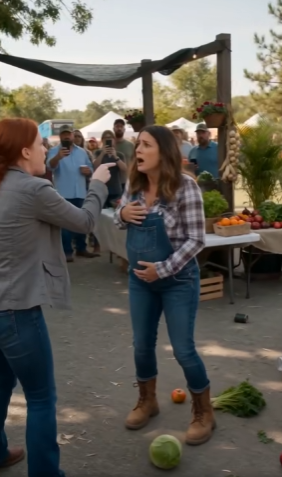
The woman stood in front of our booth, breathing hard, her hair falling loose around her face, one hand still clenched from striking me, the other waving the paper like a flag of war.
Around us, the county fair had gone silent in the strangest way. Not completely silent—there were still distant carnival bells, the hum of generators, a child crying somewhere near the livestock pens—but the people closest to us had stopped talking. Reporters lowered their microphones. Farmers abandoned baskets of produce. Teenagers held their phones higher.
I kept one hand over my stomach.
Our baby moved beneath my palm, a slow roll that made my knees tremble with relief.
Caleb reached me first.
“Emma,” he said, voice breaking. “Are you hurt?”
“I’m okay,” I whispered, though I wasn’t sure. My cheek stung. My pride burned. My heart pounded so hard it felt like it had moved into my throat.
Fair security pushed through the crowd. Two men in yellow vests stepped between me and the woman, but she didn’t back away.
“Ask him!” she screamed. “Ask your perfect husband what he did!”
Caleb’s arm went around me, but his eyes stayed fixed on the paper.
The woman saw him looking and laughed bitterly.
“You recognize it, don’t you?”
Caleb swallowed.
I turned to him. “What is she talking about?”
He didn’t answer.
That was when fear changed shape.
Before that moment, I was afraid of the woman. Afraid of the crowd. Afraid of the shock running through my body.
But now I was afraid of my husband’s silence.
The woman shoved the document toward the nearest reporter. “Read it. Read what his family signed.”
A local reporter named Vanessa Quinn took the paper carefully, like it might explode. She unfolded it. Her eyes moved across the first page.
Then she looked at Caleb.
“Mr. Harlan,” she said slowly, “is this your signature?”
My husband closed his eyes.
The crowd breathed in at once.
I stared at him. “Caleb?”
His voice came out rough. “Emma, I can explain.”
Those four words broke something open inside me.
Because people only say I can explain when they know the truth looks unforgivable.
The woman pointed at me again, but this time her anger looked soaked in pain. “You’re living in my house. Selling food from my land. Smiling in front of cameras while my family got thrown away.”
“My land?” I whispered.
Caleb’s hand tightened around my shoulder.
The woman’s eyes filled. “My grandfather’s land.”
Security asked her to step back. She refused until Vanessa lowered the document and said, “This appears to be an old purchase agreement involving Harlan Family Farms and the Mercer estate.”
Mercer.
The name hit me somewhere deep, though I didn’t know why.
Caleb’s father, Walter Harlan, appeared from behind the booth, his face red with anger. “This is nonsense.”
The woman turned on him. “You remember me, don’t you?”
Walter’s expression changed for half a second.
It was enough.
My mother-in-law, Ruth, came rushing behind him, wiping her hands on her apron. “What in heaven’s name is going on?”
“This woman attacked Emma,” Caleb said.
The woman laughed sharply. “That’s all you care about? Not what your family did?”
Fair security held out a hand. “Ma’am, you need to come with us.”
“No,” I said.
Everyone looked at me.
My voice shook, but I repeated it. “No. Wait.”
Caleb turned. “Emma, she hit you.”
“I know what she did.” I looked at the woman. “But I want to know why.”
The woman stared at me, her rage flickering into confusion.
I took a breath. “What is your name?”
She hesitated.
“Lila Mercer,” she said. “My name is Lila Mercer.”
At the sound of it, Ruth gasped.
Walter snapped, “Do not say another word.”
Lila’s eyes blazed. “You don’t get to tell me to be quiet anymore.”
Vanessa looked between them, reporter instincts sharpening. “Mr. Harlan, did your family purchase land from the Mercers?”
Walter lifted his chin. “Our farm has been legally owned by the Harlan family for decades.”
“That isn’t an answer,” Vanessa said.
I turned to Caleb.
His face was pale, his jaw tight, his eyes full of something I had never seen there before.
Shame.
“Caleb,” I whispered, “what did you sign?”
He looked at me then.
And in front of the entire county fair, my husband said the sentence that made my world tilt.
“I signed it to keep the bank from taking the farm.”
PART 3 — THE FARM I THOUGHT I KNEW
The security team led Lila Mercer away, but not before she looked back at me.
Her anger had not disappeared. It had only changed targets.
“You think you married into a good family,” she said. “Ask them what happened to mine.”
Then she was gone, swallowed by yellow vests and murmuring strangers.
The fair did not return to normal.
How could it?
A pregnant woman had been struck beside a booth full of peaches and honey jars. A stranger had accused one of the county’s most respected farm families of stealing land. A reporter had a document. Half the crowd had videos. And my husband looked like a man waiting for a house to collapse.
Walter grabbed Caleb’s arm. “Not here.”
Caleb pulled away. “Dad.”
“Not here,” Walter repeated, louder.
I looked at my father-in-law and realized something that chilled me.
He was not worried about me.
Not my cheek. Not the baby. Not the public scene.
He was worried about the document.
Ruth came to my side, hands fluttering. “Emma, sweetheart, let’s get you somewhere quiet.”
I stepped back from her.
“Did you know?”
Her face crumpled. “I don’t know what you mean.”
“Yes, you do.”
Caleb said my name softly, but I didn’t look at him.
“Did you know who Lila Mercer was?”
Ruth’s silence answered before she did.
Walter slammed his fist on the booth table. Jars rattled. “Enough. We are not discussing family matters in front of strangers.”
Vanessa, still holding the document, said, “A woman was attacked in front of witnesses, Mr. Harlan. This is no longer only a family matter.”
Walter glared at her. “That paper is private property.”
“It was handed to me by the person carrying it.”
“Then give it back.”
“No,” I said.
My own voice surprised me. It was sharper now.
Walter turned toward me. “Emma, you’re upset.”
“I am eight months pregnant, I was just attacked, and I have learned there is a woman claiming our farm belongs to her family.” I looked at Caleb. “I think upset is reasonable.”
Caleb lowered his eyes.
The county fair manager arrived and insisted I be checked by the medical tent. Caleb walked beside me, but the space between us felt wider than the fairgrounds.
In the tent, a nurse checked my blood pressure. She asked if I had pain, dizziness, or contractions. I answered carefully. The baby’s heartbeat sounded strong on the monitor, steady and quick like a tiny galloping horse.
The sound nearly made me cry.
Caleb stood in the corner, twisting his wedding ring.
The nurse told me I should call my doctor and rest. She also said stress was not something to ignore this late in pregnancy.
When she stepped out, Caleb moved toward me.
“Emma.”
I held up one hand.
“No soft voice. No half-truths. Tell me what that document is.”
He sat across from me on a folding chair that looked too small for him.
“The farm was in trouble three years ago,” he said.
“Before we got married.”
He nodded.
“My father had taken loans against equipment. Bad harvests, bad choices, too much pride. We were months away from losing everything.”
“What does that have to do with Lila Mercer?”
Caleb rubbed his face. “The back fifty acres used to belong to her grandfather. Everyone knew it as Mercer land. Her family lost it after he died.”
“Lost it how?”
His silence made my stomach tighten.
“Caleb.”
“There was a debt claim,” he said. “My father said her grandfather owed him money for seed, repairs, and feed. He produced signed notes. The estate couldn’t pay. The land was transferred.”
“That sounds legal.”
“It looked legal.”
My breath caught. “Looked?”
Caleb swallowed. “A few months ago, I found old papers in the barn office. Some signatures didn’t match. Dates were wrong. One note was dated after Mr. Mercer had already been hospitalized.”
I stared at him.
The tent felt suddenly too hot.
“You found proof your father may have taken land using false documents?”
“I found questions.”
“No. Don’t do that. Don’t make it smaller because it belongs to your father.”
Pain flashed across his face.
“I confronted him,” Caleb said. “He said I didn’t understand. He said the Mercers owed everyone in town and the land would have been sold anyway.”
“And you believed him?”
“I wanted to.”
That answer hurt because it was honest.
“What did you sign?”
He looked at the ground. “An agreement with my father. He transferred operational control of the farm to me after I agreed not to reopen old disputes while he was alive.”
I stared at him.
“You agreed to bury it?”
“I agreed to save the farm.”
“Those are not the same thing.”
“I know.”
“No,” I said, standing carefully. “I don’t think you do.”
He rose too. “Emma, I was going to tell you.”
“When?”
He had no answer.
I touched my stomach. “After our daughter was born? After I spent years raising her on land that might have been taken from someone else?”
His eyes filled. “I was trying to fix it quietly.”
“Quietly for who?”
He flinched.
I walked past him out of the medical tent.
The fairgrounds were still buzzing. People looked at me, then looked away, embarrassed by their own curiosity. Our family booth had been shut down. Walter was speaking angrily into a phone. Ruth sat behind the table crying into a napkin.
Vanessa Quinn approached slowly.
“Emma,” she said, “do you want the document?”
I nodded.
She handed me a copy. “I photographed it. Lila asked me to.”
I looked down.
There was Caleb’s signature.
There was Walter’s.
And there, in old fading ink, was another name.
Thomas Mercer.
Lila’s grandfather.
A dead man who, according to Caleb, may not have been able to sign anything at all.
PART 4 — THE HOUSE THAT DIDN’T FEEL LIKE HOME
I did not ride home with Caleb.
My sister, Nora, came to get me after I called her from behind the livestock barn, where the smell of hay and dust helped me breathe.
Nora arrived in twelve minutes, which was impressive because she lived twenty minutes away and obeyed no speed limits when angry.
She stepped out of her truck wearing muddy boots and the expression of a woman ready to fight a tractor.
“Where is he?” she asked.
“Nora.”
“Fine. Where is everyone I need to hate?”
I almost laughed. Almost.
Then she saw my cheek.
Her face changed.
“Oh, Em.”
“I’m okay.”
“You don’t look okay.”
“I’m not.”
She hugged me gently, careful of my stomach, and that was when I finally shook. Not loudly. Not dramatically. Just enough to admit my body had been holding too much.
Nora drove me to her house.
Caleb called six times.
I didn’t answer.
He texted.
Please let me know you and the baby are safe.
I sent back:
We are safe. I need the truth before I need comfort.
He replied immediately.
You deserve it.
But he did not send more.
That night, I sat at Nora’s kitchen table with the document spread in front of us. Her husband, Miles, made tea and wisely said almost nothing.
Nora read every line twice.
“This is bad,” she said.
“I know.”
“No, Emma. This is county-history bad. Harlan Farms is practically on every brochure. Their apples, their dairy, their pumpkin festival, their charity auctions. If part of that farm was taken illegally—”
“Don’t say illegally yet.”
She looked at me. “Why are you protecting them?”
“I’m not.”
“You are a little.”
Maybe she was right.
Because loving a family makes truth complicated.
I thought of Ruth teaching me to can tomatoes. Walter walking me through the orchard the first spring after Caleb and I married, telling me each tree had a temperament. Caleb lifting me onto the old fence at sunset and saying our children would know every inch of the farm.
I had believed him.
Now I wondered which inches had belonged to someone else.
Around midnight, Caleb came to Nora’s house.
Miles answered the door and blocked it with his body.
I heard Caleb say, “I’m not here to argue. I just need to see her.”
Nora looked at me. “Your call.”
I nodded.
Caleb entered quietly, hat in his hands, eyes red. He looked at my cheek and seemed to fold inward.
“I should have been there,” he said.
“Yes.”
“I should have told you.”
“Yes.”
“I should have stood up to my father before this touched you.”
My throat tightened. “Yes.”
He sat across from me.
No excuses.
That mattered, but not enough.
“I called Lila,” he said.
I stiffened. “You have her number?”
“I found it through someone. She wouldn’t speak to me long. But she said her mother died believing the Harlans stole everything.”
The kitchen went quiet.
Caleb placed a folder on the table.
“What is that?” I asked.
“Everything I found months ago. The notes. The hospital dates. Copies of transfer papers. My father’s agreement. I should have brought it to you when I found it.”
I opened the folder.
There were yellowed papers, photocopies, bank records, handwritten notes in Walter’s blocky script, and a small photograph of an older man standing beside a young girl near a red barn.
On the back, someone had written:
Grandpa Thomas and Lila, summer fair, 2004.
I stared at the picture.
Lila could not have been more than seven. She was holding a blue ribbon and smiling as if the world had just handed her proof that hard work mattered.
“What happened to them?” I whispered.
Caleb’s voice was low. “After the land transfer, her family left the county. Her mother fought it for years but couldn’t afford lawyers. Lila came back two months ago after finding her mother’s files.”
“And your father knew?”
“Yes.”
“Your mother?”
He hesitated.
I closed my eyes.
“Yes,” he said.
Nora muttered something under her breath.
Caleb leaned forward. “Emma, I’m turning it over.”
“To who?”
“The county attorney. A land-rights lawyer. Anyone who can investigate properly.”
I searched his face. “Why now? Because people saw? Because reporters care? Because you got caught?”
He absorbed every word like he deserved the hit.
“At first, yes, I was scared of exposure,” he said. “But when I saw you standing there with your hands over our baby, while Lila screamed about what we took, I realized something.”
“What?”
His eyes filled.
“I have been trying to protect the farm like it’s land and barns and a family name. But the farm is supposed to be what we grow on it. If we grow our daughter on a lie, then we didn’t save anything.”
I looked down at the folder.
For the first time that day, I believed him.
But belief and forgiveness were not the same.
“Caleb,” I said softly, “I cannot go back to that house tonight.”
He nodded, though it hurt him. “I know.”
“And I cannot raise our daughter under Walter’s roof of secrets.”
“I know that too.”
“Do you?”
He looked at me.
“I moved out,” he said. “I packed a bag before coming here. I’m not going back unless it’s to clean out our things or face him.”
I stared at him.
Behind me, Nora stopped pretending not to listen.
Caleb’s voice broke. “I chose wrong before. I’m choosing you now.”
I wanted to fall into his arms.
I also wanted to scream at him.
So I did neither.
I placed one hand on the folder and said, “Then tomorrow, we go to Lila.”
PART 5 — LILA MERCER’S BLUE RIBBON
Lila did not want to see us.
That was fair.
She agreed only after Vanessa Quinn, the reporter, offered to attend as a witness and after I promised Caleb’s father would not be there.
We met at the old community center on Mill Road, the one with peeling white paint and a bulletin board full of church suppers, lost dogs, and tractor repair ads.
Lila arrived wearing jeans, a faded green jacket, and exhaustion.
When she saw my cheek, her face changed.
Shame moved across it quickly, but it was there.
“I shouldn’t have hit you,” she said before sitting down.
“No,” I said. “You shouldn’t have.”
She nodded.
“I’m sorry.”
I believed her apology. Not because it fixed what she had done, but because she did not decorate it with excuses.
We sat across from each other at a folding table. Caleb sat beside me, but not too close. Vanessa set a recorder in the middle after everyone agreed.
Lila brought two boxes.
Inside were decades of grief.
Letters from her mother to county offices. Copies of legal complaints that went nowhere. Photographs of fields before Harlan fences were built. Medical records showing Thomas Mercer had suffered a stroke before one of the disputed notes was signed. Bank records that did not match Walter’s claims. A child’s blue ribbon from the county fair.
Lila touched the ribbon with one finger.
“My grandfather won this for peaches,” she said. “He used to say fruit could taste like sunshine if you respected the dirt.”
Caleb looked away.
Lila noticed.
“You sell peaches from that field now.”
He nodded.
“My mother bought Harlan peaches once after we left,” Lila said. “She cried in the car.”
Nobody spoke.
Outside, wind rattled the community center windows.
I touched the edge of the blue ribbon. “Lila, why did you come at me?”
Her eyes filled immediately.
“I saw the article about the fair,” she said. “The one saying Harlan Farms was celebrating three generations of honest farming. There was a picture of you at the booth, pregnant, smiling, holding peaches from my grandfather’s field.”
Her voice cracked.
“I know it wasn’t your fault. I knew that even then. But I saw you standing in the life my mother begged for, and I just—” She stopped. “I lost myself.”
I looked down at my hands.
I could have hated her easily if she had stayed only angry.
It is much harder to hate someone when you can see the wound under their rage.
Caleb pushed his folder forward. “This is what I found.”
Lila stared at it but didn’t touch it.
“I should have come to you months ago,” he said. “I didn’t. That was cowardice.”
“Yes,” she said.
He nodded. “I’m sorry.”
Her mouth trembled. “Your sorry doesn’t bring back my mother.”
“No,” he said. “It doesn’t.”
That answer seemed to surprise her.
Caleb continued, “But I want to help make the record true. Even if it costs us land. Even if it costs my family name.”
Lila looked at me. “Do you agree?”
The question was not casual.
She was asking who I was.
Not Caleb’s wife. Not Walter’s daughter-in-law. Not the smiling pregnant woman at the fair booth.
Me.
I thought of my daughter.
I thought of her tiny feet kicking beneath my ribs while adults argued over dirt, money, pride, and history.
“Yes,” I said. “I agree.”
Lila wiped her face. “Then I want the land back.”
Caleb inhaled slowly.
Vanessa looked up.
I nodded. “Then that is where the truth should start.”
Caleb turned to me, something like shock in his eyes.
“What?” I said quietly. “Did you think I wanted stolen peaches?”
His face crumpled—not from anger, but relief and sorrow mixed together.
Lila looked at the table.
“I don’t even know if I can farm it,” she said. “I don’t have equipment. I don’t have money. I just know my mother died with a folder under her bed labeled ‘Home.’”
The word split the room open.
Home.
That was what the farm had been to me too.
The porch with hanging ferns. The kitchen smelling like bread. The orchard at dusk. The nursery Caleb painted butter yellow. The old rocking chair Ruth said had held three generations of Harlan babies.
Could two families call the same land home when one had been pushed off it?
The door opened suddenly.
Walter Harlan walked in.
Ruth followed, pale and frightened.
Caleb stood. “Dad, I told you not to come.”
Walter ignored him and looked straight at Lila.
“You have no idea what your grandfather was,” he said.
Lila rose slowly. “And you have no idea what my mother became after you were done with us.”
Walter’s face reddened. “Your grandfather owed half the county.”
“Then prove it with papers a living man actually signed,” I said.
Walter turned toward me as if I had betrayed him personally.
“Emma, you are carrying a Harlan child.”
I stood too.
“No,” I said, voice shaking. “I am carrying my child. And she will not be used as a fence post for your lies.”
Ruth began to cry.
Walter’s mouth twisted. “You think you know farming because you married into it? Land is not sentimental. Land is survival.”
Lila’s eyes flashed. “It was our survival too.”
Caleb stepped between them.
“Dad,” he said, “I’m submitting the documents.”
Walter went still.
“You do that,” he said softly, “and you are no son of mine.”
The words landed like stones.
Caleb’s face went white.
For one awful second, I thought he might fold.
Then he reached back and took my hand.
His palm was cold.
But his voice was steady.
“Then I’ll be a better father than I was a son.”
PART 6 — THE BARN OFFICE BURNS WITH TRUTH
The county investigation began two days later.
By then, the fair video had spread everywhere.
Some people defended the Harlans because they loved our farm stand and could not imagine Walter doing wrong. Some defended Lila because old-timers remembered Thomas Mercer as a gentle man who gave away peaches to children. Some attacked me for “turning on family.” Others called me brave, which felt strange because most days I was just tired and trying not to cry in grocery store aisles.
Caleb and I rented a small cottage near Nora’s house.
It had uneven floors, a stubborn back door, and a nursery barely big enough for a crib. But it was quiet. More importantly, it was ours without Walter’s shadow.
Caleb filed documents with the county attorney.
Vanessa published a careful report, not sensational, but devastating. She included the timeline, the disputed signatures, the hospital records, and my statement that truth mattered more than a farm’s reputation.
That sentence made Walter furious.
He left a voicemail for Caleb so loud I heard it across the kitchen.
“You are letting your wife poison you,” he shouted. “That Mercer girl wants money. That reporter wants fame. And Emma wants control.”
Caleb deleted the voicemail without answering.
But I saw his hands shaking.
Leaving a family is not always a single brave moment.
Sometimes it is a hundred small griefs.
Then, three nights before my due date, Ruth came to the cottage.
She stood on the porch in the rain, soaked through, clutching a metal tin.
Caleb opened the door and froze.
“Mom?”
She looked past him at me.
“I have something,” she said. “And I am ashamed.”
We let her in.
She sat at our kitchen table, trembling so hard I wrapped a towel around her shoulders even though part of me still wanted to hate her.
The tin was old, decorated with faded Christmas holly.
Ruth opened it.
Inside were letters.
Dozens of them.
“I kept them,” she whispered. “Walter told me to burn them years ago. I couldn’t.”
Caleb’s face tightened. “What are they?”
“Letters from Clara Mercer. Lila’s mother.”
The room went still.
Ruth pulled one out.
Her voice broke as she read.
Clara had begged Walter to review the transfer. Begged him to meet. Begged him to look at Thomas’s medical records. Begged him not to fence off the well road because it was where she scattered her mother’s ashes. Begged him, finally, to tell her the truth before illness took what strength she had left.
There were no replies.
Except one.
Ruth handed it to Caleb.
It was from Walter.
The matter is closed. Your father made choices. Do not contact my family again.
Caleb’s eyes filled with tears.
Ruth covered her mouth. “I told myself it was business. I told myself Walter understood things I didn’t. But when Lila came back, I knew. And when she struck Emma, I thought, this is what silence grows. It grows until innocent people bleed for guilty people’s comfort.”
Her words shook me.
Not because they erased her silence.
Because she finally named it.
“Why now?” Caleb asked.
Ruth looked at him. “Because your father is moving records from the barn office tonight.”
Caleb stood so fast the chair nearly fell.
“What records?”
“The originals.”
Rain lashed the windows.
For a second, no one moved.
Then Caleb grabbed his keys.
I grabbed my coat.
He turned. “Emma, no.”
“Don’t start.”
“You’re due any day.”
“And apparently the truth is being carried out of a barn in the rain.”
Nora would later say this was the most pregnant sentence ever spoken in our county.
We called Vanessa. We called the county attorney’s office emergency line. We called Lila.
Then we drove to Harlan Farms.
The farm looked haunted in the storm. The orchard bent under the wind. The farmhouse windows glowed yellow. At the far end of the property, the barn office light was on.
Walter’s truck was parked outside.
So was another vehicle.
Lila arrived right behind us, her face pale.
“That’s Earl Dobbins’s truck,” Caleb said.
“Who is Earl?” I asked.
“Retired county clerk.”
Ruth made a small sound of horror.
The barn door was open.
Inside, Walter and Earl stood over boxes of records.
For a moment, everyone froze.
Then Walter roared, “Get out.”
Caleb walked forward. “Step away from the boxes.”
Earl lifted his hands. “I was just helping move storage.”
Lila pointed at the files. “Those are Mercer records.”
Walter laughed. “You people are ridiculous.”
Then the county attorney’s investigator arrived, followed by a sheriff’s deputy.
Walter’s face changed.
Not fear.
Fury.
The deputy ordered everyone back while the investigator reviewed the boxes. Vanessa filmed from outside the barn. Rain drummed on the metal roof like a thousand impatient fingers.
One box was labeled:
MERCER NOTES / TRANSFER / WELL ROAD.
Lila began to cry.
Not loudly. Not weakly.
Like someone seeing a grave opened.
The investigator lifted a ledger and flipped through it. His expression hardened.
“Mr. Harlan,” he said, “these records are now evidence.”
Walter’s shoulders sank for the first time.
Caleb reached for me, but before his hand touched mine, a sharp pain tightened across my abdomen.
I gripped the edge of a worktable.
Caleb turned instantly. “Emma?”
I breathed through it.
Everyone looked at me.
The pain eased.
Then, a minute later, another one came.
Nora, who had arrived unnoticed behind us, shouted from the barn door, “Oh, you have got to be kidding me.”
I looked at Caleb.
His eyes widened.
I managed one breathless sentence.
“I think your daughter wants to be present for the deposition.”
PART 7 — THE BABY BORN DURING THE STORM
Our daughter was born before sunrise.
Not in the barn, thankfully, though Nora threatened to tell people that version because “it had better symbolism.”
Caleb drove me to the hospital while rain streaked the windshield and the world blurred into headlights. Nora followed. Ruth came too, silent in the back seat, clutching the tin of letters like a confession.
At the hospital, everything became bright lights, calm nurses, monitors, and time folding in strange ways.
Caleb stayed beside me.
He did not tell me to be calm. He did not say everything was fine. He did not pretend the night had not cracked his entire family open.
He held my hand and said, “I’m here.”
At one point, during a wave of pain, I snapped, “You better be, because your family’s land scandal started this.”
A nurse laughed.
Caleb said, “Fair.”
Hours passed.
Outside, the storm faded.
Inside, our daughter arrived with a fierce cry and a full head of dark hair.
They placed her on my chest, warm and wriggling, and my whole world narrowed to the weight of her.
Clara June Harlan.
We had chosen June months earlier.
Clara came in the quiet moment after birth, when Caleb looked at me and said, “Only if you want to.”
I thought of Lila’s mother. The letters. The word Home written on a folder. The years of being ignored.
“Yes,” I whispered. “Clara June.”
Ruth sobbed into her hands.
Caleb touched our daughter’s tiny fingers, tears slipping down his face.
“I’m going to do better,” he told her.
I believed him.
Not because babies magically heal families. They don’t.
But because he had already begun paying the price of truth.
By afternoon, news came from the farm.
The original documents had been secured. Earl Dobbins admitted Walter had asked him to “clean up” old county filing mistakes. Investigators found two versions of Thomas Mercer’s signature. One appeared genuine. The other did not.
By evening, Lila came to the hospital.
She stood awkwardly in the doorway holding flowers from the hospital gift shop.
“I can come back,” she said.
“No,” I told her. “Come in.”
She stepped closer and looked at the baby.
Her face softened in a way I had never seen before.
“What’s her name?”
I looked at Caleb.
He nodded.
“Clara June.”
Lila’s hand flew to her mouth.
For a moment, she couldn’t speak.
Then she whispered, “My mother would have liked that.”
“I hope so.”
Lila wiped her eyes. “She loved babies. She used to say they were proof the world hadn’t given up yet.”
I looked down at my daughter.
Tiny Clara yawned, completely unimpressed by land disputes, family betrayals, or county history.
Lila placed the flowers on the windowsill.
“I don’t know how to be around you,” she admitted. “Part of me hates everyone named Harlan.”
“I understand.”
“But you named your daughter after my mom.”
“I named her after a woman who kept telling the truth even when nobody answered.”
Lila cried then.
Caleb stood and faced her.
“I know I can’t fix what my father did,” he said. “But I want to help restore what can be restored. The land. The record. Your family’s name.”
Lila looked at him for a long time.
“My grandfather planted the north peach rows,” she said.
“I know.”
“If the land comes back to me, I want those trees left alone.”
Caleb nodded. “They’re yours.”
“And if there’s a way…” She hesitated. “If there’s a way to farm it together for one season, just until I learn what I’m doing, I might accept that.”
I stared at her.
Caleb did too.
Lila lifted her chin. “Not because I forgive you. Because I don’t know the soil anymore, and my mother would haunt me if I let pride kill peach trees.”
For the first time since the fair, I smiled.
“That sounds like Clara,” Ruth whispered.
Lila looked at her.
Ruth lowered her gaze. “Your mother wrote beautifully.”
Lila’s face hardened, but not completely.
“You should have answered her.”
Ruth nodded, tears falling. “Yes. I should have.”
No one forgave anyone in that hospital room.
But something shifted.
A door opened, not to the past, but to a future that would not be built by pretending.
PART 8 — THE END — THE PEACHES THAT BELONGED TO THE TRUTH
The investigation took months.
By then, Clara June had learned to smile, and the county had learned that legends can lie.
Walter fought until the evidence cornered him. The forged signatures. The clerk’s altered filings. The hidden letters. The suspicious transfer. The box he tried to move in the rain.
He claimed he had only done what was necessary to save Harlan Farms.
That was the tragedy of him.
He believed survival excused anything.
In the end, a settlement restored the disputed fifty acres to Lila Mercer. Walter resigned from every farm board, every committee, every public position he had once ruled like a king in muddy boots. Earl Dobbins lost his pension privileges and reputation. Ruth moved into a small apartment near town and began volunteering at the community center, where she sorted donated books and answered letters promptly, as if trying to make up for every one she had ignored.
Caleb and Walter did not speak for a long time.
Sometimes Caleb grieved that quietly, while rocking Clara on our cottage porch.
“Do you miss him?” I asked one evening.
He looked out at the fields turning gold beneath sunset.
“I miss who I thought he was,” he said. “I don’t know if I miss who he is.”
That was honest enough.
As for Lila, she got her land back in early spring.
The first time she walked the north peach rows as owner, she carried her mother’s blue ribbon in her coat pocket.
Caleb walked beside her, explaining irrigation lines, soil reports, pruning schedules. I followed with Clara strapped against my chest, her little hat slipping sideways no matter how often I fixed it.
Lila stopped beneath the oldest tree.
“My grandfather named this one Beatrice,” she said.
Caleb blinked. “The tree?”
“He named all the good ones.”
Caleb looked embarrassed. “We just called it Row Four, Tree Seven.”
Lila gave him a look of deep disappointment. “That is exactly the kind of emotional failure I expect from Harlans.”
I laughed before I could stop myself.
Lila smiled.
It was small.
But it was real.
That year, Harlan Farms changed.
Not all at once. Not perfectly. But truthfully.
The restored Mercer land became Mercer Peach Orchard, operated by Lila with Caleb’s help for the first season. By summer, the county fair asked if she wanted a booth.
She almost said no.
Then she called me.
“I don’t know if I can stand there,” she said.
“I’ll stand with you,” I said.
So one year after she had stormed toward me in rage, Lila Mercer and I stood side by side at the county fair beneath a new sign.
MERCER PEACH ORCHARD — EST. BY THOMAS MERCER, RESTORED BY TRUTH.
Caleb unloaded crates nearby with Clara on his hip. Ruth arranged sample cups quietly at the back of the booth. Nora took pictures of everything and threatened to make a scrapbook titled County Fair Chaos: A Healing Journey.
People came slowly at first.
Some apologized to Lila for not listening years ago. Some apologized to me for gossiping. Some avoided eye contact and bought peaches in silence, which was also fine.
Then Vanessa Quinn arrived with a camera crew.
Lila stiffened.
I touched her elbow. “You don’t have to.”
She took a breath. “No. I do.”
Vanessa asked what it felt like to return to the fair.
Lila looked at the camera, then at the booth, then at the orchard display behind us.
“I came here last year angry enough to hurt someone who didn’t deserve it,” she said. “I will regret that forever.”
My throat tightened.
She continued, “But I was angry because my family’s truth had been buried for years. This year, I’m here because it was finally dug up. Not perfectly. Not painlessly. But truth came back.”
Vanessa turned to me. “Emma, what do you want people to remember?”
I looked at Caleb holding Clara, at Ruth wiping tears beside a basket of peaches, at Lila standing under her grandfather’s name.
Then I said, “That a family name is only honorable if the people carrying it are willing to tell the truth about how it was built.”
Caleb’s eyes shone.
The interview ended.
The fair moved around us in bright summer noise. Children ran between exhibits. Farmers argued lovingly over tomatoes. Somewhere, a band played slightly off-key. The same place that had witnessed humiliation now witnessed restoration.
Near sunset, Lila handed me a peach.
“For Clara,” she said.
I smiled. “She has no teeth.”
“Then for when she does.”
We both laughed.
Later, as the fair lights came on, Walter appeared at the edge of the crowd.
Caleb saw him first.
His whole body went still.
Walter looked older. Smaller. He wore no Harlan Farms cap, no committee badge, no confident scowl. In his hands was a small wooden crate.
He approached slowly.
Lila tensed.
Ruth stopped breathing.
Walter set the crate on the table.
Inside were old peach labels from the Mercer farm. Faded, carefully preserved, each one printed with Thomas Mercer’s name.
“I found these in the attic,” Walter said.
Lila stared at them.
Walter’s voice was rough. “They should have been returned.”
Lila did not thank him.
She didn’t forgive him.
She simply took the crate.
Walter looked at Caleb, then at Clara, asleep against his shoulder.
“I thought land made a family,” he said.
Caleb answered quietly. “No. What we do with it does.”
Walter nodded once, as if the sentence had hurt and healed him at the same time.
Then he walked away.
That was the last shocking thing the fair gave us.
Not an attack.
Not a document.
Not a scandal.
A man who had spent his life gripping stolen ground finally letting go of one small piece of the past.
That night, after we packed up the booth, Lila pressed the old blue ribbon into my hand.
I tried to give it back.
She shook her head. “Keep it for Clara. Tell her the story when she’s old enough.”
“All of it?”
“All of it,” she said. “Not the pretty version.”
So years from now, when my daughter asks why she is named Clara, I will tell her about a woman who wrote letters no one answered. I will tell her about a young woman who came to the fair carrying grief like fire. I will tell her about her father, who chose truth after failing it. I will tell her about land, and lies, and peaches sweet enough to taste like sunshine when people finally respected the dirt.
And I will tell her this:
Inheritance is not only what we receive. It is what we refuse to pass on.
At the end of that fair night, Caleb, Lila, Ruth, Nora, and I stood beneath the booth lights while Clara slept through everything, one tiny fist curled against her cheek.
Vanessa took one final photograph.
In it, none of us looked perfect.
We looked tired.
Changed.
Human.
Behind us, the sign glowed in the summer dark:
MERCER PEACH ORCHARD.
And for the first time, the land beneath our feet belonged not to the loudest family, or the proudest name, or the oldest lie.
It belonged to the truth.
THE END
