I smiled slightly.
Mr. Brown had deliberately increased his speaking speed.
The vocabulary changed too.
No longer simple greetings.
He began discussing the most complicated section of the cooperation agreement: exclusivity, technical licensing, regional distribution rights and penalties for delayed delivery.
The professional interpreter beside me lowered her head.
Manager Ly stared at me as though I had suddenly grown another face.
I answered without hesitation.
Not word for word.
I reorganized Mr. Brown’s meaning into concise business language and explained it to General Manager Vuong.
Then I turned back to Mr. Brown and replied in French.
His assistant stopped packing the documents.
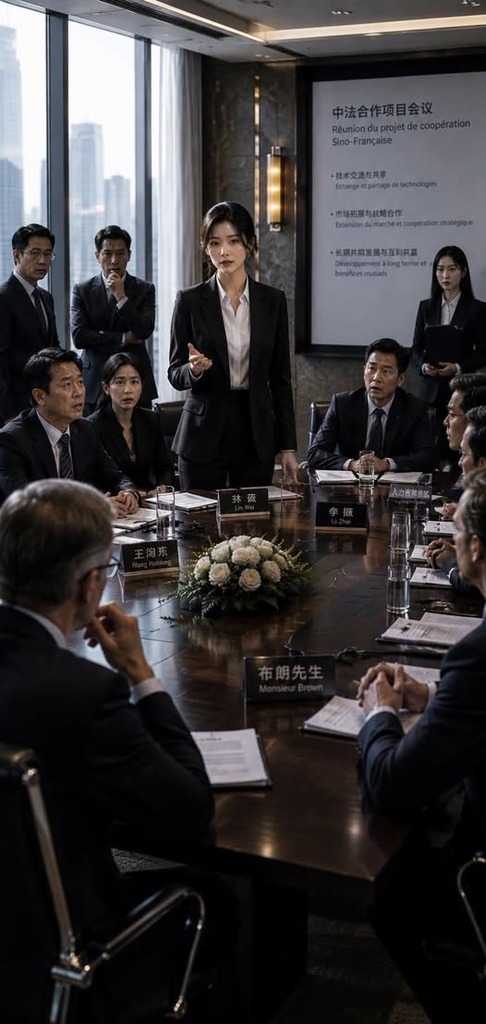
Five minutes later, everyone sat down again.
Ten minutes later, the atmosphere had completely changed.
Thirty minutes later, Mr. Brown was smiling.
But the most important moment came when he pushed the draft agreement toward me and pointed to clause seventeen.
He asked something.
I read the paragraph.
Then my expression changed.
—General Manager Vuong.
—What?
I turned toward him.
—We cannot accept this clause as written.
Manager Ly immediately interrupted:
—Lin Wei, your job is translation. Don’t give opinions about the contract.
I ignored him.
General Manager Vuong looked at me.
—Why?
I pointed at the French version.
—The Chinese draft says that if our company fails to meet the first-year sales target, the French side may renegotiate the distribution area.
I paused.
—But the French version gives them the right to terminate our exclusive distribution authorization for the entire Asia-Pacific region.
Everyone froze.
General Manager Vuong grabbed the document.
—What?
Manager Ly hurriedly said:
—Impossible. Legal reviewed it three times.
Mr. Brown watched us calmly.
I continued:
—There’s more.
I turned two pages.
—The Chinese version specifies a twelve-month technical support period.
—The French contract says six months of free support, with the remaining six charged according to their annual service rate.
General Manager Vuong’s face darkened.
This was no longer a language problem.
It involved tens of millions.
Manager Ly snatched the documents.
—You must have misunderstood.
I looked at him.
—Then ask Mr. Brown.
Nobody spoke.
Finally, General Manager Vuong gestured.
—Ask.
I translated the question.
Mr. Brown listened.
Then gave a long answer.
When he finished, I translated:
—Mr. Brown says their company sent the revised French version eight days ago and specifically requested that our side confirm the modifications.
General Manager Vuong slowly turned toward Manager Ly.
—Eight days ago?
Manager Ly’s lips moved.
No sound came out.
The French delegation had not secretly changed anything.
Our own team simply had not properly reviewed the latest version.
And if I had not noticed it?
We might have proudly signed a contract worth more than one hundred million yuan without fully understanding what we were signing.
General Manager Vuong’s voice became terrifyingly calm.
—Manager Ly.
—Yes… General Manager Vuong?
—After this meeting, bring me every email related to this project.
Manager Ly’s face turned gray.
The negotiation continued for another three hours.
By lunchtime, we had corrected seven discrepancies.
Two were translation errors.
Three were changes our side had failed to incorporate.
The final two involved genuine differences in commercial expectations.
Those required negotiation.
That was when Mr. Brown tested me again.
—Mademoiselle Lin, êtes-vous seulement interprète?
I smiled.
—Non, monsieur. Aujourd’hui est mon premier jour au département de stratégie commerciale.
No, sir. Today is my first day in the commercial strategy department.
Mr. Brown stared at me.
Then laughed loudly.
The room relaxed for the first time all morning.
—Your company is interesting.
He looked toward General Manager Vuong.
—You put your best negotiator in the back row.
General Manager Vuong’s expression became complicated.
Because technically, I wasn’t even a negotiator.
I was a new employee whose probationary contract had not yet been fully processed.
At five forty that afternoon, both parties signed a memorandum confirming the revised framework.
The final contract would be completed after legal review.
When Mr. Brown stood to leave, he shook my hand.
—When we meet again, Mademoiselle Lin, I hope you’re sitting at the table from the beginning.
—Me too.
After the delegation left, nobody moved.
General Manager Vuong closed the conference-room door.
Then looked at me.
—Lin Wei.
—Sir.
—Your CV says “knows some French.”
I nodded.
A strange expression appeared on his face.
—What exactly does “some” mean to you?
I thought about it.
—Enough to work.
Someone at the back coughed to hide a laugh.
Manager Ly did not laugh.
General Manager Vuong asked:
—Where did you learn it?
—Lyon.
The room became quiet again.
—I studied spatial economics and international commercial management there for four years.
Manager Ly suddenly looked at my CV.
—I didn’t see that.
—It’s there.
I answered.
—Under education.
He flipped through the pages.
Then stopped.
His face stiffened.
My university’s official English name did not contain the word “France.”
Apparently he had skimmed it, seen an unfamiliar foreign school and moved on.
General Manager Vuong asked:
—Why didn’t you write “fluent French”?
I answered honestly:
—Because I hadn’t used it professionally for almost two years. I didn’t want to exaggerate.
He stared at me for several seconds.
Then he laughed.
—Everyone else exaggerates their CV.
—You downgraded yours.
I didn’t answer.
His smile disappeared.
—And you, Manager Ly?
Manager Ly straightened.
—General Manager Vuong…
—You laughed at this line during her interview, didn’t you?
His face became pale.
Apparently someone from HR had already mentioned it.
Manager Ly forced a smile.
—It was only a joke.
General Manager Vuong tapped the corrected contract.
—Today your joke almost cost us more than one hundred million yuan.
No one dared breathe loudly.
But I did not need revenge.
The meeting had already said enough.
Three days later, the company announced an internal review of the entire international cooperation process.
The professional interpreter was not fired.
I specifically told General Manager Vuong that her failure had been caused by panic and inadequate preparation, not dishonesty.
She later came to my desk.
—Thank you.
I shook my head.
—You don’t owe me anything.
She hesitated.
—Weren’t you angry when Manager Ly looked down on you?
I smiled.
—Of course.
—Then why didn’t you embarrass him more?
I looked toward the glass office at the end of the floor.
Manager Ly was inside explaining eight days of ignored emails to the audit team.
—Because sometimes people do a better job embarrassing themselves.
Two months later, the French project officially launched.
Mr. Brown returned.
This time there was a nameplate waiting for me at the main conference table.
LIN WEI — INTERNATIONAL PROJECT COORDINATOR
Manager Ly was no longer responsible for international recruitment or overseas cooperation.
He had been transferred to an internal administrative position after the review found repeated negligence.
He passed my desk once and stopped.
—Lin Wei.
I looked up.
He seemed uncomfortable.
—About your interview…
—I remember.
His face tightened.
—You could have told me your French was that good.
I almost laughed.
—You could have asked.
He had nothing to say.
A year later, the French project exceeded its first-year target.
I became deputy director of international strategy.
At the celebration dinner, General Manager Vuong raised his glass.
—Do you remember your first day?
—Unfortunately.
Everyone laughed.
He continued:
—I learned something that day.
I expected another joke.
Instead, he looked around the table.
—Never judge the smallest line on someone’s résumé before discovering why they wrote it so modestly.
Mr. Brown, who had flown in for the celebration, raised his glass toward me.
—And never place Mademoiselle Lin in the back row.
I smiled.
During the interview, Manager Ly had glanced at the words “knows some French” and chuckled.
I had not defended myself.
Not because I was ashamed.
Not because I lacked confidence.
I simply understood something he did not.
A résumé only tells people what you claim you can do.
Sooner or later, work reveals what you can actually do.
And on the day a hundred-million-yuan agreement almost walked out the door, the line he had laughed at became the one line everyone in that company remembered.
