At 7:10 the next morning, I was still asleep when Liu Zhenhua’s hospital entered its first crisis.
The first surgery was an extended pancreaticoduodenectomy.
The patient had a complicated vascular variation.
Normally, before surgery, I would have uploaded a complete three-dimensional reconstruction, risk map, and step-by-step contingency plan into the department’s internal system.
This time, there was nothing.
Tu Khai stood inside the conference room staring at the CT scans.
—Where is Doctor Tran’s surgical model?
The resident answered carefully:
—She deleted her personal files before leaving.
Tu Khai frowned.
—Then restore them.
—They weren’t hospital files.
Silence.
The resident continued:
—Doctor Tran built them herself.
Tu Khai’s face changed slightly.
But that was only the beginning.
At 7:40, the second operating team called Liu Zhenhua.
Their patient required a difficult liver resection.
The surgeon asked:
—Has Professor Li arrived?
Liu Zhenhua frowned.
—Why would Professor Li come?
—Doctor Tran said last week that Professor Li would assist remotely because the tumor is close to a major vessel.
Liu Zhenhua immediately called him.
Professor Li answered.
The moment he heard Liu Zhenhua’s request, he said only one sentence.
—Tran Hy invited me. She no longer works there.
Then he hung up.
At 8:05, Academician Truong’s office canceled three scheduled expert consultations.
At 8:20, another hospital specialist withdrew from a complex operation.
At 8:35, the anesthesiology department reported that four high-risk patients could not proceed because my perioperative risk system was no longer accessible.
By nine o’clock, ten difficult surgeries had been suspended.
Not canceled.
Suspended.
Because nobody dared continue.
The new Da Vinci robot stood polished and immaculate in the center of the operating department.
It was worth millions.
But nobody knew how to make a machine replace judgment.
Liu Zhenhua finally lost his temper.
—What are you all doing?!
He slammed the conference table.
—We have the best equipment in the city!
The deputy director looked exhausted.
—Director Liu, equipment can assist surgery.
He paused.
—It cannot decide what to do when anatomy stops matching the textbook.
Everyone looked at Tu Khai.
He turned pale.
—Why are you looking at me?
One surgeon answered coldly:
—Because you’re the chief surgeon now.
The room fell silent.
Tu Khai stood up.
—You think I can’t do it?
Nobody answered.
That was worse.
He grabbed the first patient’s files.
—I’ll operate.
The anesthesiology chief immediately stopped him.
—No.
Tu Khai stared.
—What do you mean, no?
—The patient has already been categorized as extremely high risk. Without a clear vascular strategy, I won’t authorize it.
Tu Khai slammed the file down.
—You’re deliberately humiliating me!
The anesthesiologist looked directly at him.
—No.
—We’re trying not to humiliate ourselves in front of a dead patient’s family.
Liu Zhenhua’s face became livid.
At 9:30, the first group of family members began asking questions.
At ten, complaints reached hospital administration.
At eleven, one patient’s relatives demanded immediate transfer to another medical center.
By noon, three more families followed.
That was when Liu Zhenhua finally called me.
My phone rang while I was making tea.
I looked at the screen.
Then declined.
He called again.
Declined.
The third time, I answered.
—Doctor Tran.
His voice was unusually soft.
—There are several surgeries today that need your assistance.
I took a sip of tea.
—Then ask your chief surgeon.
Silence.
—Tran Hy, don’t be emotional.
I almost laughed.
—Director Liu, I resigned yesterday.
—You can’t ignore patients because of personal grievances.
There it was.
The moral pressure.
Exactly what he had used on me for years.
Every time there was an impossible case, he said:
“Think about the patient.”
Every time I stayed overnight, he said:
“Think about the department.”
Every time someone else received the promotion, he said:
“Think about the collective.”
I placed the cup down.
—Director Liu, when you removed me from my position for the third time, did you think about the patients?
He became silent.
I continued:
—When you gave authority over difficult operations to someone who couldn’t independently manage them, did you think about the department?
—Tran Hy—
—I’m no longer an employee.
Then I hung up.
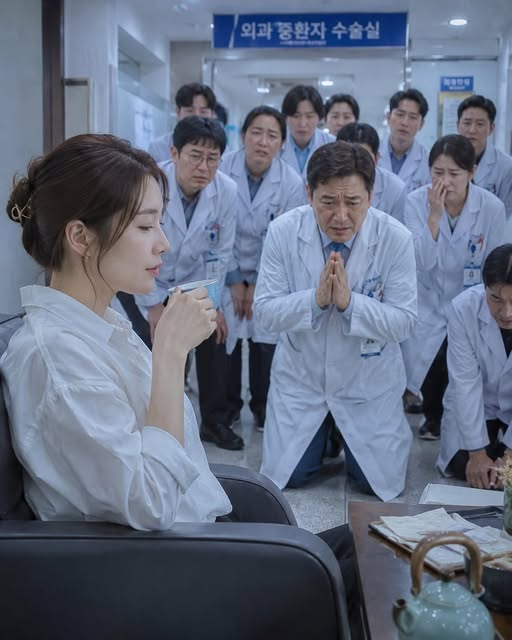
One hour later, somebody knocked on my door.
Not one person.
More than twenty.
Liu Zhenhua stood at the front.
Behind him were department directors, senior surgeons, residents, and even Xiao Wang.
Their expressions ranged from embarrassment to desperation.
Liu Zhenhua wiped sweat from his forehead.
—Doctor Tran.
I opened the door only halfway.
—What is this?
—Come back.
He forced a smile.
—The hospital needs you.
I looked behind him.
Tu Khai was not there.
Interesting.
—And the new chief surgeon?
Liu Zhenhua hesitated.
—We can reconsider the appointment.
I smiled.
—Reconsider?
His face stiffened.
—Tran Hy, ten operations are waiting.
—Then why are you standing here instead of operating?
Nobody answered.
I stepped outside with my tea.
—Yesterday you said my interpersonal skills were insufficient.
—You said I needed more training.
—You said collective interests came first.
I looked at him.
—Have I suddenly finished my training overnight?
Several younger doctors lowered their heads to hide smiles.
Liu Zhenhua swallowed his humiliation.
—Yesterday’s decision may have been… inappropriate.
—Inappropriate?
I shook my head.
—No.
—It was extremely appropriate.
He stared at me.
—It finally taught me where I stand in your hospital.
My former department deputy stepped forward.
—Doctor Tran, patients truly are waiting.
That sentence made me quiet.
I could punish Liu Zhenhua.
I could embarrass Tu Khai.
But the people lying in those hospital beds had done nothing to me.
So I looked at Liu Zhenhua.
—I can assist with today’s emergency surgeries.
His eyes lit up.
—Good. Then—
—As an external consultant.
The smile froze.
—What?
—I am not returning to the hospital.
I held up one finger.
—First condition: every procedure I participate in must be under my clinical authority.
Second.
—Tu Khai does not enter my operating room.
Third.
—My technical systems remain my intellectual property. If the hospital wants to use them, you sign a licensing agreement.
Fourth.
—Every specialist I invite receives formal consulting compensation. No more asking me to “use my relationships for the collective.”
Liu Zhenhua’s face became uglier with every sentence.
Finally he said:
—You’re bargaining while patients are waiting?
I looked straight at him.
—No.
I’m making sure you can never again build your hospital on my sacrifice and then tell me I should be grateful for the privilege.
Nobody spoke.
After almost a minute, Liu Zhenhua nodded.
—Fine.
I changed clothes and went with them.
The moment I entered the surgical building, nurses stopped in the corridors.
Some looked relieved.
Others almost applauded.
I didn’t smile.
There were still patients waiting.
The first operation lasted several hours.
Successful.
The second followed immediately.
Then the third.
By midnight, the most dangerous cases had been stabilized or completed.
When I finally removed my surgical cap, Xiao Wang was waiting outside.
His eyes were red.
—Teacher Tran, are you really not coming back?
I looked toward the department I had spent eight years building.
Then I shook my head.
—No.
—Why?
I smiled faintly.
—Because sometimes saving a place means leaving it long enough for everyone to see what was actually holding it together.
Three days later, the hospital board launched an internal review.
Tu Khai was removed from the chief position.
The robotic-equipment sponsorship agreement was investigated.
Liu Zhenhua was ordered to explain why clinical leadership had been exchanged for donor influence.
And then Academician Truong called me.
His first sentence was simple.
—Are you done wasting your time there?
I laughed.
—Probably.
—Good.
He paused.
—The National Medical Center is establishing a complex surgery institute.
My hand stopped.
—I recommended one person to lead it.
I already knew the answer.
He continued:
—You.
One month later, I stood inside a new operating center with my name printed on the office door.
Dr. Tran Hy — Director, Complex Surgery Institute.
No relationship hire above me.
No machine bought to replace me.
No administrator explaining that my skill mattered less than somebody else’s surname.
As for Liu Zhenhua’s hospital?
It survived.
But not unchanged.
For years, they had believed I was simply one excellent surgeon among many.
It took only one day without me for them to discover the truth.
I had never been demanding recognition.
I had been quietly carrying responsibilities they were too comfortable to notice.
