The studio was smaller than the children’s bedroom at the Ha house.
But when Yang Fei opened the door, sunlight covered almost the entire floor.
My old drafting table stood beside the window.
On it was a cardboard box.
I opened it.
Inside were drawings from six years earlier.
Mechanical joints.
Rehabilitation braces.
A walking-assistance system for children with neuromuscular disorders.
My handwriting filled every margin.
For five years, everyone had called me Mrs. Ha.
Looking at those pages, I suddenly remembered that before becoming someone’s wife and someone’s mother, I had been Tang Zhiyi.
And Tang Zhiyi had once been very good at something.
Yang Fei placed coffee beside me.
—The rehabilitation project you abandoned was never really abandoned.
I looked up.
She opened her laptop.
—Ha Medical commercialized the basic structure three years ago.
My fingers stopped.
—What?
—Your original patent application was filed before marriage.
She turned the screen toward me.
—They improved it, renamed it and built a product line around it.
I stared at the numbers.
Revenue.
Licensing.
Hospital contracts.
All from an idea Ha Jingheng once told me was “safer in the company’s hands while I recovered from pregnancy.”
I whispered:
—He never told me.
Yang Fei laughed without humor.
—Apparently he didn’t think Mrs. Ha needed to know what happened to Tang Zhiyi’s work.
That afternoon, I called my lawyer.
Not to destroy Jingheng.
Not to take Ha Medical.
Just to ask one question.
—What still belongs to me?
Three days later, Jingheng finally called.
—Where are you?
—Nancheng.
Silence.
—When are you coming back?
I looked at the drafting board in front of me.
—I’m not.
His breathing changed.
—The children keep asking where you are.
That hurt.
But I didn’t let him hear it.
—You can tell them the truth.
—What truth?
—That their mother moved out because their parents are divorcing.
He lowered his voice.
—Xiaoman cried last night.
My eyes burned.
For years, whenever the children cried, I surrendered first.
Maybe Jingheng expected the same.
I closed my eyes.
—Comfort her.
He went silent.
Then:
—Shen Lingyi came over.
Something inside me became strangely calm.
—Good.
—She tried to make Xiaoman sleep, but Xiaoman wouldn’t let her touch your pillow.
I didn’t answer.
—Zhiyi…
It was the first time in years he had called my name instead of saying “wife.”
—Come home.
—No.
I ended the call.
Then I cried for almost an hour.
Leaving didn’t mean I loved my children less.
It simply meant I had finally understood that loving them did not require disappearing inside their lives.
The robotics competition took place that Saturday.
I didn’t plan to attend.
Then, at nine twelve, my phone rang.
Xiaoyu.
—Mom?
His voice sounded unusually small.
—What happened?
—The robot isn’t working.
I closed my eyes.
—Where is Aunt Lingyi?
Silence.
—She doesn’t know how to fix it.
I almost smiled.
Five days earlier, he had told me I wouldn’t be useful there.
—Did you check the obstacle sensor?
—Yes.
—Power distribution board?
—Yes.
—Then open the rear housing and look at the second blue cable.
There was noise on the other end.
A minute later he shouted:
—It’s loose!
—Reconnect it and restart the controller.
Silence.
Then:
—It works!
His excitement came through the phone.
I smiled despite myself.
—Good luck.
—Mom…
—Yes?
He hesitated.
—Can you come?
My chest tightened.
—Not today.
—Why?
Because I needed him to understand that I wasn’t an emergency service waiting behind a door after being dismissed.
But he was five.
So I simply said:
—Because Mom has work.
He stayed quiet.
Then whispered:
—Okay.
Before hanging up, he added:
—Mom… you really do know robots.
I laughed softly.
—A little.
Jingheng appeared in Nancheng the following Monday.
He entered Yang Fei’s studio and stopped when he saw me standing before a presentation screen surrounded by engineers.
For almost an hour, he said nothing.
He watched me explain actuator resistance, rehabilitation angles and production costs.
When the meeting ended, everyone called me:
—Director Tang.
Not Mrs. Ha.
Not someone’s mother.
Director Tang.
Jingheng remained at the door.
—You restarted the project.
—I did.
His eyes moved toward the prototype.
—Why didn’t you tell me you wanted to work again?
I looked at him.
—I did.
He froze.
Then remembered.
Two years earlier.
I had once shown him a sketch after the children went to sleep.
He had barely looked at it.
—Wait until they’re older.
I had waited.
Apparently, he had forgotten.
—My lawyer contacted Ha Medical this morning, I said.
His expression changed.
—About the patent?
—So you knew.
He went silent.
That answer was enough.
—Why didn’t you tell me the company was using it?
—The legal department said the derivative product belonged to Ha Medical.
—That’s not what I asked.
He looked away.
Finally:
—I thought you weren’t interested anymore.
I laughed.
—You thought I wasn’t interested because I stopped asking after being ignored enough times.
That sentence seemed to hit him harder than anger.
The divorce became final four months later.
I received the share of the marital assets legally owed to me.
My original intellectual property remained mine, and Ha Medical signed a new licensing agreement instead of fighting me over it.
I never tried to take the company.
I wanted my name back.
The children stayed primarily with Jingheng at first because their school and routines were there.
But every Wednesday and every other weekend, they came to Nancheng.
The first few visits were difficult.
Xiaoman asked repeatedly:
—Is Lingyi Mom now?
I always answered the same way.
—No.
—Then why does she come to our house?
—Ask Dad.
Eventually, Jingheng stopped inviting Lingyi.
Not because I demanded it.
Because for the first time, he had to handle his children’s confusion without using another woman to fill my place.
Six months later, Xiaoyu brought his new robotics project to my studio.
On the title page he had written:
Technical adviser: Mom
I stared at it.
—Who told you to write this?
He looked offended.
—You helped me.
Then he added quietly:
—I told my teacher you’re an engineer.
I swallowed hard.
—Designer.
—Fine. Designer.
He hugged my waist.
Xiaoman immediately joined him.
And for the first time since leaving, I understood that I had not lost my children.
We were simply learning each other again outside the old house.
A year later, Jingheng came to pick them up.
Before leaving, he looked around my expanded studio.
Twenty employees.
Three prototypes.
My name on the glass door.
—You seem happy.
—I am.
His eyes lowered.
—Would you ever consider coming back?
I looked at him for a long moment.
—No.
He nodded as if he had expected it.
Then he whispered:
—I thought you could never leave the children.
I smiled sadly.
—That’s why you weren’t afraid of losing me.
He had no answer.
The children called him from the elevator.
Jingheng turned to leave.
Then I said:
—Take good care of them.
He looked back.
—I will.
The door closed behind him.
For five years, I had believed a good mother should make herself indispensable.
Cook everything.
Remember everything.
Attend everything.
Give up everything.
I was wrong.
My children did not need a mother who erased herself for them.
They needed to learn that the woman they called Mom had a name, work, dignity and a life that mattered too.
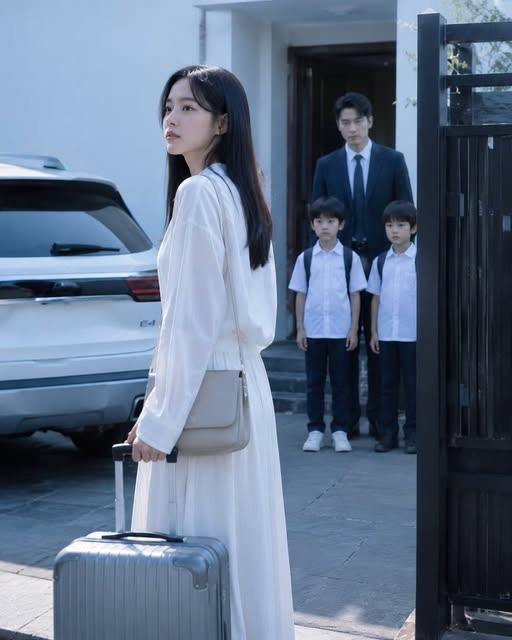
And the day I left the Ha family house with one suitcase, I didn’t abandon my children.
I simply stopped abandoning myself
