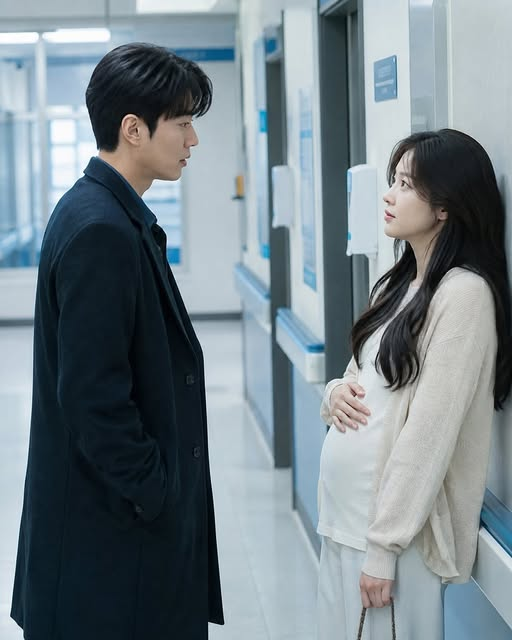
Luc Canh Sam stared at me.
—If you’re not pregnant, why were you touching your stomach?
I folded my arms.
—Maybe because my stomach hurt.
—You’re lying.
—Then why ask if you’ve already decided the answer?
His jaw tightened.
I reached for the door.
—Leave.
He put one hand against the frame.
Not touching me this time.
—I’ll find out myself.
I looked directly at him.
—If you investigate my medical records again, my lawyer will handle it.
His expression flickered.
So he understood.
Someone had already told him more than they should have.
I closed the door.
This time he didn’t stop me.
That afternoon, I called my lawyer.
I told her everything.
The hospital encounter.
The messages.
His appearance at my apartment.
And the pregnancy.
She remained silent for several seconds.
—So the baby is his?
—Yes.
The dates left no doubt.
She sighed.
—You can keep your medical information private, but once the baby is born, there will be questions of paternity, support and parental rights.
I knew.
That was the part I had been avoiding.
I didn’t want Luc Canh Sam back.
But I also couldn’t erase a biological father because our marriage had failed.
—Prepare everything properly.
I placed my hand over my stomach.
—I’m not going to use the child to punish him.
Then I added:
—But he is never going to use this child to control me either.
Three days later, he received a formal letter from my lawyer.
He appeared at her office before the scheduled appointment.
I arrived twenty minutes later.
He was already sitting there.
No arrogance.
No girlfriend.
No mocking smile.
Only exhaustion.
When I sat down, he pushed a document toward me.
—The woman you saw at the hospital isn’t my girlfriend.
I looked at him.
—You introduced her that way.
His face stiffened.
—I was angry when I saw you.
—So you used another woman to humiliate your ex-wife.
Silence.
That was apparently not the defense he had imagined.
He finally said:
—She’s my cousin’s sister-in-law. I asked her to play along.
I almost laughed.
—Congratulations.
—For what?
—You’ve somehow made it more pathetic.
My lawyer coughed to hide a smile.
Canh Sam’s ears turned red.
Then he looked at my abdomen again.
—Is the baby mine?
I didn’t answer immediately.
His hands tightened on his knees.
For the first time, there was no command in his voice.
—Please tell me.
I remembered the day of our divorce.
The pen.
His cold face.
If you have any self-respect, don’t come back and beg me.
I opened my bag.
Placed the first ultrasound report on the table.
Six weeks pregnant.
Dated one week before we signed.
His face lost all color.
He picked it up.
Once.
Then read it again.
—You knew.
—Yes.
His voice became almost inaudible.
—You knew when we divorced?
—Yes.
His eyes slowly lifted.
—Why didn’t you tell me?
I smiled without warmth.
—That night you told me marrying me was eight lifetimes of bad luck.
He looked away.
—I was angry.
—You told me my presence disgusted you.
—I didn’t mean—
—I was carrying the ultrasound report in my handbag while you said it.
That finally silenced him.
I continued:
—I went home intending to tell you.
—I even bought the little box.
His breathing stopped.
—What box?
I had forgotten he never saw it.
I took out my phone and found an old photograph.
A tiny pair of socks inside a white box.
Beside them was the ultrasound.
I had planned to place it on the dinner table.
Instead, that night became our final argument.
Canh Sam stared at the photograph for a long time.
Then lowered his head.
—I didn’t know.
—Exactly.
My voice was quiet.
—You never knew because you were too busy trying to hurt me.
He asked for reconciliation that day.
I refused.
He offered to buy me a larger apartment.
I refused.
He wanted me to move back into the old house “for the baby’s safety.”
I laughed.
—The baby is perfectly safe without your marble floors.
Eventually, my lawyer interrupted.
—Mr. Lu, being the father doesn’t restore your marriage.
That sentence finally made him stop.
He looked at me.
—Then what can I do?
It was the first useful question he had asked.
—Wait.
—For what?
—Until I’m ready to discuss what role you’ll have after the baby is born.
He nodded.
And surprisingly, he did.
The following months were strange.
Canh Sam didn’t come to my apartment without permission again.
He stopped demanding updates.
Instead, once a week, I received one message.
How was the checkup?
If I answered, he thanked me.
If I didn’t, he left me alone.
At six months, I allowed him to attend an ultrasound.
The technician pointed at the screen.
—Here’s the baby’s hand.
Canh Sam didn’t speak.
He simply stared.
His eyes became red.
Then he turned his face away.
Outside the examination room, he asked:
—Boy or girl?
—Girl.
He nodded.
Then whispered:
—I used to think I didn’t want children.
I looked at him.
—You didn’t want a lot of things while we were married.
He accepted the blow without arguing.
That was new.
Our daughter was born healthy.
I named her Lam Tieu An.
Canh Sam was listed as the father after a formal paternity test.
When he received the result, he stared at the line confirming paternity for almost a minute.
Then he laughed.
A strange, broken laugh.
—So you really lied to me that day.
—Yes.
—You said she wasn’t mine.
—I was terrified you’d treat my pregnancy like property.
He didn’t defend himself.
—You had reason to think that.
That answer surprised me more than an apology would have.
He became a better father than he had been a husband.
Not immediately.
He had to learn.
That a baby didn’t care about meetings.
That feeding schedules didn’t move because he had a conference call.
That money could hire help but couldn’t replace showing up.
And most importantly, that being Tieu An’s father didn’t mean controlling her mother.
We never remarried.
People asked.
His parents hoped.
Even Canh Sam brought it up once, nearly two years later.
We were sitting in the park while Tieu An slept in her stroller.
—If I asked you again now, would the answer still be no?
I looked at him.
He had changed.
So had I.
But change didn’t erase history.
—Yes.
He lowered his eyes.
Then nodded.
—I thought so.
—Does that make you angry?
—No.
He looked at our daughter.
—It just makes me regret becoming the man you had to leave before I learned how to become better.
For once, I didn’t need to answer.
Three years after our divorce, Tieu An started kindergarten.
On her first day, she held one of my hands and one of his.
At the classroom door, she looked up.
—Mommy lives in one house.
Then at him.
—Daddy lives in another.
She frowned seriously.
—But you’re both mine.
Canh Sam laughed.
I did too.
That was enough.
I had once believed the only choices were to hide my pregnancy forever or return to a marriage that had broken me.
I was wrong.
My daughter could have her father without me surrendering my life back to him
And Luc Canh Sam eventually understood the lesson our divorce had been trying to teach him from the beginning:
Being someone’s father gave him responsibility
It never gave him ownership of the woman who chose to leave
