Daniel called me thirty-four times the next morning.
I answered none.
At nine, my lawyer called.
—Sofia, the protective order has been requested. Do not return to the apartment alone.
I looked at my mother’s pale face across the hotel room.
—The apartment is mine.
—I know.
—Then why should I be the one who can’t go home?
There was a pause.
—You won’t be.
Two hours later, Daniel received formal notice that he had to stay away from me while the case was being reviewed.
That was when he finally understood that I hadn’t left to “calm down.”
He called from another number.
I answered only because my lawyer had told me to record every contact.
His first words were:
—You called the police on me?
No apology.
No concern.
Just outrage.
—Yes.
—Sofia, I’m your husband.
—Not for much longer.
His breathing became heavy.
—Do you know what this could do to my job?
I almost laughed.
There it was again.
His job.
His reputation.
His mother.
Everything mattered before me.
—You should have thought about that before yesterday.
—It was a family argument!
—The police can decide what it was.
His voice suddenly softened.
—Come home.
I closed my eyes.
—No.
—Mom already said she’ll apologize.
—I’m not divorcing your mother.
Silence.
—I’m divorcing you.
For the first time, Daniel had no answer.
The living-room security recording made everything simple.
Not emotionally.
Legally.
The camera had captured the argument.
My mother’s medication on the table.
Mrs. Zhao’s comments.
Daniel losing control.
And afterward, his voice saying that I had “caused the situation.”
My lawyer watched the footage once.
Then closed the laptop.
—Keep the original file untouched.
I nodded.
—Will he be able to take the apartment?
—It was purchased before marriage and registered solely to you.
She shook her head.
—No.
I almost smiled.
Daniel had spent years behaving as if everything I owned had automatically become part of his family.
My apartment.
My salary.
My time.
Even my mother’s dignity.
That illusion ended quickly once paperwork became involved.
Mrs. Zhao came to find me three days later.
She wasn’t allowed upstairs, so she waited in the lobby of my lawyer’s building.
The moment she saw me, she began crying.
—Sofia, a family shouldn’t destroy itself over one mistake.
I stopped.
—One mistake?
—Daniel was angry.
—You held my mother back when she tried to intervene.
Her crying stopped.
She looked around nervously.
—I was afraid the elderly woman would fall.
I stared at her.
Even now she could rewrite anything.
—Then tell that version to the authorities.
I started walking.
She grabbed my sleeve.
—Think about your child.
I turned.
—That’s exactly what I’m doing.
My son had heard enough shouting in that house.
He didn’t need to grow up learning that love meant one person could frighten another and apologize afterward.
Mrs. Zhao whispered:
—Daniel loves you.
I gently removed her hand.
—Then he should learn that love without respect is useless.
Daniel moved out of my apartment under supervision.
When I returned, the house felt enormous.
My mother stood beside me.
—Are you sure?
I knew what she meant.
Divorce.
The complaint.
Everything.
I looked at the living room.
The table.
The chair where Daniel had sat every morning.
The family photographs.
I expected grief.
Instead, I felt exhausted relief.
—Yes.
That evening I removed our wedding photograph from the wall.
I didn’t break it.
I simply put it in a box.
Some endings don’t need destruction.
They only need a closed lid.
A month later, Daniel asked to meet through our lawyers.
I agreed to a public place.
He looked thinner.
His arrogance was gone.
—Mom moved back to her apartment.
I said nothing.
—I’ve started counseling.
I nodded.
—Good.
His eyes immediately lifted.
Maybe he heard hope in that one word.
So I corrected it.
—Good for you.
Not for us.
His shoulders fell.
—Sofia, I wasn’t myself that day.
—You were yourself.
He flinched.
I continued calmly:
—Maybe not the version of yourself you like.
—But nobody else controlled your hands.
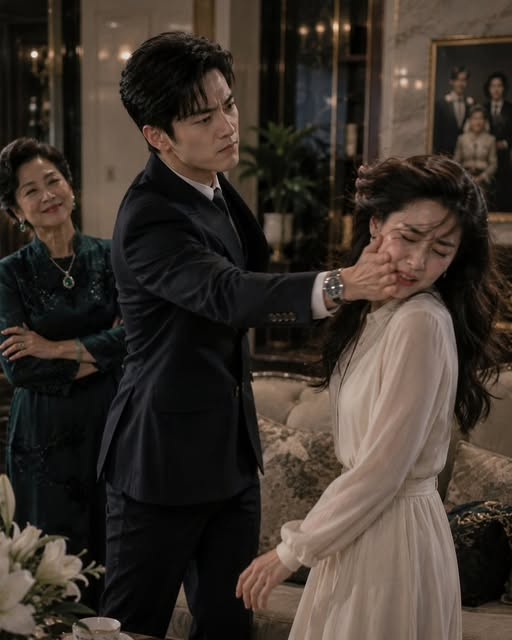
—Nobody made you choose intimidation over conversation.
His eyes turned red.
—I regret it every day.
I believed him.
That was the strange part.
I believed Daniel regretted everything.
But regret wasn’t a time machine.
—I know.
—Then why can’t you give me one chance?
I looked at him.
—Because chances are for mistakes that don’t make me afraid of the person beside me.
He lowered his head.
For several minutes, neither of us spoke.
Then he whispered:
—Will our son hate me?
—I hope not.
He looked surprised.
—I want him to have a healthy relationship with you.
I paused.
—But that will depend on what kind of father you choose to become.
Not what kind of husband you failed to be.
The divorce was finalized six months later.
The apartment remained mine.
Parenting arrangements were made through formal channels.
Daniel’s contact with me became limited to matters involving our son.
His mother was never again allowed to interfere with my mother’s medical care.
And my mother?
She recovered.
The first thing she did after returning home was organize her medication into a bright blue box and write her name across the top.
Then she looked at me.
—Now nobody touches it except me.
I laughed.
It was the first time laughter had sounded natural in that apartment for months.
Almost a year later, Daniel came to pick up our son.
He stood outside the door.
He never entered without permission anymore.
That boundary alone told me he had changed more than all the apologies ever could.
Our son ran toward him.
—Dad!
Daniel crouched and hugged him.
Then looked at me.
—Thank you.
I frowned.
—For what?
—For not teaching him to hate me.
I thought for a moment.
—He’ll form his own opinion of you.
—Make sure you give him good reasons.
Daniel nodded.
Then left.
I closed the door.
Quietly.
No trembling.
No fear.
Just a door closing.
That was when I understood what had changed most.
For years, Daniel thought being a good son meant defending his mother no matter what she did.
He learned too late that protecting one woman never gave him the right to humiliate another.
And I learned something too.
His regret did not require my return
His apology did not erase my decision
He thought twelve slaps would force me to lower my head.
Instead, they became the last twelve reasons I ever needed to walk out and never again look at him as my husband
