PART 2
The conference room was chaos.
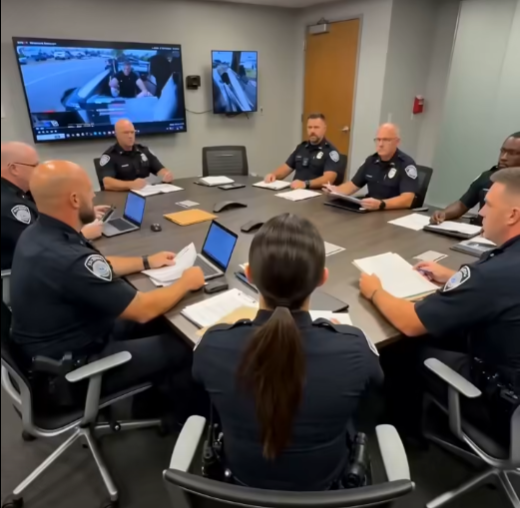
Two officers helped me back into my chair while Internal Affairs investigators restrained Derek Collins.
His face was red with rage.
“You set me up!” he shouted.
“I built this department! I earned everything!”
Nobody responded.
Because everyone had just watched the footage.
There was no argument left to make.
The video spoke for itself.
The captain waited until Derek stopped struggling.
Then he placed a thick sealed file on the table.
The room slowly became quiet.
I noticed something unusual.
The file wasn’t marked by Internal Affairs.
It carried the insignia of the Professional Standards Bureau.
That immediately got everyone’s attention.
The captain opened it carefully.
Several documents slid onto the table.
Photos.
Financial records.
Complaint summaries.
Interview transcripts.
The captain looked directly at Derek.
“When did this start?”
For the first time all afternoon, Derek looked genuinely frightened.
“I don’t know what you’re talking about.”
The captain didn’t respond.
Instead, he turned the first page around so everyone could see.
My stomach tightened.
The document listed six separate citizen complaints spanning four years.
Every complaint involved Derek.
Every complaint had been closed without disciplinary action.
At first glance, that didn’t seem unusual.
Police departments receive complaints all the time.
Then Internal Affairs displayed supporting evidence recovered during a recent audit.
Suddenly the complaints looked very different.
Witness statements had disappeared.
Evidence logs had been altered.
Supervisor notes had been modified.
Several investigations appeared intentionally undermined.
The room fell silent again.
One investigator leaned forward.
“These aren’t mistakes.”
“No,” the captain replied quietly.
“They aren’t.”
PART 3
Over the next hour the file revealed problem after problem.
Each discovery was worse than the last.
An excessive-force complaint.
A questionable arrest.
A use-of-authority allegation.
A missing evidence discrepancy.
Individually, none had resulted in formal discipline.
Together, they formed a disturbing pattern.
And the pattern centered around one person.
Derek Collins.
The investigator leading the review finally spoke.
“Three months ago, when we recovered the missing bodycam backup, we started asking additional questions.”
Derek stared at the table.
“We discovered something unusual.”
The investigator opened another folder.
Several names appeared on the screen.
Officers.
Supervisors.
Civilian employees.
Individuals connected to previous complaints.
“We began interviewing people.”
The investigator paused.
“And people started talking.”
The room felt smaller.
He clicked to the next slide.
Email records.
Text messages.
Call logs.
Years of communication.
According to the investigation, Derek had developed a reputation inside certain circles.
Not as a hero.
Not as a leader.
But as someone who always seemed to avoid accountability.
Witnesses described reports changing after submission.
Evidence disappearing.
Statements being revised.
People being pressured into silence.
Nobody had enough proof individually.
But now investigators were seeing the entire picture.
And it wasn’t pretty.
Then the investigator displayed a timeline.
That was when everything changed.
The timeline stretched back nearly eight years.
Long before I ever became Derek’s partner.
PART 4
I sat frozen as the presentation continued.
The officer I had worked beside every day suddenly seemed like a stranger.
The investigator pointed toward an entry near the beginning of the timeline.
“A former patrol officer resigned shortly after filing a complaint involving Collins.”
Another entry.
“A civilian witness withdrew allegations under suspicious circumstances.”
Another.
“A rookie officer transferred departments after reporting misconduct.”
The list kept growing.
Each case seemed isolated.
Each one appeared insignificant.
Until investigators connected them.
Then a disturbing pattern emerged.
Every person who challenged Derek experienced consequences.
Careers stalled.
Assignments changed.
Complaints vanished.
Transfers occurred.
Nothing obvious.
Nothing dramatic.
Just enough pressure to make problems disappear.
The captain looked exhausted.
As if he couldn’t believe what he was reading.
Then Internal Affairs revealed the breakthrough.
A retired lieutenant had recently contacted investigators.
He provided archived records he had kept personally for years.
Records that were never supposed to exist.
Copies of original reports.
Unedited versions.
Versions that differed significantly from official files.
The room erupted into whispers.
The retired lieutenant’s records exposed something nobody expected.
Multiple reports had been altered after submission.
Not by accident.
Deliberately.
And the alterations consistently benefited Derek.
PART 5
The investigation intensified immediately.
Within days, federal auditors arrived.
Digital forensic specialists began examining years of department records.
The findings were staggering.
Metadata showed reports accessed late at night.
Audit logs revealed unauthorized modifications.
Deleted files were recovered.
Hidden communications resurfaced.
Every week produced another revelation.
Meanwhile, Derek remained on administrative leave.
Officially he was prohibited from contacting department personnel.
Unofficially, rumors spread that he was desperately trying to learn how much investigators knew.
Then came the discovery that shocked everyone.
A financial audit uncovered unexplained deposits.
Nothing enormous.
Nothing flashy.
But enough to raise serious concerns.
Thousands of dollars spread across multiple accounts.
The transactions coincided with several questionable investigations.
The captain ordered a full review.
What investigators uncovered next nearly brought the entire case into criminal territory.
A local towing contractor admitted making payments to secure favorable treatment.
A private security company disclosed unusual consulting arrangements.
A business owner acknowledged receiving special consideration after providing benefits to certain officers.
Investigators still needed proof.
But the evidence was mounting rapidly.
The bodycam footage that exposed Derek’s false hero narrative had opened a door.
Behind it was an entirely different story.
PART 6
Three weeks later, I received an unexpected call.
Internal Affairs wanted another interview.
When I arrived, the lead investigator looked exhausted.
Stacks of files covered his desk.
He closed the door.
Then he showed me something I never expected to see.
A handwritten notebook.
The cover was worn.
The pages were old.
The notebook belonged to a former detective who had died several years earlier.
Inside were detailed notes about misconduct allegations that never reached formal investigation.
Page after page documented concerns involving Derek.
Witness names.
Dates.
Conversations.
Observations.
The detective had apparently suspected something for years.
But he never gathered enough evidence to prove it.
Until now.
The notebook connected dozens of loose ends.
It identified people investigators hadn’t previously interviewed.
Those interviews produced new witnesses.
New witnesses produced new evidence.
And suddenly the case exploded.
Several individuals agreed to cooperate.
One former supervisor admitted being pressured to overlook irregularities.
Another acknowledged approving reports without proper review.
The wall protecting Derek was beginning to collapse.
And once it started falling, it fell fast.
PART 7
The disciplinary hearing took place two months later.
Unlike the original review meeting, this hearing lasted three full days.
Witness after witness testified.
Evidence was presented.
Records were analyzed.
Experts explained digital audit trails.
Former employees shared experiences.
By the end, the outcome seemed inevitable.
Still, nothing prepared the room for Derek’s final statement.
When given the opportunity to speak, he stood slowly.
For several seconds he said nothing.
Then he looked directly at everyone.
“I never thought it would go this far.”
The room remained silent.
His voice shook.
“I told myself I was protecting my career.”
He swallowed hard.
“Then I told myself I was protecting my family.”
He looked toward the floor.
“And eventually I stopped caring about the difference.”
Nobody interrupted.
Nobody moved.
For the first time, Derek wasn’t angry.
He wasn’t defensive.
He wasn’t making excuses.
He simply looked tired.
Very tired.
The hearing board deliberated for less than an hour.
The recommendation was unanimous.
Termination.
Decertification proceedings.
Referral for criminal review.
The career Derek had spent more than a decade building ended that afternoon.
But the story still wasn’t over.
PART 8 (THE END)
Several months later, the department held a ceremony.
Not for Derek.
For something entirely different.
The department was implementing sweeping reforms.
Evidence management procedures.
Bodycam storage protections.
Independent review protocols.
Whistleblower safeguards.
Policies designed to ensure that what happened could never happen again.
During the ceremony, the chief called me to the stage.
I felt uncomfortable immediately.
I never wanted recognition.
I certainly never wanted attention.
But the chief insisted.
Standing before the assembled officers, he spoke plainly.
“The truth survived because someone was willing to tell it.”
The room was quiet.
He continued.
“Officer integrity is not measured when everything is easy. It is measured when honesty becomes expensive.”
Those words stayed with me.
Because they were true.
For months, remaining silent would have been easier.
Questioning the official narrative would have been easier.
Accepting someone else’s version of events would have been easier.
But easier isn’t always right.
After the ceremony, a young rookie officer approached me.
He seemed nervous.
“Can I ask you something?”
“Of course.”
He hesitated.
“Were you scared when all this started?”
I laughed softly.
“Absolutely.”
He looked surprised.
“You were?”
“Every day.”
The rookie nodded thoughtfully.
Then he asked the question that mattered most.
“So why didn’t you stay quiet?”
I looked around the precinct.
At the officers walking the halls.
At the citizens entering the lobby.
At the badge pinned to my uniform.
Then I answered honestly.
“Because trust is the only thing this job truly depends on.”
The rookie never forgot that conversation.
Neither did I.
Years later, investigators would describe the bodycam recovery as one of the most important discoveries in department history.
Not because it exposed one officer.
Not because it ended one career.
But because it revealed weaknesses that allowed misconduct to hide in the first place.
The missing footage had nearly buried the truth.
Instead, it uncovered it.
The commendation Derek wanted was never awarded.
The promotion never happened.
The false narrative collapsed.
And the officer many people believed was the hero became the central figure in one of the department’s biggest internal investigations.
As for me, life eventually returned to normal.
Patrol calls.
Night shifts.
Paperwork.
The ordinary rhythm of police work.
But every time I clipped on my body camera before a shift, I remembered that meeting.
The darkened conference room.
The recovered footage.
The silence as the truth appeared frame by frame.
And the sealed personnel file that revealed the bodycam incident had only been the beginning.
In the end, the investigation wasn’t about glory.
It wasn’t about promotions.
It wasn’t about recognition.
It was about accountability.
Because reputations can be manufactured.
Reports can be altered.
Stories can be rewritten.
But eventually, if preserved long enough, the truth finds its way back into the light.
THE END
“`
