PART 2
The parade field fell completely silent.
The sting from the slap still burned across my cheek.
Hundreds of recruits stood frozen in formation.
The commanding officer was already moving toward Sergeant Eric Collins.
But before anyone reached him, the recruit holding the sealed packet spoke again.
His voice shook slightly.
Yet he didn’t back down.
“Sir, Sergeant Collins is mentioned on every page.”
Every eye turned toward the packet.
Eric’s expression changed instantly.
The anger vanished.
For the first time all afternoon, he looked nervous.
Very nervous.
The commanding officer extended his hand.
“Bring that packet here.”
The recruit marched forward.
The envelope remained sealed.
Official battalion markings covered the front.
It wasn’t supposed to be opened until after graduation.
Eric suddenly stepped forward.
“Sir, those evaluations aren’t relevant.”
That was the wrong thing to say.
The commanding officer narrowed his eyes.
“Then you won’t mind if I read them.”
Eric didn’t answer.
That answer was answer enough.
The commanding officer broke the seal.
The field remained silent as paper slid from the envelope.
At first he simply scanned the first page.
Then the second.
Then the third.
His expression darkened.
By the fifth page, every officer standing nearby knew something was wrong.
Very wrong.
“What exactly is this?” the executive officer asked.
The commanding officer looked up.
“These are anonymous recruit evaluations.”
The executive officer frowned.
“That’s normal.”
“Not like these.”
He handed over the packet.
The executive officer began reading.
Within seconds, his face changed too.
Now everyone wanted to know what was inside.
Especially Eric.
PART 3
The commanding officer ordered the formation to remain in place.
Then he began reading excerpts aloud.
The first evaluation described unnecessary humiliation.
The second described favoritism.
The third described threats.
The fourth described intimidation.
The fifth described something worse.
A recruit wrote that Eric frequently claimed credit for training improvements created by other instructors.
Including me.
Murmurs spread through the formation.
The commanding officer continued reading.
More comments appeared.
Different recruits.
Different platoons.
Different training cycles.
Yet the complaints sounded remarkably similar.
Again and again, recruits described the same behavior.
Eric constantly sought recognition.
Eric belittled instructors who performed well.
Eric took credit for successes that weren’t his.
Then one evaluation included a statement that changed everything.
The recruit claimed Eric intentionally altered performance reports to make certain instructors appear less effective.
The commanding officer immediately stopped reading.
The field became silent again.
Because that allegation wasn’t simply unprofessional.
It was career-ending.
Eric’s face turned pale.
“That’s ridiculous.”
Nobody responded.
The problem was obvious.
There weren’t one or two complaints.
There were dozens.
PART 4
The battalion commander arrived less than twenty minutes later.
Someone had called him immediately after the slap.
By then the evaluation packet had been reviewed by multiple officers.
The battalion commander listened carefully.
Then he turned toward Eric.
“Did you strike Instructor Moore?”
Every recruit watched.
Every instructor watched.
Every officer watched.
Eric hesitated.
The silence lasted too long.
Finally he answered.
“Yes, sir.”
The battalion commander nodded.
Then he pointed toward military police waiting nearby.
“Escort him from the field.”
Gasps spread through the formation.
Eric looked stunned.
As though he genuinely believed there would be no consequences.
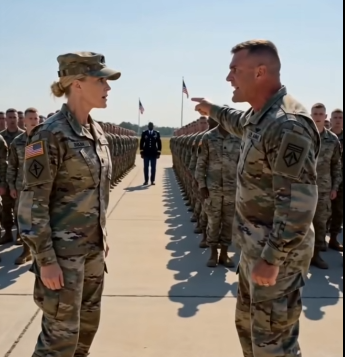
As military police approached, he pointed toward me.
“She’s manipulated everyone!”
Nobody moved.
Nobody agreed.
Nobody supported him.
That seemed to anger him even more.
But before he could continue, he was escorted away.
The graduation ceremony resumed.
Yet everyone knew the story wasn’t over.
In many ways, it had just begun.
Because investigators were now interested in those evaluations.
And what they uncovered would shock the entire training brigade.
PART 5
Three days later, an official inquiry began.
At first the investigation focused on the assault.
That part was straightforward.
Hundreds of witnesses had seen it.
Several cameras had recorded it.
There was no dispute.
Then investigators started reviewing the evaluation packet.
Patterns emerged immediately.
The complaints stretched back years.
Not months.
Years.
Different recruits.
Different companies.
Different training cycles.
Yet the allegations remained remarkably consistent.
One investigator noticed something unusual.
Several instructors had received unexpectedly low performance ratings.
Ratings that influenced promotion opportunities.
Assignment selections.
Career advancement.
The investigators dug deeper.
And discovered something disturbing.
The low ratings almost always benefited one person.
Eric Collins.
The inquiry expanded overnight.
Training records were pulled.
Evaluation histories were reviewed.
Archived reports were examined.
And that’s when investigators found the first undeniable piece of evidence.
Several evaluation summaries had been modified after submission.
The original versions still existed in backup files.
The changes consistently elevated Eric’s standing.
And diminished everyone else’s.
Including mine.
PART 6
The deeper investigators dug, the worse things became.
Former instructors were interviewed.
Retired personnel were contacted.
Previous commanders provided statements.
One retired first sergeant revealed something nobody expected.
He had maintained personal copies of instructor rankings for nearly a decade.
At the time, he didn’t trust some of the numbers he was seeing.
So he saved everything.
Those records became invaluable.
The original rankings told a completely different story.
Multiple instructors had outperformed Eric over the years.
Multiple instructors should have received recognition instead.
Yet somehow the official results consistently favored him.
The evidence became overwhelming.
Then investigators discovered emails.
Hundreds of them.
Some contained complaints.
Others contained warnings.
Several supervisors had raised concerns years earlier.
The concerns never went anywhere.
Until now.
The inquiry team eventually reached a troubling conclusion.
Eric hadn’t simply been jealous of my award.
He had spent years building his reputation by undermining others.
The recognition I received threatened that image.
And when the recruits publicly chose me instead of him, he snapped.
PART 7
The formal hearing took place two months later.
The room was packed.
Commanders.
Investigators.
Legal advisors.
Senior noncommissioned officers.
Everyone wanted to hear the findings.
Witness after witness testified.
Evidence filled entire tables.
Evaluation records.
Email chains.
Archived reports.
Video footage from the parade ground.
Then the recruits spoke.
Several volunteered to testify.
Their statements were powerful.
One recruit described how I stayed late every night helping struggling trainees.
Another described extra coaching sessions before difficult evaluations.
Another recalled me spending hours mentoring recruits who wanted to quit.
None of them talked about toughness.
None of them talked about punishment.
They talked about leadership.
Real leadership.
The kind that improves people instead of tearing them down.
As testimony continued, Eric sat silently.
Gone was the confidence.
Gone was the arrogance.
Gone was the certainty.
By the end of the hearing, the outcome seemed obvious.
But nobody expected Eric’s final statement.
When asked if he wished to address the panel, he stood slowly.
Then he said something surprising.
“I never thought they’d choose her.”
The room remained silent.
“I thought if I worked harder, talked louder, and demanded more respect, people would eventually see me as the best.”
He swallowed.
“But they never did.”
For the first time, he sounded less angry than defeated.
And perhaps he finally understood why.
PART 8 (THE END)
Three weeks later, the final decision was announced.
Eric Collins was removed from his instructor position.
His promotion recommendations were withdrawn.
Several previous evaluations were corrected.
Multiple recognition decisions were reviewed.
The battalion also implemented major reforms regarding instructor assessments.
Transparency increased.
Independent reviews expanded.
Evaluation safeguards were strengthened.
The sealed packet from the recruit had exposed problems nobody realized existed.
Months later, I was walking across the training grounds when a familiar voice called my name.
I turned.
A group of former recruits approached.
Many had already reported to their operational units.
Some had traveled hours to visit.
One of them carried a small framed photograph.
It showed our graduation cycle.
Hundreds of recruits standing proudly together.
He handed it to me.
On the back was a handwritten message signed by dozens of names.
The note read:
“Thank you for teaching us that leadership is earned, not demanded.”
For several moments I couldn’t speak.
Of all the awards I’d received, that simple message meant the most.
Because it came from the people who mattered.
The recruits.
The people whose lives and careers had been shaped during those months.
Years later, many of those recruits became leaders themselves.
Some became instructors.
Some became senior noncommissioned officers.
Some became officers.
A few even returned to the same training battalion.
Whenever they were asked about leadership, many remembered that graduation day.
Not because of the award.
Not because of the scandal.
But because of the lesson it revealed.
Authority can be given.
Rank can be awarded.
Titles can be assigned.
But respect is different.
Respect cannot be demanded.
It cannot be forced.
It cannot be stolen.
It must be earned.
Eric spent years trying to convince people he was the most important instructor in the battalion.
In the end, the recruits themselves revealed the truth.
And the evaluation packet he feared most became the very thing that exposed everything.
As for me, I kept the photograph.
It still hangs in my office today.
Not as a reminder of the slap.
Not as a reminder of the investigation.
But as a reminder that the strongest leaders aren’t the ones who seek applause.
They’re the ones who inspire it.
And on that graduation field, surrounded by hundreds of recruits, that truth became impossible for anyone to ignore.
