I picked up the shopping list.
It continued for almost an entire page.
Imported supplements for his mother.
Designer cosmetics for Phiangdao.
A new tablet for his nephew.
Gifts for relatives I had met only twice.
At the bottom, my mother-in-law had written:
“Praepilai will pay. She earns more.”
I stood there for several seconds.
Then I laughed.
Not because it was funny.
Because suddenly everything became clear.
This had never been a honeymoon.
It was an introduction to the rest of my married life.
Pichaya’s family would ask.
He would agree.
And I would pay.
I photographed the list and sent it to my lawyer.
Then I called my bank.
First, I removed Pichaya’s supplementary access to the account where my salary was deposited.
Next, I canceled the card his mother had been using.
Finally, I transferred my personal savings into the account protected under our prenuptial agreement.
My lawyer called twenty minutes later.
“You really signed the divorce papers?”
“Yes.”
“Three days after the wedding?”
“Three days too late.”
He laughed softly.
“Then we’ll make this simple.”
The apartment we lived in was mine.
Purchased four years before I met Pichaya.
The car was mine.
The savings were mine.
Even most of the furniture was mine.
Pichaya had contributed monthly household expenses, but legally he owned almost nothing inside that home.
I packed his clothes first.
Then his mother’s.
Then the boxes Phiangdao had left at our place because “her apartment was too small.”
By noon, everything was labeled.
PICHAYA.
MOTHER.
PHIANGDAO.
I called a storage company.
“Pick it all up.”
That afternoon, I changed the locks.
At four, Pichaya finally found a number I hadn’t blocked.
He called from the hotel reception.
“Praepilai!”
His voice exploded through the phone.
“What did you do to the bank card?”
“I canceled it.”
“My mother was trying to pay for lunch!”
“Then you should pay.”
“You know I don’t have enough on that account!”
“Then eat somewhere cheaper.”
He went silent.
I could almost imagine his expression.
He had never heard me speak to him like that.
Then his voice softened.
“Enough. You’ve made your point.”
I smiled.
“What point?”
“You wanted me to know you were upset.”
“No.”
“I wanted a divorce.”
Silence.
Then he laughed.
“You’re not divorcing me because you slept on a couch for one night.”
“I didn’t sleep on the couch.”
“What?”
“I flew home.”
Another silence.
“And your things are no longer in my apartment.”
His voice turned sharp.
“Our apartment.”
“My apartment.”
“Praepilai.”
“The deed is in my name.”
He breathed heavily.
“What about Mom and Phiangdao’s belongings?”
“In storage.”
“You threw my mother’s things out?”
“I moved the belongings of people who don’t live here.”
His anger became almost hysterical.
“You’ve lost your mind!”
“No.”
I looked around the quiet apartment.
“I found it.”
They returned to Bangkok the following afternoon.
Not because the honeymoon was over.
Because Pichaya’s credit card limit had been reached.
When they arrived at my door, Pichaya tried his key.
It didn’t work.
He tried again.
Then he began pounding.
“Praepilai!”
I watched through the security camera.
His mother was standing behind him with three suitcases.
Phiangdao looked furious.
I opened the door but kept the chain attached.
My mother-in-law immediately shouted:
“What kind of daughter-in-law changes the locks while her elders are traveling?”
“The divorced kind.”
She froze.
Pichaya pushed forward.
“Stop saying that.”
I held up the signed agreement.
His face changed.
“I already submitted it.”
His mother snatched the papers.
After reading the first page, she looked at her son.
“What does this mean?”
“It means your son is leaving this marriage with what he brought into it.”
Her expression relaxed slightly.
Then my lawyer stepped into view behind me.
“He brought approximately seventy-eight thousand baht in personal savings and one motorcycle registered before marriage.”
Her smile disappeared.
“What about this apartment?”
“Ms. Praepilai’s premarital property.”
“The car?”
“Hers.”
“The investment account?”
“Hers.”
She stared at me.
Then she said the sentence that ended any remaining doubt.
“But Pichaya is your husband! If you have money, isn’t it his money too?”
I smiled.
“That belief is exactly why he’s no longer going to be my husband.”
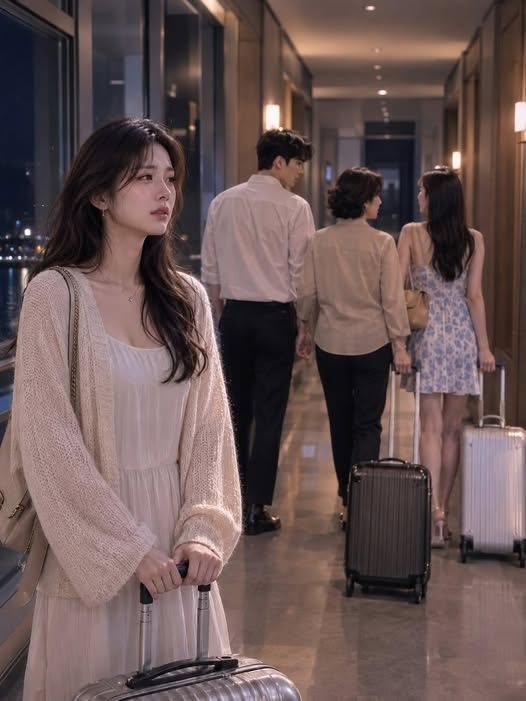
Phiangdao suddenly stepped forward.
“What about the money for my new business?”
I blinked.
“What money?”
She looked at her brother.
Pichaya’s face went white.
That was how I found out.
Before our wedding, Pichaya had promised his sister six hundred thousand baht to open a beauty salon.
My money.
Not his.
He had planned to ask me after the honeymoon, assuming I would agree because we were “family.”
His mother had also expected me to help pay the down payment on a larger apartment for her.
They had already chosen one.
I looked at Pichaya.
“You planned all of this?”
He lowered his voice.
“I was going to discuss it with you.”
“When?”
“After we got back.”
“After your mother and sister slept in our honeymoon room while I slept in the lobby?”
His face tightened.
“It wasn’t like that.”
“It was exactly like that.”
The divorce took less than three months.
Pichaya tried everything.
Anger.
Apologies.
Flowers.
Then he blamed his mother.
When that failed, he blamed Phiangdao.
Finally, he blamed me.
“You never gave our marriage a chance.”
I looked at him across the mediation table.
“I gave it three days.”
“And in three days, you taught me exactly what the next thirty years would look like.”
He had no response.
His mother called me repeatedly until my lawyer sent a formal notice.
Phiangdao’s salon never opened.
Without my money, her “business plan” apparently disappeared too.
Pichaya moved into his mother’s apartment.
Six months later, I heard through mutual friends that they were fighting constantly.
His mother complained he did not earn enough.
Phiangdao complained he no longer paid for her expenses.
The same man who had told me that family should always give way to family was suddenly discovering how exhausting generosity felt when the money came from his own pocket.
A year later, I returned to Chiang Mai.
Alone.
I stayed at a small riverside hotel.
I booked the best room they had.
That evening, I sat on the balcony drinking tea while the mountains disappeared beneath the sunset.
No one asked me to buy water.
No one handed me a shopping list.
No one told me where to sleep.
The same taxi driver who had taken me to the airport happened to pick me up on my final day.
He recognized me.
“You were the lady who threw away her wedding ring.”
I laughed.
“You remember?”
“Hard to forget.”
He looked at me through the mirror.
“Did everything work out?”
I thought for a moment.
Then I nodded.
“Yes.”
I had once believed leaving my honeymoon alone meant my marriage had failed.
Later, I understood something much simpler.
The marriage had failed when my husband watched his new wife stand in a hotel hallway and decided her comfort mattered less than everyone else’s.
Getting on that plane wasn’t the failure.
It was the first successful decision I made as a married woman.
And by the time Pichaya and his family finally regretted treating me like the wallet, servant, and spare bed of their household…
I was already somewhere they could no longer reach.
Living a life where no one had to move aside so someone else could take their place.
