PART 2 — THE ENVELOPE
The room felt frozen in time.
My cheek still stung from the slap.
The commanding general stood motionless behind his desk.
The inspector general investigator calmly stepped forward.
No one spoke.
No one moved.
The sealed envelope in his hand suddenly seemed more important than anything else in the room.
The investigator opened it.
Inside was a thick stack of documents.
Emails.
Phone records.
Meeting notes.
Memorandums.
The investigator placed them carefully on the general’s desk.
Then he looked directly at him.
“Sir, these documents were submitted by multiple witnesses.”
The general’s face lost what little color remained.
One of the colonels standing near the wall visibly swallowed.
The investigator continued.
“The complaint alleges repeated attempts to contact members of the War College selection board.”
A collective gasp moved through the office.
My stomach tightened.
That wasn’t just inappropriate.
It was potentially career-ending.
The investigator lifted the first document.
“Would you like me to read the names involved?”
The general remained silent.
The investigator took that as permission.
And began reading.
PART 3 — THE NAMES
One by one, names filled the room.
Retired officers.
Former instructors.
Administrative staff.
Board liaisons.
Individuals who had received phone calls from the general.
Individuals who had been asked unusual questions.
Individuals who reported feeling pressured.
The evidence was overwhelming.
The investigator finally stopped.
Then he revealed the most damaging detail.
Several conversations had been recorded.
Legally.
With consent.
The investigator pressed a button on a small recorder.
A voice filled the room.
The general’s voice.
No one could mistake it.
The recording was crystal clear.
“Perhaps another review of the applicants would be appropriate.”
Another voice responded.
“The board has already made its decision.”
The general answered immediately.
“Some decisions deserve reconsideration.”
The room fell silent.
The recording ended.
Nobody breathed.
Nobody needed an explanation.
The implication was obvious.
The investigator looked around the room.
Then he calmly asked:
“Would anyone here like to dispute the authenticity of this recording?”
No one spoke.
Not even the general.
PART 4 — THE SON
For several minutes the investigation team reviewed documents.
The atmosphere became unbearable.
Then the lead investigator asked a question nobody expected.
“Where is Major David Mercer?”
The room looked confused.
The name wasn’t familiar to everyone.
Then realization hit.
David Mercer.
The general’s son.
The officer whose application had not been selected.
One staff officer quietly explained that he was attending training several states away.
The investigator nodded.
Then he opened another folder.
Inside was a signed statement.
Everyone watched.
The investigator read aloud.
The statement was written by David himself.
The room became absolutely silent.
According to the document, David had repeatedly told his father not to interfere.
Not once.
Not twice.
Repeatedly.
He had warned him.
Argued with him.
Even refused offers of assistance.
One passage stunned everyone.
“If I am qualified, I want to earn selection honestly. If I am not selected, then another officer deserves the opportunity.”
I felt chills.
The investigator lowered the paper.
The room looked shocked.
Even the general appeared stunned.
Because for the first time, everyone understood something important.
His son had never wanted any of this.
The pressure.
The interference.
The favoritism.
None of it came from David.
It came entirely from the general.
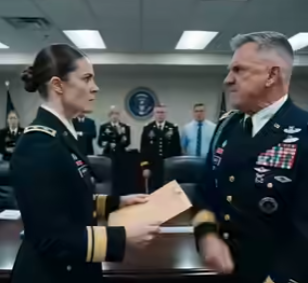
PART 5 — THE SECOND INVESTIGATION
The inspector general team wasn’t finished.
Not even close.
The lead investigator opened a second envelope.
This one was marked confidential.
His expression hardened.
“There’s another matter.”
The general looked exhausted.
“What matter?”
The investigator placed several evaluation reports on the desk.
My heart skipped a beat.
I recognized them.
They were officer evaluation reports.
Mine.
The investigator looked toward me.
“Captain King, did you ever receive copies of these evaluations?”
I frowned.
“No, sir.”
The room immediately grew tense.
The investigator nodded.
“That’s what we expected.”
He turned another page.
Several evaluations had been altered.
Not dramatically.
Subtly.
A score lowered here.
A recommendation weakened there.
Small changes.
Changes that could affect promotion boards.
School selections.
Career progression.
The investigator continued.
“Someone attempted to reduce the competitiveness of multiple officers.”
The room erupted.
Several staff officers immediately recognized the significance.
This wasn’t just about War College anymore.
This was about careers.
Dozens of careers.
Possibly hundreds.
The investigator finally revealed the conclusion.
Every altered report involved officers who competed directly against individuals favored by the general.
The room went silent again.
The scope of the scandal had suddenly become much larger.
PART 6 — THE WOMAN IN THE PHOTOGRAPH
As investigators continued reviewing evidence, another discovery emerged.
One investigator removed an old photograph from the file.
The picture showed a young lieutenant standing beside the general decades earlier.
The lieutenant was a woman.
I didn’t recognize her.
But the general did.
His reaction was immediate.
His eyes widened.
The investigator noticed.
“Do you know her?”
The general sat down heavily.
For the first time all day, he looked defeated.
Completely defeated.
“Yes.”
The investigator waited.
The general stared at the photograph.
Then he quietly answered.
“Her name was Sarah King.”
My heart nearly stopped.
King.
My last name.
The room spun.
The investigator looked surprised.
“You knew Captain King’s mother?”
I stared at the general.
The general stared at me.
Then he nodded slowly.
Sarah King had served under him decades earlier.
According to everyone who knew her, she had been one of the most talented officers of her generation.
Brilliant.
Respected.
Exceptional.
But her career had stalled unexpectedly.
Promotion opportunities disappeared.
Assignments vanished.
Recognition faded.
Eventually she left the service.
The investigator opened another file.
And the truth emerged.
The same pattern investigators found today had happened years earlier.
Sarah King had competed against another officer favored by powerful leadership.
Her evaluations had been manipulated.
Just like mine.
The room fell silent.
The general lowered his head.
Because he had known.
For years.
And done nothing.
PART 7 — THE TRUTH NOBODY EXPECTED
The investigation stretched for months.
News of the scandal spread throughout military circles.
The general was relieved of command pending review.
Additional inquiries uncovered widespread misconduct.
Records were corrected.
Promotions reconsidered.
Careers restored.
But the biggest surprise arrived when David Mercer finally returned.
I expected resentment.
Anger.
Embarrassment.
Instead, he asked to meet.
When we sat down together, he looked exhausted.
“I’m sorry.”
The words caught me off guard.
“You don’t owe me an apology.”
He shook his head.
“Maybe not.”
His voice was quiet.
“But I still wanted to say it.”
David explained that he had spent years trying to earn recognition on his own.
Yet people constantly assumed his success came from his father.
Now he understood how damaging favoritism could be.
How unfair it felt.
How deeply it affected others.
Then he handed me something.
A letter.
I opened it carefully.
Inside was a recommendation.
Not for himself.
For me.
Written by several senior officers who had worked with both of us.
The recommendation praised integrity.
Leadership.
Professional courage.
The qualities expected of future senior leaders.
At the bottom were dozens of signatures.
David’s was one of them.
PART 8 — THE END
One year later, I arrived at War College.
The acceptance letter that had nearly become a disaster sat framed in my office.
Not because of the achievement.
Because of what it represented.
Truth.
Accountability.
Perseverance.
The investigation had transformed more than a single command.
New oversight procedures were implemented.
Evaluation systems were strengthened.
Whistleblower protections expanded.
Officers finally felt safer reporting misconduct.
One afternoon, while walking across campus, I received a message.
It was from my mother.
She had been following every development.
For years she carried the disappointment of opportunities lost.
Recognition denied.
A career unfairly altered.
Now the official review board had formally corrected her record.
Decades later.
Justice had finally arrived.
I called her immediately.
She cried before she could speak.
So did I.
Months later, during a leadership symposium, a guest speaker addressed our class.
It was David.
He spoke openly about accountability.
Humility.
The dangers of privilege.
The importance of earning trust.
When the session ended, the audience applauded for several minutes.
As everyone departed, he walked over and smiled.
“Looks like we both ended up where we were supposed to be.”
I smiled back.
“Looks like it.”
Years earlier, a general believed influence could determine destiny.
He was wrong.
Because merit survived.
Truth survived.
And integrity survived.
The slap that should have ended my career instead exposed years of hidden misconduct.
The acceptance letter that nearly became a weapon against me became proof that I belonged.
And the opportunity I fought so hard to earn became the beginning of something far greater than I ever imagined.
Not every battle is fought on a battlefield.
Some are fought in offices, boardrooms, and quiet moments when doing the right thing carries a price.
But in the end, integrity remains undefeated.
