PART 2
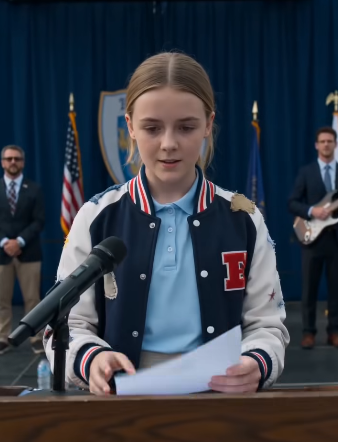
The amphitheater had become so quiet that the wind moving through the pine trees sounded deafening.
Hundreds of people stared at Victoria Sinclair.
For the first time in her life, she looked completely powerless.
The principal held the documents with trembling hands.
His eyes moved slowly across the final page.
Then he looked up.
“What investigators concluded,” he said carefully, “is that Miss Sinclair deliberately orchestrated the theft and destruction of academic records belonging to multiple students.”
The crowd erupted.
“What?”
“No way!”
“Academic records?”
Teachers exchanged stunned looks.
Parents began whispering frantically.
Several reporters rushed closer to the stage.
Victoria’s face turned white.
“That’s a lie!”
But her voice cracked.
The principal continued reading.
“The investigation found evidence that school database access credentials were improperly obtained and used to alter attendance histories, disciplinary records, and scholarship eligibility files.”
A collective gasp swept through the audience.
My stomach dropped.
Because one of the students mentioned in the report was me.
The principal looked directly at me.
Then back at the document.
“One affected student lost eligibility for several academic opportunities as a result of the alterations.”
I suddenly remembered something.
Months earlier, I had been denied a state scholarship.
The committee claimed my attendance records showed excessive absences.
The decision made no sense.
I had nearly perfect attendance.
My teachers had even argued on my behalf.
But nobody could explain the discrepancy.
Now I finally understood.
Someone had changed the records.
And according to the report, that person was Victoria.
PART 3
The crowd exploded into chaos.
Reporters immediately began broadcasting live updates.
Parents stood from their seats.
Students pulled out their phones.
Victoria looked around desperately.
“You’re all making a mistake.”
Nobody seemed convinced.
Then a voice came from the audience.
A teacher.
“I knew something wasn’t right.”
Everyone turned.
The teacher stepped forward.
“Three scholarship candidates were suddenly disqualified this year.”
Another teacher nodded.
“And every one of them was competing against Victoria.”
More whispers spread through the crowd.
Victoria’s breathing became visibly heavier.
The principal opened another document.
His expression darkened.
“There appears to be additional evidence.”
Victoria took a step backward.
“No.”
The principal continued reading.
“The investigation also identified anonymous complaints submitted against fellow students.”
A reporter raised a camera.
The principal looked shocked.
“Dozens of them.”
The audience gasped again.
Many of those complaints had triggered disciplinary reviews.
Others had delayed scholarship applications.
Some students had even lost opportunities because of them.
And every complaint traced back to the same source.
Victoria Sinclair.
A girl who already had every advantage imaginable.
Yet somehow it wasn’t enough.
She wanted every spotlight.
Every scholarship.
Every award.
Every opportunity.
Even the ones she hadn’t earned.
Then her phone rang.
The sound echoed through the amphitheater.
Everyone looked toward her.
Victoria glanced at the screen.
Her face immediately changed.
Fear.
Pure fear.
She declined the call.
One second later, it rang again.
The caller ID displayed a name many people recognized.
Charles Sinclair.
Her father.
The media mogul.
The owner of the largest news network in the region.
And apparently, he was watching.
PART 4
Victoria finally answered.
The microphone near the podium accidentally picked up part of the conversation.
Everyone heard the shouting.
“Don’t say another word.”
Her father’s voice boomed through the speakers.
The audience froze.
Victoria turned away.
“Dad—”
“I said stop talking.”
The call ended.
The silence afterward felt heavier than before.
The reporters immediately exchanged excited glances.
Because if Charles Sinclair was involved, the story had become much bigger.
Far bigger.
A school district investigation was one thing.
A media empire protecting misconduct was another.
Then a reporter raised her hand.
“Principal Hayes, may I ask a question?”
The principal nodded.
The reporter stepped forward.
“Why was this suspension notice being delivered privately instead of publicly?”
The principal hesitated.
Then answered honestly.
“Because we received multiple requests asking us not to proceed.”
The audience murmured.
“Requests from whom?” the reporter asked.
Another pause.
Then he said it.
“Individuals connected to the Sinclair Media Group.”
The amphitheater exploded.
Students shouted.
Parents demanded answers.
Teachers stared in disbelief.
The cameras captured everything.
For years, Charles Sinclair’s network had built a reputation on exposing corruption.
Now allegations suggested they might have hidden it within their own family.
Victoria looked like she wanted the ground to swallow her whole.
But fate wasn’t finished.
Not even close.
Because another envelope suddenly appeared.
PART 5
A woman stepped forward from the audience.
Nobody recognized her at first.
She carried a thick brown folder.
And she looked determined.
“Principal Hayes.”
The principal frowned.
“Can I help you?”
The woman handed him the folder.
“My name is Rachel Moreno.”
The name seemed familiar.
Then a reporter gasped.
Rachel had once worked as an investigative journalist for Sinclair Media.
Until she abruptly resigned.
The crowd leaned closer.
Rachel looked directly at Victoria.
Then at the cameras.
“I believe those people deserve the full truth.”
The principal opened the folder.
His eyes widened.
Inside were emails.
Financial documents.
Internal memos.
The more pages he turned, the paler he became.
“What is this?” he asked.
Rachel took a deep breath.
“Evidence.”
The crowd fell silent.
“Evidence that certain stories were buried.”
A reporter whispered, “Oh my God.”
Rachel nodded.
“For years, journalists uncovered misconduct involving influential families.”
She looked directly at Victoria.
“Some stories never aired.”
The implication hit everyone immediately.
The Sinclairs had allegedly used their influence to suppress damaging information.
Not once.
Not twice.
Repeatedly.
Then Rachel revealed the most shocking fact of all.
The first complaint against Victoria had been filed nearly three years earlier.
Three years.
And every investigation had mysteriously disappeared.
Until now.
PART 6
The scandal became national news before the festival even ended.
News vans flooded Yellowstone.
Television crews arrived from neighboring states.
Social media exploded.
By sunset, millions had seen the footage.
Victoria shoving me.
The envelope falling.
The documents being revealed.
The suspension notice.
Everything.
I should have felt victorious.
Instead, I felt overwhelmed.
None of this was supposed to happen.
I just wanted to give a graduation speech.
That night, after returning home, my father and I sat quietly in our small kitchen.
Buckets of unsold flowers stood near the door.
The scent of roses filled the room.
My father looked exhausted.
But proud.
Very proud.
“You handled yourself well today.”
I stared down at my hands.
“I didn’t do anything.”
He smiled.
“Sometimes doing nothing is exactly what matters.”
I didn’t understand.
Then he pointed toward the television.
Reporters were interviewing students.
Teachers.
Parents.
Everyone wanted someone to blame.
Someone to attack.
Someone to hate.
“You didn’t become that person,” he said.
I looked at him.
He continued softly.
“You stayed respectful.”
Those words stayed with me.
Because the next morning everything changed again.
A letter arrived at our house.
And it carried a name I never expected to see.
Victoria Sinclair.
PART 7
I opened the envelope carefully.
Inside was a handwritten note.
Just one page.
No lawyers.
No public relations team.
No excuses.
Only Victoria.
The handwriting shook in places.
As if she’d been crying while writing it.
The first line stunned me.
“You deserved that speech.”
I read the sentence three times.
Then continued.
Victoria admitted everything.
Not every detail.
But enough.
She described growing up inside a family obsessed with image.
Perfection.
Winning.
Control.
Failure wasn’t tolerated.
Second place wasn’t acceptable.
Being ignored felt like disaster.
Over time, she became addicted to attention.
Every achievement had to belong to her.
Every spotlight.
Every headline.
Every award.
Until eventually she stopped caring how she got them.
Then she wrote something unexpected.
“When everyone applauded for you, I realized nobody was looking at me.”
The sentence felt painfully honest.
“I hated that feeling.”
I kept reading.
“But when the envelope fell, I finally understood what real humiliation feels like.”
Then came the final line.
“I am sorry.”
No excuses.
No justification.
Just those words.
I didn’t know what to think.
But a week later, I received another surprise.
One even bigger than the first.
PART 8 — THE END
Three weeks after the festival, the state scholarship committee contacted me.
The investigation had uncovered the altered records.
Every false absence.
Every manipulated file.
Every fabricated complaint.
The committee unanimously reversed its decision.
Then they offered something else.
A full academic scholarship.
Not because of sympathy.
Because my actual records qualified me.
I sat in stunned silence.
My father cried.
The first time I had ever seen him cry.
Years of selling flowers.
Years of sacrifice.
Years of struggling to pay bills.
And suddenly a future that seemed impossible was real.
But the biggest surprise came months later.
At graduation.
As students gathered for the ceremony, I noticed someone standing alone near the back.
Victoria.
She looked different.
Quieter.
Humbler.
The confidence that once demanded attention was gone.
She approached slowly.
“I heard you’re leaving for college next month.”
I nodded.
She smiled faintly.
“Congratulations.”
For a moment neither of us spoke.
Then she handed me a small package.
Inside was a single flower.
A white lily.
The same kind my father sold at the market.
Attached was a note.
“Real success doesn’t need stolen applause.”
I looked up.
Victoria smiled sadly.
Then turned and walked away.
I never saw her again.
Years later, I learned she left the state, enrolled in a different school, and spent much of her time working with organizations focused on ethics education.
Maybe people can change.
Maybe some scandals destroy lives.
Or maybe they reveal the truth people need most.
As for me, I finally delivered the speech that had been interrupted.
Not at the festival.
At graduation.
Standing before my classmates, teachers, and family, I looked across the crowd and saw my father holding a bouquet of flowers.
The same flowers that helped keep our lights on.
The same flowers that paid for notebooks.
The same flowers that carried us through difficult years.
I smiled and spoke the words I had written long before any scandal existed.
“Achievement isn’t about standing above others.”
“It’s about becoming someone you can respect when nobody is watching.”
The audience rose to its feet.
My teachers applauded.
My father wiped away tears.
And as the applause echoed across the valley, I realized something remarkable.
The envelope that was supposed to protect a lie had exposed the truth.
The scandal that was supposed to destroy a future had restored one.
And the girl who tried to steal the spotlight accidentally taught everyone the most important lesson of all:
Character matters long after applause fades.
That lesson changed every life it touched.
And it became the happiest ending nobody in Yellowstone could have predicted.
