The word “Reaper” hadn’t been spoken in years.
Not since the day I buried my uniform.
Not since I promised Sarah that Tyler would never know the person I used to be.
But now, sitting alone in that hospital parking lot, I realized something painful.
I had spent seventeen years running from violence.
And violence had found my son anyway.
The man on the other end of the phone didn’t ask questions.
He didn’t need to.
“Where?”
“Mercy General Hospital.”
A short pause.
Then:
“We’ll be there.”
The call ended.
I stared at the dark hospital windows.
Behind one of them was my son.
My entire world.
And somewhere in this county, Sheriff Rick Barnes was probably sleeping peacefully.
Because men like him always slept peacefully.
They believed consequences were for other people.
They believed a badge erased mistakes.
They believed the right people would protect them.
They were usually right.
Usually.
I walked back inside.
The hallway smelled like disinfectant and fear.
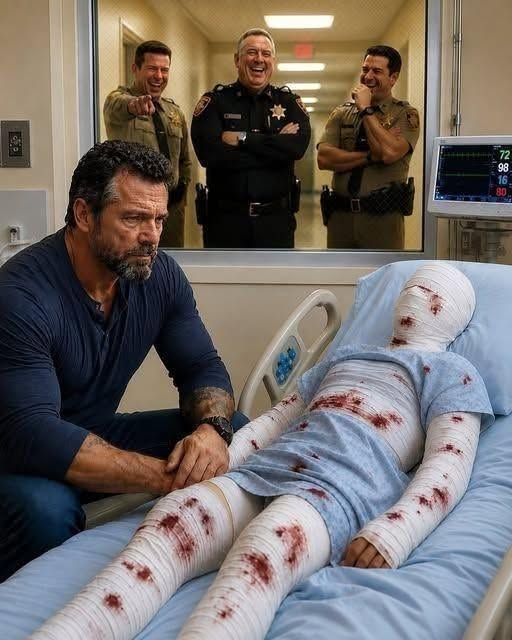
Sarah was sitting beside Tyler’s room, her hands wrapped around a cup of untouched coffee.
When she saw me, she immediately stood.
“Dennis.”
I sat beside her.
“How is he?”
She wiped her eyes.
“They took him out of surgery twenty minutes ago.”
I nodded.
“And?”
She looked at the floor.
“The doctor said they did everything they could.”
My jaw tightened.
“What did Barnes say?”
Sarah looked confused.
“What?”
“What happened before he shot him?”
She hesitated.
Then her face changed.
Like she had been holding something back.
“Tyler said he was walking home from practice.”
She swallowed.
“Barnes stopped him.”
“Why?”
“He said Tyler looked suspicious.”
I closed my eyes.
My son.
A seventeen-year-old boy.
Carrying a basketball bag.
Walking home.
Suspicious.
“What happened next?”
Sarah’s voice became quieter.
“Tyler asked why he was being stopped.”
“And?”
“He said Barnes got angry.”
She looked toward the hospital room.
“Tyler told him he hadn’t done anything.”
I already knew where this was going.
“Then Barnes pulled his weapon.”
Sarah started crying.
“He begged him.”
“He told him he was just a kid.”
My hands curled into fists.
“And Barnes laughed.”
She nodded.
“He laughed.”
For seventeen years, I had taught myself patience.
Control.
Discipline.
The ability to wait.
But hearing those words, I felt something I hadn’t felt in decades.
Not anger.
Something colder.
Purpose.
The elevator doors opened.
Three men stepped out.
They looked ordinary.
That was the point.
One wore a mechanic’s jacket.
One wore a delivery uniform.
One carried a medical bag.
Nobody would look twice.
Nobody except me.
The first man walked toward me.
“Dennis Irwin?”
I stood.
“Who’s asking?”
He smiled slightly.
“You used to call me Ghost.”
Sarah looked between us.
She had never seen this side of me.
The side I had buried.
“Marcus.”
He nodded.
“It’s been a long time.”
The others approached.
Evan.
Cole.
People who once followed me into places where nobody expected them to return.
Now they stood in a hospital hallway because my son needed them.
“I told you I was done,” I said quietly.
Marcus looked toward Tyler’s room.
“No.”
His voice was calm.
“You told us you wanted a normal life.”
A pause.
“But normal people don’t watch their children get hurt and do nothing.”
I looked away.
Because he was right.
The next morning, I walked into the Livingston County courthouse.
The same building where I had spent seventeen years mopping floors.
The same building where people ignored me.
Where politicians stepped around my bucket.
Where Sheriff Barnes walked past me without ever learning my name.
But today was different.
I wasn’t carrying a mop.
I was carrying evidence.
Security footage.
Medical records.
Witness statements.
Everything.
Barnes was inside his office laughing with two deputies.
When he saw me standing there, he smirked.
“Well, look who showed up.”
His eyes moved over my old boots.
My faded jacket.
The same clothes I wore every night.
“Come to clean my office?”
The deputies laughed.
I didn’t react.
“Sheriff Barnes.”
He leaned back.
“You have something to say?”
“Yes.”
I placed a folder on his desk.
“You’re going to answer for what happened to my son.”
His smile faded slightly.
Then he laughed.
“You?”
The word was full of disrespect.
“You’re a janitor.”
I looked at him.
“That’s what you think.”
Barnes opened the folder.
The first page was the hospital report.
The second was witness testimony.
The third was the security footage showing his patrol car.
His expression changed.
Only for a second.
But I saw it.
Fear.
Then arrogance returned.
“You don’t understand how this works.”
He leaned forward.
“People like me don’t fall.”
I almost smiled.
Because that sentence was always said by people right before they did.
I turned to leave.
Then Barnes called after me.
“Wait.”
I stopped.
He looked at me differently now.
Not like a janitor.
Like a problem.
“Who are you?”
I looked over my shoulder.
For seventeen years, I had been invisible.
But invisibility was a choice.
Not a weakness.
“My name is Dennis Irwin.”
I paused.
“And before I cleaned your floors…”
“I cleaned up situations men like you were never supposed to survive.”
For the first time, Sheriff Rick Barnes looked uncertain.
Because he finally understood something.
The old man with the mop wasn’t harmless.
He was someone who had spent years choosing peace.
And he had just been given a reason to stop choosing it.
That afternoon, Barnes received a call from someone higher up.
Then another.
Then another.
Because the investigation he thought he controlled had suddenly become something much bigger.
And when the first official report landed on his desk, his face went completely white.
The shooting of Tyler Irwin wasn’t the only thing they found.
There were years of hidden complaints.
Missing evidence.
Buried reports.
And a pattern that showed Sheriff Barnes had been protected for far too long.
But the person who finally brought him down wasn’t a politician.
Wasn’t another officer.
It was the father he thought didn’t matter.
read the entire Part 3 below.
