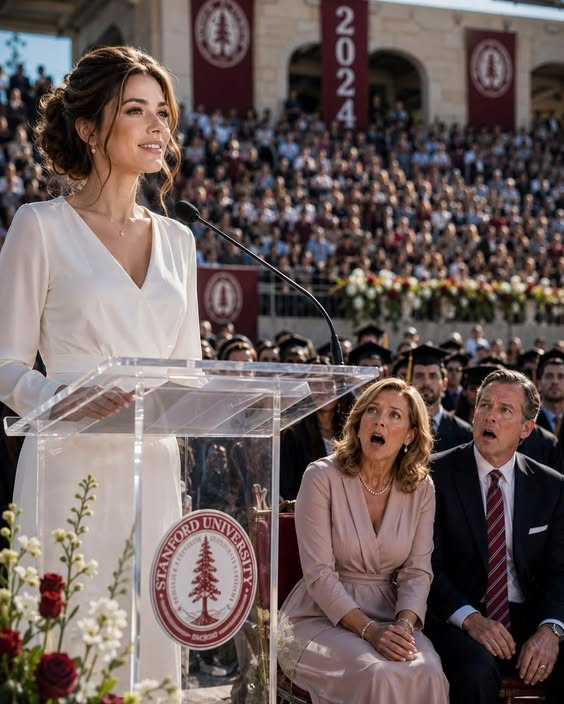
The applause continued for several seconds after I reached the podium.
Thousands of voices filled the stadium.
Students cheering.
Families shouting names.
Phones raised in the air, recording a moment they believed belonged only to the graduates.
But I wasn’t looking at the crowd.
I was looking at my mother.
For years, I had imagined this moment differently.
I imagined her standing in the front row at my PhD graduation.
I imagined her crying when my name was announced.
I imagined her saying, “That’s my daughter.”
Instead, two years earlier, she had looked at my greatest achievement and decided it wasn’t worth a plane ticket.
Now she was sitting in a Stanford stadium, watching me stand under the spotlight.
The irony was almost impossible to ignore.
The dean smiled beside me.
“Dr. Sarah Mitchell, the stage is yours.”
I adjusted the microphone.
For a moment, I thought about giving the speech I had written.
A speech about innovation.
A speech about renewable energy.
A speech about the future.
But then I remembered the message.
9:47 on a Tuesday morning.
“It’s embarrassing telling people you’re still a student at thirty.”
Those words had followed me through every failure.
Every rejected grant.
Every sleepless night.
Every moment when I wondered if my family was right.
So I decided the truth deserved to be heard.
“Good morning, everyone.”
My voice echoed across the stadium.
“Today is a celebration of achievement. But I want to begin by talking about something nobody sees.”
The crowd became quiet.
“The years before the achievement.”
I looked down briefly.
“The nights when nobody knows how hard you’re working. The failures nobody applauds. The moments when you wonder if the dream you are chasing is too difficult, too unrealistic, or simply not worth it.”
Out of the corner of my eye, I saw my mother shift in her seat.
She knew.
She knew exactly what I was talking about.
“Two years ago, I graduated from this university with my doctorate.”
The crowd applauded.
“My family wasn’t there.”
A silence fell.
“Not because they couldn’t come.”
I paused.
“But because they didn’t believe it mattered.”
My father’s hand slowly lowered his phone.
My mother’s expression changed.
For the first time, she wasn’t looking at me like someone who had disappointed her.
She was looking at me like someone she was finally seeing.
“I received a message the morning before my graduation.”
I smiled slightly.
“Four words.”
I let the silence build.
“Did it go okay?”
A few people in the audience laughed softly.
But many didn’t.
Because they understood.
Everyone knows what it feels like to achieve something and still wait for one specific person to say they are proud.
“I spent years trying to prove my work had value.”
I looked across the stadium.
“Then I realized something important.”
“The people who truly believe in your future don’t need to be convinced.”
The crowd erupted in applause.
Behind the curtain, I saw several faculty members wiping their eyes.
My mother looked frozen.
But I wasn’t finished.
“Today, I stand here because of everyone who supported me.”
“My research partners.”
“My team at Solar Reach.”
“The communities who trusted us enough to test our technology.”
“And most importantly…”
I looked toward the graduates.
“Because I learned how to believe in myself, even when the people closest to me couldn’t.”
The applause that followed was louder than anything I had heard before.
And somehow, it wasn’t revenge.
It wasn’t anger.
It was freedom.
After the ceremony, I returned backstage.
My phone had dozens of notifications.
Emails.
Messages.
Requests for interviews.
But one message stood out.
From my mother.
“Can we talk?”
I stared at the screen.
Two years ago, I would have answered immediately.
I would have dropped everything.
I would have tried to repair the distance between us.
But something inside me had changed.
I wasn’t the woman waiting for approval anymore.
I replied:
“Yes. Tomorrow.”
Not today.
Not because I wanted to punish her.
Because for once, my time mattered too.
The next morning, I met my parents at a small café near campus.
My mother looked different.
Older somehow.
Not physically.
Emotionally.
She kept touching her coffee cup but barely drank.
“Sarah…”
I waited.
“I’m sorry.”
Two words.
The words I had waited years to hear.
But strangely, they didn’t feel like the miracle I once imagined.
“I should have been there.”
I nodded.
“Yes.”
She looked surprised.
Maybe she expected me to say it was okay.
Maybe she expected forgiveness before she had earned it.
“I thought your research was a phase,” she admitted.
“I thought Derek was making the safer choice.”
I looked at her.
“Derek got his MBA. I’m proud of him.”
Her eyes filled with tears.
“I know.”
“But why did you have to choose one child to believe in and one child to doubt?”
She looked down.
And for the first time, she didn’t have an answer.
My father finally spoke.
“Sarah, we were wrong.”
I looked at him.
“We thought success looked like a big company, a high salary, a traditional career.”
I smiled sadly.
“But I built a company because I wanted to solve a problem. Not because I wanted people to call me successful.”
My mother wiped her eyes.
“Can we fix this?”
That question stayed between us.
Because some things can be repaired.
But they cannot be erased.
“I don’t know,” I said honestly.
Her face fell.
“But I want to try.”
She looked up.
“Really?”
I nodded.
“Yes.”
“But you have to understand something.”
“What?”
“I can’t go back to being the daughter who waits for permission to be valued.”
My mother nodded slowly.
“I understand.”
For the first time in years, I believed she might.
Six months later, Stanford invited me back again.
This time, not for a graduation.
For the opening of a new research center funded by Solar Reach.
When I stepped onto the stage, I saw my parents sitting in the front row.
Not because they had to.
Not because someone told them it mattered.
Because they chose to come.
My mother stood afterward and hugged me.
It wasn’t a perfect moment.
There were still wounds.
Still conversations we needed to have.
Still years we couldn’t recover.
But as she held me, she whispered:
“I’m proud of you, Sarah.”
And this time…
I believed her.
Because I had finally learned the most important lesson.
Your worth is not created when someone recognizes it.
It exists long before they do.
And sometimes the person you spend your whole life trying to impress…
Is the one person you should have been believing in all along.
