I left the diner just before sunset.
The entire drive home, my phone continued to light up on the passenger seat.
David.
Sarah.
David again.
They weren’t calling to ask if I was okay.
They weren’t calling because they were worried about my feelings.
They were calling because the machine they depended on had suddenly stopped working.
For years, I had convinced myself that helping my son was what a mother did.
After my husband passed away, I remembered how difficult those first months had been for David.
He had a mortgage.
A young family.
A demanding job.
And every time he came to me with a problem, I told myself the same thing.
“Just until he gets back on his feet.”
But somehow, “just until” had turned into six years.
Six years of paying bills I never discussed.
Six years of quietly transferring money because I didn’t want my son to struggle.
Six years of believing my generosity was an act of love.
Until the day they decided my kindness meant I had lost control.
When I arrived home, there was already a car parked in my driveway.
David’s SUV.
I almost laughed.
Apparently, the emergency was serious enough that he could leave work and drive across town.
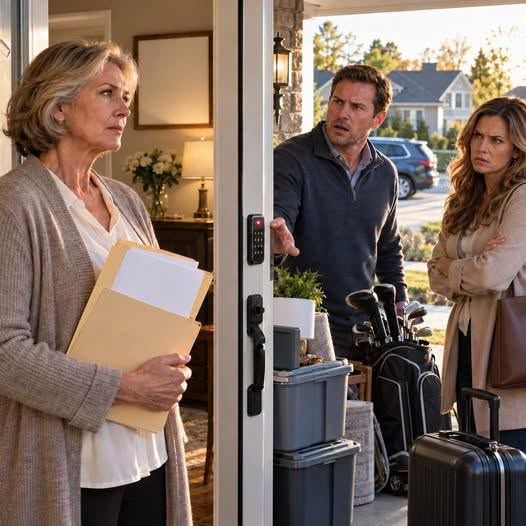
I stepped inside and found him standing in the living room.
Sarah was beside him, arms crossed.
Neither of them looked apologetic.
They looked angry.
“Mom,” David said immediately, “what did you do?”
I placed my purse on the table.
“I closed an account.”
His expression hardened.
“You closed our account.”
“No,” I corrected calmly.
“I closed my account that you were using.”
Sarah stepped forward.
“You’re making this sound so much worse than it is. We were only trying to help you.”
“Help me?”
I looked at her.
“By preventing me from buying flowers and soil?”
She sighed.
“You don’t understand. At your age, people can make emotional decisions. We were trying to protect your future.”
“My future?”
I almost couldn’t believe what I was hearing.
“My future was the one paying for your present.”
The room became silent.
David looked away.
That small movement told me everything.
Because he knew.
He knew exactly what I had discovered.
“Mom, we were going to talk to you about this eventually,” he said.
“About what?”
He hesitated.
Sarah answered for him.
“The house.”
My heart sank slightly.
“What about my house?”
She exchanged a glance with David.
Then she smiled.
A careful, rehearsed smile.
“We thought it would make sense if you moved closer to us.”
I stared at her.
“I live twenty minutes away.”
“Yes, but your house is too much for one person now.”
There it was.
The real reason.
They weren’t worried about my cards.
They weren’t worried about my spending.
They were preparing.
Preparing to make decisions for me.
Preparing to take control.
I folded my arms.
“And what happens to my house?”
David cleared his throat.
“We could sell it.”
I looked at my son.
My only child.
The boy I had raised alone after his father died.
The boy I had stayed awake for when he was sick.
The boy whose college tuition I helped pay.
And now he was standing in my home discussing selling it like it was a piece of furniture.
“Sell it,” I repeated.
“Yes, Mom. It’s a big responsibility.”
I nodded slowly.
“I see.”
Sarah relaxed, probably thinking she had convinced me.
But she didn’t know something.
Earlier that afternoon, before closing the account, I had asked Brenda at the bank for one more thing.
A copy of every beneficiary designation.
Every authorization.
Every document connected to my finances.
Because something about David’s behavior bothered me.
It wasn’t just entitlement.
It was preparation.
After they left, I sat at my kitchen table and opened the folder Brenda gave me.
At first, everything looked normal.
Then I found a document I had never seen before.
A request for financial review.
Submitted three months earlier.
The name requesting the review was not mine.
It was David’s.
My hands went cold.
He had already started asking questions about my accounts before the argument.
Before the cards.
Before he told me I was “getting old.”
He had been planning something.
I kept reading.
Attached to the request was a note from an outside advisor.
The words made my stomach tighten.
“Client may be experiencing vulnerability due to age. Recommend family intervention regarding asset management.”
Family intervention.
That was the phrase they used.
Not conversation.
Not concern.
Intervention.
As if I was a problem to be solved.
I closed the folder and sat there quietly.
Then my phone rang.
It was Brenda.
“Jessica, I need to tell you something important.”
I straightened.
“What happened?”
“There was another inquiry made about your accounts today.”
“By who?”
A pause.
Then she answered.
“Your son.”
I closed my eyes.
“What did he ask?”
Her voice lowered.
“He asked whether you had updated your will recently.”
The room felt completely still.
Because suddenly, the frozen credit cards were no longer the biggest betrayal.
The account they depended on was only one piece of the puzzle.
David and Sarah weren’t just trying to control my money.
They were trying to position themselves before I realized what they were doing.
And they had made one very serious mistake.
They underestimated the woman whose money they were trying to take.
I opened my laptop.
I searched for the number of the attorney who had handled my husband’s estate.
Because if my son wanted to play a game with my future…
I was about to show him that I knew the rules better than anyone.
And the first thing I was going to uncover was why my own son had been asking questions about my death before I was even gone.
