PART 2 — THE VIDEO THAT MADE THE WHOLE CROWD STOP BREATHING
The final recording began in silence, and somehow that silence felt louder than Madison’s insult.
On the giant screen above the riverfront stage, the security footage showed the mural at 2:17 in the morning. The arts district was dark, the lamps along the walkway glowing like small moons over the black water.
At first, nothing happened.
Then a figure appeared.
A girl in a white designer coat, her hair tucked under a hood, moved quickly toward the mural.
The crowd leaned forward.
Madison’s face went rigid.
I stood frozen, chocolate mousse dripping from my chin onto my ruined overalls. My hands trembled at my sides. The humiliation still burned on my skin, but now something colder moved through me.
The girl in the footage looked over her shoulder.
Then she lifted a can of black spray paint.
A murmur rippled through the audience.
“No,” someone whispered.
The figure sprayed across the lower corner of the mural. Long, ugly streaks slashed through the painted faces of children, elders, musicians, boat workers, and dancers. She crossed out the river I had painted with thin silver waves. She ruined the hands that I had spent three weeks perfecting.
Then she turned slightly toward the camera.
The screen caught her face.
Madison Beaumont.
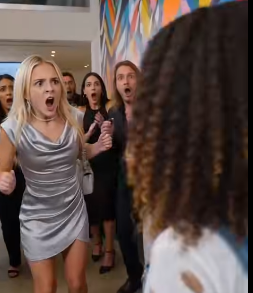
The crowd exploded.
Gasps. Shouts. Cameras clicking. Reporters pushing closer.
Madison staggered backward as if the pavement had tilted beneath her. Her lips parted, but no words came out.
The project director, Mr. Alvarez, stood beside the screen with his jaw tight.
“This,” he said, his voice carrying through the microphone, “is why the mural’s signing was delayed last month. Someone vandalized it. Someone tried to make it impossible for Liana Torres to finish.”
My name sounded strange in the air.
Liana Torres.
Not “the scholarship girl.”
Not “the kid from the west side.”
Not “the girl in paint-stained overalls.”
My actual name.
Mr. Alvarez turned toward Madison. “And this footage proves who did it.”
Madison shook her head. “That’s not—no. That video is taken out of context.”
A reporter called out, “What context could explain vandalizing public art?”
Her father, Victor Beaumont, pushed through the crowd with his wife behind him. He wore a navy suit that probably cost more than everything in my apartment. His face was red with anger, but I could not tell whether he was angry at Madison or embarrassed in public.
“Madison,” he said sharply. “What is this?”
Madison’s eyes filled with tears, but they weren’t soft tears. They were furious, cornered tears.
“She stole everything,” Madison cried, pointing at me. “Everyone acted like she was some genius. The newspapers wanted her. The city wanted her. Even you said she had talent.”
My chest tightened.
Victor Beaumont looked stunned. “So you destroyed her work?”
“I didn’t destroy it!” Madison screamed. “She fixed it, didn’t she?”
A terrible silence followed.
That sentence changed the crowd. It turned their shock into disgust.
Because everyone understood what she had just admitted.
Mr. Alvarez lowered the tablet. “You tried to ruin six months of her work because you were jealous.”
Madison’s mother covered her mouth.
My best friend, Nora, pushed through the crowd and reached me. She had been watching from the student volunteers’ area, her dark curls bouncing as she ran.
“Liana,” she whispered. “Are you okay?”
I wanted to say yes.
But my throat closed.
I looked down at the chocolate smeared across my shirt. I felt every camera. Every stranger. Every whisper. The mural behind me glowed under the afternoon light, repaired and finished, but I suddenly remembered the night I had found it ruined.
I remembered standing there alone under the lamps, my school backpack on the ground, staring at the black paint dripping down the faces I had loved into existence.
I remembered crying so hard I couldn’t breathe.
Then I remembered washing my face in the public restroom, coming back with brushes, and working until dawn because I refused to let hatred be the final mark on my wall.
Mr. Alvarez stepped toward me and handed me a clean towel.
“I’m sorry this happened here,” he said quietly.
I wiped mousse from my eyes.
Madison looked at me then. For the first time, she didn’t look powerful. She looked small. But I wasn’t ready to feel sorry for her.
Not after months of side comments.
Not after seeing her whisper to sponsors.
Not after hearing people say my mural probably only got selected because the district needed “diversity.”
Not after that night.
Victor Beaumont turned toward the director. “We will handle this privately.”
Mr. Alvarez’s expression hardened. “No, Mr. Beaumont. This mural belongs to the public. This ceremony belongs to the community. And what happened to Liana happened in public.”
A roar of applause broke out.
Madison flinched.
Then someone from the crowd shouted, “Let her sign it!”
Another voice joined. “Let Liana sign!”
Soon the whole waterfront was chanting my name.
“Liana! Liana! Liana!”
My knees nearly gave out.
Nora squeezed my hand. “Go.”
I looked at Madison. Her face twisted with humiliation.
For one dangerous second, I wanted revenge. I wanted to make a speech that would crush her. I wanted everyone to remember her as the spoiled girl who tried to ruin me.
But then I looked at the mural.
At the faces of my neighborhood.
At the grandmother holding a lantern.
At the boy launching a paper boat.
At the workers carrying beams.
At the musicians filling the sky with painted notes.
This mural was never supposed to be about Madison.
It was never supposed to be about me either.
It was about what survives.
So I stepped forward, took the ceremonial marker, and stood beneath the corner where my signature belonged.
My hand shook as I wrote:
Liana Marisol Torres
The crowd erupted.
But just as I lowered the marker, Madison made a sound I never expected.
Not anger.
Not a scream.
A sob.
She turned and ran down the riverside path, past the reporters, past her parents, past the applause that no longer belonged to her.
And even though she had humiliated me in front of hundreds of people, something about the way she ran made my heart twist.
Because she didn’t look like a villain escaping punishment.
She looked like someone running from a truth that had finally caught her.
PART 3 — THE GIRL WHO HAD EVERYTHING AND STILL FELT INVISIBLE
The next morning, my face was everywhere.
News clips. Social media posts. Local papers.
“TEEN ARTIST VINDICATED BY SECURITY FOOTAGE.”
“HEIRESS CAUGHT VANDALIZING RIVERSIDE MURAL.”
“CHICAGO STUDENT’S MASTERPIECE SURVIVES SABOTAGE.”
By lunchtime, my phone had so many notifications it froze.
Teachers congratulated me in hallways. Students I barely knew asked for selfies. Even the principal announced my achievement over the speakers, using a voice so proud you would think he had personally taught me how to hold a paintbrush.
But fame felt strange.
It didn’t erase the mousse hitting my face.
It didn’t erase Madison’s voice saying, “People should know who really deserves credit.”
It didn’t erase the footage of her destroying my work.
That afternoon, I went to the mural alone.
The district was quieter now. No stage. No cameras. No champagne glasses. Just the river, the wind, and my painted wall stretching beneath the bridge.
I stood before it and traced the air near my signature.
That was when I noticed an envelope taped beneath the ledge.
My name was written on it.
Not typed.
Handwritten.
LIANA.
I pulled it free and opened it.
Inside was one page.
I am not asking you to forgive me.
I know I don’t deserve that.
I just need you to know the video didn’t show everything.
Madison.
My pulse quickened.
The letter continued.
The night I vandalized your mural, I was not alone.
I read that line three times.
The wind seemed to stop.
Not because someone helped me spray paint it. I did that. I won’t lie anymore.
But someone sent me there.
Beneath the words was a phone number.
For a long time, I just stood there.
Then Nora’s voice came from behind me. “Please tell me that’s not from her.”
I jumped and turned. “How did you know I was here?”
“You always come here when your brain is loud.”
I handed her the letter.
She read it, and her eyebrows climbed higher with every line.
“Oh, absolutely not,” she said. “This is how people get dragged into rich people drama and end up on documentaries.”
“She says someone sent her.”
“Of course she does. Yesterday she got exposed in 4K. Today suddenly there’s a mystery villain.”
I wanted to agree.
I really did.
But something about the letter felt different from Madison’s usual performance. There were no excuses. No dramatic words. No attempt to sound innocent.
Just fear.
Nora folded the paper. “You’re not calling her.”
“I might.”
“Liana.”
“What if it’s true?”
“What if it’s a trap?”
I stared at the mural again.
The repaired section looked flawless from a distance. But I knew where the damage had been. I knew the exact places where black paint had bled beneath the color. I knew how hard I had worked to cover the scars.
Maybe that was why I couldn’t ignore the letter.
Because hidden damage still mattered.
That evening, I called the number from my bedroom while my little brother Mateo played video games in the living room and my mother cooked arroz con pollo after another double shift at the clinic.
Madison answered on the first ring.
For a moment, neither of us spoke.
Then she said, “I didn’t think you’d call.”
“I almost didn’t.”
“I deserve that.”
Her voice sounded raw, nothing like the sharp, polished girl from the ceremony.
“Who sent you?” I asked.
She inhaled shakily. “Can we meet?”
“No.”
“Please.”
“No,” I repeated. “You threw dessert at me in front of half of Chicago and vandalized my mural. You can talk on the phone.”
A long silence.
Then Madison said, “It was my father’s project manager. Dalton Reed.”
I frowned. I knew the name. Dalton was the man who always stood near the Beaumont family during district events. Tall, silver-haired, constantly smiling with no warmth behind his eyes.
“He told me your mural was a problem,” Madison continued. “He said the sponsors wanted a cleaner story. A Beaumont story. He said if your mural got damaged badly enough, the board would replace it with a digital installation from our family foundation.”
My stomach turned.
“Why would you listen?”
Madison gave a broken laugh. “Because I’m stupid.”
“That’s not an answer.”
“Because I wanted my father to notice me.” Her voice cracked. “Because every time he talked about the district, he talked about legacy. The Beaumont name. The future. And then everyone started talking about you. Your mural. Your talent. Your story.”
“So you tried to erase mine.”
“Yes,” she whispered. “I did.”
The honesty hit harder than any excuse could have.
Madison continued, “But Dalton didn’t care about me. He used me. After the footage came out, he told my father I acted alone. He said I was unstable.”
“Maybe he’s right.”
“I know what I did was terrible,” she said. “But Dalton has been stealing from the project. I heard him talking about invoices, fake restoration costs, contractors who don’t exist. The mural vandalism was supposed to justify emergency repair funds.”
I sat up straighter.
“You have proof?”
“No,” she said. “But I know where it might be.”
I closed my eyes.
This was the last thing I wanted. I wanted peace. I wanted art school applications. I wanted my mother to stop worrying about rent. I wanted one full week without someone rich deciding my life was a game board.
But I also knew something else.
If Dalton had used Madison to damage the mural, then he had used my work, my pain, and my public humiliation to hide something bigger.
“Where?” I asked.
Madison exhaled.
“My father’s yacht office.”
PART 4 — THE SECRET INSIDE THE YACHT OFFICE
Nora said the plan was terrible.
She said it while pacing my bedroom. She said it while eating my brother’s chips. She said it while pointing at me like a prosecutor.
“You are not sneaking into a yacht office with the girl who assaulted you with mousse.”
“She didn’t assault me with mousse.”
“She weaponized dessert.”
Mateo, sitting on the floor, raised his hand. “I agree with Nora.”
“You’re eleven,” I said.
“I have wisdom.”
I groaned into my pillow.
Nora sat beside me. Her voice softened. “Liana, I know you want the truth. But Madison is not your responsibility.”
“I’m not doing it for Madison.”
“Then who?”
I looked toward the kitchen, where my mother was reviewing bills at the table, her tired hands pressing against her forehead.
“For everyone they think they can use,” I said.
The next day, I met Madison outside Beaumont Marina just after sunset.
She wore a plain gray hoodie and jeans. No jewelry. No perfect makeup. She looked like she was trying to disappear.
“You came,” she said.
“I still don’t trust you.”
“You shouldn’t.”
That answer annoyed me because it sounded too honest.
The Beaumont Marina glittered with money. Yachts lined the docks like floating mansions. Glass offices overlooked the water, their windows reflecting the city lights.
Madison led me through a side entrance.
“My father has a private office above the showroom,” she whispered. “Dalton uses it after hours.”
“How do you know?”
“Because he thinks no one pays attention to me unless I’m causing trouble.”
We climbed a narrow staircase.
Every sound felt too loud.
At the top, Madison entered a code into the keypad. The lock clicked open.
Inside, the office smelled like leather, cedar, and cold air-conditioning. Framed photographs of Victor Beaumont shaking hands with mayors and business leaders covered the walls. A model yacht sat on a glass table. Behind the desk was a locked cabinet.
Madison moved straight to it.
“Do you know the code?” I asked.
“No.”
“Great.”
“But I know where he keeps things.”
She reached beneath a decorative silver compass on the desk and pulled out a tiny key.
I stared. “That was almost too easy.”
“Rich people think obvious hiding places become clever if the object is expensive.”
Despite myself, I nearly laughed.
Madison unlocked the cabinet.
Inside were folders, contracts, and several small black drives.
She pulled out one labeled RIVERSIDE EMERGENCY RESTORATION — PHASE TWO.
My heart pounded.
“There shouldn’t be a phase two,” I said. “The mural is finished.”
Madison opened the folder.
Inside were invoices for cleaning crews, repainting specialists, scaffold rentals, and security upgrades.
Total cost: $486,000.
I almost dropped the paper.
“That’s impossible,” I whispered. “I repaired the mural myself. Mr. Alvarez gave me donated supplies. It cost maybe a few hundred dollars.”
Madison looked sick. “Dalton billed the city and sponsors for nearly half a million.”
Then the office door opened.
Dalton Reed stood in the doorway.
For one second, no one moved.
He smiled.
“Well,” he said softly. “This is disappointing.”
Madison stepped in front of me. “Dalton—”
“Don’t.” His smile vanished. “You have already caused enough problems.”
He closed the door behind him.
My hand tightened around the folder.
Dalton looked at it and sighed. “That paperwork is confidential.”
“So is fraud,” I said, surprising myself with how steady my voice sounded.
His eyes shifted to me. “You should be careful, Miss Torres. Public affection is temporary. One wrong headline, and the city will forget you.”
Madison trembled. “You told me to ruin the mural.”
“I told you that emotional reactions have consequences,” Dalton said. “You chose vandalism.”
“You said my father would finally respect me if I protected the Beaumont legacy.”
“And did he?”
Madison flinched.
Dalton stepped closer. “Give me the folder.”
I backed away. “No.”
His expression hardened.
Then an alarm blared.
All three of us froze.
A voice shouted from downstairs, “Security! Upstairs!”
Dalton’s face changed.
Not fear.
Calculation.
He lunged toward me.
Madison shoved him.
The folder flew from my hands, papers scattering like white birds.
“Run!” Madison yelled.
We bolted through a side door onto an exterior balcony. The cold river wind slapped my face. Metal stairs spiraled down toward the docks.
Behind us, Dalton shouted, “Stop them!”
We ran down the stairs, across the dock, past polished yachts and coiled ropes. My shoes slipped on wet wood. Madison grabbed my arm before I fell.
At the end of the dock, a security guard blocked our path.
Madison raised both hands. “Call my father!”
The guard hesitated.
Dalton appeared behind us, breathing hard. “They broke into a private office and stole documents.”
I looked at the guard. “Check the folder. He’s stealing from the arts district.”
Dalton laughed. “A vandal and a scholarship girl. That’s your source?”
The words hit like a slap.
But before I could answer, another voice cut through the night.
“Actually,” Nora said from behind the guard, holding up her phone, “their source is a livestream with eight thousand viewers.”
I stared.
Nora smiled sweetly. “I told you the plan was terrible. So I followed you.”
Mateo’s voice came from the phone speaker. “And I told Mom.”
My soul left my body.
Then my mother’s furious voice came from somewhere near the marina entrance.
“LIANA MARISOL TORRES!”
For the first time in my life, I was grateful to be in trouble.
PART 5 — WHEN THE TRUTH COST MORE THAN MONEY
The police arrived before Dalton could talk his way out of anything.
So did Victor Beaumont.
So did Mr. Alvarez.
So did three reporters who had apparently been watching Nora’s livestream like it was the finale of a crime show.
My mother reached me first.
She grabbed my shoulders, checked my face, my arms, my hands, then pulled me into the kind of hug that is half love and half punishment.
“You scared ten years off my life,” she whispered.
“I’m sorry.”
“You will be.”
Fair.
Across the marina, Madison stood alone while her father spoke with officers. She looked smaller than ever beneath the white dock lights.
Dalton kept insisting the documents were private financial records taken out of context.
Then Nora handed the police her phone.
“I recorded him threatening them,” she said.
Dalton’s mouth snapped shut.
Mr. Alvarez reviewed the invoices with a face that darkened by the second.
“These charges were submitted after the vandalism,” he said. “But we never approved this restoration company. And this address…” He looked up. “This is a storage unit.”
Victor Beaumont turned slowly toward Dalton.
“Is that true?”
Dalton adjusted his cuffs. “Victor, this is a misunderstanding.”
“Answer me.”
Dalton said nothing.
That silence was louder than an admission.
Madison looked at her father. “He used me.”
Victor’s face tightened. “You still chose to vandalize the mural.”
“I know,” she said, tears slipping down her cheeks. “I know I did. I hate that I did.”
For the first time, Victor Beaumont looked less like a powerful man and more like a father who had missed something important for too long.
He lowered his voice. “Why didn’t you come to me?”
Madison laughed once, painfully. “When?”
That single word broke something open between them.
Victor looked away.
The scandal unfolded quickly after that.
Dalton Reed was arrested two days later after investigators found shell companies connected to multiple development projects. The fake restoration invoices were only part of it. Money had been leaking from the arts district for months.
The news loved the story.
They loved Dalton’s fall.
They loved Madison’s disgrace.
They loved Nora’s livestream.
And they loved me most of all.
But being loved by strangers is exhausting when your actual life still needs groceries.
My mother worried the attention would turn cruel. “People cheer today,” she said one night while folding laundry. “Tomorrow they look for flaws.”
“I didn’t ask for any of this.”
“I know, mija.”
She sat beside me and touched my hair. “But your name is out there now. Protect it.”
I tried.
I went to school. I painted. I answered interview questions carefully. I ignored comments online from people saying Madison had only made a “teen mistake,” and others saying her life should be destroyed forever.
Neither side felt right.
Then, one week after the marina incident, Madison came to our apartment.
My mother opened the door and stared at her with the expression of a woman who could defeat armies using only a wooden spoon.
Madison held a small box.
“Mrs. Torres,” she said, voice shaking, “I came to apologize.”
My mother crossed her arms. “To me?”
“To you. To Liana. To Mateo. To everyone I hurt.”
Mateo peeked from behind the couch. “Did you bring mousse?”
Madison blinked.
Nora, who had been doing homework at our kitchen table, choked on her soda.
Madison looked down at the box. “No. I brought tres leches cake.”
Mateo considered this. “Acceptable.”
My mother did not move.
Madison swallowed. “I know cake doesn’t fix anything.”
“No,” my mother said. “It doesn’t.”
“I’m paying for the damaged supplies. I’m doing community service at the district. And I’m giving a public statement taking full responsibility.”
I stood in the hallway, unsure what to feel.
Madison turned to me.
“I’m sorry,” she said. “Not because I got caught. Not because people hate me. I’m sorry because I looked at something beautiful you made and decided my insecurity mattered more than your work.”
The room went quiet.
Her words landed differently this time.
No performance.
No audience.
Just shame.
I wanted to stay angry because anger was easier. Anger made me strong. Anger gave me a wall to stand behind.
But her voice cracked when she said, “I don’t expect forgiveness. I just wanted to say it without cameras.”
My mother looked at me.
The choice was mine.
I took a breath. “I don’t forgive you yet.”
Madison nodded quickly. “I understand.”
“But I believe you’re sorry.”
Her eyes filled.
That was all I could give.
And somehow, it was enough to make her cry.
PART 6 — THE PAINTING MADISON NEVER SHOWED ANYONE
Community service looked strange on Madison Beaumont.
The first Saturday she arrived at the arts district wearing expensive sneakers, Mr. Alvarez handed her a bucket, gloves, and a scraper.
“Gum removal,” he said.
Madison stared at the sidewalk.
Nora whispered, “Character development smells minty.”
I elbowed her.
For weeks, Madison worked quietly. She cleaned benches. Sorted donated supplies. Helped children wash brushes after weekend art classes. At first, everyone watched her like she might explode.
But she didn’t.
She showed up early.
She stayed late.
She stopped wearing clothes that looked like magazine ads and started wearing old jeans stained with primer.
One afternoon, I found her sitting alone behind the supply room, sketching in a small notebook.
She slammed it shut when she saw me.
“What was that?” I asked.
“Nothing.”
“You draw?”
“No.”
“That was a sketchbook.”
“It’s a notebook with emotional damage.”
I almost smiled. “Can I see?”
Madison hesitated.
Then she handed it over.
I opened the pages and forgot what I was going to say.
They were beautiful.
Not polished. Not perfect. But alive.
Lonely girls standing in giant rooms. Boats tied to docks with chains made of flowers. A child behind a glass wall reaching for a paintbrush outside.
The last drawing showed the mural.
But in Madison’s version, I stood painting while a shadow behind me held a spray can. Above us, a little girl watched from the sky, crying gold tears.
I looked up.
Madison’s cheeks were red. “I know they’re not good.”
“They are good.”
“Don’t be nice.”
“I’m not.”
She looked away. “My mother used to paint.”
I had never heard anyone mention that.
“She stopped after my brother died,” Madison said.
The words came so quietly I almost missed them.
“You had a brother?”
“Elliot. He was seven. I was nine.” She stared at the ground. “Boating accident.”
I didn’t know what to say.
The Beaumont yacht empire suddenly felt less glamorous.
Madison twisted her hands. “After that, my father became obsessed with legacy. The business. The name. The foundation. My mother disappeared into charity events. And I learned that if I caused problems, at least someone looked at me.”
The air shifted.
Not enough to erase what she had done.
But enough to reveal the wound beneath it.
She continued, “When people praised your mural, I hated you because you had made grief beautiful. I had only made mine ugly.”
I sat beside her.
For a long while, neither of us spoke.
Then I said, “The mural wasn’t beautiful at first.”
Madison looked at me.
“I painted over mistakes constantly. Some days I hated it. Some days I wanted to quit. Some days the faces looked wrong, the colors looked dead, and I thought everyone would realize I was pretending to be an artist.”
“You?”
“Me.”
She stared at me as if that was impossible.
I handed back her sketchbook. “You should keep drawing.”
“My father would laugh.”
“Then don’t show him first.”
“Who should I show?”
I shrugged. “Someone who knows what it’s like to make something while feeling broken.”
Her eyes softened.
That day, we painted together for the first time.
Not on the mural.
On scrap boards behind the supply room, where no one important could see.
Madison painted a river at night.
I painted a boat made of lanterns.
Nora found us later and stared like she had walked in on a ghost friendship.
“I leave you alone for one hour,” she said, “and suddenly enemies-to-art-partners?”
Madison smiled faintly. “She still doesn’t forgive me.”
“Good,” Nora said. “Forgiveness should have a waiting list.”
But she sat down anyway.
And somehow, beneath the bridge with paint on our hands and the river shining beside us, the world felt less divided than before.
PART 7 — THE WALL BENEATH THE WALL
Two months later, the city announced a permanent youth arts program in the riverside district.
They called it The Living Wall Initiative.
I was invited to design the first project.
Madison volunteered quietly, never asking to be featured. Nora handled sign-ups. Mateo became the unofficial snack inspector. My mother pretended not to cry when she saw kids from our neighborhood lining up for free art supplies.
The new project involved a long neglected underpass wall near the riverwalk. It was cracked, stained, and covered with old posters.
On the first day, we began scraping away loose paint.
That was when Mateo shouted, “Uh, Liana? The wall has a secret.”
I turned.
Beneath the peeling layers, a patch of color had appeared.
Not graffiti.
A painting.
We carefully removed more flakes.
A face emerged.
Then hands.
Then a boat.
Mr. Alvarez brought restoration tools. By sunset, we had uncovered part of a hidden mural beneath decades of paint.
An elderly woman from the neighborhood, Mrs. Kowalski, came by walking her small dog. She stopped so abruptly the dog kept going and nearly pulled her over.
“Oh my God,” she whispered.
“You know this mural?” I asked.
Her eyes filled with tears. “Everyone thought it was gone.”
More people gathered.
Mrs. Kowalski touched the air near the wall. “It was painted in 1978. After the factory fire. Families lost everything. A young artist painted this for the workers.”
“What was her name?” Madison asked.
Mrs. Kowalski smiled sadly. “Marisol Vega.”
My breath stopped.
Marisol was my middle name.
“My abuela’s name was Marisol Vega,” I said.
The old woman turned to me slowly. “Your grandmother was Marisol?”
I nodded, unable to speak.
Mrs. Kowalski gripped my hands. “Then this is hers.”
The world blurred.
My grandmother had died when I was six. I remembered her only in fragments: warm hands, humming, the smell of turpentine, a laugh like wind chimes. My mother always said Abuela had painted signs and portraits, but she had never mentioned a mural.
That night, my mother came to the underpass straight from work.
When she saw the uncovered face on the wall, she covered her mouth.
“Mamá,” she whispered.
It turned out my grandmother had painted the original mural after a factory fire displaced dozens of families, including her own. Years later, during redevelopment, it had been painted over and forgotten.
Except it had not disappeared.
It had been waiting.
The city wanted to restore it.
Reporters returned.
Sponsors returned.
Victor Beaumont returned too, quieter than before. He stood with Madison, studying the uncovered mural.
“My company helped fund the redevelopment that covered it,” he said.
Madison looked at him. “Then help uncover it.”
He nodded.
For once, no speech followed.
Just action.
Restoration experts joined us. Historians searched archives. Community members brought old photographs. The hidden mural grew day by day, emerging like a memory refusing to die.
Then came the shocking discovery.
Behind a loose brick near the center of the wall, restoration workers found a rusted metal box.
Inside were old newspaper clippings, sketches, and a sealed letter.
The envelope read:
FOR THE ARTIST WHO FINDS THIS WALL AGAIN.
My hands shook as Mr. Alvarez gave it to me.
The crowd waited silently.
I opened the letter.
The handwriting was delicate but strong.
To whoever uncovers this,
Art is how the forgotten remain in the room.
They may paint over us. They may rename our streets. They may build towers where our homes once stood.
But color remembers.
If this wall finds another artist, promise me you will not only restore what was lost. Promise me you will add what survived.
Marisol Vega.
I couldn’t read the last line aloud because I was crying too hard.
My mother held me.
Madison stood nearby with tears streaming down her face.
And in that moment, the story changed.
The mural was no longer just mine.
It belonged to my grandmother.
To the workers.
To the families.
To Madison’s grief.
To my mother’s sacrifice.
To every person who had ever been covered over and still found a way to shine through.
I looked at Madison.
She looked back.
Then I said, “We need to paint a new section.”
Her eyes widened. “We?”
“Yes,” I said. “We.”
Nora gasped dramatically. “Historical moment. I need snacks.”
But she was smiling.
PART 8 — THE MASTERPIECE NO ONE SAW COMING
The final unveiling happened on a bright spring morning, almost exactly one year after the day Madison threw chocolate mousse at me.
This time, the waterfront was packed again.
Artists.
Sponsors.
City officials.
Reporters.
Families.
Children holding paintbrushes.
But everything felt different.
The stage was smaller. The crowd was closer. There were no velvet ropes separating important people from ordinary ones.
Because that had been my only condition.
No one would stand behind a barrier to look at a community wall.
The restored mural stretched beneath the underpass in breathtaking color. My grandmother’s original work formed the heart of it: workers holding lanterns after the factory fire, families carrying children and blankets, a river reflecting flames and stars.
Around it, we had added new scenes.
A nurse coming home at sunrise, inspired by my mother.
A girl repairing a mural under moonlight, inspired by the night I refused to give up.
A child launching a paper boat, inspired by Mateo.
A circle of young artists painting together, inspired by the kids who now filled the district every weekend.
And near the edge, partly hidden unless you looked closely, Madison had painted a white yacht tied to the dock with ropes that transformed into roots.
Beside it stood two children.
A girl and a boy.
The boy held a lantern.
The girl held a brush.
When Victor Beaumont saw that section, his face crumpled.
Madison stood beside him, trembling.
“That’s Elliot,” she whispered.
Victor reached for her hand.
For a moment, she seemed shocked.
Then she took it.
The applause began softly and grew until it echoed beneath the underpass like thunder.
Mr. Alvarez stepped to the microphone. “Today, we unveil not one artist’s masterpiece, but a conversation across generations.”
He looked at me. “Liana Torres reminded this city that art is not decoration. It is testimony.”
Then he looked at Madison. “And Madison Beaumont reminded us that accountability is not the end of a story. Sometimes, when someone chooses repair over pride, it can become the beginning of one.”
Madison lowered her head, crying openly.
When it was my turn to speak, I looked out at the crowd.
One year ago, I would have searched their faces for judgment.
Now I saw people.
Messy. Proud. Hurting. Hopeful.
I took a breath.
“My grandmother wrote that color remembers,” I said. “I think people do too. We remember harm. We remember kindness. We remember who tried to erase us. But we also remember who came back with a brush and helped repair the wall.”
I turned to Madison.
She covered her mouth.
“I didn’t know how this story would end,” I continued. “I thought it ended with security footage proving I made the mural. But that footage only proved what happened on the surface.”
I touched the restored wall behind me.
“The real masterpiece was underneath.”
The crowd went still.
“The real masterpiece was my grandmother’s hidden work. It was my mother’s sacrifices. It was my best friend refusing to let me be stupid alone. It was my little brother calling for backup. It was a community that remembered what others tried to cover. And yes, it was even a girl who made a terrible choice, then chose to spend every day afterward becoming someone different.”
Madison sobbed.
Nora whispered loudly, “I am emotionally compromised.”
People laughed through tears.
Then came the surprise.
Victor Beaumont stepped forward with an envelope.
Madison looked confused. “Dad?”
He faced the crowd.
“For years,” he said, “I believed legacy was something you put your name on. Buildings. Foundations. Donations. I was wrong.”
His voice broke slightly.
“Legacy is what you protect when no one is applauding.”
He handed the envelope to Mr. Alvarez.
“The Beaumont family is transferring ownership of the marina storage building beside the district to the city arts foundation. It will become a free youth studio and restoration center. Not named after my family.”
A stunned murmur spread.
Victor looked at me, then Madison.
“It will be called The Marisol Vega Center for Living Art.”
My mother gasped.
I couldn’t move.
Mr. Alvarez’s eyes shone.
Then Madison stepped up beside her father, holding another folder.
“And I’m donating my college fund to launch its first scholarship,” she said.
Victor turned sharply, startled. “Madison—”
She smiled through tears. “I already applied for financial aid.”
The crowd laughed softly.
She looked at me. “The first scholarship is for young artists whose work tells the truth about where they come from.”
My heart felt too full for my chest.
“You don’t have to do that,” I whispered.
“I know,” Madison said. “That’s why I want to.”
Then Mateo raised his hand from the front row. “Will the center have snacks?”
Victor smiled. “Yes.”
Mateo nodded solemnly. “Then I support this legacy.”
Everyone burst into laughter.
But the biggest shock came after the ceremony.
A woman with silver hair approached my mother and me. She carried an old canvas bag and had tears in her eyes.
“Are you Elena Torres?” she asked my mother.
My mother nodded.
The woman opened the bag and pulled out a wrapped bundle.
“I was your mother’s apprentice,” she said. “Before she died, Marisol asked me to keep these safe until her family found their way back to the wall.”
Inside were twelve small paintings.
My grandmother’s paintings.
Scenes of our old neighborhood.
A portrait of my mother as a little girl.
And one unfinished canvas of a baby with dark eyes.
On the back, written in my grandmother’s hand, were the words:
For Liana, who will finish what I could not.
I pressed the canvas to my chest and cried in front of everyone.
This time, I did not feel embarrassed.
Madison stood nearby, crying too. Nora hugged us both even though she claimed she was “not joining a group sob.” Mateo ate cake with deep emotional focus.
Later, after the crowd faded and the river turned gold with sunset, Madison and I sat beneath the mural.
“Do you forgive me now?” she asked quietly.
I looked at the wall.
At the scars beneath the paint.
At the old colors and new colors living together.
Then I looked at her.
“I think forgiveness is like restoration,” I said. “You don’t pretend the damage never happened. You work with it until something honest can exist there.”
Madison nodded. “Is that a yes?”
I smiled.
“It’s a beginning.”
She smiled back, and for the first time, there was no jealousy in it.
Only relief.
A year earlier, security footage had revealed Madison vandalizing my mural.
Everyone thought that was the shocking truth.
But they were wrong.
The footage proved who created the masterpiece.
It proved I had painted through exhaustion, humiliation, and doubt.
It proved Madison had tried to destroy what she couldn’t understand.
But the secret no one expected was that the greatest masterpiece had been hidden beneath the wall all along, waiting for the right hands to uncover it.
My grandmother’s.
Mine.
Madison’s.
The community’s.
And as the sun slipped behind Chicago’s skyline, the river caught the colors of both murals—the old and the new—and carried them forward like a promise.
Some people try to erase your story.
Some people try to steal your light.
But what is made with truth has a way of surviving every shadow.
And sometimes, the person who once ruined your masterpiece returns with trembling hands, a broken heart, and enough courage to help you paint the happiest ending no one saw coming.
THE END
