PART 2 — THE NAME IN THE LEDGER
The foundation director held the green donor ledger open beneath the golden lights of Seattle City Hall, and the entire ballroom leaned into the silence.
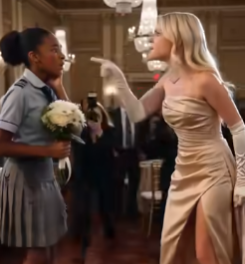
Victoria Kensington stood frozen near the stage steps, her hand still lifted from the slap she had given me. Her face, so polished and proud only moments earlier, now looked strangely fragile, as if one sentence had reached beneath all the diamonds and found the fear underneath.
The director adjusted his glasses.
“The family listed here,” he said slowly, “as the original anonymous sponsor of the Rainier Community Greenhouse is…”
He looked at me.
Then at Victoria.
Then back at the page.
“The Alvarez family.”
For one second, no one moved.
My name was Marisol Alvarez.
I was sixteen years old.
My mother cleaned offices at night. My grandfather sold tamales from a cart near the bus station until his knees gave out. We lived in a two-bedroom apartment above a laundromat that shook every time the dryers ran.
My family did not fund city projects.
My family counted coins before grocery trips.
My family reused jars, patched jackets, and prayed old things lasted one more winter.
A stunned murmur moved through the crowd.
Victoria let out a sharp laugh.
“That’s impossible,” she said. “Her family? Look at her.”
My cheek burned hotter than before.
Several guests turned toward Victoria with disgust.
The director did not argue. He simply turned the ledger toward the mayor and the board members seated beside her.
The mayor leaned close. Her expression changed from confusion to astonishment.
“This record goes back twelve years,” she said.
The director nodded. “The donor requested anonymity. The money was routed through a community trust. Small payments at first, then larger contributions after the land lease was secured.”
Victoria crossed her arms, trying to recover her confidence.
“So? Maybe someone used their name. People lie.”
At that moment, an elderly voice rose from the front row.
“No,” it said. “No one lied.”
My grandfather stood slowly.
His brown hands trembled around the handle of his cane. His best shirt was buttoned wrong at the collar, and his shoes were so carefully polished that the cracks in the leather shone.
“Abuelo?” I whispered.
He looked at me with eyes full of apology.
“I wanted to tell you someday, mija,” he said. “Not like this.”
The ballroom turned toward him.
He walked toward the stage, each step careful and heavy. My mother rose from her seat, one hand pressed to her mouth. Her eyes were already wet.
The director lowered the microphone for him.
My grandfather looked out at the room of wealthy donors, politicians, reporters, and people who had never once noticed the man selling food outside their office buildings.
“My name is Rafael Alvarez,” he said. “Twelve years ago, my wife died.”
The room softened.
“She loved plants. She grew tomatoes on our fire escape. Basil in coffee cans. Cilantro in broken buckets. She used to say, ‘A neighborhood with gardens is a neighborhood with hope.’”
My throat tightened.
I remembered my abuela only in flashes. Warm hands. A floral apron. The smell of soil after rain.
Grandfather continued, “After she passed, I saved what I could from the tamale cart. Five dollars here. Twenty there. When the city talked about building a greenhouse for families who could not afford fresh food, I gave in her name.”
The director gently turned another page in the ledger.
There it was.
Not just Alvarez.
In Memory of Elena Alvarez.
My abuela.
My knees nearly buckled.
My mother began crying openly.
For years, I had worked in that greenhouse believing I was only continuing something useful. I never knew I was walking inside my grandmother’s dream.
Victoria shook her head violently.
“This is ridiculous,” she snapped. “Even if some old man gave a few dollars, that doesn’t make her important.”
The words hit the room like poison.
My grandfather did not flinch.
“No,” he said quietly. “Money did not make her important.”
He turned to me.
“Work did. Love did. Showing up did.”
The applause began softly.
A community organizer near the aisle stood first. Then a teacher. Then a councilwoman. Then a table of local families who received vegetables from the greenhouse every week.
Soon the ballroom thundered.
Not polite applause.
Not charity applause.
It was the sound of people recognizing what had been hidden in plain sight.
Victoria stepped backward, pale with humiliation.
The event coordinator moved toward me. “Marisol,” he said gently, “the bouquet.”
I looked down.
Somehow, despite the slap, despite the shaking in my hands, I was still holding it.
Fresh fern.
White roses.
Tiny sprigs of rosemary from the greenhouse.
My cheek stung. My heart pounded. My grandfather stood beside me with tears in his eyes.
And for the first time all night, I understood.
Victoria had tried to knock me away from the stage.
Instead, she had pushed me directly into the truth.
PART 3 — THE GIRL WITH SOIL UNDER HER NAILS
I climbed the stage steps while the applause trembled around me.
The ballroom lights were blinding. Reporters aimed cameras at my face, probably capturing the red mark across my cheek. I wanted to hide behind the bouquet. I wanted to run back to the greenhouse, where the air smelled like damp leaves and no one cared whether my shoes were old.
But my grandfather’s words stayed with me.
Work did. Love did. Showing up did.
The mayor stood near the podium. She was a tall woman with silver hair and kind eyes, but even she looked shaken by what had happened.
“Marisol,” she said softly, “are you all right?”
I nodded, though I was not sure it was true.
She took the bouquet with both hands.
“These are beautiful.”
“They were grown by students,” I said. My voice sounded smaller than I wanted. “And by families from the neighborhood.”
The mayor turned toward the microphone.
“Then this bouquet represents Seattle better than any imported arrangement ever could.”
More applause rose.
Victoria stood below the stage, her jaw clenched so tightly it seemed painful. Security had moved beside her, but no one had removed her yet. Her father, Conrad Kensington, arrived from the donor table at the front, his tuxedo perfect, his expression cold.
Everyone in Seattle knew the Kensingtons.
Kensington & Vale Jewelers sponsored museum wings, hospital galas, private school auctions, and every event where photographers outnumbered volunteers. Their family name sparkled across billboards above downtown streets. Victoria had grown up beneath chandeliers, praised for breathing correctly, photographed for charity campaigns she barely attended.
And I had seen her before.
Not up close.
Never like this.
But I had watched her from across rooms at school events. She moved like the world had already been reserved for her. Teachers smiled nervously around her. Students stepped aside. Administrators praised her leadership because her family donated enough to make everyone forget she never stayed to clean up.
At school, I was the greenhouse girl.
The one who left early to catch the bus.
The one with soil under her nails.
The one who smelled faintly of compost and mint.
Victoria called me “garden help” once in the hallway.
I pretended not to hear.
That night, pretending became impossible.
Conrad Kensington approached the stage.
“Mayor Whitcomb,” he said smoothly, “I apologize for my daughter’s emotional reaction. Clearly there has been confusion regarding the ceremony.”
The mayor looked at him without smiling.
“Your daughter assaulted a student.”
His expression tightened for half a second before returning to its polished calm.
“An unfortunate mistake.”
I heard my mother inhale sharply from the front row.
A mistake was forgetting a name.
A mistake was spilling water.
A slap was a choice.
Conrad turned toward the audience.
“Our family has supported environmental causes for years. Victoria has been under tremendous pressure preparing for tonight’s youth leadership recognition. I’m certain she reacted from shock, not malice.”
Victoria’s eyes flicked toward him.
It was strange.
For all her arrogance, she suddenly looked less like a queen and more like a daughter waiting for instructions.
The foundation director spoke before anyone else could.
“Mr. Kensington, your family’s contributions are appreciated. But tonight’s bouquet presentation was not a donor privilege. It was awarded for service.”
Conrad smiled.
“Of course.”
But his eyes were sharp.
Then he looked at me.
For a moment, the ballroom disappeared.
I felt the full force of his attention, cold and measuring.
“Young lady,” he said, “I trust you understand that public embarrassment can damage many futures. Including your own.”
The warning was wrapped in velvet, but everyone heard the blade inside it.
My grandfather took one step forward.
“My granddaughter understands more than you think.”
Conrad barely glanced at him.
“I’m sure she does.”
The mayor lifted her hand.
“This event will continue. Miss Kensington will be escorted from the presentation area.”
Victoria’s mouth opened.
“Dad—”
Conrad’s voice dropped. “Not now.”
That was all.
Two words.
But they silenced her completely.
Security guided Victoria away from the stage. Her heels clicked against the marble floor, each step louder than the last. As she passed me, she whispered something only I could hear.
“This isn’t over.”
I believed her.
Because her eyes were no longer just angry.
They were afraid.
And frightened people with power can become more dangerous than cruel ones.
PART 4 — THE PRICE OF BEING SEEN
By morning, my face was everywhere.
Not my whole story.
Just my face.
A frozen image of my cheek turned red beneath Victoria’s hand. A clip of the donor ledger being opened. My grandfather at the microphone, saying my grandmother’s name with trembling pride.
The headlines called it shocking.
The comments called it inspiring.
Then the ugliness arrived.
Some people wrote that I was brave.
Others wrote that I had planned the whole thing.
A stranger posted, “Funny how poor people always become heroes when cameras are around.”
Another wrote, “The Kensington girl shouldn’t have slapped her, but this Marisol seems fake.”
I turned my phone off after that.
At school, everything changed.
Students stared when I entered the hallway. Some smiled. Some whispered. A few clapped awkwardly, which somehow felt worse. My locker had a sticky note on it that said GREENHOUSE QUEEN with a little crown drawn above the words.
Then I found another note under it.
STAY IN THE DIRT WHERE YOU BELONG.
I folded it slowly and put it in my backpack.
I did not want anyone to see my hands shaking.
At lunch, my best friend Naomi found me behind the library, sitting against the brick wall where no cameras could reach.
Naomi was the kind of friend who could insult you and comfort you in the same sentence.
“You look terrible,” she said, sitting beside me.
“Thanks.”
“I mean emotionally terrible. Your hair is fine.”
I laughed despite myself.
Then my eyes burned.
“I hate this,” I whispered.
“I know.”
“I didn’t ask to be on the stage.”
“I know.”
“I didn’t even know about Abuelo’s donations.”
Naomi leaned her shoulder into mine.
“That part was kind of legendary, though.”
I wiped my face with my sleeve.
“My grandma built the greenhouse, and I didn’t even know.”
“No,” Naomi said. “Your grandma planted it. Your grandpa watered it. You kept it alive.”
That sentence stayed with me all afternoon.
After school, I went to the greenhouse.
The moment I opened the door, warm air wrapped around me. Rows of lettuce stretched beneath misting lines. Tomato vines climbed twine toward the glass ceiling. A class of third graders had painted signs near the herb section: BASIL, OREGANO, HOPE.
That last one had been my idea.
I walked between the beds, checking leaves for pests and adjusting a drip hose that always slipped loose. My body knew what to do here. The greenhouse did not care about headlines. It only asked for patience.
Then I heard voices near the supply shed.
Adults.
Angry ones.
I moved closer, hidden behind tall bean trellises.
The greenhouse manager, Mr. Park, stood with two people in suits I did not recognize. One held a clipboard. The other spoke with the flat tone of someone delivering bad news without wanting to feel responsible.
“The lease review has been accelerated.”
Mr. Park frowned. “Accelerated? We have three years left.”
“The city has received a redevelopment proposal.”
“For this land?”
“Yes.”
My heart stopped.
Mr. Park shook his head. “This greenhouse feeds families. It runs youth programs. You cannot just—”
“The proposal includes an upscale retail plaza, public art space, and a privately funded sustainability exhibit.”
Privately funded.
I already knew.
Before they said the name, I knew.
Mr. Park’s face darkened.
“Who submitted it?”
The woman hesitated.
“Kensington & Vale Community Development.”
My fingers dug into the wooden trellis.
The slap had been public.
This was quieter.
Cleaner.
More dangerous.
Victoria had said it was not over.
Now I understood what she meant.
They were not just coming for me.
They were coming for the greenhouse.
PART 5 — THE GREENHOUSE FIGHTS BACK
That evening, my grandfather sat at the kitchen table with the donor ledger photocopies spread before him.
My mother paced behind him.
I had never seen her so angry.
“They cannot do this,” she said.
Grandfather’s mouth tightened. “People with money often confuse cannot with have not yet.”
I told them what I had heard. The accelerated lease review. The retail plaza. The sustainability exhibit that would replace an actual living greenhouse with a polished display about caring for the planet.
My mother pressed both hands against the table.
“So they want to destroy the thing your grandmother helped build because their daughter got embarrassed.”
No one answered.
Because the answer was obvious.
The next morning, Mr. Park called an emergency meeting at the greenhouse. Students came. Parents came. Elderly neighbors came carrying folding chairs. Teachers stood along the back wall. Even reporters waited outside the fence.
For the first time, I saw the full size of what we had built.
Mrs. Bell, who picked up vegetables for three families in her apartment building, stood and said, “My grandson eats greens now because of this place.”
A quiet boy named Theo said, “I used to skip school. Then Marisol taught me how to graft tomatoes. Now I want to study agriculture.”
A father with paint on his jeans said, “When I lost my job, this greenhouse helped us eat.”
Each voice made the room stronger.
Then Mr. Park asked me to speak.
I wanted to refuse.
But everyone turned toward me with expectation that did not feel like pressure.
It felt like trust.
I stood beside the seedling table.
“My grandmother believed gardens gave people hope,” I said. “My grandfather gave what little he had so this greenhouse could exist. But the truth is, it belongs to all of us. Every person who planted here. Every child who learned here. Every family who took home food from these beds.”
My voice shook, but it did not break.
“Victoria Kensington slapped me because she thought I did not belong on a stage. Now her family wants to take this greenhouse because they think people like us do not belong on valuable land.”
The room became completely still.
“So we are going to show them we belong. Not by shouting louder than them. By telling the truth louder than their money.”
The meeting erupted.
Within hours, the campaign began.
Naomi created a page called Save Rainier Greenhouse. Theo edited videos. Parents collected signatures. Teachers contacted former students. Community organizers prepared statements for the city council meeting.
Then something unexpected happened.
People who had seen the gala video began sending their own stories.
A nurse wrote that the greenhouse taught her daughter science when school felt impossible.
A chef offered to host a benefit dinner.
A retired architect offered to review city planning documents.
And then, late that night, a message appeared from an account with no profile picture.
Check the original lease. Kensington cannot touch the land if the memorial clause is active. They know this. Ask who removed it from the city packet.
I read the message three times.
Naomi, sitting beside me on my bedroom floor, whispered, “That sounds important.”
“It sounds fake.”
“Or it sounds like the part in movies where everything changes.”
The next morning, we went to City Hall records.
It took four hours, two forms, and one clerk who acted like teenagers asking questions were a threat to civilization.
But finally, we found it.
The original greenhouse land agreement.
Page seventeen.
A clause stating that as long as the property served active food-access and environmental education purposes, it could not be transferred to private commercial development without a supermajority public review.
At the bottom, signed by city officials and founding donors, was my grandfather’s shaky signature.
Beside it was another name.
One that made Naomi grab my arm.
Conrad Kensington.
I stared at it.
Kensington had signed the protection clause himself.
So why was his company now pretending it did not exist?
Then Naomi turned the page.
A recent copy had been attached.
Same agreement.
Same format.
But page seventeen was missing.
Someone had removed the clause.
And suddenly, this was no longer just revenge.
It was fraud.
PART 6 — THE HEIRESS WHO BROKE
The city council hearing was packed beyond capacity.
People stood in the aisles. Reporters lined the walls. The mayor sat at the center of the chamber, her face unreadable. Mr. Park had brought crates of vegetables from the greenhouse and placed them on the evidence table like living witnesses.
The Kensingtons arrived ten minutes late.
Conrad entered first, surrounded by lawyers.
Victoria followed behind him.
She looked different from the gala. No sparkling necklace. No dramatic makeup. Her hair was pulled back, and her eyes looked shadowed, as if sleep had become difficult.
When she saw me, she looked away.
The hearing began with polished presentations.
Kensington & Vale Community Development displayed glossy renderings of glass storefronts, rooftop gardens, and a “sustainability experience center” with interactive screens showing pictures of vegetables that would apparently replace the actual vegetables they planned to destroy.
Conrad spoke beautifully.
That was the frightening thing.
He made greed sound like generosity.
He called the greenhouse “underutilized land.”
He called displacement “modernization.”
He called a neighborhood food source “an emotional attachment to an outdated facility.”
Then Mr. Park spoke.
Then Mrs. Bell.
Then Theo.
Then my grandfather.
He walked slowly to the microphone, carrying a small framed photo of my grandmother.
“When I signed that agreement,” he said, “Mr. Kensington was there.”
Conrad’s face did not move.
Grandfather continued, “He shook my hand. He said Elena’s name would always be safe in that place.”
A councilmember leaned forward.
“Mr. Kensington, did you sign the original protective clause?”
Conrad smiled faintly.
“I would need to review the document.”
Naomi muttered beside me, “Liar.”
Then Grace Chen, the same attorney who had helped community groups before, stepped forward with our documents.
“We have reviewed the archived lease,” she said. “Page seventeen includes a memorial protection clause. The version submitted with the Kensington redevelopment proposal omits that page.”
The chamber erupted.
Conrad’s lawyers began speaking at once.
Grace raised her voice.
“We also request inquiry into who supplied the altered document to the planning office.”
The mayor’s expression hardened.
“Mr. Kensington?”
Conrad’s calm finally cracked.
“This is a clerical issue.”
A laugh rose from the back of the room.
Not amused.
Disbelieving.
Then Victoria stood.
“Dad,” she said.
Conrad turned sharply. “Sit down.”
The same command voice from the gala.
But this time, Victoria did not obey.
Her hands trembled as she walked to the microphone.
“Victoria,” Conrad warned, “do not make this worse.”
She looked at him, and for one second I saw everything she had been taught to fear.
Losing approval.
Losing status.
Losing the only version of love her world had offered her.
Then she faced the council.
“My father knew about the clause.”
The chamber went silent.
Conrad’s face drained.
Victoria swallowed hard.
“He talked about it after the gala. He said the greenhouse had become a public relations problem. He said if the old clause stayed in the packet, the redevelopment would fail.”
Her voice cracked.
“I heard him tell our legal consultant to submit the shorter copy.”
One of the lawyers stood. “This is inappropriate—”
Victoria turned on him.
“No. Slapping Marisol was inappropriate. Lying was inappropriate. Trying to erase her grandmother’s name from a place that feeds people is inappropriate.”
The words struck the room harder than any shout.
I stared at her, stunned.
Victoria looked at me.
“I wanted that stage because I thought attention meant importance,” she said. “But I watched your community fight for something real. And I realized I have spent my whole life standing in rooms my father bought for me, calling it achievement.”
Tears slipped down her face.
“I am sorry. I know that does not fix it. But I will not lie for him anymore.”
Conrad stood slowly.
“You ungrateful child.”
The mayor slammed her gavel.
“That is enough.”
But Victoria did not sit down.
For the first time since I had known her, she looked terrified and free at the same time.
And the room knew it had witnessed something no money could purchase.
A dynasty had cracked from the inside.
PART 7 — THE SEEDS BENEATH THE FLOOR
The investigation moved quickly after Victoria’s testimony.
The redevelopment proposal was suspended. The planning office opened an inquiry. Conrad Kensington stepped down temporarily from three charitable boards while lawyers used phrases like “document irregularities” and “internal review,” which everyone knew meant something rotten had finally reached the light.
But the greenhouse was not safe yet.
Suspended did not mean defeated.
We still had to prove the memorial clause remained valid.
Two days before the final vote, my grandfather asked me to come with him to the greenhouse after closing.
The sky outside was heavy with rain. Inside, the glass roof clicked softly as droplets fell against it. The rows were dim, lit only by the security lamps near the entrance.
Grandfather carried an old metal box.
“I should have shown you this sooner,” he said.
We sat on overturned buckets near the herb beds.
He opened the box.
Inside were photographs, letters, receipts, and a cloth pouch tied with red string.
The first photo showed my grandmother standing in an empty lot, laughing, holding a shovel taller than her hip. Beside her stood my grandfather, much younger, and a group of neighbors I recognized only from faded community center pictures.
“She fought for this land before I gave a cent,” Grandfather said. “She went to meetings. She cooked for volunteers. She wrote letters in English even when it tired her.”
He handed me a yellowed envelope.
Inside was a letter in my grandmother’s handwriting.
My hands shook as I read.
A greenhouse is not made of glass. It is made of promises. The promise that children will learn patience. The promise that hungry families will not be ashamed. The promise that beauty can grow in a place people have forgotten.
I pressed the page to my chest.
Grandfather untied the red string pouch.
Seeds poured into his palm.
“They are from her last tomato plant,” he said. “I kept them too long.”
“No,” I whispered. “You kept them safe.”
He smiled sadly.
“She wanted them planted when the greenhouse no longer needed saving.”
I looked around at the shadowed beds.
“What if that never happens?”
He closed my hand around the seeds.
“Then plant them when you need courage.”
The next day, Victoria came to the greenhouse.
No cameras followed her. No jewelry flashed at her throat. She stood outside the fence holding a cardboard box.
Naomi saw her first.
“Oh absolutely not,” she said.
But Victoria did not try to enter.
She waited.
I walked out.
“What are you doing here?”
She looked down at the box.
“These are files from my father’s office. Copies. Emails. Meeting notes. The legal team will probably say I stole them.”
“Did you?”
“Yes.”
I blinked.
She gave a weak laugh.
“I’m trying this new thing where I tell the truth even when it makes me look terrible.”
Inside the box were documents showing Kensington executives had discussed removing the memorial clause from public packets months before the gala. They had also described the greenhouse families as “low-influence users” and the student program as “sentimentally useful but politically manageable.”
That phrase made me feel ill.
Low-influence users.
That was what powerful people called human beings when they wanted to move them out of the way.
Victoria looked at the greenhouse behind me.
“I don’t expect forgiveness,” she said.
“Good,” Naomi snapped from behind the gate.
I did not turn.
Victoria nodded. “Fair.”
I studied her for a long moment.
“Why are you really doing this?”
She looked at her shoes.
“Because when I slapped you, everyone saw me clearly for the first time. I hated you for that. But then I realized they were not seeing something new. They were seeing what I had become.”
Her eyes lifted.
“I do not want to be that person forever.”
I took the box.
Our fingers brushed briefly.
No friendship passed between us.
Not yet.
Maybe not ever.
But something else did.
A fragile understanding that people could break things, and still choose to stop breaking more.
That evening, we submitted the files.
By midnight, the story had spread.
By morning, the vote was no longer about whether the greenhouse deserved protection.
It was about whether the city would admit people without power had protected the truth better than people with titles.
PART 8 — THE END — THE BLOOM NO ONE SAW COMING
The final council vote happened on a Thursday afternoon beneath a sky so clear it felt impossible after so much rain.
The chamber was full again, but this time the mood was different.
Less fear.
More fire.
The mayor opened the meeting with a statement confirming that the original memorial clause was valid, that the altered packet had been withdrawn, and that the Rainier Community Greenhouse would remain protected from private commercial redevelopment.
Then came the vote.
One by one, councilmembers said yes.
Yes to the clause.
Yes to the greenhouse.
Yes to the community trust.
Yes to a new permanent educational fund named after my grandmother, Elena Alvarez.
When the final yes was spoken, the room erupted.
My mother grabbed me so tightly I could barely breathe. Naomi screamed directly into my ear. Mr. Park covered his face. Theo jumped up and down. Mrs. Bell shouted, “Let them try us again!”
My grandfather did not move at first.
He simply sat with both hands on his cane, staring ahead.
Then he whispered, “Elena, we did it.”
That was when I broke.
Not because we had won.
Because I finally understood we had never been as powerless as they wanted us to believe.
Outside City Hall, reporters crowded around us.
This time, I did not shrink.
A journalist asked, “Marisol, what do you want people to remember from all this?”
I looked at the cameras.
Then at Victoria, standing alone near the steps.
Her father was absent. His company had announced a formal leadership change that morning. Her mother had taken temporary control of the foundation arm and publicly apologized to the greenhouse community. Conrad Kensington was now under investigation, and for once, his money could not polish the story clean.
Victoria caught my gaze.
She did not smile.
She only nodded.
I turned back to the microphone.
“I want people to remember that charity is not the same as justice,” I said. “Charity can put your name on a wall. Justice keeps a grandmother’s promise alive after powerful people try to erase it.”
The reporters grew quiet.
“And I want people to remember that communities are not weak because they need help. They are strong because they know how to help each other.”
That evening, we gathered at the greenhouse.
No chandeliers.
No marble floors.
No cameras at first.
Just neighbors, students, families, folding tables, music from someone’s old speaker, and trays of food that stretched from the lettuce beds to the tool shed.
The air smelled of basil, rain, tamales, and fresh soil.
My grandfather brought the red string pouch.
We stood near a newly cleared bed in the center of the greenhouse. A small wooden sign had been placed there.
ELENA’S GARDEN — A NEIGHBORHOOD WITH GARDENS IS A NEIGHBORHOOD WITH HOPE
Grandfather handed me the seeds.
“Together,” he said.
My mother placed her hand over mine.
Then he placed his over hers.
We pressed the seeds into the soil.
For a moment, I imagined my grandmother there beside us, laughing softly, wiping dirt on her apron, telling us not to plant too deep.
When we finished, applause filled the greenhouse.
Gentle.
Warm.
Ours.
Later, as twilight darkened the glass roof, Victoria arrived.
She stood at the entrance holding a tray of seedlings.
Naomi muttered, “She has range, I’ll give her that.”
Victoria approached carefully.
“My mother asked if the Kensington foundation could fund the new irrigation system,” she said. “No naming rights. No ceremony. No photos.”
Mr. Park raised an eyebrow. “And you?”
Victoria looked at me.
“I asked if I could volunteer.”
The greenhouse went quiet.
Naomi crossed her arms.
“With supervision,” Victoria added quickly.
A few people laughed.
I looked at the seedlings in her hands.
They were tomato starts.
Small, green, trembling slightly in their plastic tray.
Something about that nearly undid me.
I thought about the slap. The humiliation. The threat to the greenhouse. The fear in her face when she finally told the truth.
Forgiveness, I realized, was not a door that swung open all at once.
Sometimes it was a seed.
Small.
Buried.
Uncertain.
I took one tomato seedling from her tray.
“You can start with bed four,” I said. “The drip line leaks.”
Victoria nodded.
“Thank you.”
“Don’t thank me yet,” Naomi said. “Bed four is cursed.”
This time, Victoria laughed.
Not brightly.
Not perfectly.
But honestly.
Weeks passed.
Elena’s Garden sprouted.
The first leaves came up small and stubborn, pushing through dark soil like they had been waiting twelve years for permission.
The city announced a permanent greenhouse education program. My school offered me an environmental leadership scholarship. My grandfather became unexpectedly famous among neighborhood gardeners, though he insisted fame was useless unless someone brought him better coffee.
Victoria kept showing up.
At first, people watched her closely. Some still disliked her. Some always would. But she arrived early, stayed late, cleaned tools, carried compost, and never once asked where the cameras were.
One afternoon, I found her in bed four, soaked from a leaking hose, laughing while Naomi accused her of losing a battle against basic plumbing.
I stood by the doorway and watched.
No applause.
No stage.
No diamonds.
Just work.
Real work.
And somehow, that was the most surprising ending of all.
Not that Victoria fell.
Not that my family’s secret was revealed.
Not even that the greenhouse survived.
The real surprise was that the girl who once believed I did not belong on a stage ended up kneeling in the dirt beside me, learning how to help something grow.
Months later, the first tomatoes ripened in Elena’s Garden.
They were bright red, warm from the afternoon sun, and sweeter than anything I had ever tasted.
My grandfather bit into one and cried.
My mother cried because he cried.
Naomi said, “This tomato has too much emotional pressure on it,” and then ate three.
Victoria stood quietly near the back, smiling at the vines.
I picked one tomato and held it in my palm.
It had grown from seeds my grandfather saved, from soil my community protected, beneath glass my grandmother had dreamed into existence.
And I finally understood what she meant.
A greenhouse is not made of glass.
It is made of hands.
Of memory.
Of courage.
Of people who refuse to let hope be paved over.
That night, as the sun slipped behind Seattle’s rooftops, I locked the greenhouse door and looked through the glass one last time.
Rows of green shimmered inside.
Elena’s Garden stood strong at the center.
And on the workbench near bed four, someone had left a small handwritten note.
It was from Victoria.
Marisol, you belonged on that stage. I think I belong here, learning why.
I folded the note and placed it beside my grandmother’s letter.
Then I walked home beneath the soft evening sky, my hands smelling of tomato leaves and rain, my cheek no longer burning, my heart no longer hiding.
Behind me, the greenhouse glowed in the dark like a lantern.
Not because rich people had funded it.
Not because the city had saved it.
But because love had been planted there long before any of us knew the truth.
And now, finally, it was blooming where everyone could see.
THE END
