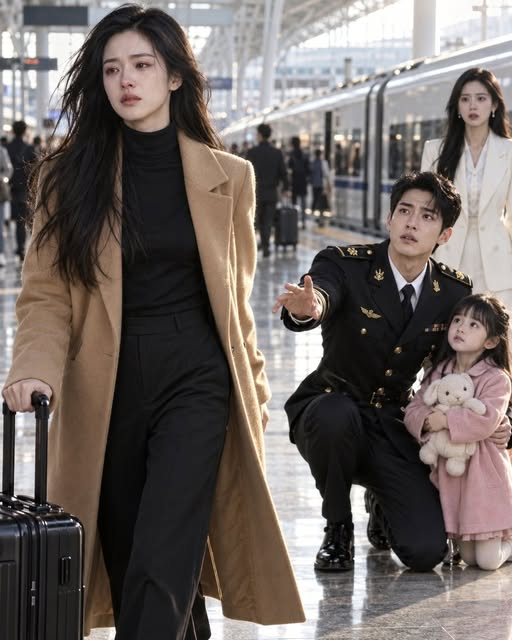
I had barely reached the station entrance when Julián caught my wrist.
“Renata.”
Five years ago, hearing my name in his voice could stop me.
Now it only made me look at his hand.
“Let go.”
Perhaps something in my expression warned him.
His fingers opened immediately.
Jimena stood several meters behind us with the little girl pressed against her side.
Julián lowered his voice.
“You can hate me. But don’t do anything impulsive.”
I almost laughed.
Too late.
“What are you afraid I’ll do?”
His eyes flickered.
Nothing more.
But after seventeen years around military officers, I knew what fear looked like when someone tried to hide it behind rank.
“Nothing,” he said.
“Then why are you nervous?”
“I’m not.”
His phone rang.
He looked at the screen.
And suddenly, Brigadier General Julián Salazar stopped breathing.
He declined the call.
It rang again.
Then Jimena’s phone began ringing too.
She checked it.
“Julián…”
“Don’t answer.”
That was when I smiled.
He looked at me.
“What did you do?”
“Nothing impulsive.”
I gently pulled my sleeve straight.
“I waited until I had evidence.”
His face hardened.
“What evidence?”
“Your father’s voice.”
The station seemed to become quieter around us.
Julián stared at me.
“My father was sick.”
“He was.”
“He was medicated.”
“Yes.”
“He didn’t know what he was saying.”
“He knew your daughter’s birthday.”
Jimena went pale.
Julián’s head snapped toward her.
I continued.
“He knew the city where you lived. He knew the apartment was purchased through a company connected to Jimena’s cousin. He knew you visited him secretly twice during those five years.”
“Renata—”
“And he knew the child wasn’t an orphan.”
The little girl looked up.
“Mom?”
Jimena immediately covered her ears.
“Take her away.”
But Julián remained frozen.
I looked at him.
“You should have done a better job deciding which lie you wanted to keep.”
He stepped closer.
“This isn’t the place.”
“You made it the place when you brought your second family into a public station.”
His phone rang for the third time.
This time he answered.
“Salazar.”
I watched the color disappear from his face.
“Yes, sir.”
Silence.
“No, sir.”
Another pause.
“I can explain.”
Those three words.
The same ones he had offered me.
He ended the call.
Jimena whispered:
“What happened?”
Julián didn’t answer her.
He looked at me.
“I’ve been ordered to report immediately.”
“That sounds important.”
“You contacted the Ministry.”
“I sent them evidence.”
“You have no idea what you’ve done.”
For five years, I had imagined this confrontation differently.
I thought I would scream.
Maybe slap him.
Maybe ask why I hadn’t been enough.
Instead, I felt strangely calm.
“No, Julián. For the first time, I know exactly what I’ve done.”
Three days later, the story he had built began collapsing.
Not publicly.
Not dramatically.
Military investigations did not work like gossip.
Records were requested.
Travel authorizations were examined.
Financial transfers were traced.
His supposed operational assignments were compared against official movement records.
And investigators started asking the question Julián had spent five years avoiding:
Where had Brigadier General Salazar actually been?
His defense was simple.
Classified work.
Protected witness.
Operational necessity.
But classified did not mean nonexistent.
Real missions left authorized trails, even when those trails were inaccessible to ordinary people.
And the investigators had access.
The deeper they looked, the worse it became.
Parts of Julián’s absence had legitimate operational origins.
That was the cleverest part.
He had used genuine classified restrictions as a curtain behind which he built an entirely different life.
Jimena had once been connected to an investigation.
But the protection period had ended years earlier.
Their relationship had not.
Neither had the apartment.
Or the school records.
Or the financial support.
Then came the document that destroyed his final explanation.
The girl’s birth certificate.
Father:
Julián Salazar.
I learned that from my attorney.
I sat silently for nearly a minute.
Not because I was surprised.
Because seeing the truth printed on an official document felt different from knowing it in my bones.
The child had been born while Julián and I were still married.
He had returned secretly enough times to maintain his new family.
He simply had never returned to me.
That distinction mattered.
For years, I had told myself he couldn’t come home.
Now I knew he simply hadn’t wanted to.
Jimena called me that night.
I almost ignored her.
Then I answered.
“Renata.”
She was crying.
“I need to explain.”
“Apparently everyone does.”
“I never wanted this.”
I looked out my apartment window.
“Which part?”
Silence.
“My husband?”
“No.”
“His money?”
“No.”
“The five years?”
“Renata, please.”
I closed my eyes.
“You sat beside me while I cried because Julián was missing.”
Her breathing stopped.
“You came to the hospital when his father was dying.”
“I know.”
“You brought me soup.”
She started sobbing.
“You hugged me and told me I was strong.”
“I was ashamed.”
“No.”
My voice became colder.
“You were comfortable.”
That silenced her.
“You watched me wear the same coat for three winters because hospital bills were destroying me. Meanwhile you were living with my husband.”
“I loved him.”
There it was.
Finally, something honest.
“Then you should have had enough courage to admit what you were doing.”
She whispered:
“I’m sorry.”
“I believe you.”
She seemed surprised.
Then I added:
“But your apology has nothing to do with my forgiveness.”
I ended the call.
Julián appeared at my door two weeks later.
No uniform.
That shocked me more than anything.
For as long as I had known him, the uniform had been his armor.
Now he looked older.
Not five years older.
Twenty.
“I’m suspended pending the investigation,” he said.
I remained in the doorway.
“That sounds like something you should discuss with your lawyer.”
“I came to see you.”
“Why?”
His eyes filled.
“My father’s grave.”
I said nothing.
“Take me there.”
For a moment, anger rose inside me.
Then I realized the grave belonged to his father too.
So the following morning, we went.
Julián knelt in front of the stone.
He touched his father’s name.
And cried.
I stood several steps away.
“I thought I had more time,” he whispered.
“So did he.”
Julián bowed his head.
“He asked about you until the end.”
I had not intended to tell him.
But some truths belonged to the dead.
“He knew you lied.”
Julián closed his eyes.
“He was ashamed.”
His shoulders shook.
I continued.
“Not because you loved someone else. He said people can stop loving each other.”
Julián looked up.
“He was ashamed because you let another person pay the price for your cowardice.”
That broke him.
For years, I had wanted Julián to understand what he had done.
Standing beside his father’s grave, I finally realized his understanding could not give those years back to me.
So I left him there.
Months passed.
The investigation became broader than our marriage.
I stayed away from it except when asked to provide information.
I did not celebrate each development.
I had spent enough of my life revolving around Julián Salazar.
I returned to active professional training.
I accepted the promotion I had postponed twice during Colonel Salazar’s illness.
I bought new clothes.
That sounds insignificant.
It wasn’t.
The first time I stood inside a store and chose something because I liked it rather than because it was cheap enough to preserve money for someone else’s treatment, I almost cried in the fitting room.
A year after the station encounter, the legal end of my marriage finally arrived.
Julián did not contest it.
He signed everything.
Before leaving, he handed me an envelope.
“I know money can’t repay you.”
I didn’t take it.
“What is it?”
“Everything you spent on my father. Hospital expenses. Medication. Funeral costs. The house.”
“I don’t want it.”
“It isn’t charity.”
He placed the envelope on the table.
“It’s a debt.”
I looked at him.
That was perhaps the first truly honorable sentence he had spoken to me in years.
So I accepted repayment of documented expenses.
Nothing more.
At the door, Julián stopped.
“Was there ever a moment when I could have fixed this?”
“Yes.”
Hope appeared in his eyes.
“Five years ago.”
It disappeared.
“You could have told me the truth.”
I opened the door.
“You chose five years of lies instead.”
He left.
I never saw Jimena again.
I occasionally wondered about the little girl.
Not with hatred.
She had been born into decisions she never made.
Whatever punishment the adults deserved, she deserved none.
Two years later, I found myself at the same bullet train station.
This time, I was traveling north to assume a new command position.
I bought coffee.
I stood beneath the departure board.
And for a second, I remembered the woman I had been the last time I stood there.
Worn sleeves.
Empty savings.
Five years of unanswered questions.
A husband who looked through her as though she were an inconvenient piece of his past.
The announcement for my train sounded.
A young lieutenant accompanying me reached for my suitcase.
“Ma’am, let me.”
“I’ve got it.”
She smiled.
“Yes, General.”
I paused.
The word still felt new.
Then I smiled back.
For years, everyone had told me that being a military wife meant learning how to wait.
Wait through deployments.
Wait through silence.
Wait through fear.
They were wrong.
There comes a moment when waiting stops being loyalty and becomes permission for someone else to waste your life.
Julián had disappeared for five years believing I would still be standing exactly where he left me.
In a way, he was right.
We did meet again at a station.
But the woman waiting there was no longer his wife.
And when my train arrived, I was the one heading north.
This time, nobody was leaving me behind.
