PART 2 — THE NAME HIDDEN IN THE FILE
The room did not breathe.
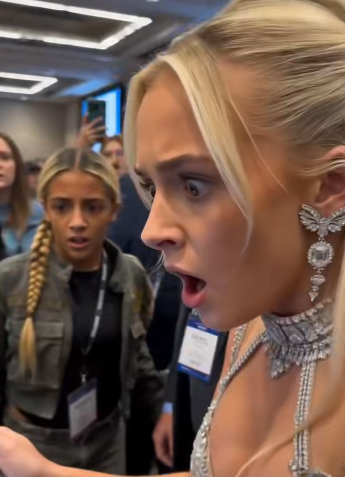
Not the teachers. Not the sponsors. Not the students with phones raised high enough to turn my humiliation into proof. Not even Serena Blackwood, whose diamond earrings still flashed beneath the ballroom lights as if they had not just become decorations on a collapsing lie.
The event coordinator, Dr. Mira Havel, stared at the final metadata entry on the tablet in her hands.
Her face changed first.
Then the face of Mr. Blackwood changed.
Serena’s father had been standing near the front row, smiling with the practiced warmth of a man who had donated enough money to expect applause every time he entered a room. His navy suit fit perfectly. His silver watch looked like it could pay my mother’s rent for a year. But when Dr. Havel lifted her eyes from the file, his smile disappeared like someone had cut the power behind it.
Dr. Havel spoke softly, but every microphone caught her.
“Administrative access was used at 7:42 this morning to remove Talia Cohen’s name from the official recognition file.”
A murmur ran through the conference hall.
I stood frozen near the ceremony marker, one knee burning from where Serena had kicked me. The pain was sharp, but it felt far away. What I felt most was the terrible heat in my face, the knowledge that hundreds of eyes were now moving between me, Serena, and the tablet.
Dr. Havel turned the device slightly toward the projection screen.
A line of text appeared behind her.
USER: EBLACKWOOD-ADMIN
Someone gasped.
Then another line appeared.
REQUEST: REMOVE STUDENT CREDIT — TALIA COHEN
Serena whispered, “No.”
It was the first honest sound she had made all night.
Mr. Blackwood stepped forward. “There has clearly been a misunderstanding.”
His voice was smooth, expensive, rehearsed. The kind of voice that expected doors to open and people to apologize for standing in the way.
Dr. Havel did not move.
“The entry is time-stamped,” she said. “It came from the sponsor administration portal.”
Serena’s mother rose slowly from her seat. Her pearls trembled against her throat.
“This is inappropriate,” Mrs. Blackwood said. “Surely we don’t need to discuss internal event errors in front of children.”
But we were not children in that moment.
We were witnesses.
My teacher, Ms. Ramirez, pushed through the frozen crowd and reached me. “Talia, are you hurt?”
I wanted to answer, but my mouth would not obey me. I looked at Serena instead.
She had always been beautiful in the way people described like it was a virtue. Blonde hair, sharp cheekbones, perfect posture, a wardrobe selected by people who knew how cameras worked. But now, under the huge white lights, she looked small. Not sorry. Not yet.
Just cornered.
Dr. Havel looked at me.
“Talia,” she said, her voice gentler now, “did you know someone had attempted to remove your name?”
I shook my head.
The motion made my throat unlock.
“No,” I said. “I only knew Serena told me I didn’t belong here.”
A hundred phones tilted closer.
Serena’s eyes flashed.
“You’re twisting this,” she snapped. “You’re making yourself the victim because that’s what people like you do.”
The silence that followed was different.
It was no longer hungry.
It was disgusted.
Ms. Ramirez stepped in front of me, her hand still on my shoulder. “Do not speak to my student that way.”
Serena laughed once, but it broke in the middle. “Your student? She recorded birds. My family funded the whole project.”
I looked at the screen behind Dr. Havel.
My name.
My hours.
My signatures.
My late-night locations.
My temperature logs.
My microphone calibration notes.
Every detail that I thought nobody cared about was suddenly glowing ten feet tall behind the people who had tried to bury me.
Something inside me steadied.
I stepped away from Ms. Ramirez’s protective hand.
“My work isn’t smaller because your family paid for the room,” I said.
Serena’s face tightened.
Then Dr. Havel did something nobody expected.
She turned to the media table and said, “The first recording will proceed.”
Mr. Blackwood’s voice cracked through the room. “Absolutely not.”
Dr. Havel looked at him with the calm of someone who had already chosen a side.
“This conference celebrates student research,” she said. “Not donor control.”
A sound passed through the hall. Not applause yet. Not fully.
But something like courage being tested.
The lights dimmed.
The giant screen shifted from the metadata record to a black visualizer. My audio file loaded. The title appeared.
NOCTURNAL WETLAND CALLS — RECORDED BY TALIA COHEN
I swallowed hard.
The first sound filled the ballroom.
A low Montana wind.
Reeds whispering.
Then, faint but clear, a birdcall rose through the darkness.
It was fragile.
Lonely.
Beautiful.
I remembered that night immediately. My fingers numb around the recorder. My braid tucked into my jacket. My breath fogging in the cold. Everyone else asleep at the lodge while I stood ankle-deep in mud, trying to hold the microphone steady because I had heard something unusual beyond the cattails.
The call repeated.
A ripple went through the scientists seated near the front.
One of them leaned forward.
Another whispered, “That’s impossible.”
My heart started pounding.
Dr. Havel turned slowly toward the screen.
The audio continued.
Three notes.
A pause.
Two rising tones.
Then a responding call from farther away.
The room shifted again.
This was no longer about Serena kicking me.
No longer about a rich girl stealing credit.
Something bigger had entered the hall through my recording.
A gray-haired ornithologist stood from the second row.
“Replay that,” he said.
Dr. Havel stared at him. “Dr. Bell?”
“Replay it,” he repeated. “From the first call.”
The file restarted.
The ballroom listened.
This time, nobody moved. Nobody whispered. Nobody even breathed too loudly.
The call came again.
Dr. Bell turned pale.
“That species hasn’t been confirmed in this region for thirty-two years,” he said.
My stomach dropped.
Serena looked confused. Her father looked furious.
Dr. Bell faced the audience.
“That recording may be evidence of a nesting pair of ivory marsh rails.”
Gasps erupted.
Ms. Ramirez covered her mouth.
Dr. Havel looked at me as if I had transformed in front of her.
I could barely understand what was happening.
I had recorded birds because the project needed someone patient enough to do the cold, lonely, unglamorous work. I had labeled files because unlabeled science becomes useless. I had backed up everything because losing data terrified me.
And now the sound everyone treated like background labor had become the most important discovery in the room.
Then Dr. Bell said the sentence that changed everything.
“Whoever tried to erase this student’s name may have attempted to bury a major conservation finding.”
Every camera turned again.
This time, not toward Serena.
Toward Mr. Blackwood.
PART 3 — THE FAMILY THAT OWNED THE LAND
Mr. Blackwood did not shout.
That was what made him frightening.
He smiled.
It was thin and bloodless, but it returned to his face like a mask sliding back into place.
“Let’s be careful,” he said. “Scientific enthusiasm can lead to exaggeration.”
Dr. Bell looked at him over his glasses. “I know what I heard.”
“With respect,” Mr. Blackwood replied, in a tone that held no respect at all, “one recording from a student does not justify public speculation.”
“A student with complete metadata,” Dr. Havel said.
“Metadata can be misunderstood.”
I heard the warning underneath.
Not just to Dr. Havel.
To everyone.
Serena’s father was reminding the room that he had power. The Blackwood Foundation funded programs, scholarships, equipment, conference spaces, conservation dinners with engraved invitations. People like him did not need to threaten loudly. They simply reminded you how much silence could cost.
Then Ms. Ramirez spoke.
“Talia has backups.”
I turned to her, startled.
She looked at me. “You do, don’t you?”
I nodded slowly.
“Yes,” I said. “Two external drives. One cloud folder. And the raw recorder files.”
A small smile touched Ms. Ramirez’s face.
“That’s my girl.”
For the first time that night, something inside me almost broke from kindness.
Serena saw it and hated it.
“You’re all acting like she’s some hero,” she said. “She probably didn’t even know what she recorded.”
I faced her.
“You’re right,” I said.
The room quieted.
“I didn’t know. That’s why I preserved the file exactly. That’s why I logged the location, time, device settings, temperature, wind, and background noise. Because I knew someone smarter than me might need the truth later.”
Dr. Bell’s expression softened.
“That,” he said, “is science.”
The applause started from the back.
One person.
Then five.
Then half the room.
It was not loud at first, but it grew with every second. Students stood. Teachers clapped. A few sponsors joined reluctantly, glancing around to see which direction safety had chosen.
I did not smile.
I could not.
Because Mr. Blackwood was no longer looking at me like an inconvenience.
He was looking at me like a locked door he intended to break.
Dr. Havel raised a hand. “We will pause the ceremony for ten minutes while the research committee reviews the file.”
“No,” Dr. Bell said sharply. “Do not pause in private.”
Mr. Blackwood’s jaw flexed.
Dr. Bell continued, “The recording should remain in public view. Chain of custody matters now.”
That phrase landed hard.
Chain of custody.
Not celebration.
Not scholarship.
Evidence.
Mrs. Blackwood grabbed Serena’s wrist. “We’re leaving.”
But Serena pulled free.
“No,” she said. “I’m not running away because some charity case got lucky with a microphone.”
The words hit me.
Charity case.
I had heard versions of it my whole life. Said softer. Smiling. Wrapped in concern. People looking at my worn shoes and deciding my story before I spoke.
But now the room heard it plainly.
Mr. Blackwood turned to his daughter with rage so cold it almost looked like fear.
“Serena,” he said, “stop talking.”
That was when I understood.
He was not angry because Serena had hurt me.
He was angry because she had lost control of the story.
Dr. Havel asked security to keep the hall doors open but prevent anyone from approaching the equipment table. Dr. Bell and two other scientists joined her at the laptop. The audio file played again at a lower volume while they examined the waveform and metadata.
I sat in a chair near the stage while Ms. Ramirez checked my knee.
“It’ll bruise,” she said softly. “Can you stand?”
“I think so.”
“Talia.”
I looked at her.
Her eyes were wet.
“I am so sorry I didn’t see what was happening sooner.”
I wanted to tell her it was fine. That I was used to it. That people like me learned to swallow sharp things and call it maturity.
But I was tired of protecting everyone from the truth.
“It wasn’t invisible,” I said. “Most people just looked away.”
Ms. Ramirez closed her eyes.
Then she nodded.
“You’re right.”
Across the room, Serena stood alone now. Her friends had drifted back like her disgrace might stain their clothes. She stared at me, and for one strange moment I saw something behind the cruelty.
Panic.
Not guilt.
Panic.
A conference staffer rushed to Dr. Havel and whispered something. Dr. Havel stiffened. She looked toward Dr. Bell. He followed her gaze to Mr. Blackwood.
Then Dr. Havel returned to the microphone.
“Ladies and gentlemen,” she said, “we have confirmed the recording location.”
A map appeared on the screen.
A red point glowed over a wetland north of the student field site.
Dr. Bell’s face hardened.
“That land,” he said, “is under development review.”
Someone in the crowd whispered, “Blackwood Ridge.”
The name spread like smoke.
Blackwood Ridge was supposed to become a luxury eco-resort. I had seen the promotional poster near the registration desk: glass cabins, private boardwalks, wellness retreats, sustainability promises printed in green ink.
Mr. Blackwood’s foundation had funded the conference.
His company owned the land.
And my recording might prove that a protected species lived there.
Serena’s attempt to erase my name was no longer petty jealousy.
It was motive.
Dr. Bell turned fully toward Mr. Blackwood.
“Did your company know there was possible protected habitat on that site?”
Mr. Blackwood laughed softly.
“This is absurd.”
But his wife sat down like her legs had given out.
Serena whispered, “Dad?”
The microphone near the stage caught it.
Just one word.
Small.
Frightened.
Dr. Havel looked at the metadata again. Then she opened the unexpected entry that showed the attempted removal.
“There is another attached note,” she said.
Mr. Blackwood moved fast.
Too fast.
“Do not open that.”
The entire room stopped.
His command echoed through the speakers.
Dr. Havel’s hand hovered over the screen.
Then she said, “This is a public student research file.”
And she opened it.
PART 4 — THE NOTE SERENA NEVER SAW
The attached note was not long.
That made it worse.
It appeared on the screen in plain black text.
REMOVE COHEN CREDIT BEFORE CEREMONY. IF RECORDING IS QUESTIONED, ATTRIBUTE FIELD CAPTURE TO BLACKWOOD STUDENT TEAM. DO NOT ALLOW LOCATION DATA TO BE DISCUSSED PUBLICLY.
Nobody spoke.
Then below the note was a forwarded message header.
FROM: ELIAS BLACKWOOD
Serena’s father.
My ears began to ring.
The ballroom lights felt too bright, the carpet too soft beneath my shoes, the air too full of perfume and money and terror. I stared at the message until the letters blurred.
They had not just tried to steal my recognition.
They had tried to steal the evidence.
My evidence.
The wetland’s evidence.
The birds’ evidence.
Dr. Bell said, “This needs to be reported immediately.”
Mr. Blackwood’s expression changed again. The smooth mask cracked, and something ugly showed through.
“You have no authority over my business.”
Dr. Bell answered, “No, but federal wildlife authorities do.”
A shock moved through the hall.
Serena turned to her father. “You said the environmental survey was clear.”
“Serena,” he snapped.
“You said there was nothing there.”
“Be quiet.”
She recoiled.
For the first time, I wondered if Serena knew less than she pretended. Maybe she had thought she was stealing a trophy, not helping bury a habitat. Maybe cruelty had made her useful to someone crueler.
That did not erase what she did.
But it complicated the shape of my anger.
Dr. Havel asked the media team to stop the livestream.
A student shouted, “Too late! It’s already everywhere.”
And it was.
Phones were glowing. Clips were uploading. Messages were flying. The conference that had begun as a neat celebration of student work had become a public collapse of the Blackwood name.
Mr. Blackwood stepped toward Dr. Havel.
Security moved first.
Two guards blocked him before he reached the equipment table.
His face flushed. “You are making a mistake.”
Dr. Havel looked exhausted, but her voice did not shake.
“No,” she said. “I believe we are finally correcting one.”
The words hit the room like thunder.
Then Serena did the last thing I expected.
She walked toward me.
Ms. Ramirez immediately stood.
“Stay away from her.”
Serena stopped a few feet from me. Her eyes were bright, but no tears fell. Maybe pride was holding them back. Maybe fear had burned them dry.
“I didn’t know about the land,” she said.
I said nothing.
“I didn’t,” she insisted. “I thought—”
“You thought humiliating me was fine as long as it was only about credit?”
Her mouth closed.
That silence answered for her.
I looked at the girl who had kicked me in front of everyone, who had called me pity and charity and thief. A part of me wanted to crush her with a sentence. I wanted to say something so sharp it would live under her skin forever.
But when I opened my mouth, what came out was quieter.
“You wanted me erased because you could not stand that I earned something you couldn’t buy.”
Her face crumpled for half a second.
Then she lifted her chin.
“I was supposed to win tonight.”
“No,” I said. “You were supposed to learn.”
Behind her, Mr. Blackwood was speaking rapidly into his phone. Mrs. Blackwood was crying without making a sound. Dr. Bell and Dr. Havel were preserving copies of everything.
The ceremony was over, though nobody had announced it.
Something else had begun.
A formal investigation started that same night.
My recording equipment was sealed. My files were copied to secure drives. Dr. Bell called a colleague who worked with endangered wetland birds. Dr. Havel gave a statement to the conference board. Ms. Ramirez called my mother.
That was the part I feared most.
My mother arrived forty minutes later wearing her work uniform beneath an unzipped coat, her curls escaping a tired bun. She pushed through the lobby crowd with a look on her face I had only seen once before, when a man at a grocery store told her to “go back” and she calmly made him wish he had swallowed his own tongue.
When she saw my limp, her face went still.
“Who touched my daughter?”
No one answered.
I pointed at Serena.
My mother looked at her.
Not with rage.
With judgment.
Serena shrank.
Then my mother turned to me and gathered me into her arms. I was taller than her, but suddenly I was six years old again, crying into the shoulder of the strongest person I knew.
“You did not disappear,” she whispered in Hebrew first, then English. “You hear me, Talia? They tried, and you did not disappear.”
That was when I finally cried.
Not loudly.
Not dramatically.
Just enough for the night to leave my body.
The next morning, the story had spread beyond Montana.
Headlines called it a scandal. Commentators called it corruption. Students called it the kick heard around the conference. I hated that phrase. It made my pain sound funny.
But other people noticed the recording.
Scientists.
Conservationists.
Journalists.
A wildlife agency issued a temporary review order for Blackwood Ridge pending habitat investigation. The resort project halted before the first foundation stone touched the ground.
And Serena Blackwood vanished from school.
For three days, I thought that was the ending.
I was wrong.
Because on the fourth day, a letter arrived at my house.
No return address.
Inside was a printed photograph of the wetland at night.
On the back, someone had written:
Your recording was not the first. Find the old ranger station.
PART 5 — THE OLD RANGER STATION
My mother wanted to call the police.
Ms. Ramirez wanted to call Dr. Bell.
I wanted to go to the ranger station.
That was not bravery. Not exactly.
It was the feeling I had learned from fieldwork: when a sound comes from the dark, you do not understand it by running away. You listen closer.
Dr. Bell insisted we go as a group. So two days later, under a sky bruised with snow clouds, I returned to the wetland with my mother, Ms. Ramirez, Dr. Bell, and a state wildlife officer named Nora Pike.
The old ranger station stood beyond a leaning fence, half-hidden by cottonwoods and winter grass. Its green paint had peeled away in strips. One window was boarded. The roof sagged like it was tired of keeping secrets.
Officer Pike cut the rusted lock.
The door opened with a groan.
Inside, dust covered everything. A metal desk. Molded maps. Broken shelves. A calendar from nineteen years ago still hanging crooked on the wall.
Dr. Bell found the first box.
Then another.
Then six more.
All labeled with dates.
Audio reels. Field notebooks. Survey tapes. Handwritten maps.
My pulse quickened.
“These are habitat records,” Dr. Bell said.
Officer Pike put on gloves. “Nobody touch anything without documentation.”
But my eyes had already landed on a familiar name written across one of the old folders.
COHEN, AMIR — FIELD ACOUSTICS ASSISTANT
My breath stopped.
Amir Cohen.
My father.
He had died when I was eight. I remembered his laugh, his old recorder, the way he could identify birds before sunrise, his stories about wetlands breathing under the moon.
But nobody had ever told me he worked here.
My mother saw the folder and went pale.
“Mom,” I whispered.
She covered her mouth.
“I didn’t know they kept his records.”
“You knew he worked at Blackwood Ridge?”
Her eyes filled.
“He worked there before it was called that. Before the Blackwoods bought it.”
Dr. Bell opened the folder carefully.
Inside were pages of notes in my father’s handwriting.
And then a tape.
Labeled:
IVORY MARSH RAIL PAIR — CONFIRMED CALL RESPONSE — A. COHEN
The room spun.
My recording was not the first.
My father had found them years ago.
Officer Pike examined the dates. “These records should have been included in the land review.”
Dr. Bell’s voice was grim. “Unless someone made sure they weren’t.”
My mother sat down in the only chair that looked strong enough to hold grief.
“Your father fought with them,” she said. “Before he died. He said a development company was pressuring surveyors. He said records were missing. I thought… after the accident, I thought it was all too painful to chase.”
“The accident?” Officer Pike asked.
My mother looked at me.
I knew the official story. A winter road. Black ice. My father’s truck going off the shoulder near the survey route.
But now the old ranger station seemed to lean closer.
My mother’s voice trembled. “He was driving back from this wetland.”
Nobody moved.
The wind pressed against the walls.
For years, my father’s death had been a closed door in my life. A tragedy with no villain, only weather. Now I stood in a forgotten ranger station, holding proof that he had found the same birds I had recorded, on the same land a powerful family wanted to develop.
The past was not past.
It had been waiting in boxes.
Officer Pike sealed the files. Dr. Bell photographed every label. Ms. Ramirez stayed beside me without speaking.
Then we heard tires outside.
A black SUV stopped beyond the fence.
Serena Blackwood stepped out.
Alone.
Her hair was tucked under a gray knit hat. No diamonds. No camera smile. No army of friends. She looked cold and terrified and younger than I had ever seen her.
Officer Pike immediately moved toward the door. “This is an active evidence site.”
Serena raised both hands.
“I know,” she said. “That’s why I came.”
I felt my mother stiffen beside me.
Serena looked at me, then at the boxes.
“My dad kept a storage room at our house,” she said. “After the conference, I heard him telling someone to destroy old survey material. I thought he meant company files. But then I found this.”
She held out a waterproof field notebook.
Officer Pike took it with gloved hands.
The name on the front made my mother cry out.
AMIR COHEN — PERSONAL LOG
Serena’s voice shook.
“I think your father gave it to mine before he died.”
My whole body went cold.
“Why would your father have my dad’s notebook?”
Serena swallowed.
“Because my father was the last person who saw him alive.”
PART 6 — THE TRUTH UNDER THE ICE
Officer Pike made Serena repeat everything on record.
This time, Serena did not perform.
She spoke like someone stepping barefoot over glass.
Her father had come home furious the night of the conference. He had yelled into the phone about old files, student evidence, habitat fraud, and a “dead man’s notes.” Serena, frightened by what she had accidentally helped expose, had searched his private storage room when he left for a meeting.
Behind locked cabinets of contracts and donor plaques, she found my father’s notebook sealed in a plastic evidence bag that had no official label.
Inside the notebook were field notes, coordinates, and a final entry written the day he died.
Officer Pike opened to the marked page and read silently.
Her face hardened.
Then she handed it to my mother.
My mother read one line and made a sound I will never forget.
Not a scream.
Not a sob.
A breaking.
I took the notebook from her trembling hands.
My father’s handwriting slanted across the page.
Meeting Elias Blackwood tonight. He says he will “solve this quietly.” Taking duplicate tapes with me. If anything happens, the rail calls are real. Leila and Talia must know I did not lie.
Leila was my mother.
I read the line again.
Talia must know I did not lie.
My knees almost failed.
All those years, I thought my father had left me with memories.
He had left me a mission.
Serena stood in the doorway, crying now, silently and completely.
“I’m sorry,” she whispered.
I looked at her through tears.
“For which part?”
She flinched.
“All of it.”
That answer was not enough.
But it was the first one that sounded true.
The investigation widened within hours. The state wildlife agency contacted federal authorities. Blackwood Ridge’s environmental approvals were suspended. The old survey company was subpoenaed. Former employees began speaking.
One retired biologist admitted he had been pressured to mark the wetland as inactive.
A former assistant remembered Amir Cohen arguing with Elias Blackwood in a parking lot.
A mechanic confirmed that my father’s truck had been inspected after the crash and something about the brake line had bothered him, but the report had “gone missing.”
No one said murder.
Not at first.
Powerful words require proof.
But everyone felt the shape of it.
Elias Blackwood was arrested two weeks later on charges related to evidence tampering, fraud, obstruction, and conspiracy. The investigation into my father’s death reopened.
When news cameras surrounded the courthouse, he did not look smooth anymore. He looked older. Smaller. Furious that the world had stopped obeying.
Serena walked past the cameras without looking at them.
She had given a sworn statement against him.
That did not make us friends.
It did make her useful to the truth.
The conference board issued a public apology. Dr. Havel resigned from the sponsor review committee but stayed with the student program. The Blackwood Foundation tried to distance itself from Elias, but donors vanished like birds before a storm.
Meanwhile, the wetland became famous.
Experts confirmed not one, but three ivory marsh rails in the area. A nesting site was found near the reeds where I had stood with numb fingers and worn sneakers.
My father’s old tapes confirmed the species had survived there for decades.
The land was placed under emergency protection.
Then came the award ceremony.
A real one this time.
No sponsor banners.
No diamond smiles.
No stolen spotlight.
Just a modest auditorium at the state university, filled with scientists, students, teachers, my mother, and people who cared more about truth than money.
I wore the same old technical jacket.
Not because I had nothing else.
Because it had been with me in the wetland.
Dr. Bell introduced me.
“Talia Cohen did more than record a bird,” he said. “She preserved evidence with care, courage, and discipline. She reminded us that science often depends on the person willing to do quiet work when nobody is watching.”
When I reached the podium, I saw my mother in the front row holding my father’s notebook against her heart.
My hands shook.
I looked at the audience.
“I wanted one clean moment where my name was said without pity,” I began.
My voice cracked, but I continued.
“I didn’t know my recording would expose what happened to the wetland. I didn’t know it would bring my father’s work back. I didn’t know truth could sleep inside metadata, old tapes, and forgotten boxes.”
I looked down at my worn sneakers.
Then up again.
“But I know this now: quiet work is still work. Hidden people are still people. And no one with money gets to decide whose name belongs to the truth.”
The auditorium rose.
My mother cried openly.
Ms. Ramirez clapped with both hands over her heart.
Dr. Bell wiped his eyes.
And at the very back, half-hidden near the exit, Serena Blackwood stood alone.
She clapped too.
PART 7 — THE APOLOGY IN THE RAIN
Three months passed before Serena spoke to me again.
By then, spring had softened the edges of Montana. Snowmelt filled the low places. The wetland shimmered green and silver under wide skies. Boardwalks were being planned, not for a resort, but for a protected research sanctuary named after my father.
The Amir Cohen Wetland Acoustic Preserve.
The first time I saw the sign design, I had to leave the room.
Grief is strange. Sometimes happiness opens the wound wider than sadness.
Serena found me outside the university lab after a student research meeting. Rain misted over the parking lot. She had no umbrella.
Neither did I.
For a moment, we just stood there, two girls soaked by the same weather.
“I’m transferring schools,” she said.
I nodded.
“Probably good.”
She almost smiled, but it didn’t survive.
“I deserved that.”
“You deserved worse.”
“I know.”
The honesty surprised me.
She looked different now. No perfect armor. No diamonds. No superior tilt to her chin. Her blonde hair was shorter, cut just above her shoulders, as if she had needed to remove something heavy.
“My father’s lawyers want me to stop cooperating,” she said. “My mother wants me to say I was confused.”
“Were you?”
“No.” She swallowed. “Not about what I heard. Not about what I found.”
Rain gathered on her lashes.
“I hated you,” she said.
“I noticed.”
“Not because of you, exactly. Because everyone kept saying I was special, and then you walked in with your old jacket and your field logs and suddenly special meant nothing. You had something real.”
I did not answer.
She continued anyway.
“I thought if I could make you look small, I would feel big again.”
“That’s a terrible apology.”
“I know.” Her voice broke. “I’m trying to make it true before I make it pretty.”
That line stayed with me.
Maybe because it was the first thing she ever said that did not sound polished.
She reached into her bag and pulled out a small recorder.
My father’s model.
Old, scratched, carefully cleaned.
“I found this with the notebook,” she said. “Officer Pike cleared it for return. Your mother said I should give it to you myself.”
I took it.
My fingers closed around the worn metal.
For a second, the parking lot disappeared.
I was eight again, sitting beside my father while he taught me how to listen for distance in sound.
“Close your eyes, Talia,” he had said. “The world tells the truth in layers.”
I pressed the recorder to my chest.
Serena whispered, “I can never fix what I did.”
“No,” I said.
She nodded, tears mixing with rain.
“But you can decide what you do next.”
Her eyes lifted to mine.
It was not forgiveness.
Not yet.
Maybe not ever in the way stories like to make forgiveness clean.
But it was a door left unlocked.
Serena testified six weeks later.
Her statement helped prove that Elias Blackwood had knowingly concealed habitat records and ordered the destruction of evidence. The reopened crash investigation took longer, but investigators found enough irregularities to bring additional charges connected to my father’s death.
The trial would stretch for years.
Truth can be slow.
But it had started moving.
And once it moved, even money could not fully stop it.
My life changed too.
I received a scholarship from a conservation institute. Dr. Bell invited me to assist with the official acoustic monitoring program. Ms. Ramirez started a student field ethics club and made the first rule simple: credit belongs to the person who earned it.
Students who had filmed my humiliation sent apologies. Some were sincere. Some sounded like fear wearing manners.
I accepted very few.
The video of Serena kicking me never fully disappeared. Sometimes it resurfaced online with cruel captions or dramatic music. For a while, every replay made me feel trapped in that ballroom again.
Then one day, Dr. Havel sent me a different clip.
It was the moment my recording played.
The room dark.
The birdcall rising.
Everyone listening.
My name glowing on the screen.
I saved that one.
Not because it erased the other video.
Because it reminded me the story did not begin with the kick.
It began with a girl in the dark, holding a microphone steady.
PART 8 — THE END: THE SOUND THAT CAME BACK
One year after the conference, I returned to the wetland at night.
Not for evidence.
Not for a ceremony.
For my father.
The preserve sign stood near the entrance now, simple and beautiful beneath a shield of clear varnish.
AMIR COHEN WETLAND ACOUSTIC PRESERVE
Below his name was a line from his notebook:
THE WORLD TELLS THE TRUTH IN LAYERS.
My mother stood beside me, her hand wrapped around mine.
Ms. Ramirez came too. Dr. Bell carried equipment. Officer Pike, now more friend than investigator, brought thermoses of coffee. And to my surprise, Serena came last, stopping a respectful distance away.
She did not ask if she could join us.
She waited.
My mother looked at me.
The choice was mine.
I looked at Serena, then at the reeds silvered by moonlight.
“Stay quiet,” I said.
Serena nodded.
We walked out along the new research boardwalk. Frogs clicked in the dark. Wind moved through cattails. The sky above us was endless and bright with stars.
I set my father’s recorder beside my newer equipment.
Old and new.
Past and future.
For a long time, nothing happened.
That is the part people forget about listening. Most of it is waiting. Most of it is faith without applause.
Then, near midnight, the first call came.
Three notes.
A pause.
Two rising tones.
My mother gripped my hand so hard it hurt.
Another call answered from far across the wetland.
Dr. Bell bowed his head.
Ms. Ramirez cried quietly.
I closed my eyes.
The sound moved through me, not like proof this time, but like a greeting.
For years, I had imagined my father as gone completely, swallowed by ice and time and unanswered questions. But standing there in the dark, hearing the same rare birds he had once protected, I understood something that felt impossible and true.
He had not vanished. His work had waited for mine.
Then the old recorder flickered.
A tiny red light blinked.
I frowned.
“That battery shouldn’t still work,” Dr. Bell whispered.
The device crackled softly.
My breath caught.
A voice emerged through static.
Not live. Not magic. A damaged old file finally waking after years of silence.
My father’s voice.
“Talia,” it said, faint but unmistakable.
My mother sobbed.
The recording continued, broken in places, but clear enough.
“If you ever hear this, it means you found your way back to the marsh. I brought you here when you were little. You laughed every time the rails called. You said they sounded like stars squeaking.”
A laugh broke out of me through tears.
I did not remember saying that.
But my father had.
His voice softened.
“Listen carefully, my brave girl. People will try to make truth seem small when it gets in their way. They will call it noise, mistake, pity, luck. But truth has a sound. Once you learn it, you will hear it everywhere.”
The static deepened.
Then his final words came through.
“Don’t let them take your name.”
The recorder clicked off.
No one moved.
The wetland sang around us.
My mother folded me into her arms, and this time we cried without fear. Dr. Bell removed his glasses. Officer Pike turned away to give us privacy. Ms. Ramirez whispered, “He knew.”
Serena stood at the edge of the boardwalk, tears shining on her face.
I looked at her and saw not the girl who had kicked me, not only that girl, but someone who would spend a long time trying to become better than the worst thing she had done.
The rails called again.
This time three voices answered.
A nesting family.
A future.
Months later, the court ruled that Blackwood Ridge could never be developed. The land was transferred permanently into public conservation trust. Elias Blackwood’s empire collapsed under the weight of records he thought he had buried. His name became a warning in environmental law classes.
Mine became attached to the discovery.
Not as charity.
Not as pity.
As fact.
I went on to study bioacoustics, the science of listening to life hidden in sound. My first published paper included my father as a historical contributor. My mother framed the journal page and hung it beside a photo of him holding me as a child.
Serena wrote to me once from her new school.
The letter was short.
I told the truth again today, even though it cost me something. I thought you should know.
I kept it in a drawer.
Not because we were friends.
Because proof of change matters too.
And every year, on the anniversary of the night everything broke open, I return to the wetland. I wear my old technical jacket until the seams complain. I bring both recorders. I stand under the stars and listen.
The world is never silent.
It hums with what people try to hide.
It rustles with what refuses to die.
It calls from dark water, from old files, from daughters who will not disappear.
And when the ivory marsh rails sing across the reeds, I hear my father’s voice beneath them, steady as moonlight.
Don’t let them take your name.
They didn’t.
They never will.
