PART 2 — THE SIGNATURE BENEATH THE LIE
The silence after the final entry appeared felt heavier than the cinnamon crumbs sticking to my old cotton dress.
I stood beneath the bright lights of the Charleston Community Genealogy Hall, smelling sugar, butter, and humiliation, while everyone stared at the screen behind the stage.
The event coordinator, Mrs. Clara Whitcomb, held the Photo Match File in both hands.
Her face had gone very still.
On the projector, beneath my name, my hours, my label drafts, and my signed research forms, one final line glowed in clean black type.
ACCESS REQUEST: REMOVE EMA VARGA FROM UNVEILING CREDIT
Below it was a timestamp from that morning.
And below that was a name.
AUTHORIZED BY: STERLING HERITAGE FOUNDATION OFFICE
A wave of murmurs rippled through the hall.
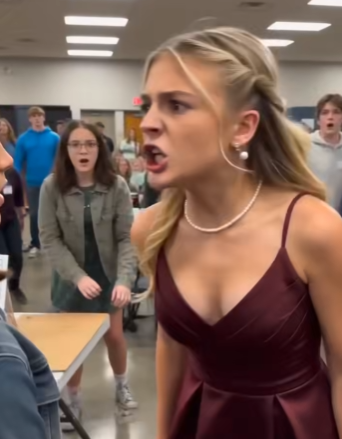
Olivia Sterling’s pearl earrings trembled as she shook her head. “That is fake.”
Nobody believed her.
Not even her mother.
Mrs. Sterling sat in the front row with one white-gloved hand pressed against her collarbone. Mr. Sterling, tall and silver-haired, rose slowly from his chair, his polished smile gone.
“Clara,” he said, “surely this can be handled privately.”
Mrs. Whitcomb did not look away from the file. “A student was publicly humiliated on stage.”
Olivia’s eyes sharpened. “She humiliated herself by pretending she discovered something my family donated.”
My throat tightened.
Cinnamon crumbs clung to my denim jacket. One cookie had broken against my shoulder and left a dark smear of filling near the collar. Around me, phones were still raised, capturing every second. I could feel my cheeks burning.
But the file was open.
The truth was breathing.
Mrs. Whitcomb turned another page.
“The photograph was submitted to the student research committee by Ema Varga three weeks ago,” she said. “The match request, family-line comparison, label drafts, and restoration notes were all signed by Ema.”
The projector changed.
A scanned image appeared.
An old photograph.
Sepia-toned. Creased at the corners. A group of workers standing outside a narrow Charleston boardinghouse in the late 1890s. Their clothes were plain. Their faces were tired. One young woman near the center had dark hair braided over her shoulder and eyes that seemed to look directly through the years.
I knew her face.
I had stared at it for hours after school while matching names, dates, census lines, church records, immigration documents, and handwritten notes.
Mrs. Whitcomb continued.
“The photograph was not part of the Sterling family donation.”
She looked at Olivia.
“It was found misfiled inside a box of unprocessed community archives.”
Olivia laughed once, too loudly. “And she magically found it?”
“No,” I said.
My voice was small, but the microphone caught it.
Everyone turned.
I swallowed, tasted humiliation, and spoke again.
“I didn’t magically find it. I found it because I stayed after school and sorted nine boxes nobody else wanted to touch.”
A few students lowered their phones.
Mrs. Whitcomb nodded. “Ema identified three unnamed individuals in this photograph using photo-matching software and handwritten family records.”
Olivia crossed her arms. “So what? It is still connected to my family exhibition.”
“No,” Mrs. Whitcomb said. “That is exactly the issue.”
The hall quieted further.
She turned one more page.
“There is a family match attached to the young woman in the center.”
My heart began beating painfully fast.
I had known there was a match. I had written the label myself.
But Mrs. Whitcomb’s face told me something more had appeared.
She read the line aloud.
“Subject identified as Ilona Varga, born 1879 in Budapest, arrived in Charleston in 1896.”
My breath left me.
Varga.
My last name.
I heard my teacher, Mr. Rhodes, whisper, “Ema…”
The room blurred at the edges.
I had seen the name, but I had not known. Not truly. Varga was not rare where my father’s family came from. I had marked it as possible, pending review. I had not dared imagine that the woman in the photograph might be mine.
Mrs. Whitcomb looked at me gently.
“Ema, the final confirmation came this morning from the attached church register. Ilona Varga was your great-great-grandmother.”
A sound moved through the audience.
Not gossip.
A gasp.
I stared at the photograph.
The young woman in the old dress stared back.
All my life, my family history had felt like pieces in separate drawers. My Hungarian father’s side scattered by migration and poverty. My American mother’s side quiet about what had been lost. We had no grand portraits. No silver-framed ancestors. No donated gallery wing.
And there she was.
Not rich.
Not famous.
But present.
My blood, standing in the photograph Olivia had tried to claim.
Olivia’s face twisted.
“That makes no sense,” she snapped. “Why would her family be in our archive?”
Mrs. Whitcomb looked down at the file.
“That,” she said slowly, “is the question.”
PART 3 — THE HOUSE THAT STOLE NAMES
Mr. Sterling stepped forward quickly.
“This is an emotional misunderstanding,” he said. “Old photographs pass through many hands. The Sterling family has preserved Charleston history for generations.”
A woman in the back muttered, “Preserved or possessed?”
People turned.
Mr. Sterling pretended not to hear.
But I did.
And something inside me shifted.
Because suddenly I remembered the old label on the back of the photograph. Not the official archive label, but the faded pencil note nearly erased by time.
Boardinghouse staff, east wing, Sterling property.
I had assumed the note meant the building was owned by the Sterlings.
I had not understood why it mattered.
Mrs. Whitcomb returned to the microphone. “The unveiling will proceed, but credit will remain with the student researcher who completed the match.”
Olivia’s mother stood. “Absolutely not.”
Her voice was soft but poisonous.
“This event exists because families like ours fund it. We will not have our name dragged through speculation because one girl found a dusty picture.”
One girl.
Dusty picture.
I looked at my stained dress and worn shoes. I felt the eyes of the room trying to decide what I would do with my humiliation.
Then the photograph filled the screen again.
Ilona Varga stood in the center, hands folded, chin lifted.
She did not look like someone waiting for permission.
So I spoke.
“Why did someone try to remove my name this morning?”
Mrs. Sterling’s expression froze.
Mr. Sterling answered before she could. “Administrative confusion.”
“Then why replace it with Olivia’s?”
The hall erupted.
Mrs. Whitcomb snapped the file shut halfway, then opened it again like she had chosen courage over comfort.
She projected the next page.
REPLACEMENT REQUEST: OLIVIA STERLING — PRIMARY STUDENT CURATOR
Olivia whispered, “Dad…”
The microphone near the stage caught it.
Her father did not look at her.
He looked at Mrs. Whitcomb with the cold fury of a man unused to being disobeyed.
“You are jeopardizing decades of partnership.”
Mrs. Whitcomb’s hands trembled around the file, but her voice held.
“No, Mr. Sterling. I am correcting the public record.”
That was when applause began.
Only a few claps at first.
Then more.
Then louder.
Students stood near the back. Teachers joined them. A few community historians rose too, faces tight with old frustrations.
My eyes burned.
Not because everyone suddenly loved me.
Because someone had finally said record instead of reputation.
The ceremony paused while the committee reviewed the file, but nobody left. The audience buzzed with questions. People crowded near the display table. The Sterlings retreated to the front row like royalty forced to wait among citizens.
Mr. Rhodes came to my side with a napkin and a bottle of water.
“Ema,” he said softly, “let me help.”
He brushed cookie crumbs from my jacket with careful, fatherly gentleness.
That nearly broke me.
“I’m okay,” I lied.
“No,” he said. “You are standing. That is different.”
I looked at him then.
His eyes were wet.
“I should have noticed how they treated you.”
I wanted to forgive him immediately. I wanted to make it easy because that was what tired girls learned to do.
Instead, I whispered, “A lot of people noticed.”
He closed his eyes.
Then nodded.
“You’re right.”
Across the room, Olivia stood alone near a flower arrangement, her wine-red dress bright as spilled blood. Her friends had drifted away from her. The cameras were no longer flattering her. They were documenting her.
She stared at the photograph on the screen.
For the first time, she looked confused.
Not sorry.
Confused.
As if history had betrayed her by belonging to someone else.
Mrs. Whitcomb called the committee back to the stage. Beside her stood an elderly woman with silver curls and a cane, Dr. Ruth Bellamy, the local genealogist who had verified many of the records.
Dr. Bellamy leaned into the microphone.
“I have examined the Photo Match File,” she said. “The match appears credible, and the supporting documents are significant.”
Mr. Sterling said, “Significant how?”
Dr. Bellamy looked at him.
“Because Ilona Varga was listed for years in Sterling household ledgers only by her first name.”
The hall quieted again.
Dr. Bellamy continued.
“Cook. Laundress. Seamstress. East wing girl. Never full identity. Never family origin. Never descendants.”
My stomach turned.
East wing girl.
Not Ilona.
Not Varga.
Not someone’s daughter.
Not my great-great-grandmother.
Just labor.
Mrs. Sterling lifted her chin. “That was common recordkeeping for the time.”
Dr. Bellamy’s eyes flashed. “Common does not mean harmless.”
The applause came quicker this time.
Then Mrs. Whitcomb opened a second folder.
“One more archival link was found attached to the photograph. It was not part of Ema’s original submission. It came from a sealed Sterling donation box delivered last year.”
Mr. Sterling went pale.
Actually pale.
Olivia saw it.
So did I.
Mrs. Whitcomb unfolded a scanned document onto the projector.
It was an old letter.
The handwriting was faded but readable.
At the top was a name.
Ilona Varga.
At the bottom was a signature.
And beside it, stamped in blue archival ink, was a note that made the entire hall go still.
WITHHELD FROM PUBLIC CATALOG — STERLING FAMILY REQUEST
PART 4 — THE LETTER IN THE SEALED BOX
Dr. Bellamy asked for the room to remain calm.
Nobody listened.
Whispers rose into arguments. Reporters moved closer. Students recorded the screen. Older community members leaned forward as if the past itself had just stepped onto the stage.
Mrs. Whitcomb read from the letter.
Only a few lines.
But they changed everything.
I ask that my wages be paid as promised. I ask that the photograph be given to my sister if I am sent away. I ask that my name not be forgotten in this house.
My hands flew to my mouth.
Ilona had written that.
My great-great-grandmother had written that.
More than a century ago, in a house connected to Olivia’s family, she had asked not to be forgotten.
And I had found her because nobody else wanted to arrange photo labels.
Olivia sat down hard.
Her face was no longer red with anger. It was white with shock.
Mr. Sterling moved toward the stage. “That letter has not been authenticated.”
Dr. Bellamy tapped the folder. “It was authenticated before donation. The withholding request is the issue.”
Mrs. Sterling stood beside him. “Our family handles sensitive material carefully.”
“Sensitive to whom?” I asked.
My voice surprised everyone, including me.
Mrs. Sterling looked at me as if I had spoken out of turn at her dinner table.
I stepped closer to the microphone.
“Sensitive because she asked for wages? Sensitive because she asked for her name? Or sensitive because the Sterlings kept the photograph and buried the letter?”
The hall erupted.
Mr. Rhodes whispered, “Careful, Ema.”
But I was done being careful.
Careful had left cinnamon on my dress.
Careful had kept Ilona unnamed.
Careful had let people with polished shoes decide which histories were elegant enough to display.
Mr. Sterling’s voice lowered. “Young lady, you do not understand archival responsibility.”
“No,” I said. “I understand labels.”
I pointed at the photograph.
“You can make someone disappear with one wrong label. Servant. Girl. Unknown. Donor property. Family collection. You can turn a person into background.”
Then I looked at Olivia.
“And you tried to do the same thing to me.”
Her eyes filled, but she said nothing.
Mrs. Whitcomb’s expression softened with pride and fear.
Dr. Bellamy leaned toward the microphone again.
“There may be more records,” she said. “The Sterling archive contains several sealed boxes from the east wing household accounts.”
Mr. Sterling snapped, “Those are private family materials.”
A man from the city historical office stood near the aisle. “Not if they were donated under public preservation tax credit.”
The room shifted.
I did not understand all the legal words, but I understood Mr. Sterling’s face.
He had lost control.
Mrs. Whitcomb announced that the Photo Match File, the letter, and the access logs would be secured for formal review. The unveiling would be postponed for thirty minutes, not canceled.
Olivia rose suddenly and walked toward me.
Mr. Rhodes moved in front of me.
Olivia stopped.
“I didn’t know about the letter,” she said.
I stared at her.
Cinnamon still stuck to my sleeve.
“You knew about the cookies.”
Her face crumpled.
That was all I needed to say.
My mother arrived before the ceremony resumed.
She rushed in wearing her bakery apron under a raincoat, flour still dusting one wrist. Her dark hair had escaped its clip. She looked breathless, frightened, and furious.
When she saw the mess on my dress, her face changed.
“Who did this?”
No one answered.
I pointed at Olivia.
My mother looked at her, then at the Sterlings, then at the photograph on the screen.
She walked straight to me and pulled me into her arms.
For a moment, I was not seventeen. I was small again, hiding behind her skirt at family gatherings where people asked why we did not know more about our name.
My mother whispered, “You found her.”
That broke me.
Not the cookies.
Not the laughter.
Not the phones.
Those three words.
You found her.
I cried into my mother’s shoulder while the whole hall watched, and for once I did not care. Let them see. Let them record tenderness too.
When I lifted my head, Mrs. Whitcomb was back at the microphone.
“The old family photograph will now be unveiled,” she said. “The official research credit belongs to Ema Varga.”
The curtain behind the display table was drawn back.
A restored enlargement of the photograph appeared.
Ilona’s face, clear at last, looked out over the hall.
Beneath it was a new label.
ILONA VARGA AND THE EAST WING WORKERS, CHARLESTON, 1898. IDENTIFIED BY STUDENT RESEARCHER EMA VARGA.
The applause rose slowly.
Then powerfully.
I stood beside my mother, stained and shaking, while my great-great-grandmother’s name was spoken aloud in Charleston for the first time in more than a century.
PART 5 — THE ATTIC ABOVE THE STERLING HOUSE
I thought that would be the ending.
It would have been enough for most stories.
A public lie exposed. A stolen credit restored. An ancestor named.
But history does not open one door without revealing the hallway behind it.
Three days after Community Genealogy Day, Dr. Bellamy called my mother.
Her voice sounded strained.
“The Sterling family has agreed to allow a supervised review of the east wing boxes,” she said. “But there is something else.”
My mother put the phone on speaker.
Dr. Bellamy continued, “Olivia Sterling asked to speak with Ema.”
“No,” my mother said immediately.
I stood in our kitchen, staring at the framed photocopy of Ilona’s letter on the table.
“Why?” I asked.
Dr. Bellamy hesitated. “She says she found something in the attic.”
So that Saturday, under a gray Charleston sky heavy with rain, I entered the Sterling house.
Not alone.
My mother came with me. Dr. Bellamy came. Mrs. Whitcomb came. A city archive representative came with gloves, boxes, and a camera.
The Sterling mansion stood behind iron gates and old oaks, all white columns and polished windows. It looked like the kind of house tourists photographed without wondering who had scrubbed the floors.
Olivia met us in the foyer.
No wine-red dress. No pearls. No designer handbag.
She wore jeans and a plain blue sweater. Her blonde hair was tied back. Her face looked sleepless.
“I’m not asking you to forgive me,” she said before anyone could speak.
“Good,” I said.
She flinched, then nodded.
“My grandmother kept trunks in the attic. After the ceremony, my father told staff to move them to storage. I opened one.”
Mr. Sterling was not home. His attorneys had advised him to stay away during the archive review, which sounded less like dignity and more like fear wearing a suit.
We climbed a narrow staircase to the attic.
Dust floated in the air like disturbed ghosts.
At the far end, beneath a slanted window, sat three old trunks.
Olivia pointed to the smallest.
“That one.”
The archive representative photographed it from every angle before opening the lid.
Inside were linens, yellowed envelopes, a cracked leather Bible, and a small metal tin.
Dr. Bellamy opened the tin.
Photographs.
Dozens of them.
Not formal portraits.
Everyday pictures.
Women on back steps. Children near wash lines. Men with tools. A Christmas table in a narrow room. A young woman with dark braided hair holding a baby.
My mother grabbed my hand.
“Ema,” she whispered.
The young woman was Ilona.
The baby had something written on the back.
Marta, born free of this house, 1901.
Marta was my great-grandmother’s name.
My mother began to cry.
Dr. Bellamy’s hands trembled as she sorted more photographs.
Then Olivia picked up an envelope that had slipped beneath the Bible.
She looked at the front and went still.
“It has your name,” she whispered.
I took it.
Not my first name.
My family name.
For Varga descendants, if they come asking.
The attic seemed to tilt.
Inside was a folded document, brittle with age.
A statement.
Ilona’s handwriting appeared again, stronger this time.
She wrote about wages withheld. About young women brought into the Sterling household under promises of work and lodging, then trapped by debt ledgers they could never fully pay. About photographs kept by the household as “records of service.” About names altered, shortened, or omitted.
And then one final paragraph.
If my children return one day, tell them I was not ashamed. I worked. I endured. I left. I carried my own name out of that house.
I could not breathe.
My mother read over my shoulder, tears falling freely.
Olivia whispered, “I’m sorry.”
My mother looked at her sharply.
“For what you did, or for what your house kept?”
Olivia’s lips trembled.
“Both.”
No one spoke for a long time.
The rain began tapping the attic window.
The archive representative found a ledger at the bottom of the trunk. It listed payments, debts, and names. Some were crossed out. Some had question marks. Some matched people in the photograph.
Dr. Bellamy’s voice was filled with awe.
“This could help identify dozens of families.”
Dozens.
Not only mine.
The attic was full of stolen names waiting for someone to climb the stairs.
Then Olivia said something that made everyone turn.
“My father knew about the trunks.”
Mrs. Whitcomb went still. “How do you know?”
Olivia swallowed.
“Because the night after the ceremony, I heard him say, ‘If that Varga girl finds the attic set, the foundation is finished.’”
The attic air turned cold.
Dr. Bellamy closed the ledger gently.
“Then we need to get these records secured today.”
Olivia nodded.
“He also said there was one file nobody could find.”
“What file?” I asked.
She looked at me.
“The original photo match file from 1964.”
PART 6 — THE FIRST GIRL WHO FOUND ILONA
The original photo match file from 1964 was not in the attic.
It was not in the east wing boxes.
It was not in the official Sterling donation archive.
For two weeks, everyone searched.
Then Mrs. Whitcomb found it in the last place anyone expected.
Behind a false backing in an old display case at the community center.
The same display case where Olivia had thrown cookies at me.
The file was thin, tied with faded green ribbon.
On the front was a name.
RUTH ANN WEXLER — STUDENT HISTORY PROJECT, 1964
Dr. Bellamy sat down when she saw it.
“That was my sister.”
The room fell silent.
I stared at her.
Dr. Bellamy’s silver curls shook as she reached for the file but stopped before touching it.
“My older sister,” she whispered. “She died when I was young. I knew she had worked on a genealogy project, but my parents never spoke much about it.”
Mrs. Whitcomb put on gloves and opened the file carefully.
Inside was the same photograph.
The same young woman.
The same penciled note.
And handwritten beside Ilona’s face were three words:
Not household property.
Ruth Ann Wexler had found her too.
Sixty years before me.
The file included interviews with elderly residents who remembered women from the east wing. A partial name list. Notes about withheld wages. A request for public correction.
Then came a letter from the Sterling Foundation.
Dr. Bellamy read it aloud, voice breaking.
Your interpretation is irresponsible and harmful to a respected Charleston family. We recommend withdrawing the project before it affects your academic future.
There was another page.
A school note.
Student project removed from exhibition due to concerns raised by sponsor family.
Dr. Bellamy covered her mouth.
Her sister had tried to tell the truth.
And the truth had been buried before it could breathe.
I thought of the way Olivia had looked at me before throwing the cookies. The certainty in her face. The inherited ease of erasing someone.
This was not one cruel girl.
This was a tradition.
A system polished until it looked like heritage.
Dr. Bellamy wiped her eyes.
“Ruth Ann fought with them for months. My parents said she became obsessed. She lost her scholarship recommendation. She left Charleston the next year.”
“What happened to her?” I asked softly.
Dr. Bellamy looked at the file.
“She became an archivist in Maine. She spent her life restoring names in ship records, immigration files, church registers.” A sad smile touched her mouth. “I suppose she never stopped.”
Mrs. Whitcomb turned the final page.
There was a photograph of Ruth Ann at seventeen, standing beside the same display case.
She had dark hair, serious eyes, and a hand resting protectively on the old photograph.
At the bottom, she had written:
One day, another girl will find what they hid. Leave the file where truth returns to the stage.
My skin prickled.
The display case.
The stage.
Me.
Dr. Bellamy began to cry openly.
My mother put an arm around her.
I looked at Ruth Ann’s handwriting and felt the strangest sensation: not coincidence, not destiny exactly, but a line of girls across time, each holding one end of a thread.
Ilona wrote, Do not forget my name.
Ruth Ann wrote, Another girl will find what they hid.
And I had opened the Photo Match File on stage.
Olivia stood in the doorway, listening.
When Dr. Bellamy noticed her, her face hardened.
Olivia looked down.
“I gave the city attorney copies of my father’s emails,” she said quietly. “All of them.”
Mrs. Whitcomb asked, “Why?”
Olivia’s eyes lifted to mine.
“Because my family didn’t just lie about history. They kept punishing anyone who corrected it.”
She swallowed.
“And I helped them do it to Ema.”
The legal consequences came fast after that.
The Sterling Heritage Foundation was suspended from all city archival partnerships. Their tax benefits were reviewed. The donated collections were placed under independent custody. Families connected to the east wing records were contacted.
Reporters called it a scandal.
Historians called it a breakthrough.
My mother called it Ilona coming home.
And Olivia Sterling became the girl who had both caused the public humiliation and unlocked the attic that exposed the truth.
People wanted me to hate her forever.
Some days I did.
Other days, I understood that hatred was too small for what had happened.
The story was bigger than both of us.
PART 7 — THE CEREMONY OF RETURNED NAMES
The second Community Genealogy Day was held six months later.
Not in the Sterling-funded hall.
In the public library courtyard, beneath oak trees strung with warm lights.
There were no sponsor thrones. No velvet ropes. No private donor table at the front. The old photograph stood enlarged beneath a glass cover, surrounded by newly identified faces.
Ilona Varga.
Marta Varga as a baby.
Clara Baptiste.
Anna Kovács.
Josephine Reed.
Tomas Alvarez.
Lena Moreau.
Names returned one by one.
Families came from across Charleston and beyond. Some brought flowers. Some brought old letters. Some brought nothing but tears.
Dr. Bellamy stood beside a framed portrait of Ruth Ann Wexler.
“My sister believed the archive should not protect power from truth,” she said. “Tonight, her work finally stands where it belongs.”
Her voice broke.
The courtyard applauded softly, with reverence.
Then Mrs. Whitcomb called my name.
“Ema Varga, student researcher.”
I stepped forward in the same faded denim jacket.
My mother had offered to buy me something new. I almost said yes. Then I looked at the patch on my sleeve, the one she had sewn after the cookie stain would not fully come out.
I wore it like a witness.
As I approached the microphone, I saw Olivia standing at the back.
She wore a simple gray dress. No pearls. No designer handbag. Her hands were clasped tightly in front of her.
She had asked permission to attend.
Dr. Bellamy had said yes.
I had said nothing.
Now she watched me with an expression I could not read.
Shame, maybe.
Grief.
A beginning.
I looked at the crowd.
“I used to think genealogy was about finding important people in your family,” I began.
A few people smiled.
“I thought history belonged to portraits, estates, and names already printed in books. Then I found a photograph in a box nobody wanted to sort.”
I turned toward Ilona’s face.
“My great-great-grandmother asked not to be forgotten. She was ignored for more than a hundred years. But ignored is not the same as gone.”
My voice steadied.
“Tonight, we return names not because the past is clean, but because it was not. We return names because someone worked, someone suffered, someone loved, someone left, someone survived. A name is not a decoration. It is evidence of a life.”
The applause rose like wind through leaves.
Then Mrs. Whitcomb surprised me.
She gestured to a covered frame beside the photograph.
“Ema, we would like you to unveil the corrected archive label.”
My hands shook.
For one terrible second, I was back in the hall. Olivia leaning close. Cinnamon cookies flying. Phones lifting. My throat locked.
Then my mother’s hand touched my shoulder.
“You earned this,” she whispered.
I pulled the cloth away.
The new label gleamed beneath the lights:
ILONA VARGA AND EAST WING COMMUNITY, CHARLESTON, 1898. IDENTIFIED THROUGH THE RESEARCH OF RUTH ANN WEXLER AND EMA VARGA, WITH DESCENDANT FAMILIES.
Ruth Ann’s name.
My name.
Ilona’s name.
Together.
Dr. Bellamy sobbed.
I did too.
And then Olivia stepped forward.
The crowd stiffened.
She stopped several feet away from me, holding a folded paper.
“I know I don’t deserve the microphone,” she said.
The honesty startled everyone.
Mrs. Whitcomb looked at me.
The choice was mine.
I thought of the cookies. The shame. The way Olivia had tried to make me vanish.
Then I thought of the attic key, the emails, the testimony.
I nodded once.
Olivia unfolded the paper, but her eyes stayed on me.
“My name is Olivia Sterling,” she said. “At the first ceremony, I humiliated Ema Varga because I believed my family’s name mattered more than her work. I was wrong.”
Her voice shook.
“My family built its reputation by preserving history selectively. We displayed what made us noble and hid what made us responsible. I benefited from that. I repeated it.”
She turned toward the crowd.
“I am publicly releasing my claim to any student curator credit. I have also asked that the Sterling name be removed from materials connected to this collection unless the full history of withholding records is included.”
Gasps moved through the courtyard.
At the back, Mrs. Sterling turned and walked away.
Olivia watched her go.
Then she looked back at me.
“I cannot undo what I did. But I can stop defending the lie that taught me to do it.”
She left the microphone without waiting for applause.
For a moment, no one moved.
Then Dr. Bellamy clapped once.
Slowly.
Others followed.
Not celebration.
Acknowledgment.
That mattered more.
PART 8 — THE END: THE PHOTOGRAPH THAT FINALLY SMILED BACK
A year later, I returned to the archive alone.
The public library had given the east wing collection its own room. Not grand. Not flashy. Just quiet, warm, and carefully lit, with acid-free boxes, digital screens, and a wall of returned names.
Outside, Charleston glittered under summer sun.
Inside, the past waited without fear.
I was eighteen now, accepted into a university history program with a scholarship named after Ruth Ann Wexler. My mother cried for three days when the letter arrived. Then she framed it beside the bakery calendar and told every customer who bought bread.
I walked to the photograph first.
Ilona stood at the center, no longer unknown.
The label beneath her had grown.
It now included a note about withheld wages, hidden records, Ruth Ann’s suppressed 1964 project, and the student match file that reopened the case.
At the bottom was a line Dr. Bellamy had asked me to approve:
The record was corrected after Ema Varga identified her ancestor and challenged the removal of student credit during the public unveiling.
Challenged.
That word made me sound braver than I had felt.
But maybe bravery was not the absence of a locked throat.
Maybe bravery was standing there anyway while cookie crumbs stuck to your dress and the whole room watched.
Dr. Bellamy entered carrying a small archival box.
“I was hoping I’d find you here,” she said.
“What is it?”
Her eyes shone.
“One more item from Ruth Ann’s papers. It arrived from Maine yesterday.”
She placed the box on the table and opened it.
Inside was a photograph I had never seen.
A modern one, from the 1960s.
Ruth Ann Wexler stood beside an older woman in a garden. On the back, in blue ink, Ruth Ann had written:
Mrs. Marta Varga, granddaughter of Ilona. Interviewed July 1964. She says Ilona sang when she baked.
My hands began to tremble.
Marta.
My great-grandmother.
I had known her only as a name on a family tree, a woman who died before I was born.
Dr. Bellamy handed me a folded transcript.
Ruth Ann had interviewed her.
My eyes found a marked passage.
My grandmother Ilona used to say, “A house may keep your photograph, but it cannot keep your soul.” She kept one cinnamon recipe from Charleston because she said sweetness should belong to those who survived bitterness.
I started laughing and crying at the same time.
Cinnamon.
The thing Olivia had used to humiliate me.
The scent that had burned into my memory as shame.
It had belonged to Ilona too.
Not as humiliation.
As survival.
Dr. Bellamy smiled through tears. “There’s a recipe card.”
She handed it to me.
The handwriting was Marta’s.
Cinnamon honey cookies.
My mother made them the next week.
We expected to cry.
Instead, we laughed because the first batch burned black at the edges. The second batch came out perfect: golden, warm, fragrant, sweet enough to make the whole kitchen feel like an answer.
We brought a plate to the archive.
Dr. Bellamy ate one and declared it historically important.
Mrs. Whitcomb asked for two.
Even Olivia came by that afternoon.
She paused at the doorway when she saw me.
Her hair was shorter now. Her clothes simpler. She had been volunteering with the archive’s public accountability project, scanning donor correspondence and writing plain-language summaries of what her family had hidden.
She looked at the cookies.
Then at me.
For a second, we both remembered the stage.
The flying crumbs.
The laughter.
The silence.
I held out the plate.
She stared.
“You don’t have to,” she whispered.
“I know.”
Her hand shook as she took one.
She did not eat it immediately.
“I think about that day all the time,” she said.
“So do I.”
“I’m sorry, Ema.”
This time, the words did not ask to be forgiven.
They simply stood there.
I nodded.
“I know.”
That was enough for that day.
Years later, people would tell the story as if the ending had been obvious. Of course the hidden file was found. Of course the rich family was exposed. Of course the girl in the old denim jacket got her moment.
But endings never feel obvious when you are living the middle.
They feel like burning cheeks, locked throats, old shoes, and proof sitting in plain sight while powerful people hope you are too ashamed to point at it.
The Sterling Heritage Foundation never recovered its old influence. Its remaining collections were transferred into public trust. The east wing records helped hundreds of descendants reclaim names, photographs, recipes, letters, and burial places. Dr. Bellamy published Ruth Ann’s suppressed project at last, with my research added as the continuation her sister had predicted.
Olivia testified in every review hearing.
She lost friends, status, and the life she had been promised.
But she gained something harder.
A conscience that cost her.
And me?
I stopped wanting my name said without pity.
I wanted it said accurately.
At the archive dedication, I stood beside my mother beneath a wall of names. I wore a new dress under my faded denim jacket. My canvas shoes were still old, because some things deserve to walk into history exactly as they are.
Mrs. Whitcomb called me forward.
The room filled with applause.
This time, I did not flinch when cameras turned.
Behind me, the restored photograph glowed on the screen.
Ilona Varga stood in the center, her tired eyes steady, her dark braid resting over one shoulder.
For a moment, under the lights, I could almost imagine her expression changing.
Not smiling exactly.
But recognizing me.
As if she had known all along that one day a girl with worn shoes and a gentle face would find her in a mislabeled box, stand on a stage meant for someone else, and refuse to disappear.
I stepped to the microphone.
“My great-great-grandmother asked that her name not be forgotten,” I said. “Today, it is not only remembered. It is connected to every name that was hidden with hers.”
I looked at the wall.
Then at my mother.
Then at Olivia, standing quietly near the back.
And finally at the photograph.
“The truth was never lost,” I said. “It was waiting for someone to label it correctly.”
The room rose.
Applause thundered through the archive.
And above it all, I heard what no camera could capture: the rustle of old paper, the whisper of returned names, the soft laughter of women who had endured bitterness and still saved a recipe for sweetness.
Olivia Sterling had wanted her family brand to dominate the story.
Instead, her lie led us to the attic.
The attic led us to Ruth Ann.
Ruth Ann led us back to Ilona.
And Ilona led me home.
I had wanted one clean moment where my name was said without pity.
Now my name stood beside hers.
Not above.
Not below.
Beside.
Ema Varga. Ilona Varga. Ruth Ann Wexler.
A chain of women no one could erase anymore.
And when the final photograph was unveiled, every camera turned—not toward wealth, not toward pearls, not toward the family that tried to own history.
They turned toward the girl who had matched the face.
The girl who had read the file.
The girl who had carried crumbs on her dress and still uncovered the truth.
Me.
