PART 2 — THE NAME THEY TRIED TO DELETE
The room did not breathe.
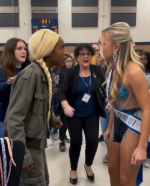
The event coordinator, Ms. Elena Ruiz, stood under the bright gymnasium lights with the official record open in her hands. Around us, parents, teachers, sponsors, students, and reporters from the local community channel had gone so silent that I could hear the tiny metallic clink of Serena Blackwood’s diamond bracelet against her wrist.
I was still trying to steady myself.
My ankle throbbed where she had kicked me. My palms burned from catching the edge of the display table. One fundraising bracelet had fallen to the floor beside my sneaker, its blue-and-gold threads twisted like a small, wounded thing.
Serena stared at the record.
For the first time since I had known her, she did not look elegant.
She looked trapped.
Ms. Ruiz turned the page slowly.
Her voice was controlled, but something furious lived beneath it.
“This entry shows that at 8:14 this morning, a request was submitted to remove Nala Mensah as lead contributor and replace her with Serena Blackwood.”
A wave of gasps rolled through the gym.
Serena’s father, Victor Blackwood, rose from the sponsor table.
“Careful,” he said sharply. “That is a serious accusation.”
Ms. Ruiz looked directly at him.
“It is not an accusation, Mr. Blackwood. It is a timestamped administrative record.”
My heart pounded so hard I felt dizzy.
The official file had my name.
My hours.
My sketches.
My signatures.
And now, apparently, the name of the person who had tried to erase me.
Ms. Ruiz looked down again.
“The request was submitted from a sponsor-access account.”
Serena’s mother pressed a hand to her pearl necklace.
Victor Blackwood’s face hardened. “Many people have access to sponsor portals.”
Ms. Ruiz nodded once. “Yes. Which is why the record logs the user ID.”
She turned the file around.
Everyone leaned forward.
Serena whispered, “No.”
Ms. Ruiz read aloud.
“Blackwood_Foundation_Admin_01.”
The gym erupted.
Students whispered. Parents stood. Phones lifted higher. A teacher moved toward me and asked if I was hurt, but I could barely hear her.
All I could see was Serena.
Her beautiful face had become a mask of panic.
“That doesn’t prove I did anything,” she snapped. “My family supports this school. We paid for half of this event.”
“And I braided bracelets until my fingers split,” I said.
My voice surprised me.
It was not loud.
But it carried.
The room quieted again.
Serena turned toward me with hate burning in her eyes.
I stepped forward despite the pain in my ankle.
“I stayed after school for weeks. I sorted materials. I fixed mistakes. I rewrote the presentation notes when the printer failed. I logged every bracelet batch. I taught freshmen how to braid the fundraiser pattern. I did the work.”
My throat tightened, but I refused to stop.
“You kicked me because you thought rich people could turn pain into silence.”
Someone near the back whispered, “Oh my God.”
Serena’s father slammed his hand on the sponsor table.
“This ceremony is over.”
Ms. Ruiz closed the record.
“No,” she said. “It is not.”
He glared at her.
Ms. Ruiz lifted the microphone from the podium.
“This fair exists to recognize student work. Not sponsor influence. Not donated money. Student work.”
She turned to me.
“Nala Mensah, please step forward.”
My body wanted to hide.
Every instinct screamed that I had already been seen too much, too violently, too publicly.
Then I looked at the display table.
At the bracelets.
At the proof.
At the threads I had braided after everyone else went home.
And I walked.
One limping step.
Then another.
The crowd parted for me.
Serena stood frozen beside the ceremony marker, the place she had tried to steal. For one second, our eyes met.
She looked furious.
I looked exhausted.
But I was still moving.
That was the difference.
When I reached Ms. Ruiz, she handed me the symbolic bracelet. It was larger than the others, braided from every team color in the school, with a tiny silver charm shaped like a sunrise.
My hands shook as I accepted it.
Ms. Ruiz spoke into the microphone.
“Tonight’s official recognition goes to Nala Mensah, whose documented leadership, labor, and design work made this fundraising project possible.”
The applause began softly.
Then it grew.
Students clapped first.
Then teachers.
Then parents.
Even some sponsors stood.
But Serena Blackwood did not clap.
Neither did her father.
And as the cameras turned toward me, I saw Victor Blackwood lower his head and whisper into his phone.
That was when I understood something colder than humiliation.
Serena had kicked me in public.
But her family had planned something much bigger in private.
PART 3 — THE SPONSOR’S SMILE
After the ceremony, Ms. Ruiz took me into the faculty lounge.
The applause still echoed in my ears, but my hands would not stop shaking.
A nurse wrapped my ankle while a school security officer asked questions. Principal Hargrove paced near the vending machine, pale and sweating, as though the scandal had bitten him personally.
“I want Serena removed from the fair,” Ms. Ruiz said.
Principal Hargrove rubbed his forehead. “Elena, we need to be careful.”
Ms. Ruiz stared at him. “A student was assaulted.”
“I understand that.”
“No, you understand that the Blackwoods donate money.”
The room went still.
Principal Hargrove looked at me, then away.
That hurt more than I expected.
Because I knew that look.
I had seen it in teachers who praised my resilience but never asked why I needed so much of it. I had seen it in sponsors who called me inspiring while scanning my faded jacket. I had seen it in adults who loved a scholarship story as long as it did not make powerful people uncomfortable.
The nurse finished wrapping my ankle.
“Can you stand?” she asked.
“Yes,” I said.
It was a lie.
But I had already done enough falling for one night.
The lounge door opened.
Victor Blackwood entered without knocking.
He was tall, silver-haired, perfectly dressed, the kind of man who made expensive suits look like armor. Serena followed behind him, eyes red but dry. Her mother, Celeste, came last, smelling faintly of perfume and cold money.
Principal Hargrove straightened instantly.
“Mr. Blackwood—”
Victor raised one hand.
“We need to resolve this before it becomes uglier.”
Ms. Ruiz crossed her arms. “Your daughter kicked a student in front of witnesses.”
Serena’s lip trembled, but I could tell it was practiced.
“I was overwhelmed,” she whispered. “Nala came at me.”
I almost laughed.
“Nala was walking to receive recognition,” Ms. Ruiz said. “There are videos.”
Victor smiled without warmth.
“Videos can be misleading.”
Then he looked at me.
Not like a person.
Like a problem.
“Nala, is it?”
“You know my name,” I said.
His smile tightened.
“I’m sure tonight was emotional for you. Students from challenging backgrounds sometimes feel pressure in public settings.”
My skin went hot.
Ms. Ruiz snapped, “Do not do that.”
He ignored her.
“My family has supported this school for years. Serena has led numerous charitable initiatives. I am willing to assume this was a misunderstanding, but only if we all behave responsibly.”
“Responsibly?” I repeated.
He reached into his jacket and removed an envelope.
He placed it on the table.
It was thick.
Too thick.
“My foundation can arrange a private scholarship contribution. Quietly. You withdraw any complaint. Serena apologizes for the confusion. The school issues a joint statement.”
My mouth went dry.
Principal Hargrove stared at the envelope.
Serena watched me with something worse than hatred.
Expectation.
She thought I would take it.
Maybe part of me understood why.
My mother worked overnight shifts at a care facility. My stepfather’s truck repair bills sat unopened on the kitchen counter. College application fees felt like mountains. A scholarship could change things.
Victor Blackwood knew that.
He had calculated my need before walking into the room.
I looked at the envelope.
Then at him.
“You think I’m for sale because my shoes are old?”
His face stiffened.
Celeste Blackwood said softly, “You should be grateful we are offering kindness.”
That word nearly made me sick.
Kindness.
As if kindness had ever needed an envelope.
I stood, pain shooting through my ankle.
“I am not withdrawing anything.”
Serena’s eyes flashed.
“You’ll regret this.”
Victor’s smile disappeared completely.
“Nala, the world is not kind to young women who confuse attention with truth.”
Ms. Ruiz stepped between us.
“And the law is not kind to adults who intimidate minors after an assault.”
Victor looked at her for a long moment.
Then he picked up the envelope.
“This school should remember who keeps its doors attractive to donors.”
Ms. Ruiz did not blink.
“And donors should remember the doors belong to students.”
The Blackwoods left.
But as Serena passed me, she whispered, “You don’t even know what you found.”
I turned.
“What does that mean?”
She gave me a smile full of poison.
“You think this is about bracelets?”
Then she walked away.
That night, I went home with my ankle wrapped, my name trending on local social media, and Serena’s words stuck in my mind like a hook.
You don’t even know what you found.
I thought the hidden record had proven my work.
I had no idea it was about to expose a crime.
PART 4 — THE BOX IN THE ART ROOM
The next morning, I did not want to go to school.
My mother stood in the kitchen at 6:30 a.m., still in her navy work scrubs, eyes tired from the night shift. She had watched the videos online before I came home. She had cried quietly while checking my ankle, then cried harder when I told her about the envelope.
“Nala,” she said, stirring oatmeal neither of us wanted, “you do not have to be brave every minute.”
I leaned against the counter.
“I know.”
But we both knew I would go.
Because staying home would let Serena’s story grow without me.
The school was chaos when I arrived.
Students stared. Some smiled. Some whispered. A few held up fists in silent support. Others looked disappointed that I was not crying harder.
My locker had a sticky note on it.
WE SAW WHAT SHE DID. YOU BELONG.
I pressed my fingers against the note and breathed.
Then I went to the art room.
That was where the bracelet project had lived for six weeks. Boxes of thread, beads, order sheets, design cards, and donation logs were stacked along the back wall.
Ms. Ruiz was already there.
She looked like she had not slept.
“We have a problem,” she said.
My stomach dropped.
“What happened?”
She pointed to the supply shelves.
“Someone came in last night.”
At first, I did not understand.
Then I saw it.
The bracelet logs were scattered. Folders had been opened. The design binder was missing. Two storage boxes were torn at the corners.
“They were looking for something,” Ms. Ruiz said.
Serena’s words returned.
You don’t even know what you found.
I walked slowly toward the display materials. My ankle protested with each step.
“What would they want?” I asked.
Ms. Ruiz shook her head. “Maybe anything that connects you to the project.”
But I was not listening anymore.
I was staring at the old cardboard box beneath the dye station.
The box nobody cared about.
The one full of rejected bracelet tags.
Each tag had been printed with QR codes for donors. Most had been thrown aside because the first batch linked to the wrong fundraising archive.
I knelt painfully and pulled the box forward.
Ms. Ruiz crouched beside me.
“What is it?”
“I scanned one of these by accident last week,” I said. “It opened an older sponsor folder. I thought it was just a mistake.”
My hands moved faster.
I found a tag with a smudged blue corner and scanned it with my phone.
A password page appeared.
I typed the old shared event code.
It opened.
Ms. Ruiz inhaled sharply.
Inside was not just the bracelet project.
It was a sponsor archive.
Folders.
Budgets.
Donation records.
Student grant assignments.
And a file labeled:
BLACKWOOD FOUNDATION — RESTRICTED MATCHING FUNDS
Ms. Ruiz whispered, “Nala, don’t touch anything else.”
But my thumb had already opened the file.
Rows of names filled the screen.
Student names.
Scholarship amounts.
Grant approvals.
Then reversals.
I saw entries labeled redirected.
Some students had been awarded small grants, then their funds had been moved into “event enhancement expenses.”
I scrolled.
My heart slammed.
There was my name.
MENSAH, NALA — COMMUNITY ARTS EQUITY GRANT — APPROVED: $7,500
Below it, another entry.
REDIRECTED TO BLACKWOOD FOUNDATION CEREMONIAL BRANDING PACKAGE
I could not speak.
Ms. Ruiz took the phone from my shaking hand.
Her face changed as she read.
“Oh, Nala.”
I had applied for that grant months earlier.
I never heard back.
I assumed I had been rejected.
Seven thousand five hundred dollars.
That was application fees, textbooks, transportation, part of a future.
My future.
Stolen and turned into banners, lighting, custom outfits, diamond-sponsored smiles.
Then Ms. Ruiz scrolled farther.
There were more names.
Dozens.
Students from low-income households. Immigrant families. Foster care. Special education programs. Art students. STEM students. Quiet kids who probably thought rejection was normal because rejection had always found them first.
And at the bottom of the file was an approval signature.
Not Serena’s.
Not Victor’s.
Principal Hargrove’s.
Ms. Ruiz turned pale.
Before either of us could move, the art room door opened.
Principal Hargrove stood there.
Behind him was Victor Blackwood.
And Serena.
Victor looked at the phone in Ms. Ruiz’s hand.
Then he smiled.
“That file is private property.”
PART 5 — WHEN THE PRINCIPAL CLOSED THE DOOR
Ms. Ruiz stood immediately.
“Nala, go to the main office.”
Principal Hargrove shut the door.
The click of the latch sounded enormous.
“No one is going anywhere until we understand what happened here,” he said.
Serena leaned against a table, arms crossed.
Her eyes found mine.
This time, she was not pale.
She looked relieved, as if the secret being out meant the mask could finally come off.
Victor stepped into the room slowly.
“Nala, you accessed confidential donor files without authorization.”
“You stole student grants,” I said.
Principal Hargrove flinched.
Victor did not.
“That is a reckless statement.”
Ms. Ruiz held up my phone. “These are scholarship records.”
“They are internal financial documents,” Victor replied. “Students misunderstand budgets all the time.”
My anger rose like heat.
“I understood my name. I understood approved. I understood redirected.”
Principal Hargrove rubbed his face. “Nala, this is complicated.”
“No,” Ms. Ruiz said. “It is not.”
He looked at her desperately. “Elena, you don’t understand what the Blackwood Foundation does for this school.”
“I understand exactly what it did.”
Victor’s voice lowered.
“Be careful, Ms. Ruiz. Your teaching contract comes up for review this year.”
There it was.
The same weapon in a different hand.
Money pressing down on truth.
I looked at Principal Hargrove and realized he was not just afraid.
He was guilty.
“You signed it,” I said.
He closed his eyes.
Victor spoke before he could.
“The principal made practical decisions under financial constraints.”
“Using money meant for students?”
Serena scoffed.
“Oh, please. Most of those kids wouldn’t know what to do with real opportunities anyway.”
The words sliced through the room.
Ms. Ruiz stared at her.
I stared too.
Serena looked almost bored.
“My family creates opportunities. We host events. We attract donors. We make this school look important. You braid some bracelets and suddenly everyone pretends you built the place.”
I felt something inside me go still.
There are insults that wound you.
And there are insults that reveal the wound was never yours.
Serena truly believed this.
She believed labor belonged underneath her name. She believed my work became valuable only when her family could stand beside it.
I reached for my phone.
Victor moved faster.
He snatched it from Ms. Ruiz’s hand.
“Evidence of unauthorized access,” he said.
Ms. Ruiz stepped forward. “Give that back.”
He slipped it into his jacket.
I felt panic.
The files.
The proof.
Gone.
Then a voice from the supply closet said, “Actually, I already sent it.”
Everyone froze.
The closet door creaked open.
Andre Patel stepped out holding his own phone.
Andre was a senior photography student, quiet, skinny, always wearing paint-stained hoodies and headphones around his neck. He had been documenting the fair for the yearbook.
And apparently, he had been hiding in the closet.
Serena looked horrified.
“What are you doing in there?”
Andre swallowed.
“Hiding from drama originally. Witnessing a felony eventually.”
Despite everything, a laugh burst out of Ms. Ruiz.
Andre held up his phone.
“I recorded all of that. Also, Nala’s screen was visible when she opened the file. I sent it to three people, including my cousin at the Albuquerque Journal.”
Victor’s face turned dark red.
Principal Hargrove whispered, “Andre, delete it.”
Andre backed up.
“No.”
Victor took a step toward him.
I moved without thinking and put myself between them, bad ankle and all.
“Touch him,” I said, “and do it on camera.”
Andre lifted his phone higher.
For the first time, Victor Blackwood looked like a man who had lost control of the room.
Then the fire alarm went off.
Shrill.
Deafening.
Students screamed in the hallway.
Ms. Ruiz grabbed my arm.
“Nala, move.”
Smoke curled under the art room door.
At first, I thought someone had pulled the alarm to create chaos.
Then I smelled burning paper.
Serena looked toward the back shelves.
The torn storage boxes.
The scattered records.
A thin orange glow flickered behind the supply cabinet.
Ms. Ruiz shouted, “Everyone out!”
But Victor did not run.
He looked at the burning shelf.
Then at me.
And in that split second, I understood.
Someone had set the fire to destroy the records.
PART 6 — THE BRACELET THAT SURVIVED THE FIRE
The hallway was chaos.
Students rushed toward exits while teachers shouted directions. The smoke thickened quickly, gray and bitter, swallowing the colorful fundraiser posters taped along the walls.
Ms. Ruiz pushed Andre ahead of her.
I limped behind them, coughing.
Behind me, Serena screamed, “Dad!”
I turned.
Victor Blackwood was still inside the art room.
Not trapped.
Searching.
He was yanking open drawers near the dye station, coughing into his sleeve, looking for something more important to him than safety.
Principal Hargrove shouted, “Victor, leave it!”
Victor ignored him.
Then part of the supply shelf collapsed.
Flames jumped toward the curtain hanging over the old kiln area.
Serena sobbed, “Daddy, please!”
I hated him.
I hated what he had done.
I hated the envelope, the threats, the stolen grants, the way he looked at me like poverty made me easy to erase.
But I also saw Serena’s face.
Not superior now.
Just terrified.
And before I could think better of it, I ran back.
My ankle screamed.
Ms. Ruiz shouted my name.
Smoke burned my eyes.
Victor was on one knee, coughing violently, reaching beneath the cabinet.
“Move!” I yelled.
He looked at me like I was impossible.
“The ledger,” he gasped.
Of course.
The physical ledger.
The thing he had wanted destroyed or recovered before anyone else found it.
I grabbed his arm.
He tried to pull away.
“Leave it!” I shouted.
He shoved me back.
Pain shot through my ankle, and I hit the edge of a table.
For a moment, flames blurred across my vision.
Then Andre appeared in the doorway with a fire extinguisher.
“Get down!”
White foam blasted across the shelves.
Ms. Ruiz came in behind him, covering her mouth with her sleeve. Together, we dragged Victor toward the hall as the sprinklers finally erupted overhead.
Water crashed down.
Smoke screamed upward.
The fire alarm shrieked.
Outside, on the football field, students huddled in clusters under the pale Albuquerque sky. Fire engines arrived minutes later, red lights flashing against the gym windows.
I sat on the grass, soaked, coughing, my ankle pulsing.
Serena stood a few yards away, staring at her father as paramedics gave him oxygen.
Then she looked at me.
For once, she had nothing cruel to say.
A firefighter approached Ms. Ruiz carrying a blackened metal cash box.
“Found this under the dye cabinet,” he said. “Looks like someone was trying to get it out before the fire spread.”
Victor tried to sit up.
“No,” he rasped.
Ms. Ruiz looked at me.
The firefighter opened the box.
Inside, wrapped in a partially burned event banner, was a ledger.
Not destroyed.
Soaked, charred at the edges, but readable.
And tucked into the front cover was a bracelet.
One of mine.
Blue and gold.
The first pattern sample I had made.
Around it was a paper tag with handwriting I recognized.
Principal Hargrove’s.
“Use Nala’s design. Rebrand under Blackwood family leadership.”
The principal sank onto the curb.
That was when the police arrived.
Victor tried to speak.
Serena tried to cry.
Principal Hargrove tried to explain.
But Ms. Ruiz handed the ledger to an officer and said the words that made every camera turn again.
“These are stolen student funds.”
PART 7 — SERENA’S CONFESSION
By sunset, the fair had become a crime scene.
Yellow tape stretched across the art wing. News vans lined the curb. Parents demanded answers. Students who had once whispered about Serena now shouted questions across the parking lot.
The Blackwoods did not leave as royalty.
They left separately.
Victor went in the back of a police car after refusing to surrender the ledger entries he had stuffed into his jacket.
Principal Hargrove was placed on administrative leave.
Celeste Blackwood followed her lawyer into a black SUV without looking at anyone.
Serena remained on the sidewalk.
Alone.
Her makeup had streaked from sprinklers and tears. Her custom event outfit clung to her like a costume after the play had ended. Without the diamonds catching light, she looked younger.
Still dangerous.
But younger.
I was sitting on the school steps with my ankle elevated when she approached.
Andre immediately lifted his phone.
Serena glared at him weakly.
“I’m not here to fight.”
I looked at her.
“Then why are you here?”
Her mouth trembled.
For a second, the old Serena tried to return. Chin up. Eyes sharp. Smile cruel.
But it failed.
“My father made me do it,” she said.
Andre muttered, “Classic.”
She shot him a look. Then her shoulders collapsed.
“No. Not all of it. I wanted the spotlight. I wanted the ceremony. I hated that everyone was talking about your bracelet pattern like it was some miracle.”
“It was a fundraiser project,” I said.
“To you,” she snapped, then stopped herself.
She looked away.
“To me, it was the first thing my father cared about all semester. He kept saying the Blackwood Foundation needed a perfect student face. Someone polished. Someone donors could trust.”
“Someone like you.”
She nodded.
“He said if your name stayed on the recognition, reporters would ask why a student with an equity grant was still wearing worn-out shoes. He said questions lead to audits.”
My breath caught.
Ms. Ruiz, standing nearby, went very still.
Serena continued.
“I didn’t know everything. Not at first. I knew he moved money around. I knew the foundation made the events look bigger than they were. But I told myself it was normal rich-people accounting.”
Her eyes filled.
“Then this morning, I saw your name in the file. The grant. The redirected amount. I asked him about it.”
“What did he say?”
Serena swallowed.
“He said some students are better as symbols than investments.”
The sentence hit me so hard I looked away.
Because that was exactly what they had wanted me to be.
Poor enough to inspire donors.
Useful enough to do the work.
Invisible enough not to receive the reward.
Serena wiped her face angrily.
“He told me to make sure you didn’t speak. He said if you looked unstable, no one would trust you.”
“So you kicked me.”
“I panicked.”
“No,” I said. “You chose.”
She flinched.
Good.
Some truths should hurt.
Serena reached into her pocket and pulled out a small silver flash drive.
“My father keeps backups. He doesn’t trust anyone. Not even his own family.”
She held it out.
“This has emails. Transfers. The list of student funds. Everything I could copy before he locked me out.”
Andre’s mouth fell open.
Ms. Ruiz took the drive carefully.
“Why give this to us?”
Serena looked at me.
For the first time, there was no superiority in her face.
Only shame.
“Because when the fire started, you came back for him.”
Her voice broke.
“And he still tried to push you away.”
I said nothing.
She looked down at my wrapped ankle.
“I don’t expect you to forgive me.”
“Good,” I said.
She nodded like she deserved that.
Then she whispered, “I’m sorry, Nala.”
The words were small.
Not enough.
But real.
Police took her statement an hour later.
By morning, the story had exploded beyond Albuquerque.
The bracelet fair had uncovered a donor fraud scheme involving stolen student grants, falsified recognition records, and an attempted cover-up fire.
The hidden record that began with my name had become a map of everyone they had erased.
And we were about to bring them all back.
PART 8 — THE END — EVERY NAME RETURNED
Two months later, the gym looked completely different.
No diamond sponsor table.
No Blackwood banners.
No ceremony marker waiting to be stolen.
Instead, the walls were covered with student work.
Paintings, robotics prototypes, poems, beadwork, science boards, photography, woodworking, short films, handmade clothing, and rows of fundraising bracelets braided by dozens of students who now knew exactly whose hands had taught the pattern.
At the front of the room stood a new display.
Not for sponsors.
For names.
Every student whose grant had been redirected was listed there, with the amount restored beside it.
Some cried when they saw it.
Some stared like they did not trust joy arriving in public.
One freshman touched her name with two fingers and whispered, “I thought I just wasn’t good enough.”
I knew that feeling.
I had lived inside it.
The investigation had moved fast because Serena’s flash drive contained everything. Emails from Victor Blackwood. Approval notes from Principal Hargrove. Foundation transfers disguised as event costs. Messages about which students were “marketable,” which were “too difficult,” and which should be used in promotional materials without receiving full funding.
Victor Blackwood was charged with fraud, intimidation, evidence tampering, and conspiracy.
Principal Hargrove resigned before the school board could fire him.
Celeste Blackwood claimed ignorance, but the investigators found her name on enough documents to make that story crack.
Serena testified.
Not perfectly.
Not heroically.
But truthfully.
That mattered.
She transferred schools afterward. Some people said she had lost everything. I did not know if that was true. People like Serena usually discover that “everything” has a way of leaving them with more than others begin with.
But she lost the spotlight she had stolen.
And I learned I did not need it.
I needed the light to reach everyone.
Ms. Ruiz became interim principal.
On the night of the restored grant ceremony, she stood at the microphone wearing a blue dress and the same blue-and-gold bracelet from the fire.
Her voice trembled as she spoke.
“This school failed many of you. Adults failed many of you. Tonight does not erase that harm, but it begins the work of repair.”
Then she called the names.
One by one.
Students walked forward with stunned faces and shaking hands.
Andre received funding for his documentary film program.
A quiet boy named Mateo received his engineering summer grant.
A Navajo student named Leona received support for her textile art project.
A refugee student named Hana received money for a medical science camp.
And then Ms. Ruiz said my name.
“Nala Mensah.”
My mother squeezed my hand.
She had taken the night off work, which meant we would feel it in the budget later, but she said some moments deserved witnesses.
I walked to the stage in a simple black dress borrowed from my cousin, my blonde braid falling over one shoulder, my ankle finally healed.
This time, no one blocked my path.
No one kicked me.
No one whispered that I did not belong.
Ms. Ruiz handed me an envelope.
Inside was the restored $7,500 Community Arts Equity Grant, plus an additional scholarship created from emergency community donations after the scandal.
I stared at the paper.
For weeks, I had thought I would feel victorious.
Instead, I felt something deeper.
Relief.
The kind that makes your bones tired.
Ms. Ruiz smiled at me.
“Would you like to say something?”
The microphone waited.
The room waited.
A few months earlier, I would have wanted one clean moment where my name was said without pity.
Now I had something else.
A voice.
I stepped up.
“My name is Nala Mensah,” I began.
My mother covered her mouth.
“I braided bracelets after school because I thought small work still mattered. I was right.”
A soft laugh moved through the room.
I continued.
“But I also learned that small work becomes dangerous to people who build big lies. A thread can lead to a knot. A record can lead to a ledger. A name can lead to every name they tried to hide.”
I looked at the students on the wall.
“They wanted some of us to be symbols instead of people. They wanted our struggle in their brochures, our labor on their tables, and our silence in their records.”
The room was completely still.
“But we are not decorations for anyone’s generosity. We are not background labor. We are not sad stories waiting for rich people to rescue us.”
My voice strengthened.
“We are artists. Engineers. Writers. caretakers. Builders. Scientists. Children of immigrants. Children of single parents. Children of tired families who still show up. We are students. And our names belong on our work.”
Applause burst through the gym.
This time, I did not shrink from it.
I let it reach me.
After the ceremony, a little girl from the middle school program came up to my table. She had brown skin, a shy smile, and purple beads at the end of her braids.
“Can you teach me the bracelet pattern?” she asked.
I smiled.
“Of course.”
She sat beside me.
I gave her blue thread, then gold.
“First,” I said, “you anchor the center. If the center is strong, the pattern holds.”
She nodded seriously, as if I had given her a secret.
Maybe I had.
Across the room, Andre filmed students laughing near the restored grant wall. Ms. Ruiz spoke with parents. My mother ate two cupcakes and pretended she had not cried through my entire speech.
Near the exit, I noticed someone standing alone.
Serena.
Her hair was shorter now. No diamonds. No custom outfit. Just jeans, a gray sweater, and a face that looked like it had learned the cost of being seen clearly.
Security watched her carefully, but Ms. Ruiz had allowed her to come because some of the recovered evidence required her testimony, and because several students had agreed she could hear the repair she helped make possible.
Serena did not approach the stage.
She did not ask for forgiveness.
She simply looked at the wall of names.
Then she looked at me and gave one small nod.
I returned it.
Not forgiveness.
Not friendship.
Just acknowledgment.
Sometimes that is all a healed wound can offer the knife.
That night, after the gym emptied, I stayed behind to collect leftover thread.
The floor was scattered with tiny pieces of color. Blue. Gold. Red. Green. Purple. White.
Threads that looked useless alone.
Beautiful together.
My mother helped me pack them into a box.
“You were magnificent,” she said.
I laughed softly. “I was terrified.”
“I know. That is why it was magnificent.”
Outside, Albuquerque glowed beneath a dark velvet sky. The air smelled like dust, rain somewhere far away, and the faint sweetness of frosting from the cupcakes we had wrapped in napkins to take home.
As we walked to the bus stop, my mother slipped her arm through mine.
“So,” she said, “what will you do with your grant?”
I looked down at the bracelet on my wrist.
The original one.
Blue and gold.
The one that had survived the fire.
“I’m going to start a student archive,” I said.
“A what?”
“A public record. For projects, hours, designs, grants, credits. So no one can quietly remove a name again.”
My mother smiled.
“That sounds like a lot of work.”
I looked back at the school.
At the windows still glowing.
At the room where they had tried to humiliate me.
At the place where my name had almost disappeared, then became the thread that pulled everything open.
I smiled too.
“I’m good at work people underestimate.”
The bus arrived, hissing at the curb.
Before stepping on, I checked my phone.
A message from Andre.
He had sent a still photo from the ceremony.
In it, I stood at the microphone beneath the restored grant wall. My braid shone under the lights. My jacket was old, my sneakers still worn, but my eyes were steady.
Behind me, every recovered name was visible.
Under the photo, Andre had typed:
THE HIDDEN RECORD DIDN’T MAKE EVERY CAMERA TURN. YOU DID.
I held the phone to my chest.
For the first time in a long time, I did not feel like a girl waiting to be chosen.
I felt like a girl who had chosen herself.
And somewhere in the city, in homes where bills sat on counters and parents worked double shifts and students wondered if their quiet labor mattered, the news spread from phone to phone, voice to voice, thread to thread.
The grants were restored.
The names were returned.
The lie was broken.
And the bracelet pattern kept growing.
THE END
