PART 2 — THE NAME THEY TRIED TO ERASE
The event coordinator’s finger froze on the final line, and suddenly the entire launch ceremony felt less like a celebration and more like a courtroom with chandeliers.
Mrs. Elaine Porter, the coordinator, was usually the kind of woman who smiled even while solving disasters. She smiled when volunteers arrived late. She smiled when boxes were mislabeled. She smiled when donors asked why the banner was not more visible in photographs.
But now she was not smiling.
She held the official record open under the bright lights beside the display table, her mouth pressed into a thin, stunned line.
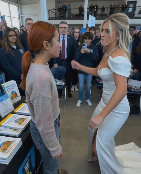
My cheek still burned from Savannah Blake’s slap.
The sound of it seemed to remain in the room, bouncing off the polished floor, the donation posters, the decorated library van parked behind us with its new blue-and-yellow wrap that read: BOOKS ON WHEELS — STORIES FOR EVERY STREET.
I stood there in my thin faded sweater, one hand against my face, while phones hovered in the air like little black mirrors.
Savannah Blake stood across from me, glittering in her white evening gown, crystal heels flashing beneath the hem, diamond necklace bright at her throat.
A few minutes earlier, she had looked untouchable.
Now she looked like a porcelain statue someone had knocked from a shelf.
Mrs. Porter read the entry aloud.
“Request submitted at 9:07 this morning to amend student recognition file. Original presenter and project contributor: Rosa Minh Nguyen. Replacement presenter requested: Savannah Elise Blake. Submitted through donor relations account belonging to… Caroline Blake.”
For one second, nobody moved.
Then a ripple passed through the crowd.
Not loud.
Not dramatic.
Worse.
It was the sound of people understanding exactly what had happened and wishing they had not been there to witness it.
Mrs. Blake rose from the front row.
She was beautiful in the expensive, cold way hotel lobbies were beautiful. Her blonde hair was twisted into a perfect knot, her navy silk dress had no wrinkles, and her expression suggested that reality itself had made an offensive mistake.
“This is clearly an administrative confusion,” she said.
Mrs. Porter lifted her eyes. “The entry is timestamped.”
“My office coordinates dozens of philanthropic commitments.”
“It includes a note requesting that Rosa Nguyen’s name be removed from the ceremony script.”
My stomach dropped.
Removed.
Not replaced accidentally.
Not adjusted.
Removed.
I stared at the page from where I stood. I could not read the small print, but I knew my name was there because Mrs. Porter had just spoken it like evidence.
Savannah whispered, “Mom, don’t.”
That small word—Mom—changed her face.
For the first time, Savannah Blake did not look like the girl who had slapped me in front of half of Detroit’s education board.
She looked like someone trapped inside a story her family had written for her.
Mrs. Blake turned sharply toward her daughter.
“Savannah, be quiet.”
Then she faced the room with a smooth smile that did not reach her eyes.
“Our family donated the van. We funded the shelves, the technology, the opening inventory. We simply believed it was appropriate that Savannah, who has represented youth literacy in our foundation materials, participate in the key presentation.”
Mrs. Porter’s voice hardened. “Participate is not the word used here.”
Principal Marlow stepped forward.
He had been quiet until then, standing near the podium with a stunned expression. Now his face had gone pale with anger.
“What word was used?” he asked.
Mrs. Porter looked down at the record.
“Replace.”
The word hit harder than the slap.
Replace Rosa Nguyen.
Replace the girl who stayed after school until the janitors turned off half the lights.
Replace the girl who packed books into crates, labeled neighborhoods by reading level, sorted bilingual picture books, repaired ripped covers with tape from the supply closet, and made route maps while other students posed beside the van for photos.
Replace the girl in old boots.
Replace me.
My throat tightened until breathing hurt.
A teacher named Ms. Halden came toward me, her eyes wet. “Rosa, honey, are you okay?”
I wanted to say yes.
I wanted to be the kind of girl who could get slapped in public and still stand there like stone.
But my cheek burned. My eyes stung. My body trembled in front of every camera.
“I’m fine,” I whispered.
The microphone caught it.
Everyone heard the lie.
A murmur moved through the crowd, and suddenly people looked ashamed.
They should have.
Because many of them had seen me for months without seeing me at all.
They had watched me carry boxes through back hallways while Savannah smiled beside oversized checks. They had watched me kneel on the floor with spreadsheets and donation lists while adults praised “student leadership” in speeches written by people who never asked who did the work.
Mrs. Porter closed the record gently, as if the book itself had been wounded.
Then she turned to me.
“Rosa,” she said, “the van key is still yours to present. Only yours.”
The key sat on the display table.
It was ceremonial, silver, oversized, tied with a blue ribbon. Not the real ignition key, of course. The real keys were with transportation staff. But this one represented the launch. The moment. The promise that books would reach children who could not always reach libraries.
I had imagined picking it up with steady hands.
I had imagined smiling without fear.
I had imagined my grandmother seeing the livestream at home and calling me her little lantern.
Instead, my face had Savannah’s handprint on it.
Savannah stepped back, trembling.
Her mother reached for her arm.
Mrs. Porter blocked them with surprising speed.
“No one leaves yet,” she said.
Mrs. Blake laughed once. “Excuse me?”
“This ceremony was interrupted by an assault and by evidence of record tampering. The school and district officials will need statements.”
“You cannot detain us.”
“No,” Principal Marlow said quietly. “But the cameras can follow you if you choose to run.”
Mrs. Blake looked around.
Every phone was still lifted.
Every camera still pointed.
Savannah’s eyes met mine.
I expected hatred.
Instead, I saw fear.
Not of punishment.
Of her mother.
That should have made me feel powerful.
It did not.
It made everything feel worse.
Because this was bigger than one slap. Bigger than one spoiled girl. Bigger than one rich woman trying to polish her family name with my labor.
Mrs. Porter touched the ceremonial key and looked at me again.
“Rosa?”
My cheek throbbed. My hands shook. My old boots felt glued to the floor.
Then, from the back of the hall, a voice rang out.
“Cháu đứng lên đi, Rosa.”
My grandmother.
Stand up, Rosa.
She stood near the entrance in her brown winter coat, smaller than almost everyone around her, silver hair pinned back, cane in one hand. She was not supposed to come because her knees hurt in cold weather, but there she was, eyes fierce, chin lifted.
Beside her stood my father, still in his mechanic’s jacket, grease dark beneath his fingernails.
He had left work early.
For me.
Something inside my chest steadied.
I lowered my hand from my cheek.
I walked to the table.
Each step felt louder than applause.
I picked up the ceremonial key.
Then I turned toward the decorated library van and held it high.
For a moment, silence.
Then one child near the front began clapping.
A little girl in a yellow coat.
Then her brother.
Then my teachers.
Then half the room.
Then all of it.
The applause rose like a storm breaking open.
I did not smile for the cameras.
Not yet.
I looked at the van.
At the shelves visible through its open side door.
At the books waiting to move.
And I knew something Savannah Blake did not.
The official record had exposed her family.
But the van still carried another secret.
One I had hidden in plain sight.
PART 3 — THE MAP INSIDE THE VAN
After the ceremony, the launch hall turned chaotic.
Reporters cornered Principal Marlow. Sponsors whispered like frightened birds. Students replayed the slap on their phones, slowing it down, speeding it up, freezing the frame where Savannah’s hand struck my face.
I hated that my pain had become content.
Ms. Halden led me into a side office, away from the noise. My father and grandmother followed. The second the door closed, my grandmother took my face gently in both hands.
Her fingertips smelled like peppermint oil and old paper.
“My child,” she whispered.
“I’m okay,” I said again.
She gave me the look Vietnamese grandmothers give when lies are too weak to deserve words.
My father paced once across the room, stopped, then turned as if he wanted to punch a wall but had remembered walls were not the enemy.
“She hit you,” he said.
His voice was low. Dangerous.
“I know.”
“In front of everybody.”
“I know.”
His eyes filled with tears, which frightened me more than his anger.
My father was a quiet man. After my mother died when I was nine, he became even quieter, as if half his words had been buried with her. He showed love by fixing things: my bike, our heater, my grandmother’s walker, the loose hinge on my bedroom door.
Now he could not fix the red mark on my cheek.
That hurt him.
I reached for his hand.
“I’m still here,” I said.
His fingers closed around mine.
Mrs. Porter entered a few minutes later with the official record tucked under one arm and a tablet under the other. Principal Marlow followed, along with a woman I did not recognize.
“This is Attorney Dana Whitaker from the district,” Principal Marlow said. “We need to discuss what happens next.”
My stomach tightened.
“What happens to the van?”
Everyone paused.
That was my first question.
Not what happens to Savannah. Not what happens to Mrs. Blake. Not what happens to me.
The van.
Because children in Brightmoor, Delray, and parts of the east side were expecting it next week. Teachers had already sent home flyers. Parents had signed permission forms. Kids had written request lists in crayon.
Mrs. Porter’s face softened.
“The launch will continue.”
I exhaled.
“But,” Dana Whitaker said, “we need to protect the integrity of the project. Rosa, Mrs. Porter mentioned that your records may include more than volunteer hours.”
I looked at Mrs. Porter.
She nodded gently.
“The Official Proof showed your signatures, hours, route logs, inventory notes, and packing records,” she said. “But there is also a separate file attached to your name. Something called the Hidden Record.”
My pulse jumped.
My grandmother’s eyes sharpened.
My father looked confused. “What hidden record?”
I swallowed.
“It’s not bad,” I said quickly. “I named it that because I didn’t want anyone messing with it.”
Principal Marlow leaned forward. “What is it?”
I hesitated.
For months, I had watched adults plan the library van like it was a moving billboard for generosity. They talked about ribbon colors, donor plaques, media coverage, and sponsor photographs. They cared about the van looking inspiring.
But I had packed the books.
I had read the request forms from schools and shelters.
I had noticed which neighborhoods asked for bilingual books, which needed early readers, which requested graphic novels for reluctant readers, which wanted GED study guides, which had children who spoke Arabic, Spanish, Vietnamese, Bengali, and English all in the same classroom.
The official route planned by the sponsor committee made no sense.
It stopped first at places near cameras.
So I made another route.
A better one.
I tracked request forms, bus access, school dismissal times, neighborhood library closures, and reading-level needs. I built a schedule that prioritized communities with the least access, not the best photo opportunities. I matched each crate of books to each stop.
That was the Hidden Record.
I told them everything.
When I finished, nobody spoke.
Then Dana Whitaker asked, “Who approved this?”
“No one,” I admitted.
My face got hot.
“I didn’t change the official plan. I just… kept notes. In case someone asked why the route felt wrong.”
Mrs. Porter opened her tablet and pulled up the file.
Rows of data filled the screen. Color-coded stops. Book categories. Family language requests. Distance from nearest public library branch. Notes from teachers. Shelter schedules. Community center hours.
Principal Marlow stared at it.
“This is better than the district proposal,” he said quietly.
Mrs. Porter whispered, “It is better than the foundation proposal too.”
My father looked at me like I had turned into someone taller.
“You did all this after school?”
“And weekends,” I said.
Grandmother clicked her tongue. “And when you told me you were doing homework.”
“It was homework-adjacent.”
She did not laugh, but her eyes did.
Dana Whitaker studied the file carefully.
“Rosa, this record may be extremely important.”
I frowned. “Because of Savannah?”
“Because of access,” she said. “If this route works, the van becomes more than a donation. It becomes a model.”
Mrs. Porter nodded. “A student-built model for equitable mobile-library service.”
The words felt too large for the little spreadsheet I had made on an old laptop that overheated if I opened too many tabs.
“I was just trying to get the right books to the right kids,” I said.
“That,” Mrs. Porter replied, “is exactly why it matters.”
Before anyone could say more, shouting erupted outside the office.
Savannah’s voice.
“I said I want to talk to her!”
Mrs. Blake answered, icy and furious. “You have done enough damage.”
The door opened.
Savannah stood there, no longer glowing. Her diamond necklace was gone, her mascara smudged, and one of her crystal heels was in her hand because the strap had snapped.
For a strange second, she looked less like a rich girl and more like someone who had run barefoot through the wreckage of her own life.
“I need to tell you something,” she said, looking at me.
My father stepped in front of me.
“No.”
Savannah flinched.
“I deserve that,” she whispered.
Mrs. Blake appeared behind her. “Savannah, we are leaving.”
Savannah shook her head.
Then she looked past her mother, past the adults, straight at me.
“My mother didn’t just try to remove your name,” she said. “She copied your Hidden Record last week.”
The room went silent.
Mrs. Blake’s face hardened.
Savannah’s voice cracked.
“She was going to announce a new foundation program tonight. Same route plan. Same language access notes. Same neighborhood schedule. She was going to call it the Blake Literacy Equity Model.”
My knees nearly gave out.
The slap had burned.
This felt like being robbed from the inside.
Mrs. Blake smiled thinly.
“Savannah is emotional and confused.”
“No,” Savannah whispered. “I was confused before.”
Then she reached into her small silver purse and pulled out a folded page.
“I printed this because I thought it would make Mom proud,” she said. “But it has Rosa’s file name on the bottom.”
She handed it to Dana Whitaker.
Mrs. Blake lunged.
My father blocked her.
For one wild second, everyone moved.
Mrs. Blake shouted. Savannah cried. Principal Marlow called security. Mrs. Porter grabbed the official record. My grandmother stood with both hands on her cane, eyes blazing.
Dana unfolded the page.
At the bottom, in small gray text, was the export label:
Hidden_Record_RNguyen_FinalDraft
And above it, in bold sponsor-font lettering:
THE BLAKE FAMILY LITERACY EQUITY MODEL
The room tilted.
Savannah looked at me, shaking.
“I’m sorry,” she said. “I didn’t know at first.”
I touched my burning cheek.
“But you knew when you slapped me?”
She closed her eyes.
“Yes.”
That one word destroyed any softness I might have felt.
At least she did not lie.
PART 4 — THE VAN THAT REFUSED TO BE A PROP
The next morning, my face was on the news.
Not my best face.
My stunned, slapped, frozen face.
The video had gone everywhere by breakfast. People online named me brave, pitiful, inspiring, dramatic, innocent, fake, brilliant, and attention-seeking before I had even brushed my teeth.
My grandmother turned off the television with a sharp click.
“Too many strangers talking,” she said.
My father placed a mug of tea beside me.
“You don’t have to go to school.”
“Yes, I do.”
He frowned. “Rosa.”
“The van route meeting is today.”
“After what happened?”
“Because of what happened.”
He looked at me for a long moment.
Then he nodded slowly, like he hated my answer but respected the spine inside it.
At school, everyone stared.
Some students whispered apologies. Some looked guilty. Some watched me with that glittery curiosity people get when your humiliation has entertained them and now they want to pretend concern is the same as kindness.
Savannah was not there.
Neither was her usual circle.
By noon, the Blake Foundation released a statement calling the slap “an unfortunate emotional exchange between two students.” It said the family remained committed to literacy, equity, and community partnership.
It did not say my name.
It did not say theft.
It did not say slap.
Ms. Halden read it in the staff room, then found me in the hallway and said, “I hope their printer jams forever.”
That was the first time I laughed.
The district meeting happened after school in the library.
My Hidden Record was projected onto a screen. Around the table sat Principal Marlow, Mrs. Porter, Dana Whitaker, two district literacy specialists, three librarians, one transportation manager, and me.
At first, I sat with my hands folded, trying to disappear.
Then they started discussing my route like I was not there.
“We should move the Delray stop earlier.”
“That might conflict with dismissal time.”
“The bilingual crate assignments need review.”
“Maybe the sponsor route should remain for launch week.”
Sponsor route.
The words lit a match inside me.
“No,” I said.
Everyone turned.
My voice shook, but I kept going.
“The sponsor route goes where cameras can park. The Hidden Record goes where kids asked for books.”
Nobody interrupted.
So I stood and walked to the screen.
I pointed at the first stop.
“This shelter requested board books and early readers because parents there asked for bedtime books. The sponsor route skips it because the parking lot is small.”
I pointed to another.
“This community center asked for Vietnamese and Spanish books. The official route sends mostly English middle-grade novels.”
Another.
“This elementary school’s library is closed twice a week because they don’t have staff. They requested graphic novels because their fourth-grade reading group won’t touch chapter books yet. The sponsor route gives them one crate.”
My voice grew stronger with every sentence.
“I packed those crates. I read those forms. I know which books go where.”
The room was silent.
Then one of the librarians, a Black woman with silver braids and bright red glasses, smiled slowly.
“What do you recommend, Rosa?”
No adult had ever asked me that in a room like this.
Not what I had done.
Not what I could carry.
What I recommended.
I looked at the map.
“We launch with the Hidden Record route,” I said. “No sponsor detour. No photo stop unless it’s already part of service. We track borrowing, requests, languages, reading levels, and attendance. After four weeks, we adjust based on use.”
The transportation manager leaned back.
“That is… actually very practical.”
“Thank you,” I said, trying not to grin.
Mrs. Porter wiped beneath one eye.
Dana Whitaker typed notes.
By the end of the meeting, the district adopted my route as the official pilot schedule.
My name was added to the document title.
Rosa Nguyen Mobile Library Access Plan.
I stared at those words until they blurred.
After the meeting, I found Savannah waiting outside the library.
She wore a plain gray coat and flat shoes. No gown. No crystals. No diamonds. Without the costume, she looked younger. Smaller. Exhausted.
“I’m not supposed to talk to you,” she said.
“Then don’t.”
She nodded as if the words hit exactly where she expected.
“I gave the district my emails.”
I stopped.
“What emails?”
“The ones from my mother. The ones telling me what to say if anyone asked about the route. The ones with screenshots from your file.”
I searched her face for performance.
There was none.
“Why?”
Savannah’s eyes filled, but she blinked the tears back.
“Because last night she told me I had embarrassed the family. Not because I hit you. Because I got caught.”
My anger did not vanish.
It sharpened into something sadder.
“That doesn’t make what you did okay.”
“I know.”
“You slapped me.”
“I know.”
“In front of everyone.”
Her voice broke. “I know.”
For a moment, the hallway hummed around us. Lockers slammed in the distance. Someone laughed near the stairwell. Life went on with cruel ease.
Savannah reached into her backpack and pulled out a small envelope.
“My written statement,” she said. “Not for forgiveness. For evidence.”
I did not take it immediately.
“What does it say?”
“The truth.”
“That you helped?”
“Yes.”
“That you knew the route was mine?”
“Yes.”
“That you slapped me because you wanted the cameras to see you, not me?”
She flinched as if I had slapped her back.
Then she nodded.
“Yes.”
I took the envelope.
Our fingers did not touch.
Savannah whispered, “My mother says people like you only win when people like us make mistakes.”
My throat tightened.
“What do you say?”
She looked at the library doors behind me.
“I say people like me were taught to call theft tradition.”
Then she walked away.
I stood there holding the envelope, furious because part of me understood her, and even more furious because understanding did not undo harm.
That evening, my grandmother made phở and said the broth needed bones to become strong.
I thought about that for a long time.
Maybe truth did too.
PART 5 — THE FIRST STOP
The library van’s first real stop was not glamorous.
No stage.
No crystal heels.
No diamond necklaces.
Just a cold Detroit afternoon, a cracked parking lot outside a family shelter, and a line of children bouncing on their toes because the van doors were about to open.
I stood beside Mrs. Porter with a clipboard clutched to my chest.
The red mark on my cheek had faded, but I still felt it sometimes, like a memory under the skin.
My father had taken off work for an hour to stand nearby. My grandmother sat inside the shelter lobby, pretending she was only there because it was warmer, though she had already told three strangers I designed the route.
The van door slid open.
For one breath, the children stared.
Then they rushed forward.
Not wildly. Not rudely. Just with the urgent hunger of kids who had been promised a room full of stories on wheels and discovered it was real.
A little boy in a green jacket grabbed a dinosaur book and pressed it to his chest.
A girl with purple beads in her hair asked if we had books about astronauts.
A mother whispered, “Do you have anything in Vietnamese? My neighbor’s daughter just came here.”
I found the crate.
“Yes,” I said, handing her two picture books and one early reader. “We brought these.”
Her face changed.
Not gratitude exactly.
Recognition.
Like someone had remembered she existed.
That was when I understood what my Hidden Record really was.
Not a spreadsheet.
Not a route plan.
A promise that nobody would be treated like an afterthought.
For the next two hours, books moved from shelves into hands. I wrote down requests. More Spanish board books. More graphic novels. More teen romance. More books about grief. More books with Black girls on the cover. More large-print books for grandparents reading aloud.
Near the end, a small girl in a pink hat pointed at my clipboard.
“Are you the boss?”
I opened my mouth to say no.
Then stopped.
Mrs. Porter looked at me with a smile.
I crouched down.
“I helped make the plan.”
The girl considered this.
“Can you plan more unicorn books?”
I wrote it down seriously.
“Yes.”
She nodded, satisfied.
That night, the local news aired a new segment.
Not the slap.
The van.
Children holding books. Parents filling request cards. Librarians restocking shelves. Me explaining how the route matched community needs.
The headline read:
STUDENT-DESIGNED LIBRARY VAN ROUTE BRINGS BOOKS TO UNDERSERVED DETROIT NEIGHBORHOODS
My grandmother recorded it on her phone even though it was already online.
She watched it four times.
My father watched quietly from the kitchen doorway.
When the segment ended, he said, “Your mother would have made everyone watch it until midnight.”
I smiled, but my chest ached.
My mother had loved libraries.
She used to take me every Saturday, even when money was tight and snow piled dirty against the curbs. She said libraries were the only places where you could be poor and still walk out rich.
After she died, I stopped going for a while.
The silence hurt too much.
Maybe that was why I packed books so carefully.
Maybe part of me had been packing them for her.
The next week, the district’s investigation intensified.
Mrs. Blake’s donor account had accessed more student files than anyone expected. Not just mine. Other projects. Other volunteer plans. Other ideas polished into foundation language.
Dana Whitaker called it “a pattern of misattribution.”
My grandmother called it “stealing with perfume.”
Savannah’s written statement became critical.
So did the emails she turned over.
The Blake Foundation tried to discredit her first.
Then me.
They claimed I had misunderstood sponsor support. They claimed the Hidden Record belonged to the launch committee. They claimed my role had been exaggerated by media pressure.
Then Dana released the audit trail.
Every edit.
Every upload.
Every signature.
Every late-night timestamp from my school account.
The truth had receipts.
At the disciplinary hearing, Savannah sat across from me with her hands folded tight.
Mrs. Blake did not attend. Her attorney did.
That told me enough.
Savannah spoke clearly.
“I slapped Rosa Nguyen because I wanted to humiliate her before the cameras could recognize her. My mother tried to replace Rosa’s name with mine. I knew the route plan was Rosa’s work before the ceremony. I participated in the lie.”
Her voice cracked.
Then she added, “Rosa did not steal from my family. We stole from her.”
The room went still.
I looked at her.
This time, she looked back.
Not asking me to save her.
Not asking me to soften.
Just standing in the wreckage with the truth in her hands.
PART 6 — THE COST OF BEING SEEN
Being recognized was not as simple as I thought it would be.
I had imagined that once people knew the truth, everything would feel clean.
Instead, life became louder.
Reporters wanted interviews. Community leaders wanted speeches. Students wanted selfies. Adults wanted me to become a symbol before I had figured out how to be a person in public.
Some praised me in ways that felt heavy.
Some questioned me in ways that felt sharp.
A man online wrote that I was “ungrateful” because without rich sponsors there would be no van.
A woman replied, Without Rosa, there would be a van full of books going to the wrong places.
I screenshotted that one.
At school, students changed around me.
Some became kinder.
Some became careful.
A few became resentful, as if my humiliation had given me unfair advantages.
The strangest were the people who suddenly wanted to confess.
One boy admitted he had seen Savannah look at my files before the ceremony but had not wanted to get involved.
A girl from student council apologized for letting Savannah take credit in meetings.
A sponsor intern sent me an anonymous message: Your name was removed from the printed donor packet too. I should have said something.
Each confession felt like a tiny weight someone placed in my backpack after the mountain had already been climbed.
One afternoon, I snapped.
Ms. Halden found me in the storage room surrounded by book crates, crying so hard I could barely breathe.
“I thought I wanted people to see me,” I said. “Now they won’t stop looking.”
She sat beside me on an overturned box.
“That happens when a quiet person becomes evidence.”
I wiped my face.
“I don’t want to be evidence.”
“I know.”
“I just wanted the books to get there.”
Ms. Halden nodded.
“Then come back to that. When everything gets too loud, return to the work.”
So I did.
The van became my refuge again.
Every Tuesday and Thursday, I helped restock. Every Saturday, I rode along when my father could spare me from chores. We adjusted the route after four weeks, just like I had recommended.
The data told beautiful stories.
At the shelter stop, board books ran out first.
At the community center, bilingual books circulated twice as fast as expected.
At one elementary school, graphic novels became the doorway into chapter books.
At a senior apartment building we added later, grandparents requested children’s books because they babysat after school.
One day, a boy named Malik returned a book about planets and said, “Do you have another one where the kid is good at science but not rich?”
I froze.
Then I found him three.
That night, I updated the Hidden Record with a new tag:
Representation request: science, working-class protagonist.
The file kept growing.
It became less hidden.
More people used it.
But the original name stayed.
Rosa Nguyen Mobile Library Access Plan.
Meanwhile, Savannah disappeared from school for two weeks after the hearing.
When she came back, she was different.
Not magically kind. Not transformed into some perfect apology-girl.
Just quieter.
Her family’s foundation lost its district partnership. Mrs. Blake resigned from two nonprofit boards, then announced she was “taking time away from public commitments.” The local paper uncovered that several youth literacy ideas credited to the Blake Foundation had originated from student committees.
Savannah’s social circle collapsed.
Some friends abandoned her because she was disgraced.
Others because she had told the truth.
Once, I saw her eating alone outside the cafeteria.
For a moment, I remembered her hand across my face.
Then I remembered her voice at the hearing.
We stole from her.
I kept walking.
Mercy is not always sitting down beside someone.
Sometimes mercy is simply not kicking them while they are already alone.
In April, the district invited me to speak at a city literacy forum.
I almost said no.
Then my grandmother said, “When someone tries to remove your name, you answer by saying it clearly.”
So I stood in front of librarians, teachers, donors, and city officials, my hands shaking behind the podium.
“My name is Rosa Nguyen,” I began.
The room listened.
“This plan worked because it began with requests, not assumptions. Communities know what they need. Students know more than adults think. And service should not be designed around who gets photographed giving. It should be designed around who receives.”
I saw people taking notes.
Actually taking notes.
Not because I was sad.
Because I was right.
Afterward, a woman from Wayne State University approached me. She directed a youth urban literacy lab and wanted to mentor me. There might be summer research opportunities. Maybe even scholarships later.
Scholarships.
The word made my father go quiet when I told him.
Then he went to the garage and stayed there too long.
When I checked on him, he was sitting on an overturned bucket, crying into his hands.
“I’m sorry,” he said immediately, wiping his face.
“For what?”
“For not knowing how big you were getting.”
I sat beside him.
“I’m not big.”
He laughed through tears.
“You are. I just kept seeing the little girl who fell asleep in the library with picture books.”
I leaned against his shoulder.
“I’m still her too.”
He kissed the top of my head.
“Good. Keep both.”
PART 7 — THE LETTER BEHIND THE SHELF
The shocking discovery came on a rainy Saturday in May.
We were cleaning the library van after a muddy route. Kids had tracked wet leaves inside, and one juice box had exploded near the lower shelves. I was kneeling with paper towels when I noticed one shelf panel was loose.
“Dad?” I called.
He came over with a screwdriver from the emergency tool kit.
“Cheap bracket,” he muttered.
When he removed the panel, something slipped out from behind it.
An envelope.
Old, yellowed, sealed with brittle tape.
On the front, written in faded blue ink, were three words:
For the reader.
Mrs. Porter thought it might be leftover trash from the used shelving units, which had been donated from an old branch library storage room. But my grandmother, who was riding with us that day, took one look and whispered, “Open carefully.”
Inside was a letter.
The paper smelled like dust and rain.
The handwriting was elegant, slanted, and shaky with age.
Mrs. Porter read the first lines aloud, then stopped, her voice breaking.
The letter had been written twenty-seven years earlier by a retired Detroit librarian named Evelyn Brooks, shortly before her branch closed during budget cuts.
She had hidden it behind a shelf because, in her words, “some messages must wait for the right hands.”
The letter spoke of children who came to the library for warmth, teenagers who came for quiet, immigrants who came for English dictionaries, elders who came for newspapers, and lonely people who came because someone would say hello.
Then came the line that made my grandmother sit down.
If this shelf ever travels again, let it carry books first to the streets that were forgotten first.
The van went completely silent.
I felt as if someone from the past had reached through the wall and touched the Hidden Record.
The shelf had been donated randomly.
The letter had survived decades.
And somehow, it had ended up inside the very van whose route had nearly been stolen, inside the very project built to reach forgotten streets first.
Mrs. Porter cried openly.
My father rubbed his eyes and blamed dust.
My grandmother looked at me with wonder.
“You see?” she said. “The dead also know where books should go.”
The district verified the letter through archive records. Evelyn Brooks had been real. Her branch had closed. The shelving units had indeed come from storage connected to that library system.
The story changed everything again.
The city paper ran a feature:
HIDDEN LIBRARIAN LETTER FOUND IN STUDENT-DESIGNED LIBRARY VAN
But this time, I did not feel swallowed by attention.
Because the story was not only about me.
It was about Evelyn Brooks.
It was about all the librarians who had carried books through impossible years.
It was about communities asking not for charity, but for memory to return.
At the end of the school year, the district held a dedication ceremony for the van’s expanded program.
The new name was painted on the side beneath Books on Wheels:
THE EVELYN BROOKS–ROSA NGUYEN MOBILE LIBRARY ROUTE
When I first saw it, I could not speak.
My name beside hers.
A sixteen-year-old girl in scratched boots beside a librarian who had hidden a message for the future.
Savannah came to the dedication.
She stood near the back, wearing a simple black dress, her hair tied in a low ponytail. No diamonds. No dramatic entrance.
After the ceremony, she approached me with a small wrapped package.
“I know gifts are weird,” she said quickly. “This isn’t expensive.”
I almost said I did not want it.
But something in her face stopped me.
I unwrapped it.
Inside was a library card catalog drawer, old and wooden, with a brass handle. Restored badly but sincerely. Inside were blank index cards.
“I’ve been volunteering at a used bookstore,” Savannah said. “They were throwing this away. I thought maybe you could use it for requests.”
I ran my fingers over the wood.
It was uneven. Sanded too hard in one corner. The varnish had bubbled slightly.
“You fixed this yourself?”
She looked embarrassed.
“Tried to.”
“It shows.”
She laughed once.
Then her face grew serious.
“I’m leaving Detroit for a while,” she said. “My father wants me to live with him in Ann Arbor. New school. Therapy. Fewer foundation galas.”
“How do you feel about that?”
“Terrified.”
“Good,” I said.
She blinked.
“Good?”
“Means it’s real.”
A small smile touched her mouth.
Then she said, “I am sorry, Rosa. For the slap. For the lie. For thinking attention was the same as worth. For helping my mother erase you because I was scared of being nobody without her.”
The apology entered the air quietly.
It did not demand.
It did not decorate itself.
It simply stood there.
I looked at her.
“I still feel it sometimes,” I said, touching my cheek.
Her eyes filled. “I know.”
“I don’t forgive you all at once.”
“I know.”
“But I believe you are trying to become someone who would not do it again.”
Savannah covered her mouth.
That was enough.
Not friendship.
Not absolution.
But enough.
PART 8 — THE END — THE STREETS THAT WERE REMEMBERED
One year after the slap, the mobile library program expanded to three vans.
The first van remained my favorite.
Its paint had a few scratches now. Its floor carried permanent scuff marks from hundreds of children’s shoes. One shelf squeaked no matter how many times my father tightened it. The request box Savannah restored sat near the door, filled with index cards written in pencil, marker, crayon, and careful adult handwriting.
More dragon books.
Books about girls who build robots.
Vietnamese fairy tales.
Stories about dads.
Books for moms learning English.
Something funny because my brother is sad.
A book where nobody dies.
That last one stayed with me.
The Hidden Record became an official district tool, though I still kept the original version saved under its old name. Not because it needed to be hidden anymore, but because I wanted to remember why I made it.
People forget the beginning when the ending looks polished.
I did not want to forget.
At the anniversary ceremony, there were cameras again.
But this time, they did not frighten me.
The event was held outside the community center from the first route stop. Children chalked drawings on the sidewalk. Librarians set up folding tables. My grandmother supervised snacks like a general commanding troops. My father stood beside the van, pretending not to beam every time someone complimented the shelving repairs.
I wore my faded sweater.
The same one.
Not because I had nothing else.
Because it had survived.
When Principal Marlow introduced me, he did not call me a victim. He did not call me inspirational. He called me the student designer of Detroit’s first equity-based mobile-library route model.
That sounded so official I almost laughed.
Then I stepped to the microphone.
A year earlier, I had stood beneath lights with a burning cheek and a throat full of silence.
Now I looked out at families, teachers, librarians, city leaders, students, and children clutching books to their chests.
“My name is Rosa Nguyen,” I said.
My grandmother nodded firmly, as if my name itself were a victory.
“This van was almost used as a prop. A backdrop. A way for powerful people to look generous without listening. But books are not props. Children are not props. Communities are not props. And neither is student work.”
The crowd grew still.
“I made the Hidden Record because I noticed a problem. The official plan asked where cameras should go. The community requests asked where books were needed. Those were not the same places.”
I looked toward the van.
“Every route is a choice. Every record is a choice. Every name included or removed is a choice. And when people say someone was forgotten, we should ask who benefited from forgetting.”
Mrs. Porter wiped her eyes.
Ms. Halden smiled so hard her cheeks must have hurt.
Savannah stood near the side of the crowd with her father. She looked nervous, but peaceful. When our eyes met, she nodded once.
I continued.
“A librarian named Evelyn Brooks hid a letter behind a shelf decades ago. She asked that if the shelf ever traveled again, it should carry books first to the streets forgotten first. We found that letter because a panel came loose. But maybe some truths only look accidental because we do not see all the hands that carried them forward.”
My voice thickened.
“My mother took me to libraries when I was little. My father fixed what broke. My grandmother told me to stand up when I wanted to disappear. My teachers protected the record. My community asked for what it needed. And I learned that being seen is not about standing in a spotlight. It is about making sure the light reaches the people behind you too.”
The applause came slowly at first.
Then stronger.
Then thunderous.
But the best sound was not applause.
It was the van door sliding open afterward.
Children rushed in.
Books moved from shelves to hands.
The work continued.
That was the happy ending no one expected.
Not that Savannah Blake was punished.
Not that her mother lost power.
Not that my name appeared in newspapers or on programs.
The real ending was this:
A little boy who once had no easy way to reach a library climbed into a van and found a book about a kid who loved science but was not rich.
A grandmother borrowed Vietnamese stories to read to a child who was forgetting the language.
A teenager took home a poetry book and returned two weeks later with one of her own poems folded inside.
A mother learning English checked out picture books and whispered, “Now I can practice with my son.”
And every time someone dropped a request card into Savannah’s crooked wooden drawer, the Hidden Record grew.
Years later, people would ask me when my life changed.
They expected me to say it changed when Savannah slapped me.
Or when Mrs. Porter opened the official file.
Or when the hidden librarian letter was found behind the shelf.
But the truth was quieter.
My life changed every afternoon I packed books no one thanked me for.
Every time I read a request form carefully.
Every time I signed my name on a line someone thought would not matter.
Every time I believed a worn-out girl in scratched boots could still know the right direction.
Savannah once told me I did not belong in her spotlight.
She was wrong in a way neither of us understood then.
It was never her spotlight.
It was not mine either.
It belonged to the children waiting at the stops.
To the librarians who came before us.
To my mother’s Saturday library walks.
To my father’s repaired shelves.
To my grandmother’s command to stand.
To every missing name restored to the record.
On the anniversary night, after the crowd left and the sun dropped behind the buildings, I climbed into the van alone.
The shelves were half-empty.
That made me happy.
I opened the old card catalog drawer and found one last request card at the bottom.
The handwriting was careful, uneven, and young.
Can you bring more stories where someone poor wins but stays kind?
I sat down on the van floor and laughed until I cried.
Then I wrote beneath it:
Yes. As many as we can carry.
And on the final page of the original Hidden Record, under the route map, beneath the data, below all the names that had nearly been erased, I added one sentence for whoever might find it someday:
The streets remembered first will teach the whole city how to read again.
THE END
