PART 2 — THE SIGNATURE UNDER THE GREASE
The event coordinator’s thumb stopped on the final entry, and the whole auditorium seemed to tilt toward the open Repair Journal.
Ms. Adrienne Vale stood under the stage lights with the journal in both hands. She was usually calm in that polished museum way, with a soft voice and careful smile, but now her face had sharpened into something fierce.
My ankle throbbed where Serena Blackwood’s crystal-studded boot had struck me.
I had not fallen completely. I had caught myself against the edge of a folding chair, but the humiliation still landed harder than my body did. One second I had been walking toward the projector. The next, I was stumbling in front of cameras, donors, teachers, students, and local film historians who had come to watch us revive a forgotten Cleveland archive reel.
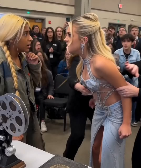
Serena stood five feet away, glittering with diamonds, her custom silver-and-black outfit designed to match the event posters. Her blonde hair spilled over one shoulder in perfect waves. Her expression had gone empty.
Ms. Vale read aloud.
“Request logged at 8:42 this morning to amend official recognition list. Original student technician: Lucia Morales. Replacement name requested: Serena Blackwood. Request submitted by Blackwood Cultural Trust liaison office. Authorized contact: Helena Blackwood.”
A gasp spread through the auditorium.
Not one gasp.
Many.
A whole room inhaling guilt.
Mrs. Helena Blackwood rose from the front row slowly, her diamonds catching the light like small knives. She was elegant, cold, and terrifyingly composed. She looked less like a mother and more like a portrait in a mansion that judged everyone passing beneath it.
“This is an internal administrative correction,” she said. “Our trust funded the archival restoration program.”
Ms. Vale did not close the journal.
“No,” she said. “Your trust funded the public screening, the reception, and part of the storage materials. The projector repair was logged separately through the student archive lab.”
Mrs. Blackwood’s smile tightened.
“My daughter has represented this initiative for months.”
“She attended photo sessions,” Ms. Vale replied. “Lucia Morales repaired the projector.”
My cheeks burned.
Every camera turned.
I hated it and needed it at the same time.
Because for months, everyone had loved the image of Archive Film Night. The posters. The donors. The dramatic phrase bringing history back to light printed in gold letters. But the actual work had happened in a cramped back room that smelled of dust, metal, vinegar, and warm oil.
I had stayed after school bent over a 16mm projector older than my mother, cleaning the gate, replacing a cracked belt, adjusting the claw movement, repairing a faulty lamp housing, and testing reels frame by frame while other students treated the archive lab like a place to leave coats.
I had kept notes because my grandfather taught me that machines remembered the hands that touched them.
Every repair.
Every failure.
Every adjustment.
Every signature.
All of it sat in that journal.
And Serena had tried to take my name from it.
Principal Han stepped forward, his face pale with anger. “Ms. Vale, continue.”
Mrs. Blackwood snapped, “This is not necessary.”
But Serena whispered, “Mom.”
That one word trembled.
Her mother ignored it.
Ms. Vale turned the journal toward the audience. “The Repair Journal was submitted with timestamps, photographs, instructor initials, replacement part receipts, and Lucia’s own diagnostic sketches. It predates all sponsor involvement.”
Then she flipped back one page.
“And the removal request was made this morning, after the final program listed Lucia as the student technician selected to start the reel.”
A student near the front muttered, “That’s insane.”
Someone else whispered, “They really tried to steal it.”
Serena looked at the floor.
I expected her to deny everything. To laugh. To say I was dramatic.
Instead, she looked scared.
Not of me.
Of her mother.
Mrs. Blackwood turned toward me with a smile so smooth it made my skin crawl.
“Lucia, dear, surely you understand. These programs are collaborative. Public recognition can become confusing when young people mistake assistance for leadership.”
I felt the words slide toward me like oil.
Assistance.
That was what they called work when the wrong person did it.
My throat tightened, but before I could speak, a voice came from the back of the auditorium.
“Lucia did not assist. She repaired.”
My grandfather.
Abuelo Mateo stood near the aisle in his brown wool cap and old work coat, leaning on his cane. He had once repaired radios, cameras, sewing machines, anything with screws and patience. His hands shook now, but his voice did not.
“She knows machines,” he said. “Because she listens when they complain.”
Some people laughed softly through the tension.
I almost cried.
My mother stood beside him, still in her hospital cafeteria uniform, her name tag crooked, eyes blazing. She must have come straight from work.
“Start the reel, mija,” she said.
My ankle hurt.
My pride hurt worse.
But there was the projector, waiting on the rolling stand beside the stage. The old Bell & Howell, cleaned and polished, its metal arms lifted like it was ready to breathe again.
Ms. Vale stepped closer. “Lucia, this moment is yours. Only yours.”
Serena flinched.
I limped forward.
The auditorium went silent.
I could hear the tiny click of phone cameras focusing. The rustle of programs. My own uneven breathing.
I passed Serena without looking at her.
At the projector, my hands stopped shaking.
That surprised me.
Machines had always done that for me. People were confusing, cruel, unpredictable. Machines were honest. If something failed, there was a reason. If something jammed, there was pressure. If something sparked, there was a connection wrong somewhere.
I threaded the film leader through the sprockets, past the gate, around the sound drum, into the take-up reel.
My fingers knew the path.
I switched on the lamp.
The projector hummed.
Not perfectly.
No old machine hummed perfectly.
But steadily.
Then I pressed the start lever.
The reel began to turn.
On the screen, after thirty years of darkness, Cleveland flickered back to life.
At first, only dust and scratches.
Then a streetcar.
Then children running past a corner store.
Then a woman laughing in front of a bakery.
The audience forgot to clap.
They simply stared.
Because the dead past was moving.
And I had brought it to light.
PART 3 — THE FRAME NOBODY WAS SUPPOSED TO SEE
The first five minutes of the archive reel were beautiful.
Black-and-white Cleveland rolled across the screen like a dream rescued from a basement. Factory gates opening at dawn. A baseball game in a vacant lot. Women in church hats walking down a sunny sidewalk. Men in work shirts leaning against cars with fins like silver fish.
Then the image jumped.
I leaned toward the projector, listening.
A faint flutter moved through the mechanism. Not dangerous. Just a splice passing through.
The screen flashed white.
Then a new scene appeared.
A small theater.
Its marquee read: LA ESTRELLA CINEMA — COMMUNITY FILM NIGHT.
My breath caught.
I had never seen that part during testing. The damaged middle section had been too brittle to run fully before the final repair. I had only inspected it by hand, inch by careful inch, and spliced enough leader to protect the reel. I knew there were unknown frames.
But I did not know this.
On screen, families stood outside the theater. Spanish signs appeared in windows. Children waved at the camera. A young man in a suit lifted a little girl onto his shoulders.
Behind me, Abuelo made a sound.
Small.
Broken.
I turned.
His face had gone white.
“Abuelo?”
He gripped his cane so hard his knuckles looked like bone.
On the screen, the camera panned across the theater entrance.
A young woman stood by the ticket booth, smiling shyly.
Beside her was a man with dark curls and a familiar proud tilt to his chin.
My grandfather whispered, “That is my brother.”
The room seemed to disappear.
My great-uncle Rafael had been a family ghost. Not because nobody spoke of him, but because they spoke of him like a song with missing verses. He had come to Cleveland before my grandfather. Worked in factories. Helped Chilean and Puerto Rican families settle. Organized community film nights. Then he vanished from our family’s story after a fire destroyed La Estrella Cinema in the 1970s.
We had only one photograph of him.
Or we thought we did.
Now he was twenty feet tall on the screen, laughing, alive, moving.
My mother covered her mouth.
Abuelo sat down heavily in the aisle seat.
The auditorium watched in stunned silence as the reel continued.
Rafael unlocked the theater doors. A group of children streamed inside. A poster advertised short films from Latin America, neighborhood newsreels, and English-language lessons. The camera cut to shelves of film cans stacked behind the concession counter.
Then something strange happened.
The screen showed Rafael holding a notebook up to the camera.
For only two seconds.
Maybe less.
But I saw the title.
REPAIR AND REEL LOG — R. MORALES
My heart slammed.
The projector clicked steadily.
The film moved on.
Then came a splice scar.
The image burned white at the edge, fluttered, and jumped to a parade downtown.
But I was no longer breathing normally.
R. Morales.
My family name.
Repair and Reel Log.
I looked toward the display table where my own Repair Journal lay beside Ms. Vale.
Serena had been humiliated by that journal.
But now the film itself had revealed another one.
A journal from the past.
A record no one knew existed.
When the reel ended, the auditorium stayed silent for three full seconds.
Then applause erupted.
But the applause sounded far away to me.
Ms. Vale came to the projector, eyes wide. “Lucia, did you know that footage was there?”
I shook my head.
Abuelo was crying now.
I had never seen him cry. Not when his hands became too stiff to repair watches. Not when he sold his old tools to pay bills after my grandmother died. Not even when he spoke about leaving Chile.
But now tears ran down his face as he stared at the blank screen.
“He kept a log,” Abuelo whispered. “Rafael always kept logs.”
Ms. Vale knelt beside him. “Do you know where it might be?”
He shook his head.
“After the fire, everything was said to be lost.”
Mrs. Blackwood’s voice cut through the moment.
“How moving,” she said, walking toward us with her attorney now beside her. “But we should avoid distracting from the official purpose of tonight’s event.”
I turned slowly.
Something in me had changed.
Maybe it was seeing my great-uncle alive on the screen. Maybe it was the pain in my ankle. Maybe it was months of being treated like a pair of hands instead of a mind.
Or maybe it was the Repair Journal still open under the lights.
“The official purpose,” I said, “was to show what student work can recover.”
Mrs. Blackwood’s eyes narrowed.
“And it has.”
“No,” I said. “It just started.”
Serena looked at me then.
Her face had no arrogance left.
Only panic.
Because she understood before I did.
If Rafael’s old repair log still existed, it might connect the archive reel to my family. It might show who preserved the films before the Blackwood Trust ever touched them. It might prove that the history they wanted to brand had been carried by people they never bothered to name.
Ms. Vale closed my Repair Journal carefully.
“We need to secure the reel,” she said.
Mrs. Blackwood stepped forward. “The Blackwood Cultural Trust has storage rights to all materials displayed tonight.”
“No,” Ms. Vale replied. “The trust has exhibition sponsorship rights. Custody remains with the school archive partnership.”
Mrs. Blackwood smiled.
“My lawyers may disagree.”
Principal Han appeared beside us.
“Then they can disagree in writing.”
For the first time, Mrs. Blackwood’s confidence flickered.
Serena whispered, “Mom, stop.”
Her mother did not even look at her.
That was when I understood Serena’s fear.
She had kicked me.
She had lied about me.
She had tried to erase me.
But she was not the only one performing.
She was her mother’s projector.
And Helena Blackwood had been threading her for years.
PART 4 — THE BOX IN THE BOILER ROOM
By Monday morning, the video of Serena kicking me had spread across Cleveland.
The clip showed everything.
Her leaning close.
My answer.
The announcer calling my name.
Her foot striking my leg.
Me stumbling.
Phones lifting.
Ms. Vale opening the Repair Journal.
The internet named it scandal, assault, donor drama, class warfare, and one person called it projector girl revenge night, which I hated less than I should have.
The Blackwood Cultural Trust released a statement calling the incident “a regrettable misunderstanding amid heightened emotions.”
My mother read it at breakfast and nearly cracked her coffee mug.
“Misunderstanding?” she said. “Her foot misunderstood your ankle?”
Abuelo muttered something in Spanish that made my mother say, “Papá.”
He shrugged. “I am old, not polite.”
At school, people stared at me differently.
Some with pity.
Some with admiration.
Some with guilt because they had watched Serena pose beside the projector for weeks while I knelt behind it with a screwdriver.
Ms. Vale pulled me from third period.
“We found something,” she said.
My pulse jumped. “Rafael’s journal?”
“Maybe.”
The old archive storage room had once been part of the school’s boiler area. Decades earlier, before renovation, the building had stored donated film equipment from closed theaters and community centers. Most of it had been cataloged badly. Some not at all.
Ms. Vale led me, Principal Han, Abuelo, and my mother down a narrow stairwell smelling of dust and warm pipes. A maintenance worker named Mr. Dorsey waited beside a rusted metal cabinet.
“Back panel was loose,” he said. “Found a box wedged behind it.”
The box was small, warped, and water-stained. On the top, in faded marker, someone had written:
LA ESTRELLA — SERVICE NOTES / DO NOT DISCARD
Abuelo sat down before anyone opened it.
Ms. Vale put on gloves.
Inside were film leader scraps, receipts, a broken lens cap, old theater tokens, and three notebooks wrapped in cloth.
The first notebook’s cover had nearly detached.
On the front, written in careful block letters:
REPAIR AND REEL LOG — RAFAEL MORALES
My mother began crying.
Abuelo touched the air above the notebook, not touching it, as if it were a sleeping bird.
“Rafael,” he whispered.
Ms. Vale opened the first page.
The handwriting was faded but readable.
Dates.
Projector maintenance.
Reel titles.
Community screening notes.
Names of volunteers.
Names of children who helped rewind film.
Names of women who translated captions.
Names of mechanics who donated parts.
Names everywhere.
Not donors.
Workers.
Helpers.
Keepers.
The kind of people history forgets unless someone writes them down.
Then Ms. Vale reached the final notebook.
Her expression changed.
“What?” I asked.
She turned the page toward us.
There, in Rafael’s handwriting, was a note dated two weeks before the La Estrella fire.
If films are moved to the Blackwood private collection for temporary protection, ensure community ownership remains documented. H. Blackwood promised public return after restoration funding. Do not surrender logs.
The room went cold.
“H. Blackwood?” Principal Han said.
Abuelo’s face hardened.
“Harold Blackwood,” he said. “Helena’s father.”
My mother looked stunned. “The Blackwoods had the films?”
Ms. Vale turned more pages.
Receipts.
Transfer notes.
A list of film cans removed after water damage.
A signature from Harold Blackwood’s private cultural collection.
And a final line underlined twice:
These reels belong to La Estrella Community Archive, not to any donor family.
My breath stopped.
The archive reel we had shown at Film Night had not simply been found in storage.
It had been returned without its story.
Without Rafael’s name.
Without the community’s ownership.
Without the logs.
No wonder Helena Blackwood wanted control.
No wonder she tried to put Serena’s name over mine.
She was not just protecting a ceremony.
She was protecting a family lie.
Ms. Vale closed the notebook slowly.
“This changes everything.”
Principal Han nodded. “We need legal counsel.”
My mother stood straighter.
“We need copies.”
Abuelo’s eyes glittered.
“And we need light.”
That afternoon, Serena found me outside the archive lab.
She looked terrible.
Not in a satisfying way.
In a human way.
No diamonds. No custom outfit. Just a black hoodie, jeans, and swollen eyes.
“I heard they found something,” she said.
I did not answer.
“My mother is furious.”
“Good.”
Serena flinched.
I expected her to snap back. She did not.
“She says you’re trying to destroy my family.”
I laughed once.
“Your family tried to erase mine.”
Her face twisted.
“I didn’t know about the old films.”
“But you knew about me.”
She closed her eyes.
“Yes.”
The hallway hummed around us.
Then she reached into her backpack and pulled out a flash drive.
“My mother’s assistant sent me talking points before the event,” she said. “They mention your name. They mention replacing you. They mention keeping the Repair Journal away from the press.”
My heart pounded.
“Why give me this?”
Serena swallowed.
“Because last night, my mother said if anyone had to take responsibility, it would be me. She said I acted impulsively because I was jealous.”
“You were jealous.”
“Yes,” she whispered. “But I was also instructed.”
That did not soften the kick.
But it widened the room around it.
Serena placed the flash drive on the bench between us.
“I am not asking you to forgive me.”
“Good.”
“I’m asking you to stop her.”
I stared at her.
For the first time, Serena Blackwood looked less like my enemy and more like another damaged record spinning inside the same machine.
I picked up the flash drive.
“This doesn’t make us even.”
“I know.”
“It makes you useful.”
She gave a broken little nod.
“I’ll take it.”
PART 5 — THE HEARING WHERE THE PAST TESTIFIED
The district hearing took place in the Cleveland Public Library’s historic conference room, which felt appropriate and terrifying.
High windows let gray light fall across the long table. The walls smelled faintly of old books and polish. At one end sat district officials, archive representatives, and a legal advisor from the city arts council. On one side sat my family, Ms. Vale, Principal Han, and me.
Across from us sat Helena Blackwood, her attorney, and Serena.
Serena did not wear diamonds.
Her mother wore enough for both of them.
Helena’s attorney began smoothly.
He said the Blackwood family had preserved cultural materials for generations.
He said adolescent conflict should not overshadow philanthropic contribution.
He said “ownership” was a complex historical question.
He said my Repair Journal showed effort, yes, but not authority.
Ms. Vale let him talk.
Then she placed my journal on the table.
“This is Lucia Morales’s complete repair documentation. Without this work, the 16mm projector would not have run the reel safely.”
She placed Rafael’s notebooks beside it.
“These are Rafael Morales’s repair and reel logs from La Estrella Cinema. They establish community stewardship of multiple reels later transferred to the Blackwood private collection under temporary protection terms.”
The attorney’s smile thinned.
Then Dana Ruiz, the city arts council lawyer, projected scans onto the wall.
Rafael’s notes.
Transfer receipts.
Harold Blackwood’s signature.
The line: not to any donor family.
Helena remained still.
Too still.
Then the flash drive Serena provided was entered.
Emails appeared.
Talking points.
Instructions.
A draft program listing Serena Blackwood as student preservation ambassador and technical lead.
Another email from Helena’s office:
Remove Lucia Morales from stage role. Her repair notes complicate the narrative.
The room changed.
Even the lawyers stopped moving.
My mother gripped my hand beneath the table.
Abuelo stared at Helena with a grief so old it looked like stone.
Finally, the district official asked if I wanted to speak.
I stood.
My legs shook, but I stood.
“My name is Lucia Morales,” I said.
It felt important to begin there.
“I repaired the projector because I knew it could work. Not because it was glamorous. Not because cameras were there. Because old machines deserve patience, and old films deserve a chance to be seen.”
I looked at Serena.
“She kicked me before I could start the reel because she wanted my moment.”
Serena lowered her head.
Then I looked at Helena.
“But this is bigger than one student being cruel. My great-uncle Rafael Morales kept records because he knew people like him were easy to erase. He wrote names down. He wrote ownership down. He wrote truth down.”
My voice strengthened.
“Your family did not preserve that history. They trapped it behind your name.”
Helena’s face remained cold.
But her hand tightened around her pen.
I continued.
“You tried to remove my name from a program because my journal connected me to the work. But you did not understand something. Repair journals are not just notes. They are witnesses.”
The room was silent.
Then Serena stood.
Her mother’s head snapped toward her.
“Sit down,” Helena said.
Serena did not.
Her voice shook so badly at first that I almost could not hear her.
“My mother told me Lucia was being over-recognized. She said the public needed a clean story. A sponsor family. A student face. A successful event. She told me Lucia’s role was technical background.”
She swallowed.
“I wanted to believe that because I wanted the stage. I wanted people to look at me like I mattered.”
Her eyes filled.
“So I kicked her. I lied. I said she stole credit from us when I knew she had done the repair work. I am responsible for that.”
Helena whispered, “Serena.”
But Serena kept going.
“My mother also knew Lucia’s Repair Journal could connect the projector work to the La Estrella reel. She wanted it minimized before anyone asked why a Morales student had repaired the machine that revealed Rafael Morales on film.”
The conference room seemed to hold its breath.
Serena turned to me.
“I am sorry,” she said. “Not because I got caught. Because I did harm.”
I did not forgive her.
Not then.
But I believed she had finally said something true.
The hearing ended with no dramatic gavel. Real justice rarely arrives with good sound design.
But decisions came.
The Blackwood Trust’s sponsorship was suspended pending investigation.
The archive materials were placed under independent custody.
Rafael Morales’s logs were transferred for conservation and digitization.
My Repair Journal became part of the official project file.
And Helena Blackwood walked out of the library with cameras waiting on the sidewalk.
This time, she could not choose the angle.
PART 6 — WHEN THE REEL FOUND ITS VOICE
The next months were strange.
One day I was a girl who fixed a projector after school.
The next, reporters wanted to interview me about archive ethics, erased communities, student labor, and donor control.
I hated half the attention.
I needed the other half.
Because attention protected the truth.
Ms. Vale helped me prepare for every interview. She taught me to say, “I don’t know yet,” and “The records show,” and “That question belongs to the community descendants.” She told me anger could be useful if I gave it a job.
So I gave my anger work.
I helped digitize Rafael’s notebooks.
I labeled names.
I cross-referenced addresses.
I searched old city directories with Abuelo, who remembered some people from stories his brother had told. My mother brought sandwiches after work and pretended not to cry whenever Rafael’s handwriting appeared on the scanner screen.
The archive reel was tested again by professionals.
More footage emerged.
La Estrella Cinema was not just a theater.
It had been a community hub.
It hosted film nights, English lessons, union meetings, children’s matinees, immigration workshops, and screenings of news from Latin America. The films Rafael protected contained neighborhood history no institution had bothered to collect.
And in one reel, there was audio.
Damaged.
Crackling.
Almost lost.
A conservation specialist recovered enough for us to hear Rafael’s voice.
The first time we listened, Abuelo held my hand.
Static filled the room.
Then a man spoke in Spanish-accented English:
“Record the names. If we do not record the names, they will call this charity later.”
Abuelo broke.
He bent forward over the table, sobbing into his hands.
My mother wrapped her arms around him.
I sat frozen, headphones still against my ears.
They will call this charity later.
Rafael had known.
Decades before Serena, before Helena, before the Blackwood Trust gala language, before donor banners and stage lights, he had known that powerful people could take community labor and rename it generosity.
His voice reached across time like a warning.
A week later, the city paper published a major story about the La Estrella Community Archive. It included Rafael’s name, the recovered footage, and the Blackwood transfer records. Other families came forward. Some recognized grandparents on screen. Others brought photographs, ticket stubs, old programs, and memories.
The archive grew.
Not from a donor vault.
From kitchen drawers and shoeboxes.
One woman arrived with a rusted film can wrapped in a towel. She said her father had kept it under his bed for forty years because he did not trust museums.
Inside was footage of a children’s parade outside La Estrella.
At the end, a little boy saluted the camera with a paper flag.
Abuelo whispered, “That is me.”
I stared.
There he was.
My grandfather as a child, grinning with missing teeth, alive inside light.
The past was no longer behind glass.
It was sitting beside me, crying.
Meanwhile, Serena changed in uneven ways.
She was suspended from event leadership roles. She had to complete restorative accountability meetings, though I refused to attend the first ones. Helena withdrew from public boards “temporarily,” which everyone knew meant forcibly. The Blackwood Trust attempted to rebrand, then paused operations when more questions surfaced about its private collection.
Serena returned to school quieter.
Some students mocked her. Some defended her. Most avoided her because scandal is contagious when social status is involved.
One afternoon, I found her outside the archive lab staring at a broken film splicer.
“What are you doing?” I asked.
She startled.
“Ms. Vale said I could volunteer. Not with the reels. Just equipment cleaning. If you object, I’ll leave.”
I looked at the splicer.
“You know how to clean that?”
“No.”
“At least you’re honest.”
She gave a tiny, embarrassed nod.
I should have walked away.
Instead, I picked up a cloth.
“Don’t touch the blade. Start with the dust.”
Her eyes widened.
“This doesn’t mean we’re friends,” I said.
“I know.”
“And if you act superior, I’ll make you clean cable bins for six hours.”
A weak smile.
“Fair.”
For twenty minutes, we worked in silence.
Then Serena said, “I used to think restoration meant making something look perfect.”
I kept my eyes on the splicer.
“It means keeping what survived.”
She absorbed that like it hurt.
“Even damage?”
“Especially damage. Scratches tell you the film traveled.”
She nodded slowly.
“I have a lot of scratches.”
I did not comfort her.
But I did not deny it either.
PART 7 — THE LOST TITLE CARD
The shocking ending began with a title card nobody had noticed.
It appeared in the restored La Estrella reel after weeks of frame-by-frame scanning. A black card with white hand-lettered words, scratched nearly beyond reading. The specialists almost skipped it as leader damage.
But I enlarged the scan.
Then sharpened contrast.
Then inverted the image.
Letters emerged.
FOR LUCÍA, WHO WILL FIX WHAT WE COULD NOT.
I stopped breathing.
There was an accent over the i.
Lucía.
My name.
But the card was decades old.
Before I was born.
Before my mother was born.
Ms. Vale thought it might refer to someone else. A coincidence. A common name.
Abuelo knew better.
He sat very still, staring at the screen.
“My mother,” he whispered. “Rafael’s mother. Her name was Lucía.”
My great-great-grandmother.
The family story said she had wanted to repair radios but was never allowed to apprentice because she was a girl. She fixed things secretly. Lamps. Fans. A neighbor’s phonograph. Rafael had learned from her, then taught my grandfather, who taught me.
Ms. Vale searched Rafael’s journal.
In the second notebook, between repair entries, we found a folded page tucked into the spine.
A letter.
Written in Spanish to Rafael from his mother, Lucía.
Abuelo translated with a trembling voice.
She wrote that machines were not magic. They were questions with bodies. She wrote that a girl’s hands were not less capable because men refused to teach them. She wrote that if he ever had daughters, nieces, students, or anyone willing to learn, he must teach them without asking whether the world approved.
Then came the final line:
One day, someone with my name may repair what history breaks. Leave her proof.
I could not speak.
My mother cried silently beside me.
Abuelo touched my braid with shaking fingers.
“You carry her name,” he said. “And her hands.”
For months, I had thought the Repair Journal was mine alone.
Now I understood it was part of a chain.
Lucía repairing in secret.
Rafael logging names.
Abuelo teaching me to listen to machines.
Me fixing the projector.
The reel revealing the past.
The journal exposing the lie.
Every generation had left a tool for the next.
The city archive decided to mount an exhibition: REPAIR WHAT HISTORY BREAKS: LA ESTRELLA AND THE MORALES LOGS.
They asked me to contribute my Repair Journal.
At first, I said no.
It felt too personal. Grease stains, frustrated notes, little drawings of sprocket teeth, one page where I had written I hate this lamp assembly six times in the margin.
Ms. Vale smiled.
“That is exactly why it matters.”
So I agreed.
Opening night came almost one year after Serena kicked me.
This time, the stage was smaller.
The room was fuller.
Families from the La Estrella neighborhood came with old photographs. Students came. Film historians came. Librarians came. My mother wore a red dress. Abuelo wore his best hat. Serena came too, standing near the back in a plain black suit, hair tied simply, no diamonds.
Helena Blackwood did not attend.
The investigation into the Blackwood private collection had uncovered several community archives held under questionable terms. Restitution agreements were underway. The family name, once printed above every cultural event in town, had become a question people asked carefully.
Before the screening, Serena approached me.
She held a small object wrapped in cloth.
“I found this in our storage,” she said. “My mother didn’t know I had it.”
I stiffened.
“What is it?”
She unwrapped a brass projector knob, old and worn smooth.
A label tied to it read:
La Estrella main projector — replaced 1971
“My grandfather kept parts as trophies,” she said, shame in every word. “I thought it should be with the logs.”
I took it carefully.
It was heavy.
Warm from her hand.
For a second, I imagined Rafael removing it, Lucía’s lessons guiding his fingers, history passing through metal.
“Thank you,” I said.
Serena nodded.
Then she whispered, “I’m sorry, Lucia.”
I looked at her.
“I know.”
“I don’t expect forgiveness.”
“You keep saying that.”
“Because I still want it.”
That honesty surprised me.
I looked toward the exhibit case where my Repair Journal lay open.
“I still remember your foot hitting me,” I said.
Her face crumpled.
“I do too.”
“I also remember you standing up at the hearing.”
She inhaled shakily.
“That doesn’t erase it.”
“No,” I said. “But it gives the record another page.”
She cried then.
Quietly.
I did not hug her.
But I handed her a tissue from my jacket pocket.
Sometimes that is the first shape mercy takes.
PART 8 — THE END — THE LIGHT THROUGH THE BROKEN FRAME
When I stepped onto the stage that night, I did not feel like the girl who had stumbled under Serena Blackwood’s kick.
I still was that girl.
But I was more.
I was Lucia Morales, daughter of a cafeteria worker who could stretch one paycheck like elastic and still buy me tiny screwdrivers for my birthday.
I was Lucia Morales, granddaughter of a man who taught me that machines tell the truth if you listen closely enough.
I was Lucia Morales, descendant of a woman named Lucía who repaired in secret and left a command across generations.
I was Lucia Morales, student technician, archive worker, repair journal keeper.
And for once, when every camera turned toward me, I did not shrink.
I unfolded my notes, then set them aside.
“I used to think repair meant returning something to the way it was before it broke,” I began.
The room quieted.
“But old projectors taught me that is not true. Some scratches stay. Some parts are replaced. Some frames are lost forever. Repair means making something able to carry light again.”
Abuelo bowed his head.
My mother pressed both hands to her heart.
I continued.
“When I fixed the projector for Archive Film Night, I thought I was only repairing a machine. I did not know the reel would show my great-uncle Rafael. I did not know his logs would expose what had been taken. I did not know my own Repair Journal would become part of a much older record.”
I looked at the audience.
“But I did know this. Work that happens in the background is still work. Hands that repair are still hands that create. Names left off the program still belong to people.”
A murmur of agreement moved through the room.
“The Blackwood family wanted a clean story. A wealthy trust saves forgotten films. A beautiful sponsor daughter stands in the spotlight. Everyone applauds. But real history is not clean. It is greasy, scratched, spliced, translated, mislabeled, hidden in boiler rooms, and carried by people who were told they were not important enough to name.”
Serena wiped her face in the back row.
I did not look away.
“This exhibition exists because records survived. My journal. Rafael’s logs. Lucía’s letter. Transfer notes someone forgot to destroy. A title card almost mistaken for damage. Proof does not always arrive polished. Sometimes it arrives stained, torn, and nearly unreadable. But if we protect it, it can still speak.”
The projector behind me began to run.
Not the old one this time. That one was now too precious to operate casually. A restored digital transfer filled the screen.
La Estrella Cinema appeared.
Families waiting outside.
Children waving.
Rafael holding up his notebook.
Then the recovered title card:
FOR LUCÍA, WHO WILL FIX WHAT WE COULD NOT.
A sound moved through the audience.
Soft.
Wondering.
Like everyone had realized the past was not finished with us.
My voice shook, but held.
“My great-great-grandmother wrote that someone with her name might repair what history breaks. I cannot repair everything. None of us can. But we can refuse to let powerful people rename theft as preservation. We can refuse to let donors become owners of community memory. We can refuse to treat student labor like decoration.”
The screen glowed behind me.
“So tonight, I want to say the names.”
One by one, I read from Rafael’s logs.
Not all of them. There were too many.
But enough.
Rafael Morales.
Lucía Morales.
Elena Cruz, translator.
Tomás Vega, projection assistant.
Maribel Ortiz, ticket table.
June Harris, neighborhood teacher.
Arturo Salinas, reel repair.
Children’s matinee volunteers, names recovered from the margin.
Each name landed like a candle being lit.
By the time I finished, people were crying openly.
Even people who had come expecting a film exhibit and not a resurrection.
The applause rose slowly.
Then fiercely.
But the best moment came after the speeches, when families gathered around the display cases and began pointing at faces on the screen.
“That’s my aunt.”
“That’s Mr. Vega’s shop.”
“My grandmother talked about that theater.”
“I thought no pictures existed.”
The archive was no longer silent.
It had become a room full of people answering back.
Later, when the crowd thinned, I found Serena standing in front of my Repair Journal. She was reading the page where I had drawn the lamp assembly wrong three times before getting it right.
“You really wrote ‘stupid tiny screw from hell,’” she said softly.
I smiled despite myself.
“It was accurate.”
She laughed, then grew quiet.
“I used to think being seen meant being admired.”
“What do you think now?”
She looked around the room at the families, the films, the logs, the names.
“I think being seen means being responsible for what the light reveals.”
That was a good answer.
Annoyingly good.
I nodded.
“Keep thinking that.”
She glanced at me. “Does the record get another page?”
I looked at her for a long moment.
Then I said, “Maybe. But you write it with what you do next.”
Years later, people would ask when everything changed.
They expected me to say it changed when Serena kicked me.
Or when Ms. Vale opened the Repair Journal.
Or when Rafael appeared on the screen.
Or when Lucía’s letter was found.
But the truth was smaller and stronger.
Everything changed in the archive lab, long before the cameras turned.
It changed when I stayed late with a machine everyone else called broken.
It changed when I wrote down every adjustment even though no one seemed to care.
It changed when I signed my name in the corner of each page because Abuelo said, Never leave good work orphaned.
That was what Serena and her mother never understood.
A spotlight can be stolen for a moment.
A stage can be manipulated.
A program can be altered.
A name can be removed from a printed list.
But work with records grows roots.
And roots crack marble.
That night, after everyone left, I stood alone in the exhibit hall with the old projector knob in my palm. The screen was blank. The chairs were empty. The air smelled faintly of dust and warm circuits.
Abuelo came to stand beside me.
“You did well, Lucía,” he said, using the old accent on purpose.
I leaned against him gently.
“Do you think she would be proud?”
He did not ask who I meant.
“Yes,” he said. “But she would also tell you to clean your tools.”
I laughed, and the sound echoed through the gallery.
Before leaving, I opened my Repair Journal to the last page.
The paper was smudged at the edge from months of oil-stained fingers. I took a pen from my jacket and wrote one final entry beneath the repair timeline, the hearing notes, the archive references, and the recovered names.
Final test: light passes through the broken frame. Image holds. Names visible. Repair ongoing.
Then I added the sentence I wanted someone to find someday, maybe years from now, maybe when another student in worn sneakers opened the journal and wondered if quiet work mattered.
Do not wait for permission to keep the record; the record may be the only thing powerful enough to keep you.
THE END
