Tham Mac Ngon stared at the divorce agreement for nearly a minute.
Then he signed.
His handwriting was as steady as it was on surgical records.
No hesitation.
No correction.
No turning back.
I watched the final stroke of his name appear beneath mine and suddenly realized something strange.
Six years of marriage could end in less than thirty seconds.
He put down the pen.
—The property transfers will be completed this week.
—Fine.
—You can continue living here.
—Fine.
His brows drew together.
Perhaps my calmness irritated him.
In the past, I could argue with him for twenty minutes because he bought the wrong soy sauce.
I could call him three times because he forgot his umbrella.
Once, when he ignored my messages during a twelve-hour operation, I sat outside the operating theater until two in the morning just to complain when he came out.
He used to say:
—Nhuoc Van, why do you care about every little thing?
Now I cared about nothing.
And somehow that seemed to frighten him more.
He finally asked:
—Don’t you have anything else to say?
I thought carefully.
Then I shook my head.
—Wish you happiness.
His expression froze.
I walked into the bathroom and closed the door.
Only then did I put both hands on the sink.
My fingers were trembling.
Not because I regretted signing.
Because hidden beneath my pajamas was a hospital report I had received three days earlier.
Pregnancy: six weeks.
I had planned to tell him after dinner.
I had even bought a tiny wooden box.
Inside was a pair of baby socks.
Now they remained hidden at the bottom of my handbag.
I looked at myself in the mirror.
Then at my stomach.
And made the second most important decision of that morning.
The first had been signing the divorce.
The second was not telling him about the child.
Not because I wanted revenge.
Not because I wanted to steal his right to know.
But because twenty minutes earlier, my husband had looked me directly in the eyes and said he wanted to build a life with another woman.
I would not use a pregnancy to keep a man who had already left.
Three days later, the divorce was finalized.
Tham Mac Ngon moved out with one suitcase.
He truly took almost nothing.
Before leaving, he stood in the entrance and looked around the house.
His gaze lingered on the photograph from our wedding.
—You can throw that away.
I nodded.
He opened the door.
Then stopped.
—Nhuoc Van.
—What?
He turned halfway.
For a second, I thought he might ask whether I was really all right.
Instead he said:
—If you need anything in the future, call me.
I smiled.
—I won’t.
The door closed.
That afternoon, I removed our wedding photograph.
But I didn’t throw it away.
I put it in a box.
Not for myself.
For the child who might someday ask who her father was.
Two weeks later, I resigned from my position at the hospital’s medical research center.
One month later, I left the city.
By then, my morning sickness had become impossible to hide.
I moved to Hangzhou, where my maternal aunt lived.
She was the only person who knew everything.
When I told her I intended to keep the baby, she didn’t lecture me.
She simply put a bowl of soup in front of me and said:
—Then eat. You’re feeding two people now.
I cried for the first time since the divorce.
My daughter was born eight months later.
I named her An An.
Peace.
She had my eyes.
But everything else belonged to her father.
The straight nose.
The shape of her mouth.
Even the tiny crease between her eyebrows whenever she concentrated.
At three years old, she would sit at the table assembling complicated puzzles without speaking.
My aunt would look at her and sigh.
—This child doesn’t need a paternity test.
I always pretended not to hear.
Life continued.
I returned to medical research.
Then I joined a biotechnology company developing artificial tissue for thoracic reconstruction.
By the time An An entered primary school, I had become director of its clinical research division.
I heard occasional news about Tham Mac Ngon.
You cannot work in medicine and completely avoid hearing about one of the country’s youngest renowned thoracic surgeons.
His department expanded.
He published papers.
He performed several difficult surgeries that made medical headlines.
And Chu Uyen Thanh remained beside him.
Someone once told me they had moved in together.
Another person said they were engaged.
I never asked which story was true.
Seven years passed.
Then one Tuesday morning, my assistant entered my office.
—Director Lam, the delegation from Central Medical University Hospital has arrived.
I continued reviewing the trial data.
—Conference room three?
—Yes.
She hesitated.
—Their thoracic surgery director is personally leading the team.
My pen stopped.
There are moments when the body remembers before the mind does.
My heartbeat changed.
But only for a second.
—What’s his name?
She checked the tablet.
—Professor Tham Mac Ngon.
Seven years.
I thought hearing his name would hurt.
It didn’t.
It simply sounded like the name of someone I used to know.
—Begin without me. I’ll join them in ten minutes.
When I entered the conference room, twelve people stood around the long table.
And at the opposite end stood my ex-husband.
He had changed.
Older.
Sharper.
There were faint lines beside his eyes.
But I recognized the way he held a pen between his fingers while listening.
Beside him sat Chu Uyen Thanh.
No longer an intern.
Her identification badge read:
Associate Chief Physician.
She looked elegant and composed.
For several seconds, nobody spoke.
Then Mac Ngon stood.
—Nhuoc Van?
I smiled professionally.
—Professor Tham. Welcome.
His face changed at the title.
Perhaps he expected anger.
Or warmth.
Or something proving that seven years hadn’t erased him.
Instead, I opened the presentation.
—Our team has reviewed your hospital’s proposal. There are three areas requiring revision.
For the next ninety minutes, I spoke only about work.
Mac Ngon barely looked at the slides.
He kept looking at me.
After the meeting, Uyen Thanh approached first.
—Sister Nhuoc Van.
I closed my laptop.
—Doctor Chu.
Her smile became awkward.
—I didn’t expect you to be here.
—Neither did I.
She glanced toward Mac Ngon.
—These years—
—We don’t need to discuss them.
I wasn’t cruel.
That made her more uncomfortable.
Before she could answer, the conference-room door flew open.
—Mom!
A small figure ran inside.
My heart stopped.
An An.
My aunt hurried behind her.
—Sorry, Nhuoc Van. Her school ended early and your phone was off—
—It’s fine.
An An wrapped both arms around my waist.
—Mom, Grandma said we’re eating noodles tonight.
Then she noticed the strangers.
She straightened immediately.
—Hello.
Uyen Thanh’s face lost color.
Mac Ngon didn’t move.
He stared at my daughter.
An An stared back.
Seven years old.
Long black hair tied behind her head.
White school shirt.
Serious eyes.
His eyes.
The entire room seemed to understand before anyone said a word.
Mac Ngon’s lips parted.
—Who is she?
I put my hand on An An’s shoulder.
—My daughter.
He took one step forward.
—How old?
I looked directly at him.
—Seven.
His face became completely white.
Uyen Thanh whispered:
—Mac Ngon…
He ignored her.
His eyes remained fixed on An An.
—Her birthday?
—That’s none of your business.
His jaw tightened.
—Nhuoc Van.
—Professor Tham, our meeting is finished.
I took An An’s hand.
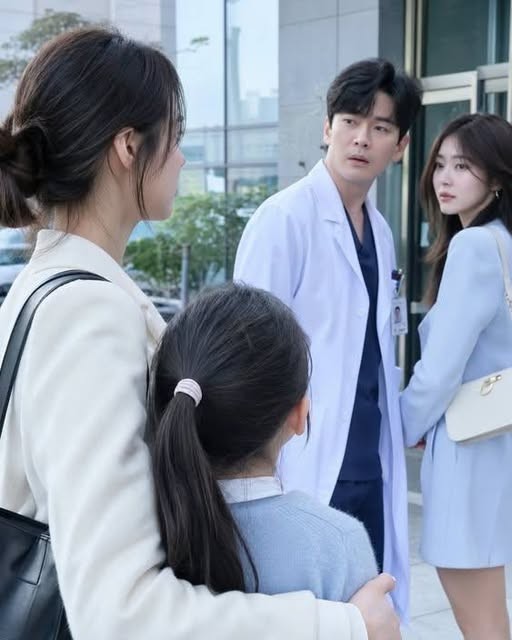
He stepped in front of us.
—Is she mine?
An An looked up at me.
—Mom?
I squeezed her hand gently.
—Go wait with Grandma outside.
My aunt understood immediately.
Once the door closed, Mac Ngon repeated:
—Is she my daughter?
Seven years ago, I might have shouted.
Instead I asked:
—Does it matter?
His expression twisted.
—Of course it matters!
—Why?
—Because if I have a child—
—You had a wife too.
Silence.
He looked as if I’d struck him.
Uyen Thanh stood behind him, pale.
I continued:
—The morning we signed the divorce agreement, I was six weeks pregnant.
His eyes reddened.
—You knew?
—Yes.
—And you didn’t tell me?
—You had just told me that the houses, cars and stocks belonged to me.
I paused.
—And that you belonged to her.
Uyen Thanh lowered her eyes.
Mac Ngon’s voice became hoarse.
—I would never have divorced you if I’d known.
That sentence confirmed I had made the right decision.
I smiled sadly.
—Exactly.
He stared at me.
—I didn’t want my daughter to become the reason her father stayed in a marriage he no longer wanted.
—You should have given me the choice.
—I gave you one.
My voice remained calm.
—Transfer her or divorce me.
I looked toward Uyen Thanh.
—You chose.
Mac Ngon suddenly turned toward her.
Something passed between them.
Not affection.
Something heavier.
Uyen Thanh’s hands tightened around her bag.
Then she said quietly:
—Tell her.
Mac Ngon froze.
I frowned.
—Tell me what?
—Uyen Thanh.
His tone was warning enough.
But she looked exhausted.
—Seven years is enough.
She turned toward me.
—Sister Nhuoc Van, there’s something you misunderstood about our divorce.
I almost laughed.
—He said he loved you.
—I know.
Her eyes filled with tears.
—But we never became a couple.
That stopped me.
I looked at Mac Ngon.
—What?
Uyen Thanh continued:
—I moved into his apartment for three months.
»I thought he loved me.
»But he slept in the study.
Mac Ngon closed his eyes.
—Stop.
—No.
She shook her head.
—You destroyed three lives because you refused to explain anything.
I stared between them.
—Explain what?
Uyen Thanh opened her handbag.
She removed an old envelope.
The paper was yellow at the edges.
—He asked me to keep this seven years ago.
Mac Ngon’s face changed completely.
—Give it to me.
She stepped away.
—No.
Then she handed it to me.
My name was written on the front.
Lam Nhuoc Van.
In Mac Ngon’s handwriting.
I opened it.
Inside wasn’t a love letter.
It was a pathology report.
Then another.
Then a consultation record.
All bearing the same patient’s name.
Chu Uyen Thanh.
I looked up.
—What is this?
She swallowed.
—I wasn’t transferred to his department by accident.
I read the diagnosis again.
Something didn’t make sense.
—Why would Mac Ngon personally supervise an intern because of this?
Neither answered.
Then I noticed another document.
A genetic screening.
At the bottom was a handwritten note.
I recognized Mac Ngon’s writing.
“Potential hereditary correlation. Family verification required.”
My stomach tightened.
—Family?
Uyen Thanh began crying.
Mac Ngon looked at the floor.
And suddenly, for the first time in seven years, I realized their relationship had contained a secret much larger than an affair.
I turned the final page.
There was a photograph attached.
A young woman standing beside Mac Ngon’s father nearly thirty years earlier.
The woman’s face looked unmistakably like Uyen Thanh.
My fingers went cold.
—Who is this?
Uyen Thanh answered in a whisper.
—My mother.
I looked at Mac Ngon.
He finally raised his eyes.
There was no love in the way he looked at her.
There was guilt.
Fear.
And something I hadn’t recognized seven years earlier.
Responsibility.
—Nhuoc Van, he said quietly, I never left you because I wanted to marry Uyen Thanh.
My throat tightened.
—Then why?
He looked through the glass wall toward the corridor.
An An was sitting outside beside my aunt, drawing something on a piece of paper.
His daughter.
The child he had just discovered existed.
Then he said:
—Because three days before I gave you the divorce agreement, my father told me who Uyen Thanh really was.
I stared at him.
Mac Ngon’s voice dropped almost to a whisper.
—She’s my sister.
