PART 2 — THE FACE ON THE SCREEN
The arena was so quiet I could hear the distant hum of the ice compressors beneath the stands.
Twenty thousand people stared at the giant screens.
The unreleased security footage continued playing.
The timestamp glowed in the corner.
Three months earlier.
Equipment Storage Room B.
The camera showed rows of training equipment and maintenance racks.
A figure entered the room.
The person wore a winter jacket and a team cap.
At first, nobody could tell who it was.
Then the footage zoomed in.
A collective gasp swept through the arena.
The face became visible.
Audrey Kensington.
Several reporters immediately stood.
Players exchanged stunned looks.
The arena operations manager remained silent while the footage continued.
Everyone watched Audrey move toward the heavy training apparatus mounted above the player access corridor.
She looked around.
Nobody else was present.
Then she grabbed the support bracket.
The crowd leaned forward.
The video showed her hanging from the equipment while laughing and recording herself on her phone.
The metal support visibly shifted.
Several bolts loosened.
The bracket bent.
The room erupted with shocked murmurs.
On the ice beside me, Audrey looked as though all the air had been sucked from her lungs.
“No,” she whispered.
The footage wasn’t finished.
It showed her noticing the damage.
For several seconds she simply stared at it.
Then she left.
Without reporting it.
Without warning anyone.
Without telling a single employee.
The screen went black.
Silence.
Absolute silence.
PART 3 — THE SECRET THAT MADE IT WORSE
The operations manager took a slow breath.
“What happened next is why we’re showing this footage today.”
My stomach tightened.
The manager opened another file.
A document appeared on the giant screens.
Maintenance reports.
Inspection logs.
Email records.
The audience watched carefully.
“After the defect was discovered,” he explained, “an internal review began.”
Several reporters started recording every word.
The manager continued.
“The investigation identified the person seen in the footage.”
Everyone knew who he meant.
Audrey stood frozen.
“The matter was reported to senior arena leadership.”
A pause.
Then he said something nobody expected.
“The investigation was immediately shut down.”
Gasps echoed through the arena.
The manager clicked another document.
An email appeared.
The sender’s name caused the crowd to explode with whispers.
It came from Audrey’s father.
The owner of one of the most successful professional hockey franchises in the country.
The email instructed executives to classify the incident as accidental damage.
No disciplinary action.
No public report.
No disclosure.
The entire arena seemed unable to process what they were seeing.
This wasn’t just recklessness.
It was a cover-up.
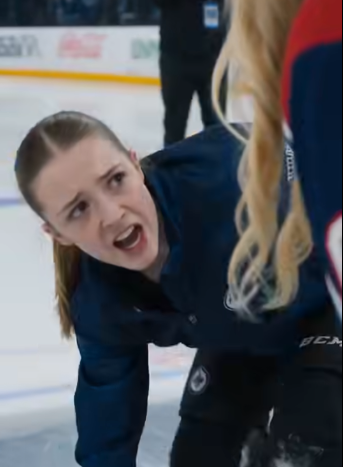
PART 4 — THE MAN WHO REFUSED TO STAY QUIET
The operations manager looked toward me.
Then he addressed the crowd.
“There is another reason this student was chosen to ring the championship bell.”
I felt every eye in the building turn toward me.
Months earlier, after discovering the damaged bracket, I had submitted a detailed safety report.
When the investigation disappeared, I kept copies.
Not because I expected recognition.
Because something felt wrong.
Very wrong.
The manager nodded.
“When records started disappearing, this student preserved evidence.”
More documents appeared on the screens.
My inspection report.
Maintenance requests.
Photographs.
Emails.
Every piece carefully documented.
The crowd began applauding.
Not politely.
Passionately.
Loudly.
For years I had worked behind the scenes.
Nobody noticed the equipment workers.
Nobody interviewed us.
Nobody remembered our names.
Yet at that moment, twenty thousand people stood and cheered.
I felt my throat tighten.
Because for the first time, they weren’t applauding a celebrity.
They were applauding honesty.
PART 5 — AUDREY’S COLLAPSE
Audrey suddenly grabbed a microphone.
“Stop!”
The word echoed through the arena.
The crowd fell quiet.
Tears filled her eyes.
“I didn’t know it would become dangerous.”
Her voice shook.
“I was sixteen.”
Nobody responded.
“I thought it was harmless.”
The arena remained silent.
Then she looked toward her father.
For the first time, genuine anger appeared on her face.
“You told me everything was handled.”
Her father stood motionless.
“You told me nobody could get hurt.”
The owner looked away.
And in that moment something became clear.
Audrey had done something reckless.
But the adults around her had transformed recklessness into deception.
For years they had protected their image instead of confronting the truth.
Audrey suddenly looked less like a villain and more like a teenager trapped inside a machine built by powerful people.
Then she lowered her head.
“I should have reported it.”
Nobody argued.
Because she was right.
PART 6 — THE INVESTIGATION
The championship game was delayed.
State athletic officials launched an immediate inquiry.
News outlets across Minnesota carried the story.
Within forty-eight hours, investigators reviewed years of arena records.
The results shocked everyone.
The damaged bracket wasn’t an isolated incident.
Several safety complaints had been quietly buried.
Minor issues.
Ignored warnings.
Missing documentation.
Nothing catastrophic.
But enough to reveal a troubling pattern.
The pressure grew.
Sponsors demanded answers.
League officials stepped in.
Within two weeks, multiple executives resigned.
Including members of the arena’s upper management.
Audrey’s father stepped down from several leadership roles pending review.
Meanwhile, reporters kept requesting interviews with me.
I declined most of them.
I wasn’t interested in becoming famous.
I only wanted people to understand why safety mattered.
Every player.
Every student.
Every worker.
Every person entering an arena deserved protection.
No exceptions.
PART 7 — THE CHAMPIONSHIP BELL
Three months later, the championship was replayed under very different circumstances.
This time the atmosphere felt lighter.
Cleaner.
Honest.
The arena was packed again.
Players lined the ice.
Families filled the stands.
The ceremonial bell waited at center ice.
When the announcer called my name, the crowd erupted.
I walked toward the platform.
My old navy jacket was still faded.
My work boots still showed years of wear.
I hadn’t changed.
But somehow everything felt different.
The operations manager handed me the mallet.
“You earned this.”
I looked across the arena.
Thousands of faces.
Players tapping their sticks against the boards.
Coaches smiling.
Workers from maintenance and equipment departments standing together near the tunnel.
People who were usually invisible.
People like me.
I lifted the mallet.
The bell rang.
Its deep sound echoed through the building.
The crowd exploded into cheers.
Not because of who my family was.
Not because of money.
Not because of influence.
Because of what was right.
And that meant more than any spotlight ever could.
PART 8 — THE END
Six months later, another surprise arrived.
A handwritten letter.
The return address stunned me.
Audrey Kensington.
I opened it carefully.
Inside was a simple note.
No lawyers.
No public relations team.
No carefully crafted statement.
Just honesty.
She wrote that after the investigation she had begun volunteering with youth hockey programs.
She attended safety training sessions.
She worked with community organizations promoting accountability in sports.
Then came the sentence that stopped me.
“For years people protected me from consequences.”
“You were the first person who protected others instead.”
I read it twice.
Then three times.
Because it revealed something important.
The championship wasn’t really about hockey.
Or bells.
Or recognition.
It was about character.
About what people choose when nobody is watching.
Months later, the state athletic association unveiled a new award.
It would be presented annually to students who demonstrated exceptional responsibility and commitment to athlete safety.
The first recipient was announced during a statewide ceremony.
When they called my name, I almost laughed.
I never wanted attention.
I only did my job.
But sometimes doing the right thing matters more than being noticed.
A plaque now hangs inside the arena.
Not in the executive offices.
Not in a luxury suite.
But near the equipment corridor where players enter the ice.
The place where everything began.
The inscription reads:
“One person’s attention prevented countless injuries.”
Whenever I pass it, I remember that day.
The shove.
The humiliation.
The giant screens.
The truth.
The applause.
And the lesson hidden beneath it all.
Power can hide mistakes.
Money can delay consequences.
Influence can silence warnings.
But eventually, the truth finds its way onto the screen.
And when it does, it shines brighter than any spotlight ever could.
The footage survived.
The truth survived.
The game survived.
And in the end…
so did everyone whose safety depended on somebody caring enough to speak up.
