Thanh Hoa nodded.
—The children’s records were handled through the Khuong family system. Unless someone specifically investigates, the Co family won’t receive an automatic notification.
I looked through the glass at the private plane waiting beneath the runway lights.
—Good.
At 2:40 a.m., we boarded.
At 3:05, City A disappeared beneath the clouds.
I held An An against my chest while Lac Lac slept beside me.
For the first time in three years, I wasn’t wondering when Co Tram Chu would come home.
Because this time, I was the one who had left.
At the Co residence, however, nobody noticed until morning.
Co Tram Chu finished working shortly after four.
He returned to the bedroom without turning on the main light.
As always, he loosened his tie and called casually:
—Khuong Niem.
No answer.
He frowned.
Then he noticed the empty dressing table.
The missing children’s crib blankets.
The half-open wardrobe.
For several seconds, he simply stood there.
Then he called the housekeeper.
—Where is Madam?
The woman went pale.
—I thought she was upstairs.
—And the children?
Silence.
His expression changed.
Within ten minutes, every employee in the residence had been awakened.
Security footage was checked.
At 1:53 a.m., a black vehicle had exited through the western service road.
Co Tram Chu watched the footage three times.
On the fourth, he finally saw me through the rear window.
I never looked back.
—Find the car.
His voice was frighteningly calm.
The security chief swallowed.
—Sir, the plate belongs to the Khuong family.
That was when Co Tram Chu remembered something.
The documents.
He returned to his office.
Thirty files remained stacked neatly on the table.
He searched through them one by one.
Then found the thirty-first sheet.
His signature was there.
So was mine.
He read the first sentence.
Then the second.
His face slowly lost color.
—Who gave me this?
His secretary stared at the page.
—I don’t know.
Co Tram Chu looked up.
—You put the documents on my desk.
—Yes, but this wasn’t among the files I prepared.
His fingers tightened around the paper.
For the first time in years, the man who could negotiate billion-yuan contracts without changing expression looked genuinely confused.
As if he couldn’t understand how his wife could disappear simply because he had signed one sheet of paper.
Then he remembered three nights earlier.
“Co Tram Chu.”
“Let’s have a…”
He had walked away before I finished.
His hand suddenly froze.
He finally understood the word I had been trying to say.
Divorce.
He grabbed his phone.
My number was unavailable.
WeChat unanswered.
The children’s nanny unanswered.
Driver A Tai unreachable.
Then his mother called.
—Tram Chu, why did the household registry office contact us about changes concerning the twins?
His expression sharpened.
—What changes?
—Their residence registration.
A pause.
—Both children have been transferred out of the Co household.
He stopped breathing.
—Transferred where?
—To the Khuong family.
The phone nearly slipped from his hand.
That morning, I landed hundreds of kilometers away.
My parents were already waiting.
Apparently Thanh Hoa had called them shortly before takeoff.
My father stood beside the car with a face darker than the sky.
The moment I appeared, he looked at the twins.
Then at me.
For years, I had imagined what he would say if I returned after ignoring all his warnings.
“I told you so.”
“You chose him.”
“Now you know.”
Instead, my father took Lac Lac from Thanh Hoa.
Then he said only:
—Let’s go home.
Those three words almost broke me.
My mother hugged me without asking about Co Tram Chu.
She touched An An’s cheek and cried silently.
Nobody asked whether I planned to go back.
Nobody told me children needed their father.
They simply made room for us.
Three days later, my attorney confirmed that the signed agreement had been received.
But there was a problem.
Co Tram Chu refused to cooperate with the final registration.
I wasn’t surprised.
What surprised me was that he came personally.
The Khuong family gate remained closed.
He stood outside for nearly an hour before my father finally allowed him into the reception hall.
I came downstairs alone.
The moment Co Tram Chu saw me, his eyes changed.
He looked thinner.
His usually immaculate appearance was gone.
—Where are An An and Lac Lac?
—Sleeping.
—I want to see them.
—We’ll arrange visitation through attorneys.
His jaw tightened.
—They’re my children.
—And I never said otherwise.
He stared at me.
—Then come home.
I almost thought I had misheard.
—What?
—Whatever you’re angry about, we’ll solve it.
I looked at him for several seconds.
—You still think I’m angry?
—Why else would you suddenly leave?
Suddenly.
The word was almost funny.
I walked toward the table and placed several folders before him.
The first contained records of every investment I had made when his project was collapsing.
The second contained guarantees signed by the Khuong family.
The third contained the children’s medical records.
Beside appointment after appointment, the emergency-contact column showed only one name.
Mine.
Then I placed my old hospital record on top.
The night I had a forty-degree fever.
He glanced at it.
I asked:
—Do you remember where you were?
He remained silent.
—Neither do I.
I smiled.
—That’s the problem, Tram Chu. There are too many days when I needed my husband and can’t remember where he was.
His face stiffened.
—I was building the company.
—I know.
—Everything I did was for this family.
—Which family?
That stopped him.
I continued:
—The children learned to walk without you.
—An An’s first fever lasted two nights. You were at a banquet.
—Lac Lac was hospitalized with pneumonia. You sent your secretary.
—My birthday came and went. You sent flowers your assistant ordered.
I pushed the divorce agreement toward him.
—You didn’t lose us three days ago.
—You just noticed three days ago.
His eyes dropped to his own signature.
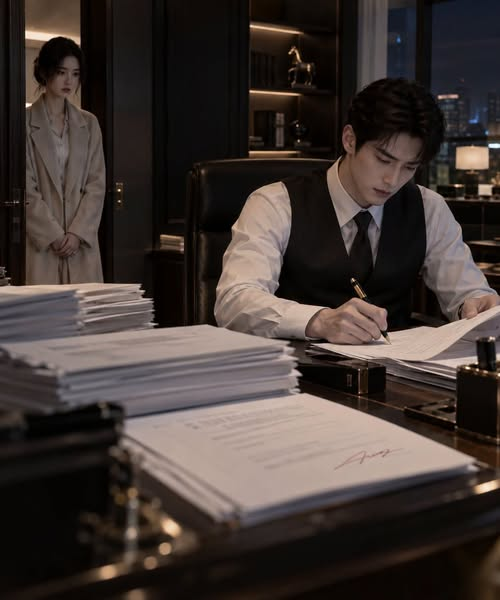
For the first time, his voice softened.
—What do you want me to do?
Years ago, that question would have made me happy.
Now it came too late.
—Nothing.
He looked up sharply.
—I want you to do exactly what you’ve been doing for three years.
I paused.
—Live your life without me.
He stayed for another hour.
I didn’t let him see the children.
Not because I wanted revenge.
Because he had arrived without arranging anything, expecting the entire household to reorganize itself around his wishes.
That was the old pattern.
I wouldn’t teach the twins that love meant surrendering every boundary.
Before leaving, he stopped at the door.
—You left me a letter.
My fingers tightened.
So he had found it.
—Yes.
—Why did you put it in the wine cellar?
I looked away.
Because that cellar contained the last bottle from our wedding.
I had once imagined opening it on our tenth anniversary.
—It seemed appropriate.
His voice became strange.
—You wrote that you were returning everything that belonged to the Co family.
—Yes.
—The house. The cars. The jewelry.
—Yes.
He took one step toward me.
—But you also wrote that there was one thing you couldn’t return.
I knew what he meant.
The twins.
—They’re not property, Tram Chu.
—That’s not what I’m talking about.
He reached into his coat.
In his hand was my letter.
One sentence had been circled.
“There is one thing I took from this marriage that you never knew existed.”
My heart stopped.
I had forgotten that line.
Co Tram Chu unfolded another paper.
—What does this mean?
I said nothing.
His eyes stayed on me.
—Khuong Niem, what did you take?
Before I could answer, my father entered.
His expression immediately changed when he saw the paper.
—That’s enough.
Co Tram Chu turned.
—Uncle Khuong, what is she hiding from me?
My father laughed coldly.
—Now you’re interested in what your wife was doing?
—Dad.
I tried to stop him.
Too late.
My father opened the drawer and threw a financial report onto the table.
Co Tram Chu picked it up.
The report belonged to the South District project.
The same project currently threatening his position inside Co Group.
He read the first page.
Then the second.
His expression slowly changed.
—Impossible.
My father said nothing.
Co Tram Chu looked at me.
—The emergency capital that saved this project four years ago…
I remained silent.
He turned to the final page.
There was my signature.
Not my father’s.
Mine.
The money had never been a gift from the Khuong family.
It had been my personal investment.
And under the original agreement, if Co Group failed to repay the investment by the specified deadline, the collateral converted into equity.
That deadline had passed six months ago.
Co Tram Chu stared at the percentage.
Eighteen percent.
Enough to make me one of the largest individual shareholders in the company he believed belonged entirely to his family.
His voice became hoarse.
—You own eighteen percent of Co Group?
—Not yet.
I looked directly at him.
—The conversion still requires one final filing.
His eyes narrowed.
—When?
My father answered for me.
—Tomorrow morning.
The room went silent.
Then my attorney entered carrying another folder.
His expression was serious.
—Miss Khuong, we discovered something while preparing the filing.
I turned.
—What?
He placed an old agreement on the table.
—Someone attempted to cancel your collateral rights three months ago.
My blood went cold.
—I never authorized that.
—I know.
He opened the last page.
A signature appeared beneath my name.
It looked almost identical to mine.
Almost.
Co Tram Chu’s expression changed.
—Who submitted it?
My attorney looked directly at him.
—Your executive office.
Co Tram Chu went completely still.
Then the attorney added:
—And the person who electronically approved the request used Chairman Co’s authorization credentials.
For the first time since arriving, Co Tram Chu looked genuinely shaken.
—That’s impossible.
My attorney slid one final document toward us.
—Then perhaps you should explain why the approval was made at 11:43 p.m. on your office computer…
He paused.
—on the same night Miss Khuong was hospitalized alone with a forty-degree fever.
