The taxi arrived nine minutes later.
I placed the twins inside first, then helped Nian’an climb in.
—Mom, are we really going to our new house?
—Yes.
—Will Dad come?
I paused.
—No.
Nian’an lowered his head.
Then, unexpectedly, he smiled.
—Then Mom won’t have to wait for him anymore.
My heart tightened.
He was only three.
Yet even he had noticed.
The apartment I had rented was small.
Two bedrooms.
Old furniture.
No elevator.
But that first night, after feeding the twins and putting them to sleep, I sat beside the window and felt something I hadn’t experienced in years.
Peace.
Nobody to wait for.
Nobody whose footsteps I had to recognize in the hallway.
Nobody who could disappoint the children simply by coming home.
The next morning, Fu Jingsen sent another 200,000 yuan.
I returned it again.
He called.
I didn’t answer.
Then came one message.
“Don’t use the children to punish me.”
I stared at those words.
Then deleted them.
He still believed everything was about him.
Three days later, I found work.
What Fu Jingsen had never known was that before marrying him, I had studied architectural design.
During the marriage, I had taken freelance projects from home whenever the children slept.
Eight thousand three hundred yuan wasn’t everything I had.
It was simply the cash I could access immediately.
I still had my skills.
And, more importantly, I had stopped being afraid.
Six months passed.
Then one year.
Fu Jingsen never visited.
He sent money occasionally.
I returned it.
On Nian’an’s fourth birthday, he sent an expensive mechanical toy.
Nian’an opened the box.
—Who sent it?
—Your father.
He stared at it for several seconds.
Then pushed it toward his brothers.
—They can play with it.
—You don’t like it?
He shook his head.
—Dad doesn’t know what I like.
That sentence hurt more than anything Fu Jingsen had ever said to me.
Because it was true.
He didn’t know Nian’an hated loud toys.
He didn’t know Nian Yu couldn’t sleep without holding the corner of my sleeve.
He didn’t know Nian Chu loved strawberries but refused to eat strawberry-flavored candy.
He didn’t know his own children.
And eventually, the children stopped asking about him.
Three years later, my design studio received its first major award.
Five years later, I opened a second office.
By the time Nian’an was nine, our company had projects in four cities.
I never became unimaginably wealthy.
I simply became independent enough that nobody could ever tell me again that raising three children meant I had no choice.
Meanwhile, I occasionally heard about Fu Jingsen.
The woman he loved had married someone else less than two years after our divorce.
Apparently, returning to the country hadn’t meant returning for him.
She had simply needed his connections to stabilize her company.
Fu Jingsen helped her.
Then she left.
I expected to feel satisfied when I heard.
I didn’t.
His heartbreak had nothing to do with me anymore.
Seven years after our divorce, we met again.
It happened at a children’s robotics competition.
Nian’an had reached the city finals.
Nian Yu and Nian Chu were sitting beside me, arguing over which brother’s robot would win.
Then someone behind us whispered:
—Fu Jingsen?
I turned.
He stood near the entrance.
Older.
Thinner.
Still dressed impeccably.
But the indifference that had once seemed permanent was gone.
His eyes found me.
Then they moved toward the three boys.
He stopped walking.
Nian’an was standing onstage.
Tall for his age.
Calm.
His profile looked almost exactly like Fu Jingsen’s.
The twins were beside me.
One laughing.
The other quietly reading the competition booklet.
Fu Jingsen approached slowly.
—Are those…
I stood.
—Yes.
His throat moved.
—They’ve grown so much.
I almost laughed.
Children tended to do that over seven years.
Nian Yu looked up.
—Mom, who is he?
Fu Jingsen froze.
Not “Dad.”
Not even recognition.
Just:
Who is he?
I answered simply:
—Your father.
All three children became silent.
Nian Chu studied him with those dark eyes that resembled his.
—Oh.
One word.
Nothing else.
Fu Jingsen’s face visibly changed.
He crouched.
—Nian Chu?
The boy frowned.
—I’m Nian Yu.
Fu Jingsen went completely still.
He had confused his own twins.
Nian Chu closed his book.
—I’m Nian Chu.
For perhaps the first time in his life, Fu Jingsen looked ashamed.
Then Nian’an came running from the stage.
—Mom!
He hugged me.
—We won!
I smiled.
—Congratulations.
Only then did he notice Fu Jingsen.
His smile disappeared.
He remembered.
Fu Jingsen whispered:
—Nian’an.
My eldest son stood in front of his brothers.
Protecting them.
—Why are you here?
—I didn’t know you would be here.
—Okay.
Nian’an took my hand.
—Mom, can we get cake now?
Fu Jingsen suddenly asked:
—Can I come?
Three children looked at him.
Nian’an answered first.
—Why?
Fu Jingsen had no response.
He had spent years assuming fatherhood was something biology preserved for him.
But children didn’t remember DNA.
They remembered who carried them through fevers.
Who attended school performances.
Who knew their favorite foods.
Who stayed.
We left without him.
That should have been the end.
It wasn’t.
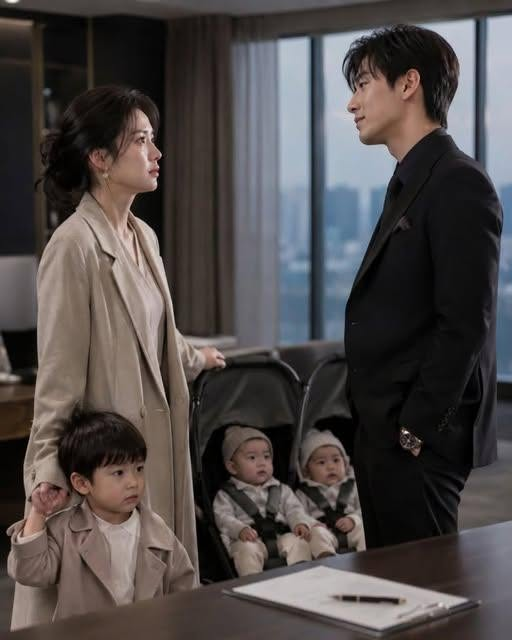
Two weeks later, Fu Jingsen appeared at my office.
This time he carried no gifts.
—I want to see the children.
—That’s their decision.
—They’re still minors.
I looked at him.
—And you’ve ignored them for seven years.
He lowered his eyes.
—I know.
That surprised me.
The old Fu Jingsen would have defended himself.
This man simply said:
—I was wrong.
I remained silent.
He placed a worn notebook on my desk.
I recognized it immediately.
My expense notebook.
The one I had left behind.
Every can of formula.
Every diaper.
Every hospital payment.
Every expense from those years.
He had kept it.
—Why do you have this?
—After you left, I found it.
His fingers tightened.
—I thought the card I gave you had paid for everything.
I said nothing.
—Then I checked.
His voice became quieter.
—You barely touched it.
He opened another page.
Nian’an’s hospitalization.
The deposit.
Medication.
Taxi.
Everything paid from my savings.
Fu Jingsen looked at me.
—I checked my calendar for that night.
I remembered.
Rain.
A burning forehead against my chest.
A crying child.
Three unanswered calls.
—I wasn’t entertaining clients.
I frowned.
He continued:
—I was at her birthday party.
Silence.
—The woman I loved.
His eyes reddened.
—While my son was in the hospital, I was celebrating another woman’s birthday.
I closed the notebook.
—Why are you telling me this?
—Because I finally understand why you left.
—Seven years too late.
—I know.
Again.
No excuse.
No defense.
That somehow made it harder to hate him.
But forgiveness and reconciliation were not the same thing.
I pushed the notebook back.
—Keep it.
He shook his head.
—It belongs to you.
—No.
I looked at him.
—You need it more.
He left without asking for anything else.
That evening, however, Nian’an came into my room.
—Mom.
—Yes?
—Did Dad come to your office?
I looked up.
—How did you know?
He handed me his tablet.
There was an email.
From Fu Jingsen.
Not to me.
To Nian’an.
“I don’t expect you to call me Dad. But I owe you an apology.”
I read no further.
That message belonged to my son.
—What do you want to do?
I asked.
Nian’an thought for a long time.
—I want to meet him once.
So I arranged it.
Saturday afternoon.
A quiet café.
Fu Jingsen arrived forty minutes early.
Nian’an asked him questions.
Why hadn’t he visited?
Why didn’t he know the twins?
Why had he wanted another woman instead of Mom?
Fu Jingsen answered every one.
Even when the answers made him look terrible.
Then Nian’an asked:
—Why did you divorce Mom?
Fu Jingsen became silent.
Finally:
—Because I thought someone I had loved before your mother was coming back for me.
—Was she?
—No.
Nian’an frowned.
—Then you lost Mom for nothing?
Fu Jingsen looked at me.
—Yes.
Nian’an nodded thoughtfully.
—That was stupid.
I nearly choked on my tea.
For the first time, Fu Jingsen laughed.
A real laugh.
Then his phone rang.
He looked at the screen.
His smile vanished.
—What happened?
I asked instinctively.
He stood.
—It’s my lawyer.
He walked several steps away.
I wasn’t listening.
Until I heard:
—What do you mean the hospital records don’t match?
My hand stopped.
Fu Jingsen turned toward me.
His face had become completely pale.
—Send them immediately.
He ended the call.
—What’s wrong?
He stared at Nian’an.
Then at the twins.
—After the competition, I updated my estate plan.
I frowned.
—That has nothing to do with us.
—It required the children’s original birth records.
My stomach tightened.
—And?
He swallowed.
—The hospital sent them today.
He placed his phone on the table.
Three birth certificates appeared.
Nian’an.
Nian Yu.
Nian Chu.
But beside the twins’ records was an additional archived document.
I read the heading.
My blood went cold.
“Neonatal identity discrepancy investigation.”
—I’ve never seen this.
—Neither have I.
Fu Jingsen opened the attached report.
The twins had been born during a night when the hospital’s electronic identification system failed.
Four newborn boys had been temporarily moved during an emergency evacuation of the maternity floor.
The hospital had investigated afterward.
But the final verification had never been completed.
Then I saw a handwritten note at the bottom.
“Mother discharged with two male infants before secondary DNA confirmation.”
I couldn’t breathe.
Fu Jingsen looked at Nian Yu.
Then Nian Chu.
Seven years ago, I had believed the worst thing he could do was abandon his children.
Now, for the first time, another possibility appeared.
One of the twins I had raised since birth might not have been the baby I gave birth to.
And somewhere in the city, another family might have been raising my son.
