Two days after I left the divorce papers on Pho Hanh Chu’s desk, I joined the emergency medical team heading to City Y.
I thought I would leave quietly.
Instead, reporters were waiting outside the hospital.
One of them was the same host who had interviewed my husband.
After several questions about the earthquake relief mission, he suddenly asked:
—Doctor Lam, Mr. Pho recently spoke about the choice in his life he would never regret. Do you have something you don’t regret?
I was about to give a professional answer.
Then I saw him.
Pho Hanh Chu was sitting in his wheelchair behind the reporters.
Assistant Phuong stood beside him.
His face looked exhausted.
Our eyes met.
Three years ago, Pho Hanh Chu had risked his life for Tham Khinh Dao.
I had spent those same three years pretending it didn’t matter.
Not anymore.
I looked directly at the camera.
—Three years ago, my husband nearly died protecting another woman.
The crowd became silent.
Pho Hanh Chu’s expression changed.
—I was the surgeon who operated on him that night.
Several reporters turned toward him.
I continued calmly.
—I knew who he had protected. But inside the operating room, he wasn’t my husband. He was my patient. So I saved him.
The host didn’t know what to say.
I smiled faintly.
—Saving his life was my responsibility as a doctor. Spending another three years trying to save our marriage was my mistake.
Pho Hanh Chu gripped the armrest of his wheelchair.
—Lam Duong.
I looked at him.
For the first time, I didn’t walk toward him when he called my name.
Instead, I turned toward the relief vehicle.
He suddenly ordered his assistant:
—Stop her.
I stopped by myself.
—Why?
His voice was low.
—We haven’t finished talking.
—There’s nothing left to discuss. Sign the divorce papers.
—I won’t.
That answer finally made me turn around.
Pho Hanh Chu looked at me with an expression I had never seen before.
Fear.
—You can’t end three years of marriage like this.
I almost laughed.
—You’re right.
I shook my head.
—It didn’t end today. It ended three years ago when you chose another woman and I convinced myself it meant nothing.
His face went pale.
Then a woman’s voice came from behind him.
—Hanh Chu!
Tham Khinh Dao.
She pushed through the reporters and hurried toward his wheelchair.
Everyone immediately recognized her.
Pho Hanh Chu looked at her.
Then at me.
And that single hesitation was enough.
I opened the vehicle door.
—Lam Duong!
This time his voice cracked.
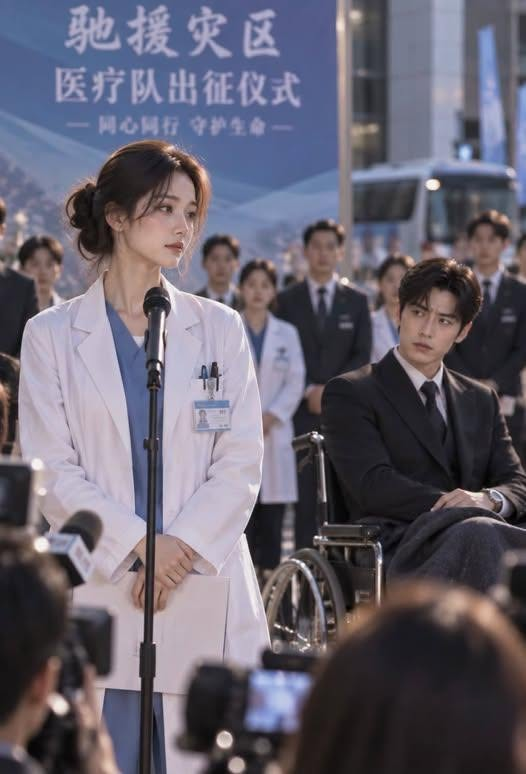
I paused.
—What?
His next words shocked everyone.
—The person I called “the most important” in that interview wasn’t Tham Khinh Dao.
I froze.
Even Khinh Dao stopped.
Pho Hanh Chu stared directly at me.
—It was you.
For three years, I had waited to hear something like that.
Now that he finally said it, I felt almost nothing.
—Then you should have said my name.
His lips parted.
No answer came.
I nodded.
—Exactly.
I got into the vehicle.
The door closed between us.
Hours later, while traveling toward City Y, my phone suddenly received a message from Assistant Phuong.
“Madam, I know you don’t want to hear about the Deputy General. But there is something about the accident three years ago that you were never told.”
I stared at the screen.
Another message appeared.
“Mr. Pho didn’t lose his leg simply because he protected Miss Tham.”
Then came a photograph.
It was an old hospital document.
My name appeared on it.
Below it was a timestamp from twenty minutes before the accident.
And beside my name were four words:
PRIMARY TARGET: LAM DUONG.
My fingers went cold.
Assistant Phuong called immediately.
I answered.
—What does this mean?
His voice trembled.
—The accident wasn’t an accident.
I couldn’t speak.
Then he said:
—And Miss Tham wasn’t the person Mr. Pho was originally trying to save.
I looked again at the document.
—Then who was?
There was a long silence.
—You, Madam.
My heart stopped.
Assistant Phuong continued:
—Someone wanted you dead that day.
Then his voice dropped.
—And Mr. Pho has known who ordered it for three years.
