What happened next was reconstructed for me much later.
Alexander called emergency services.
Nathan tried to help while Lucas stood frozen, repeating my name as though saying it enough times could undo the previous ten minutes.
The paramedics arrived quickly.
By then, nobody was laughing.
Isabella kept insisting:
—It was only a joke.
One paramedic looked at the sealed ventilation holes.
His expression changed.
—Who did this?
Nobody answered.
I was taken to the hospital.
My brothers followed.
For hours, my parents sat outside the intensive care unit while doctors worked to stabilize me.
I survived.
But when I finally woke, several days had disappeared.
My mother was beside the bed.
Her face crumpled when my eyes opened.
—Elena?
I looked at her.
Then toward the door.
Three familiar figures stood outside.
Alexander.
Nathan.
Lucas.
None dared enter.
My first words were barely audible.
—Don’t let them in.
My mother’s face went white.
But she nodded.
That was the first boundary the Shen family ever respected.
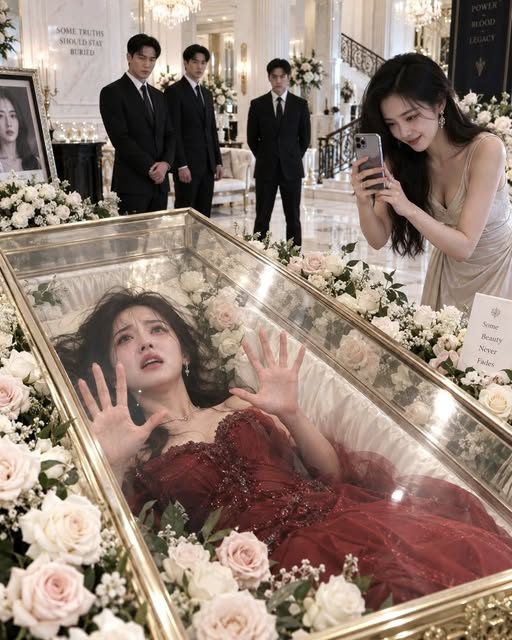
The livestream made hiding what happened impossible.
Thousands of people had seen me signal that I couldn’t breathe.
They had watched Nathan take out the key.
They had watched Isabella stop him.
They had heard Alexander insist the coffin was safe.
Most importantly, investigators found silicone deliberately blocking the ventilation openings.
Alexander immediately denied applying it.
So did Nathan and Lucas.
Then police recovered footage from the room where the coffin had been stored.
At 2:14 that afternoon, Isabella entered alone.
She remained inside for eleven minutes.
When she emerged, she was carrying a small tube.
Nathan watched the footage twice.
Then he walked into the hospital bathroom and became sick.
Isabella finally admitted it.
She claimed she only wanted me to panic.
She thought I would beg to be released.
Then everyone would laugh.
She never expected my brothers to ignore me for so long.
Alexander exploded.
—You told us the blood was fake!
Isabella screamed back:
—And you believed me!
Silence followed.
Because that was the part none of them could escape.
Isabella had blocked the holes.
But my brothers had seen me struggling.
They had possessed the key.
And they had chosen the joke.
The investigation continued through the proper legal process.
I refused to participate in family meetings designed to make everyone “understand each other.”
I didn’t need understanding.
I needed distance.
When I was discharged, I didn’t return to the Shen mansion.
My biological father offered me an apartment.
I refused.
Instead, I returned to the small town where I’d grown up.
The house my adoptive mother had left me was old.
The kitchen faucet leaked.
The garden was overgrown.
It was perfect.
Three months later, Alexander appeared outside.
He had lost weight.
—I came to apologize.
I remained behind the gate.
—Then apologize.
His eyes reddened.
—I built that thing. I told everyone it was safe. When you signaled, I thought you were trying to ruin the prank.
I said nothing.
—Every night I remember you hitting the glass.
I stopped him.
—I don’t want that description.
He lowered his head.
—Okay.
Then he whispered:
—Can you forgive me?
—Not today.
Nathan came two months later.
He brought no gifts.
He stood outside and said:
—I had the key.
Three words.
Nothing more was necessary.
—I know.
—I almost opened it.
—I know.
—Then I listened to Isabella.
—I know.
He cried.
I didn’t comfort him.
Lucas wrote letters instead.
I returned every one unopened for almost a year.
My parents visited occasionally.
They had finally stopped calling Isabella and me “both their daughters” as though equal affection could erase unequal responsibility.
I never asked them to stop loving her.
I simply refused to live inside their confusion anymore.
A year and a half after that April Fool’s Day, I opened Lucas’s latest letter.
There was only one page.
“I kept promising you strawberry cake tomorrow. I didn’t understand that love offered tomorrow is worthless when someone needs you today.”
I read that sentence twice.
Then I called him.
Not to reconcile.
Just to talk.
Healing happened like that.
Not dramatically.
Alexander remained someone I saw occasionally.
Nathan eventually became the brother I spoke to most, but rebuilding trust took years.
Lucas visited every month and helped repair my adoptive mother’s house.
Nobody ever again asked me to prove that I belonged.
And Isabella?
I saw her once more.
Years later.
She waited outside a courthouse after the legal consequences of that night had finally run their course.
She looked smaller than I remembered.
—Elena.
I stopped.
—I’m sorry.
I believed her.
But believing an apology and restoring a relationship are different things.
—I hope you become someone who would never do it again.
Her eyes filled.
—Does that mean you forgive me?
I thought about the eight months I’d spent chasing the Shen family’s approval.
Then I shook my head.
—It means I don’t want to spend the rest of my life carrying you.
I walked away.
Years passed.
I became a teacher in the town where my adoptive mother had raised me.
Every spring, strawberry plants grew beside my house.
One April morning, Nathan arrived carrying a cake.
Alexander brought tea.
Lucas brought absolutely nothing because I’d finally convinced him that visiting his sister didn’t require payment.
We sat outside.
Nobody mentioned blood.
Nobody mentioned coffins.
Nobody called anything a test.
Alexander cut the cake.
Before handing me the first piece, he hesitated.
—Elena?
—What?
He swallowed.
—I’m glad you’re here.
Such a simple sentence.
Once, I would have done almost anything to hear it.
Now I smiled because I no longer needed it.
That was the strange thing about finally becoming part of the Shen family.
It happened only after I stopped trying to earn the position.
I had entered that glass coffin believing that if I endured one more humiliation, three brothers might finally accept me.
Instead, surviving that night taught me something my adoptive mother had understood all along:
Family isn’t the person who demands proof that you belong.
It’s the person who opens the door before you ever have to beg.
