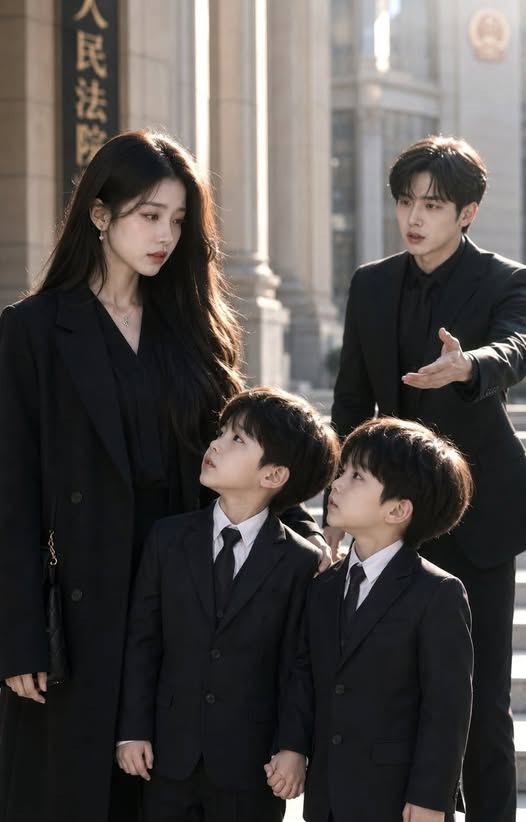
The courtroom went completely silent.
Daniel stared at Noah as though he no longer recognized his own son.
The judge extended his hand.
—Bring me the device.
Noah walked forward.
His fingers were trembling now.
He had been brave long enough to tell the truth.
The moment he returned, I opened my arms.
He ran into them.
Liam followed.
I held both boys while the court arranged for the USB to be examined properly.
Daniel’s lawyer leaned toward him and whispered furiously.
Daniel suddenly said:
—He’s nine! He doesn’t understand what he recorded!
Noah buried his face against my shoulder.
I looked at Daniel.
—Then why are you afraid of it?
He said nothing.
The hearing was paused.
When it resumed, the contents of the USB changed everything.
Noah had recorded several conversations on an old tablet Daniel believed was broken.
In one recording, Daniel spoke to Mrs. Li.
Her voice was unmistakable.
—What should I say about Mrs. Pei?
Daniel answered:
—Say she leaves the children alone. Say she loses control easily.
Then Mrs. Li asked:
—But that isn’t true.
Daniel’s response made my stomach turn.
—It doesn’t have to be true forever. It only has to be believable in court.
Daniel lowered his head.
Another recording concerned the mysterious telephone number.
He knew it belonged to Grace.
He had known all along.
Yet he’d allowed his lawyer to imply I was having an affair.
Then came the recording Noah had mentioned.
Daniel was discussing plans to relocate the boys after obtaining primary custody.
He believed that once enough distance existed between us, I would eventually give up trying to maintain regular contact.
I looked at my children.
So that had been the plan.
Not divorce.
Erasure.
The judge didn’t issue a dramatic decision immediately.
Real courts didn’t work like television.
The recordings had to be authenticated.
Mrs. Li had to be questioned.
The allegations had to be investigated.
But Daniel’s strategy had collapsed.
Temporary arrangements were changed while the evidence was reviewed, and the children’s welfare became the court’s priority.
Outside the courtroom, Daniel caught up with me.
—You put Noah up to this.
I stopped.
—I didn’t even know the USB existed.
—He’s a child!
—Exactly.
I turned toward him.
—And somehow our nine-year-old understood that what you were doing was wrong before you did.
Daniel’s face tightened.
—I was afraid you’d take them from me.
I stared at him.
—So you tried to take them from me first?
He had no answer.
Mrs. Li eventually admitted that Daniel had pressured her.
She withdrew her earlier statement and provided messages supporting her account.
Grace also produced records showing that the number Daniel’s lawyer had presented as belonging to an unidentified man belonged to her.
Piece by piece, the story Daniel had constructed came apart.
And something else happened.
I got a lawyer.
Grace refused to let me continue alone.
—Wanting nothing doesn’t mean you deserve nothing —she told me.
That sentence changed me.
For years, Daniel had controlled the finances because I was “better with the children.”
I’d accepted it.
I’d mistaken dependence for division of responsibility.
My attorney discovered that I had legal interests in marital property and savings regardless of my willingness to walk away.
So I stopped saying:
“I want nothing.”
Instead, I said:
“I want what is fair.”
Months later, the divorce was finalized.
The parenting arrangement centered on the boys’ stability, schooling and safety.
Daniel remained their father.
I never tried to erase him the way he’d tried to erase me.
But his access to their lives came with responsibilities and boundaries he could no longer rewrite whenever convenient.
I returned to work.
The beginning was humiliating.
My résumé had a nine-year gap.
My first salary was far below what I’d once earned.
I rented a modest apartment.
No marble floors.
No private garden.
No housekeeper.
Noah and Liam shared a bedroom.
On our first night there, I apologized.
—I’m sorry it’s small.
Liam looked around.
—Can we put stars on the ceiling?
—Of course.
Noah asked:
—Are we staying?
I understood the real question.
—Yes.
His shoulders relaxed.
—Then it’s good.
That nearly broke me.
Three years later, I was promoted.
Five years later, I bought a home.
Not enormous.
But mine.
Daniel changed too.
Not quickly.
At first, every conversation became an argument.
Then one afternoon Noah refused to go with him.
Daniel asked why.
Noah answered:
—Because when I’m with you, I feel like I have to choose between loving you and loving Mom.
That sentence did what lawyers, judges and consequences hadn’t.
Daniel stopped fighting.
He started listening.
He eventually apologized to the boys.
Then, years after the divorce, he apologized to me.
—I thought because you had no salary, everything we had belonged to me.
I remained silent.
—Then I realized you had spent nine years doing work I never had to think about because you were doing it.
He looked ashamed.
—I didn’t understand its value until you stopped doing it for me.
I nodded.
—You should have.
—I know.
That was all.
There was no reconciliation.
Some apologies close wounds.
They don’t reopen doors.
When Noah turned eighteen, he was accepted into university.
That evening, while we were sorting through old boxes, he found the little black USB.
He held it up.
—You kept this?
I smiled.
—Your lawyer told me to.
He laughed.
Then became serious.
—Mom, were you angry that I recorded Dad?
I thought carefully before answering.
—I was sad that you ever felt you needed to.
His eyes dropped.
I took the USB from his hand.
—What happened between your father and me should never have become something you had to fix.
—But it helped you.
—It did.
I touched his cheek.
—But protecting me was never supposed to be your job.
Liam appeared at the door.
—Are we getting sentimental again?
Noah threw a pillow at him.
They started laughing.
I looked at them and suddenly remembered that courtroom.
Two frightened nine-year-old boys.
One hiding behind his brother.
The other carrying a secret inside his sock because the adults around him had failed to make him feel safe.
That was the part I never celebrated.
The USB had changed the case.
But it wasn’t my victory.
My victory came afterward.
It was rebuilding without teaching my sons to hate their father.
It was returning to work when I was terrified nobody would hire me.
It was learning that asking for fairness wasn’t greed.
It was discovering that leaving a marriage with dignity didn’t require leaving empty-handed.
Years earlier, I’d entered that courtroom believing I had nothing.
No income.
No house.
No lawyer.
No power.
I had been willing to surrender everything except my children.
But I walked out understanding something Daniel had spent years making me forget.
I had never been nothing.
And neither my marriage nor my motherhood needed a man’s permission to have value.
