PART 2 — THE MOLD THAT CHANGED EVERYTHING
The room became silent.
Not ordinary silence.
The kind of silence that arrives when hundreds of people realize something important is about to happen.
My cheek still burned from Audrey Whitmore’s slap.
I could feel the sting beneath my skin.
But nobody was looking at me anymore.
Every eye was fixed on the organizer.
And on the original stamp mold resting inside the open case.
The organizer carefully lifted the documents.
Page after page appeared on the large screen behind the ceremony stage.
Restoration records.
Workshop attendance logs.
Historical preservation notes.
Wax temperature measurements.
Seal impression tests.
And beside nearly every page appeared the same name.
YASMIN REED.
Gasps spread through the audience.
Teachers exchanged shocked looks.
Students whispered.
Sponsors leaned forward.
The organizer adjusted the microphone.
“The restoration of the First Student Council Seal was considered impossible.”
The room listened carefully.
“Most of the original mold had deteriorated.”
A photograph appeared on the screen.
The damaged seal.
Cracked.
Broken.
Nearly unreadable.
Then another image appeared.
The restored version.
Perfect.
Detailed.
Complete.
The audience erupted into murmurs.
The organizer continued.
“One student spent three months reconstructing the missing sections.”
He looked directly at me.
“That student was Yasmin Reed.”
Audrey’s face lost color.
Her smile disappeared completely.
Then the organizer revealed one final page.
A page marked with red notes.
The room grew quiet again.
His voice hardened.
“Someone attempted to alter these records.”
The audience froze.
A digital scan appeared on the screen.
Crossed-out names.
Modified entries.
Removed signatures.
The evidence was impossible to ignore.
Then the organizer pointed to the audit report.
A login history.
A user account.
A timestamp.
And one name.
AUDREY WHITMORE.
The entire hall gasped.
Audrey suddenly looked less like a queen and more like someone trapped.
PART 3 — THE VIDEO SHE NEVER EXPECTED
“No.”
Audrey shook her head violently.
“That’s fake.”
Her voice sounded desperate.
For the first time all day, she looked afraid.
Then another voice echoed from the back of the room.
“It isn’t fake.”
Everyone turned.
Mrs. Daniels, the workshop supervisor, stepped forward holding a tablet.
Her expression was grim.
Very grim.
The organizer nodded.
“Show them.”
The giant screen changed.
Security footage appeared.
A date flashed across the screen.
Two weeks earlier.
11:53 PM.
The wax-seal workshop.
Long after students had gone home.
The audience watched silently.
A figure entered the room.
Opened a records cabinet.
Removed the restoration files.
Flipped through the pages.
Then began changing entries.
My entries.
My hours.
My restoration notes.
My contributions.
One by one.
The figure turned.
The camera captured her face perfectly.
Audrey Whitmore.
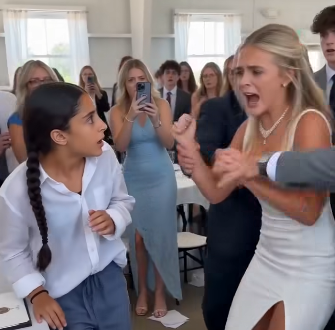
The room exploded.
Students gasped.
Teachers stood.
Reporters immediately raised cameras.
Flashbulbs illuminated the hall.
The footage continued.
Everyone watched as Audrey attempted to transfer credit from my work into her own project file.
There was no misunderstanding.
No mistake.
No confusion.
Only deliberate deception.
Then Audrey made the biggest mistake of her life.
Instead of apologizing—
She pointed at me.
And laughed.
A cold, ugly laugh.
Then she said,
“She’s still nobody.”
The room froze.
Several students visibly recoiled.
Even some of Audrey’s closest friends stepped away from her.
The cruelty of the statement seemed to hang in the air.
One reporter whispered,
“Did she really say that?”
Another nodded.
“Everyone heard it.”
And everyone had.
PART 4 — THE MAN WHO REMEMBERED MY MOTHER
Then something unexpected happened.
A distinguished older man stood from the sponsor section.
The room immediately recognized him.
Professor Nathan Holloway.
A respected historian.
A preservation expert.
A man whose opinion carried enormous weight throughout Salem.
He slowly walked toward the stage.
Then looked directly at me.
His eyes softened.
“I know who Yasmin Reed is.”
I blinked.
Confused.
I had never met him.
Professor Holloway smiled sadly.
“No, Yasmin.”
He paused.
“But I knew your mother.”
My breath caught.
The room became silent.
My mother had passed away four years earlier.
Few people ever mentioned her anymore.
The professor continued.
“Twenty years ago, she volunteered at the historical archives.”
Tears immediately filled my eyes.
“She spent hundreds of hours preserving records that nobody else cared about.”
His voice trembled.
“When a flood damaged part of the collection, she worked through the night to save it.”
The audience listened carefully.
Then he smiled.
“And today, I learned her daughter did exactly the same thing.”
I couldn’t stop crying.
Not from sadness.
From gratitude.
Someone remembered her.
Someone remembered her kindness.
The audience erupted into applause.
People stood.
Teachers wiped tears away.
Students cheered.
For the first time in my life, I felt visible.
Not because of poverty.
Not because of sympathy.
Because of my work.
Because of who I was.
PART 5 — THE FALL OF A PERFECT IMAGE
Audrey’s reputation collapsed in real time.
Phones buzzed throughout the ceremony hall.
Videos spread across social media.
The slap.
The accusations.
The altered records.
The security footage.
Everything.
Within minutes, thousands of people were watching.
Then Audrey’s parents arrived.
The room parted immediately.
Everyone expected them to defend her.
To deny everything.
To blame someone else.
Instead, something shocking happened.
Her father watched the footage.
Read the documents.
And closed his eyes.
The disappointment on his face was devastating.
“Audrey.”
His voice cracked.
“What have you done?”
Audrey looked stunned.
“You always told me our family’s reputation mattered.”
The room held its breath.
Her father nodded.
“It does.”
Then his expression hardened.
“But reputation without integrity is worthless.”
The words struck like lightning.
Audrey looked as though she had never heard that lesson before.
The sponsor board met privately.
After twenty tense minutes, they returned.
Their decision was immediate.
The Whitmore family would lose several leadership roles connected to future educational programs.
Additional oversight would be imposed.
Gasps filled the hall.
Audrey looked devastated.
For years she had believed influence could solve everything.
Now she was learning otherwise.
PART 6 — THE ANNOUNCEMENT NOBODY EXPECTED
The ceremony should have ended there.
Instead, it became something unforgettable.
Professor Holloway stepped back to the microphone.
The crowd quieted.
He smiled at me.
Then addressed the audience.
“History is protected by people most of us never notice.”
The audience listened carefully.
“People who work quietly.”
“People who expect no applause.”
“People who continue even when nobody is watching.”
His eyes met mine.
“People exactly like Yasmin Reed.”
My heart started pounding.
Then he made an announcement that stunned everyone.
Including me.
“I am establishing a Historical Preservation Scholarship.”
Gasps echoed throughout the hall.
Professor Holloway raised a hand.
“The first recipient will be Yasmin Reed.”
For a moment I couldn’t breathe.
The audience exploded into applause.
Students cheered.
Teachers cried.
Sponsors smiled.
The scholarship covered tuition support, preservation internships, and advanced historical studies.
It was more than I had ever dreamed possible.
Tears streamed down my face.
The standing ovation lasted nearly two minutes.
When the microphone was handed to me, my hands trembled.
I looked across the crowd.
Then spoke.
“My mother taught me something.”
The room became silent.
“Important things stay important even when nobody notices them.”
For a second, nobody moved.
Then thunderous applause filled the hall.
PART 7 — THE TRUTH ABOUT AUDREY
Two weeks later, I received a message.
From Audrey.
I almost ignored it.
Almost.
Instead, I agreed to meet.
We sat in a small park outside Salem.
No reporters.
No cameras.
No sponsors.
Just two girls whose lives had collided.
Audrey looked completely different.
No designer gown.
No diamonds.
No confidence.
Just a tired eighteen-year-old.
For several moments neither of us spoke.
Then she surprised me.
She apologized.
A real apology.
Not rehearsed.
Not polished.
Not forced.
The kind that hurts.
“I was terrible to you.”
I nodded.
“Yes.”
Tears filled her eyes.
“I know.”
The wind rustled through the trees.
Then she told me something nobody else knew.
Her entire life had revolved around expectations.
Winning.
Being admired.
Being perfect.
Anything less felt like failure.
She had grown up believing recognition was proof of value.
When my name was announced during the ceremony—
She panicked.
Not because I had harmed her.
Because she couldn’t stand someone else receiving the attention she wanted.
It didn’t excuse her actions.
Not even a little.
But it explained them.
For the first time, I saw something beneath the arrogance.
Fear.
Fear of being forgotten.
Fear of being ordinary.
The same fear many people carry.
Only she had allowed it to control her.
After a long silence, I finally said,
“You can’t undo what happened.”
She nodded.
“I know.”
“But you can decide who you become now.”
Fresh tears rolled down her face.
And for the first time since I met her—
She smiled honestly.
PART 8 — THE END
One year later, the restored student council seal became one of Salem’s most celebrated educational projects.
Schools used it as an example of historical preservation.
Museums requested presentations.
Students volunteered in greater numbers than ever before.
And the original stamp mold became famous.
Not because it exposed a scandal.
Because it preserved the truth.
As for me, my life changed completely.
The scholarship opened doors.
New opportunities appeared.
Dreams I never thought possible became real.
But my favorite moment happened on an ordinary afternoon.
I returned to the wax-seal workshop.
A younger student stood alone near a heating station.
Nobody noticed her.
Nobody thanked her.
Nobody interviewed her.
I recognized that feeling immediately.
Because I had once been her.
I walked over.
“How’s the project going?”
She looked surprised.
“Pretty good, I think.”
I smiled.
Then handed her a notebook.
A blank notebook.
Her eyes widened.
“What’s this for?”
I looked around the workshop.
The wax.
The tools.
The molds.
The history.
Then I smiled.
“For your records.”
She tilted her head.
“Why?”
I thought about the slap.
The accusations.
The evidence.
The scholarship.
The impossible chain of events that had changed my life.
Then I answered.
“Because truth deserves proof.”
The girl smiled.
A bright hopeful smile.
And in that moment I finally understood what the original stamp mold had really proven.
It wasn’t simply evidence that I deserved credit.
It proved something far more powerful.
The truth leaves an impression.
People can deny it.
Hide it.
Erase names.
Rewrite stories.
Or try to steal recognition.
But eventually the truth presses itself into history.
Just like a seal pressed into wax.
Permanent.
Visible.
Impossible to ignore.
As I walked home beneath the golden Salem sunset, I imagined my mother smiling somewhere beyond the clouds.
For years I thought recognition would change my life.
I was wrong.
What changed my life was continuing to do the right thing when nobody was watching.
The girl they tried to erase became the person nobody could forget.
And the original stamp mold made sure the truth would remain forever.
THE END.
