Lam Van stopped outside the guest-room door.
Inside, Luc Dao was still talking.
—My mother said my sister-in-law has always been soft-hearted. If she really cared about the money, she would have asked for it already.
The person on the other end said something.
Luc Dao laughed.
—Exactly. Besides, my brother’s money will eventually belong to their family anyway.
Lam Van lowered her eyes.
Strangely, she wasn’t angry.
She simply felt tired.
The girl whose hand she had held for seventeen days in the hospital was gone.
Or perhaps she had never really known her.
Lam Van quietly opened the front door.
The conversation stopped immediately.
Luc Dao came out.
—Sister-in-law? You’re back?
—Yes.
—Why didn’t you say anything?
Lam Van smiled.
—Would it have changed what you said?
Luc Dao’s face went white.
That night, Lam Van did something she should have done months earlier.
She opened her banking records.
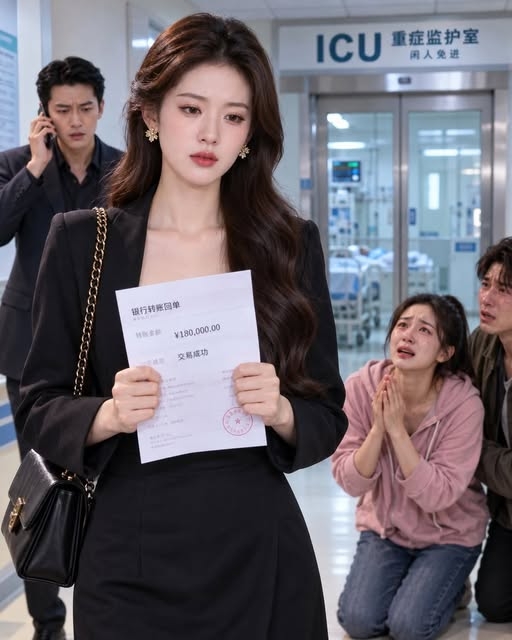
180,000 yuan.
Of that amount, 150,000 had come from savings accumulated during her marriage and 30,000 from her mother’s family.
She printed the transfer certificate.
Hospital receipts.
Messages.
Then she photographed everything and stored copies.
The following morning, she told Luc Dao:
—You need to find another place to stay by the end of the week.
Luc Dao stared at her.
—Because of what you heard?
—Because you’re healthy now, and this arrangement was temporary.
—Sister-in-law, don’t be so sensitive.
Lam Van smiled.
There it was again.
Sensitive.
Narrow-minded.
Calculating.
Every word existed for the same purpose:
to make her ashamed of having boundaries.
—I’m not discussing it.
When Luc Minh learned what happened, he came home furious.
—She’s my sister!
—Then you can help her rent an apartment.
—This is her brother’s house too!
Lam Van looked at him.
—Good. Pay half the household expenses from now on.
He froze.
For three years, Lam Van had handled utilities, groceries and countless small expenses because Luc Minh always claimed the hardware store needed cash.
She had believed marriage meant not keeping score.
Unfortunately, everyone else had been keeping score.
They had simply made sure she was always the one paying.
From that month onward, Lam Van changed.
Not dramatically.
She simply stopped volunteering.
Her mother-in-law’s birthday arrived.
No expensive cosmetics.
Just a polite phone call.
Luc Minh’s cousin married.
Lam Van didn’t provide the customary large gift from their household.
—Ask Luc Minh.
New Year approached.
Her mother-in-law called.
—Van Van, remember to prepare the gifts.
—Luc Minh can prepare them.
Silence.
Then:
—You’re the daughter-in-law.
—And he’s your son.
The call ended quickly.
For the first time, Lam Van understood how much “family harmony” had depended on her never saying no.
Then came the money.
She spoke with a lawyer about the 180,000 yuan and learned that recovering any portion would depend on how the payment and surrounding communications could legally be characterized and documented.
So she stopped arguing emotionally.
She preserved evidence.
She separated her salary.
She documented household finances.
And most importantly, she stopped giving Luc Minh unrestricted access to money that was solely hers.
Six months later, his hardware store suddenly needed capital.
He came home unusually affectionate.
—Van Van, could you transfer me 80,000?
She looked up.
—No.
His smile disappeared.
—We’re husband and wife.
—Exactly.
—What does that mean?
—It means you should be comfortable discussing money honestly.
He stared at her.
—You’re still upset about Dao Dao?
—No.
She closed her laptop.
—I’m awake because of Dao Dao.
That night became the beginning of the end.
The more Lam Van examined their finances, the more contradictions she found.
When Luc Dao was fighting for her life, Luc Minh had claimed the store had no available cash.
That wasn’t entirely true.
The business had been under pressure, but there had been money.
Some had gone toward inventory.
Some toward personal spending.
And some had simply been kept untouched because Luc Minh assumed Lam Van would find another solution.
When she confronted him, he became defensive.
—She survived, didn’t she?
Lam Van stared at him.
That sentence ended whatever affection remained.
—Yes.
Her voice was very quiet.
—Because someone paid.
A year later, Lam Van divorced him.
She didn’t “destroy” the Luc family.
She did something they found much harder to accept.
She stopped supporting them.
The property and finances were handled through the legal process.
Lam Van kept what she was entitled to.
Luc Minh kept what belonged to him.
Luc Dao never voluntarily returned the full hospital expense.
Lam Van eventually decided she would not sacrifice years of her life chasing every yuan if the legal cost and emotional cost became greater than what she could realistically recover.
But she never forgot the lesson.
Two years passed.
Lam Van changed jobs.
Her experience in education sales helped her join a rapidly expanding professional-training company.
Within eighteen months, she became regional sales manager.
Her income nearly tripled.
Then, one afternoon, the receptionist called.
—Manager Lam, someone is asking for you.
—Who?
—She says she’s your former sister-in-law.
Lam Van went downstairs.
Luc Dao was standing in the lobby.
She looked thinner.
Older.
And frightened.
—Sister-in-law—
—Don’t call me that.
Luc Dao swallowed.
—Lam Van… please help us.
Apparently, Luc Minh’s hardware business had accumulated serious debt after a failed expansion.
Their parents had mortgaged property to help him.
Now repayment deadlines were approaching.
Luc Dao had borrowed money too.
They needed 200,000 yuan quickly.
Lam Van almost admired the number.
Two hundred thousand.
So close to 180,000.
—My brother knows he was wrong —Luc Dao said hurriedly—. My mother too.
Lam Van looked at her.
—And you?
Luc Dao’s eyes reddened.
—I was immature.
—You were twenty-five.
Luc Dao became silent.
—Do you remember what you said while staying in my guest room?
Tears appeared.
—I do.
—You said I voluntarily paid, so your family didn’t owe me anything.
Lam Van paused.
—Today you’re voluntarily asking me for help.
She smiled.
—I’m refusing.
Luc Dao began crying.
—But if we can’t get the money, my parents could lose their home.
Years earlier, those tears would have destroyed Lam Van’s defenses.
Now she felt sympathy without surrendering judgment.
—I’m sorry you’re facing that.
Luc Dao looked stunned.
—That’s all?
—What else should there be?
—You have money now!
Lam Van finally understood.
Nothing fundamental had changed.
They still believed that if she possessed something, family ties entitled them to it.
—Yes.
Lam Van nodded.
—I have money.
—And I decide what happens to it.
Luc Dao left without another word.
That evening, Luc Minh called from an unfamiliar number.
Lam Van almost declined.
Then she answered.
—Van Van.
She hadn’t heard that name in years.
—What?
—Can we meet?
—No.
—Please.
He sounded exhausted.
—Just once.
She agreed to ten minutes in a café near her office.
Luc Minh arrived looking nothing like the man she’d married.
He placed an envelope on the table.
Inside were bank-transfer records.
—What’s this?
—Thirty thousand.
Lam Van looked at him.
—I know it isn’t everything.
He lowered his head.
—It’s what I can return now.
For several seconds, she said nothing.
Then Luc Minh whispered:
—I should have paid for my sister.
Lam Van’s fingers stopped.
—Yes.
—I had money.
—I know.
His eyes closed.
—I was afraid the store would fail if I took too much out. I told myself you had savings and we’d settle it later.
—But later never came.
—No.
He swallowed.
—Because once Dao Dao survived, everyone wanted to forget what it cost.
Finally.
The truth.
Not that they were poor.
Not that Lam Van had volunteered.
They had simply found it easier to let her absorb the loss.
—I’m sorry.
She accepted the envelope.
Not as reconciliation.
As repayment.
—I’ll document this as partial repayment.
Luc Minh gave a bitter smile.
—Still so careful?
Lam Van looked at him.
—No.
Then she smiled faintly.
—I finally became careful.
He had no response.
Over the following years, Luc Minh repaid more in irregular installments.
Not because Lam Van returned to the family.
She never did.
Not because she threatened revenge.
She didn’t need to.
Their greatest consequence was living without the woman whose generosity they had mistaken for weakness.
Years later, Lam Van unexpectedly saw Luc Dao outside a hospital.
Luc Dao was holding the hand of another woman.
Her sister-in-law.
Their mother was undergoing surgery.
When Luc Dao saw Lam Van, she hesitated before approaching.
—She’s paying part of my mother’s medical expenses.
Lam Van looked toward the woman.
Luc Dao’s eyes reddened.
—Now I understand.
Lam Van said nothing.
—I keep thinking about those seventeen days.
Luc Dao’s voice trembled.
—You worked all day and still came to the hospital every evening. You paid the money. You cooked for me. And after I recovered, I let Mom convince me that you owed us all of it simply because you married my brother.
She wiped her eyes.
—I’m sorry.
This time, Lam Van believed her.
But believing an apology did not require rebuilding a relationship.
—I hope your mother recovers.
Then she walked away.
For years, the Luc family believed Lam Van’s greatest weakness was that she cared too much.
They were wrong.
Kindness had never been her weakness.
Her mistake was believing kindness required silence.
The 180,000 yuan taught her otherwise.
She didn’t destroy her husband’s family.
She didn’t need to.
She simply stopped paying for their choices.
Stopped solving their emergencies.
Stopped accepting disrespect as the price of belonging.
And when they finally understood how much she had once done for them, the woman they remembered no longer existed.
The old Lam Van would have emptied her savings to keep everyone else safe.
The woman she became still knew how to help.
She had simply learned one crucial difference:
Helping someone was an act of kindness.
Being treated as though you owed them everything was not.
