“Yes.”
Noah’s voice was barely audible.
“Take me with you, Mom.”
The system responded immediately.
“Consent confirmed.”
“Direct descendant transfer authorized.”
A pale light surrounded Noah.
For the first time since the earthquake began, his frightened expression softened.
—Will you be there?
—Yes.
I reached for him.
—Wherever we go, I’ll be there.
The corridor opened.
And the ruins disappeared.
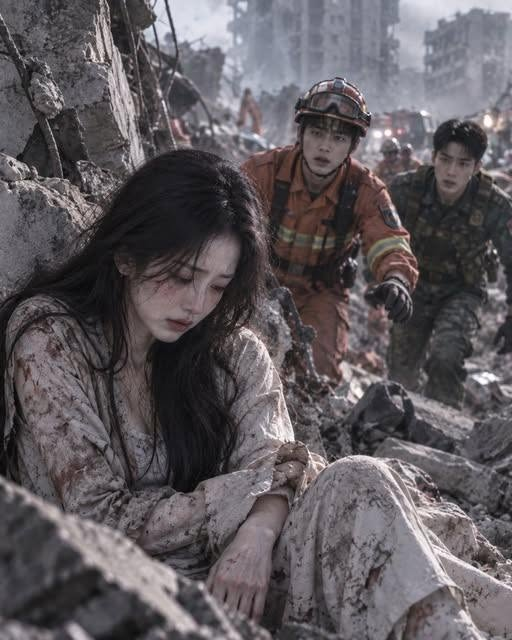
When Adrian finally reached Mercer Street, rescue workers were already tearing through the collapsed structure.
—Elena!
He tried to enter.
Two rescuers stopped him.
—Captain, the structure is unstable.
—My wife and son are inside!
The same man who had calmly said I could wait was suddenly fighting to reach us.
Nathan arrived minutes later.
—Where’s Elena?
An operator looked at him strangely.
—Sir, Mercer Street wasn’t included in the first extraction list.
Nathan froze.
He remembered his own order.
No preferential treatment.
He had been so determined to appear impartial that he’d failed to judge the actual emergency in front of him.
Margaret arrived next.
Three people who had believed there would always be more time now stood together outside the ruins.
Eventually, the rescue crew reached the place where Noah and I had been trapped.
But we were gone.
No explanation.
No footprints leading away.
Only the little red emergency whistle Adrian had once given Noah.
Adrian picked it up with trembling fingers.
—Where are they?
Nobody knew.
For weeks, he searched.
Hospitals.
Shelters.
Evacuation centers.
Every unidentified survivor list.
Nothing.
Nathan reopened every operational record.
That was when he discovered how badly his concern about “favoritism” had distorted his judgment.
Emergency priority should have been based on condition and rescue feasibility.
Instead, he’d lowered our priority specifically because we were family.
Margaret had made the same mistake.
She had confused professionalism with emotional distance.
And Adrian had trusted an imaginary second team without confirming that anyone had actually been assigned.
Their decisions were formally reviewed.
Adrian never tried to excuse his.
When asked why he’d left Mercer Street, he answered:
—I believed Elena and Noah could wait.
Then, after a long silence:
—I was wrong.
But by then, Noah and I were somewhere none of them could reach.
I woke beneath sunlight.
Real sunlight.
I opened my eyes and found myself lying beneath an enormous tree.
—Mom!
Noah ran toward me.
Healthy.
Warm.
Smiling.
I caught him in my arms.
For several seconds I couldn’t speak.
The system appeared one final time.
“Return completed.”
“Original-world identity restored.”
Then memories flooded back.
Before entering Adrian’s world, I had belonged here.
My parents were alive.
My childhood home still existed.
Only a short period had passed in this world despite the years I’d experienced elsewhere.
Noah looked around.
—Is this your home?
I smiled through tears.
—Our home now.
My parents found us minutes later.
Explaining Noah wasn’t simple.
Eventually, however, my mother stopped asking questions and simply hugged him.
My father crouched in front of him.
—So you’re my grandson?
Noah studied him seriously.
—Are you nice?
Dad laughed.
—I’ll try very hard to be.
Noah nodded.
—Okay. You can be Grandpa.
And just like that, we began again.
Years passed.
Noah stopped waking up asking whether Adrian had finally come looking for him.
That was the hardest part.
Not because he hated his father.
Because for a long time, he still loved him.
Children don’t erase love simply because adults disappoint them.
So I never taught Noah to hate Adrian.
When he asked about him, I told the truth gently.
His father had loved him.
His father had also made a terrible choice when Noah needed him most.
Both things could exist at once.
Back in Adrian’s world, the disappearance changed all three of them.
Nathan resigned from emergency command and later returned only after retraining, determined never again to confuse fairness with deliberately disadvantaging someone he loved.
Margaret left administration and spent years improving disaster triage protocols.
Adrian remained in rescue work.
But before every operation, he personally confirmed assignments.
No assumptions.
No imaginary second team.
No “someone else will handle it.”
Olivia eventually transferred away.
She and Adrian never became a couple.
Years later, she reportedly told him:
—You keep looking at me like saving me cost you your family.
Adrian answered:
—It wasn’t your fault.
For once, he understood that clearly.
The choice had been his.
Ten years passed in my new life.
One evening, Noah and I were walking home when he suddenly asked:
—Mom, do you think Dad still remembers me?
I stopped.
He was sixteen now.
Almost taller than me.
—I think he remembers you every day.
Noah looked toward the sunset.
—I’m not angry anymore.
I squeezed his hand.
—You don’t have to be.
—But I don’t want to go back.
My heart tightened.
—You don’t have to do that either.
That night, for the first time in ten years, the system appeared.
“One cross-world observation opportunity remains.”
“No physical return permitted.”
“Would the host and descendant like to observe?”
I looked at Noah.
He nodded.
The light changed.
And there was Adrian.
Older.
Standing beside a memorial garden.
Nathan and Margaret were there too.
On the stone were two names.
Mine.
And Noah’s.
Adrian placed Noah’s little red whistle beneath them.
Then he said quietly:
—I came back, buddy.
He paused.
—I just came back too late.
Beside me, Noah wiped his eyes.
He didn’t call out.
There was no magical reunion.
No reversal.
Some consequences couldn’t be undone simply because people finally understood them.
Noah whispered:
—I hope Dad has a good life.
The system asked:
“Would you like to remain?”
Noah looked at me.
Then at Adrian one final time.
—No.
He smiled sadly.
—Let’s go home, Mom.
The image disappeared.
The corridor closed forever.
Noah took my hand.
And together we walked toward the house where my parents were waiting for dinner.
Adrian had once believed he could leave because someone else would return for us.
Nathan believed refusing to prioritize family automatically made him fair.
Margaret believed professionalism meant treating the people closest to her with less compassion than strangers.
All three learned the same lesson.
Fairness doesn’t mean abandoning the people you love.
Duty doesn’t require pretending they are strangers.
And love means very little when it is always followed by the words:
“You can wait.”
Noah waited once.
He never had to wait again.
